Top-down Ground Proof Procedure Idea: search backward from a query - - PowerPoint PPT Presentation

top down ground proof procedure
SMART_READER_LITE
LIVE PREVIEW

Top-down Ground Proof Procedure Idea: search backward from a query - - PowerPoint PPT Presentation

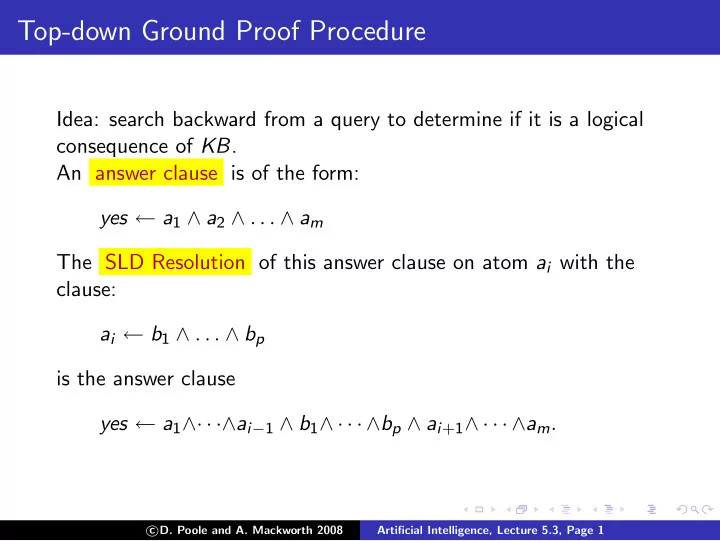
Top-down Ground Proof Procedure Idea: search backward from a query to determine if it is a logical consequence of KB . An answer clause is of the form: yes a 1 a 2 . . . a m The SLD Resolution of this answer clause on atom a i with


slide-1
SLIDE 1

Top-down Ground Proof Procedure

Idea: search backward from a query to determine if it is a logical consequence of KB. An answer clause is of the form: yes ← a1 ∧ a2 ∧ . . . ∧ am The SLD Resolution of this answer clause on atom ai with the clause: ai ← b1 ∧ . . . ∧ bp is the answer clause yes ← a1∧· · ·∧ai−1 ∧ b1∧ · · · ∧bp ∧ ai+1∧ · · · ∧am.

c

  • D. Poole and A. Mackworth 2008

Artificial Intelligence, Lecture 5.3, Page 1

slide-2
SLIDE 2

Derivations

An answer is an answer clause with m = 0. That is, it is the answer clause yes ← . A derivation of query “?q1 ∧ . . . ∧ qk” from KB is a sequence of answer clauses γ0, γ1, . . . , γn such that

◮ γ0 is the answer clause yes ← q1 ∧ . . . ∧ qk, ◮ γi is obtained by resolving γi−1 with a clause in KB, and ◮ γn is an answer. c

  • D. Poole and A. Mackworth 2008

Artificial Intelligence, Lecture 5.3, Page 2

slide-3
SLIDE 3

Top-down definite clause interpreter

To solve the query ?q1 ∧ . . . ∧ qk: ac := “yes ← q1 ∧ . . . ∧ qk” repeat select atom ai from the body of ac; choose clause C from KB with ai as head; replace ai in the body of ac by the body of C until ac is an answer.

c

  • D. Poole and A. Mackworth 2008

Artificial Intelligence, Lecture 5.3, Page 3

slide-4
SLIDE 4

Nondeterministic Choice

Don’t-care nondeterminism If one selection doesn’t lead to a solution, there is no point trying other alternatives. select Don’t-know nondeterminism If one choice doesn’t lead to a solution, other choices may. choose

c

  • D. Poole and A. Mackworth 2008

Artificial Intelligence, Lecture 5.3, Page 4

slide-5
SLIDE 5

Example: successful derivation

a ← b ∧ c. a ← e ∧ f . b ← f ∧ k. c ← e. d ← k. e. f ← j ∧ e. f ← c. j ← c. Query: ?a γ0 : yes ← a γ4 : yes ← e γ1 : yes ← e ∧ f γ5 : yes ← γ2 : yes ← f γ3 : yes ← c

c

  • D. Poole and A. Mackworth 2008

Artificial Intelligence, Lecture 5.3, Page 5

slide-6
SLIDE 6

Example: failing derivation

a ← b ∧ c. a ← e ∧ f . b ← f ∧ k. c ← e. d ← k. e. f ← j ∧ e. f ← c. j ← c. Query: ?a γ0 : yes ← a γ4 : yes ← e ∧ k ∧ c γ1 : yes ← b ∧ c γ5 : yes ← k ∧ c γ2 : yes ← f ∧ k ∧ c γ3 : yes ← c ∧ k ∧ c

c

  • D. Poole and A. Mackworth 2008

Artificial Intelligence, Lecture 5.3, Page 6

slide-7
SLIDE 7

Search Graph for SLD Resolution

a ← b ∧ c. a ← g. a ← h. b ← j. b ← k. d ← m. d ← p. f ← m. f ← p. g ← m. g ← f . k ← m. h ← m. p. ?a ∧ d yes←a^d yes←j^c^d yes←k^c^d yes←m^c^d yes←g^d yes←b^c^d yes←m^d yes←m^d yes←f^d yes←p^d yes←d yes←m yes←p yes←h^d yes←m^d yes←

c

  • D. Poole and A. Mackworth 2008

Artificial Intelligence, Lecture 5.3, Page 7