SLIDE 1
Top Down Parsing Issues
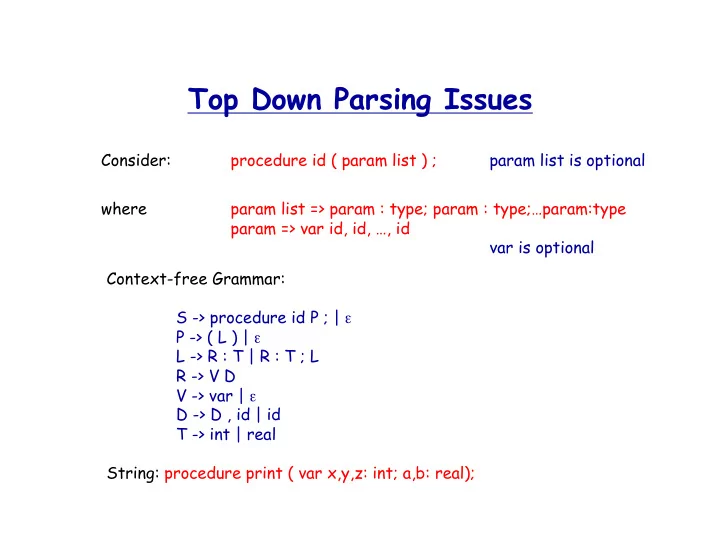
Consider: procedure id ( param list ) ; param list is optional where param list => param : type; param : type;…param:type param => var id, id, …, id var is optional Context-free Grammar: S -> procedure id P ; | ε P -> ( L ) | ε L -> R : T | R : T ; L R -> V D V -> var | ε D -> D , id | id T -> int | real String: procedure print ( var x,y,z: int; a,b: real);
SLIDE 2
Recursive-descent Parsing
CFG: T -> T * F | F => T -> F T’ F -> ( E ) | id T’ -> * F T’ | ε F -> ( E ) | id T( ) F( ) { { } T’( ) { } } Consider input string: a * b * c
SLIDE 3 Table-driven Top Down Parsing
$ S TOP Parsing Stack ( id * id ) * id $……. Parser Driver Token stream nonterminals T T’ F input symbols ( id ) * $ Parsing Table[A,x] = production to apply for A on input x lookahead TOP = lookahead = $
ACCEPT! TOP = lookahead <> $
POP stack; ADVANCE lookahead; TOP is terminal<> lookahead -> error TOP is nonterminal
Lookup(Table[TOP,lookahead]) For production X -> Y1 Y2 … Yn POP X; PUSH Yn Yn-1… Y2 Y1
SLIDE 4
Predictive Parser (Top Down)
Nonterminal Input Token E E->TE’ E -> TE’ id + * ( ) $ E’ E’->+TE’ E’->ε E’-> ε T T->FT’ T->FT’ T’ T’-> ε T’->*FT’ T’-> ε T’-> ε F F->id F->(E) Let input token stream be: ( id + id ) * id $ Initial Stack: $ E
SLIDE 5
Predictive LL(1) Parse Table Build
Key Insight: Given input “a” and nonterminal B to be expanded, which one of the alternatives B -> α1 | α2 | … αn is the unique choice to derive a string starting with “a”? B parsed a start symbol start symbol B parsed ε a
SLIDE 6
Computing FIRST and FOLLOW
* FIRST(α) = { a | α => aβ for some β } FIRST(α) = set of terminals that can begin strings derived by α E -> T E’ E’ -> + T E’ | ε T -> FT’ T’ -> *FT’ | ε F -> ( E ) | id FOLLOW(N) = set of terminals that can immediately follow N in right sentential form FOLLOW(N): For A -> α N β, Add FIRST(β), except ε, to FOLLOW(N) For A -> α N β and FIRST(β) has ε, or A -> αN, Add FOLLOW(A) to FOLLOW(N) Add $ to FOLLOW(START SYMBOL)
SLIDE 7 LL(1) Parse Table Construction
Look at each production, A -> α, and FIRST(α):
- If terminal a in FIRST(α) ==>
- If ε in FIRST(α), then
If terminal b in FOLLOW(A) ==> If $ in FOLLOW(A) ==> a _________ A | A -> α b _________ A | A -> α $ _________ A | A -> α _______________________________________________ Nonterminal id + * ( ) $
E’ T T’ F
SLIDE 8
Is a Grammar LL(1)?
Method: * Construct table and look for multidefined entries. If no multidefined entries, then LL(1) grammar * Look at FIRST and FOLLOW sets as follows: A grammar G is LL(1) iff whenever there exists A -> α | β in G, all of the following conditions hold true: * FIRST(α) ∩FIRST(β) = 0 * At most 1 of α and β derive the empty string * If β derives the empty string, then FIRST(α) ∩ FOLLOW(A) = 0
SLIDE 9 Summary: Top-down Parsing
* To avoid backtracking:
- no left recursion, no common prefixes, no ambiguity -> rewrite
* Easy to write parser: but sometimes difficult to structure grammar to be LL(1) * Error detection:
- terminal on TOP not equal terminal on input
- no table entry for [TOP, input]
* Error Recovery:
- panic mode:
- skip input until input in FOLLOW(TOP) or FIRST(TOP)
- pop terminal and pretend match
- phrase level
- error calls in table
SLIDE 10
Let’s look at some grammars…
Example 1: E -> T E’ E’ -> + T E’ | ε T -> F T T’ -> * F T’ | ε F -> ( E ) | id Example 2: S -> iEtSS’ | a S’ -> eS | ε E -> b
SLIDE 11 Grammar Class Inclusion Tree
context-free unambiguous context-free
LR(k) = LR(1) LALR(1) SLR(1) LL(1) simple precedence LR(0)
SLIDE 12 Table-driven Bottom-up Parsing
TOP Parsing Stack ( id * id ) * id $……. Parser Driver Token stream parse states Action ( id ) * $ lookahead Table[state,terminal] = - shift token and state onto stack.
- reduce by production A -> β
pop rhs from stack; push A; push next state given by Goto[exposed state,A]
$ Goto T T’ F 1 2
SLIDE 13 LR Parsing Example
1: P -> b S e 2: S -> a ; S 3: S -> b S e ; S 4: S -> ε state | b e a ; $ | P S
1 | s4 r4 s5 | 2 2 | s3 | 3 | accept| 4 | s4 r4 s5 | 7 5 | s6 | 6 | s4 r4 s5 | 10 7 | s8 | 8 | s9 | 9 | s4 r4 s5 | 11 10 | r2 | 11 | r3 | Parse Table Stack Input 0 ba;a;e$ 0b1 a;a;e$ 0b1a5 ;a;e$ 0b1a5;6 a;e$ 0b1a5;6a5 ;e$ 0b1a5;6a5;6 e$ 0b1a5;6a5;6S10 e$ 0b1a5;6S10 e$ 0b1S2 e$ 0b1S2e3 $ accept!
SLIDE 14 DFA for parser
S -> E E -> T | E + T | E - T T -> I | ( E ) 1 6 8 3 2 7 4 9 10 11 E + T i (
i T T i ( E )
( ( + Reduce States: 3: T -> i 2: E -> T 8: E -> E + T 9: E -> E - T 11: T -> ( E ) 1: (on $) S -> E stack input i-(i+i)$ 0i3
0T2
...
SLIDE 15
Semantic Actions during Parsing
S -> E { $$ = $1; root = $$; } E -> E + T { $$ = makenode(‘+’, $1, $3);} // E is $1, - is $2, T is $3 E -> E - T { $$ = makenode(‘-’, $1, $3);} E -> T { $$ = $1;} // $$ is top of stack T -> ( E ) { $$ = $2;} T -> id { $$ = makeleaf(‘idnode’, $1);} T -> num { $$ = makeleaf(‘numnode’, $1);} Consider parsing 4 + ( x - y ) state semantic value Parsing Stack S 4 num S
SLIDE 16 Building LR(0) and SLR(1) Parse Tables
- 1. Augment grammar
- Add a production S’-> S, where S is original start state
- Causes one ACCEPT table entry when reduce S’->S on $.
- 2. Create DFA from grammar
item A -> α . β
- just seen a string derivable from α
- expect to see a string derivable from β
NFA : Each state represents a set of recognized viable prefixes (kernel set of items) DFA: Subset construction to go from NFA to DFA = closure(kernel) A-> α.X β A-> αX.β X-> .γ X->a.w X ε a A-> α.X β X -> .γ A-> αX.β X-> a.w X a
SLIDE 17
LR(1) Parser (for same grammar)
17:S’->G.,$ (1) 3:G->f.,$ T->f.,=,+,* (2) 0:S’->.G,$ G->.E=E,$ G->.f,$ E->.T,=,+ T->.f,=,+,* T->.T*f,=,+,* E->.E+T,=,+ (0) 1:G->E.=E,$ E->E.+T,=,+ (3) 5:E->E+.T,=,+ T->.f,=,+,* T->.T*f,=,+,* (5) 9:T->f.,=,+,* (6) 10: E->E+T.,=,+ T->T.*f,=,+,* (9) 6:G->E=E.,$ E-> E.+T, $,+ (8) 2:E->T.,=,+ T->T.*f,=,+,* (4) 4:G->E=.E,$ E->.T,$,+ T->.f,$,+,* T->.T*f,$,+,* E->.E+T,$,+ (7) 8: T->f.,$,+,* (6) 15:T->T*.f,$,+,* (10) 7: E->T.,$,+ T->T.*f,$,+,* (4) 13: E->E+.T,$,+ T->.f,$,+,* T->.T*f,$,+,* (5) 14:E->E+T.,$,+ T->T.*f,$,+,* (9) 16: T->T*f.,$,+,* (11) 11:T->T*.f,=,+,* (10) 12:T->T*f.,=,+,* (11) G f E T = + f T E T f T f * + * f * f *