Tooele Chemical Agent Disposal Facility TOCDF Occupational and - - PowerPoint PPT Presentation

tooele chemical agent
SMART_READER_LITE
LIVE PREVIEW

Tooele Chemical Agent Disposal Facility TOCDF Occupational and - - PowerPoint PPT Presentation

Occupational and Environmental Health Practices Tooele Chemical Agent Disposal Facility TOCDF Occupational and Environmental Health Practices Tooele Chemical Agent Disposal Facility (TOCDF) Operated by URS for the U.S. Armys


slide-1
SLIDE 1

Occupational and Environmental Health Practices

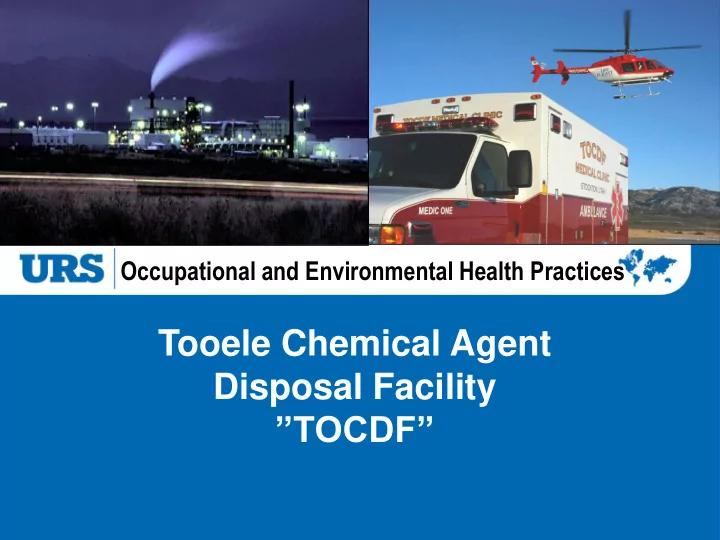
Tooele Chemical Agent Disposal Facility ”TOCDF”

slide-2
SLIDE 2

Tooele Chemical Agent Disposal Facility (TOCDF)

  • Operated by URS for the U.S. Army’s Chemical Materials

Agency

  • Originally contained 42% of the nations chemical weapons
  • Other Agent Disposal Facilities locations:
  • Anniston, AL;
  • Umatilla, OR;
  • Pine Bluff AR;
  • Pueblo, CO; and
  • Bluegrass, KY.
  • Sites having finished

destruction include:

  • Johnston Island,
  • Aberdeen, MD and
  • Newport, IN

Occupational and Environmental Health Practices

slide-3
SLIDE 3

Chemical Demilitarization Program

  • Chemical Weapons Convention Treaty
  • Signed January 1993 by ISS nations
  • Required signees to destroy all chemical weapons in

possession

  • Process receives close monitoring by state, national and

international groups

  • Our mission is the destruction of chemical

weapons and secondary waste in a manner that is safe, secure and environmentally protective for workers and the public

Occupational and Environmental Health Practices

slide-4
SLIDE 4

Chemical Demilitarization Program – Utah

  • U.S. Army Chemical Material Agency is the “owner” of

chemical weapons and the primary customer

  • Citizens and State of Utah are the key stakeholders
  • Treatment, storage and

disposal of hazardous waste in accordance with the RCRA

  • TOCDF is located on the

Deseret Chemical Depot (DCD), which is 20 miles south of Tooele, UT

Occupational and Environmental Health Practices

slide-5
SLIDE 5

Chemical Demilitarization Approach

  • TOCDF employs incineration technology to destroy what was originally

42% of the nations chemical agents (nerve and mustard)

Occupational and Environmental Health Practices

TOCDF Slide Format

LIQUID INCINERATOR

HIGH VELOCITY BURNER POLLUTANTS TO SCRUBBER SYSTEM SUMP

AFTERBURNER PRIMARY INCINERATOR

COMBUSTION AIR BLOWER VORTEX BURNER

slide-6
SLIDE 6

Chemical Weapons Stockpile

  • Weapons included more than 1,000,000 projectiles, rockets, land mines

and bulk agent containers, exceeding 26,000,000 pounds of agent

  • TOCDF employs a workforce of 1170 employees with diverse make-up

including management, engineering, operations/maintenance, environmental, safety and medical.

  • We expect to complete the mission within 2 years

Occupational and Environmental Health Practices

slide-7
SLIDE 7

TOCDF Accomplishments 2010

  • National Safety Council Award for 10,000,000 safe work
  • hours. Now exceeding 11.5 Million hours
  • A combined Recordable Illness & Injury Rate less than one

fourth the industry average. The current RIR is 0.48

  • OSHA Voluntary Protection Program (VPP)

Star Status (2nd year in the program)

  • First-ever annual zero penalty environmental notice from

the Utah Division of Solid and Hazardous Waste

  • Zero error surety (chemical agent security) program

Occupational and Environmental Health Practices

slide-8
SLIDE 8

Major Noncompliances Employee Observations / Suggestions

Submitting Employee Concerns, Suggestions for Improvement, or Observations

Deficiencies

Major Noncom- pliances Major Non- compliances Record- able Injury

Minor Noncompliances

Minor Non- compliances Admin / Minor Noncompliances

First Aid or Non- compliance

Near Misses

Nearly Noncompliances Potential Noncompliance Averted Incident w/o Damage or Loss TAKING ACTION TO RESOLVE CONCERNS, IMPLEMENT IMPROVEMENTS, OR CORRECT NEAR-MISS PERFORMANCE WILL PREVENT VIOLATIONS, INJURIES, AND NON-COMPLIANCES

Reportable Noncompliances Reportable Accidents

Environmental

The TOCDF Big “ESS” Performance Pyramid

Surety Safety & Health

Violation

slide-9
SLIDE 9
  • RIR at the end of February 2011 is 0.48
  • 46 First Aid Injuries in 2010; 4 First Aid Injuries YTD
  • 7 Recordable Injuries in 2010; 0 Recordable Injuries YTD

Big ESS - Safety / Health – Illness & Injury Rate

0.5 1 1.5 2 2.5 3 3.5 4 4.5 1995 1997 1999 2001 2003 2005 2007 2009 2011

Occupational and Environmental Health Practices

slide-10
SLIDE 10

Big ESS Safety & Health Cont.

  • Approaching 6 years with Zero Lost Workday Cases
  • The goal through the end of the project is zero lost work days
  • Continuous safety awareness and improvement through

employee leadership and management commitment

  • Work planning
  • Condition reporting
  • Workforce Safety Action Team (SAT)
  • Fostering individual ownership / accountability
  • Expanded training programs

Occupational and Environmental Health Practices

slide-11
SLIDE 11

Big ESS Pyramid – Security

  • Measured by the absence of:
  • Violations
  • Major non-compliances
  • Outstanding results during oversight inspections

Occupational and Environmental Health Practices

slide-12
SLIDE 12

0.00 0.67 1 2 3 4

Dec-09 Jan-10 Feb-10 Mar-10 Apr-10 May-10 Jun-10 Jul-10 Aug-10 Sep-10 Oct-10 Nov-10

Number of Events

Violations Major Noncompliances 12 Month Violation Rate 12 Month Noncompliance Rate Noncompliance Goal

SURETY/SECURITY VIOLATIONS & MAJOR NON-COMPLIANCES

Occupational and Environmental Health Practices

slide-13
SLIDE 13

TOCDF RCRA NONCOMPLIANCE TOTALS

60 59 32 41 13 51 20 10 5 8 12

Jan- Dec 2000 Jan- Dec 2001 Jan- Dec 2002 Jan- Dec 2003 Jan- Dec 2004 Jan- Dec 2005 Jan- Dec 2006 Jan- Dec 2007 Jan- Dec 2008* Jan- Dec 2009** Jan- Dec 2010

* Started including the State identified findings **Started CAMDS Closure and Area 10 Secondary Waste Operations

Big ESS Pyramid - Environmental

Occupational and Environmental Health Practices

slide-14
SLIDE 14

Big ESS Pyramid – Environmental

  • Environmental Managements Systems (EMS)
  • EMS Self-Certification
  • EMS Committee
  • Environmental Leadership Committee (ELS)

Occupational and Environmental Health Practices

slide-15
SLIDE 15

Site ESS Scoreboards

  • Installed in 2010 to

communicate timely and accurate information and status to workforce

Occupational and Environmental Health Practices

slide-16
SLIDE 16

Commitment to Continuous Improvement

  • Condition Reporting
  • Program provides avenue for employees to suggest,

perform and document process improvements and corrective actions in all facets of work at TOCDF

  • 3282 CRs were submitted in 2010
  • Management Assessments
  • Management team conducts regular assessments of

essential functions and processes to determine overall value

  • There were 1028 Management Assessments completed

in 2010

Occupational and Environmental Health Practices

slide-17
SLIDE 17

Commitment to Continuous Improvement

  • Peer Observations
  • 452 Peer Observations in 2010
  • Observe behavior and work practices for all aspects of

work at TOCDF, CAMDS and Area 10

  • Performed by all employees as peers to provide open

review and feedback for the purpose of coaching and improvement

  • Intended and encouraged to include broad objectives of

Safety, Environmental, Surety, Quality, Disciplined Operations and the TOCDF Vision for Success

Occupational and Environmental Health Practices

slide-18
SLIDE 18

Occupational Health Clinic Mission Statement

To provide comprehensive occupational health services while minimizing the occurrence of job-related health risks, illness and injury

Occupational and Environmental Health Practices

slide-19
SLIDE 19

TOCDF Occupational Health Program

  • Screening and monitoring of Advanced Level A (DPE)

entries around the clock

  • Manage Heat Stress Prevention Program
  • Evaluation of potential new employees – Post offer
  • Medical Surveillance –

Annual Health Review

  • Emergency care for occupational

and non-occupational injury / illness

  • Case Management
  • Substance Abuse / Dependency

evaluations

Occupational and Environmental Health Practices

slide-20
SLIDE 20

TOCDF Medical Services Configuration

  • Two Physicians
  • Four Physician Assistants
  • Twenty F / T Paramedics
  • Occupational Health Nurse
  • Laboratory Technician
  • Support Personnel

Occupational and Environmental Health Practices

slide-21
SLIDE 21

Cholinesterase Program

  • Blood test to measure red blood cell acetylcholinesterase

activity

  • Nerve agent depresses AChE activity
  • Baseline established at time of employment and re-

established every three years

  • “Priority Blood Draws” for ChE activity when potentially

exposed to nerve agent

  • Employee evaluation when baseline changes are +/- 10%

Occupational and Environmental Health Practices

slide-22
SLIDE 22

500 1000 1500 2000 2500 3000 3500 4000 2001 2002 2003 2004 2005 2006 2007 2008 2009 2010 DCD TOCDF

CHOLINESTERASE (ChE) SPECIMENS TESTED

Occupational and Environmental Health Practices

slide-23
SLIDE 23

20 40 60 80 100 120 2001 2002 2003 2004 2005 2006 2007 2008 2009 2010

PRIORITY CHOLINESTERASE (ChE) TESTS

Occupational and Environmental Health Practices

slide-24
SLIDE 24

GREATER THAN 10% INCREASE / DECREASE IN CHOLINESTERASE (ChE)

2 4 6 8 10 12 14 16 2001 2002 2003 2004 2005 2006 2007 2008 2009 2010 10% HIGH 10% LOW

Occupational and Environmental Health Practices

slide-25
SLIDE 25

Hearing Conservation Program

  • 420 employees currently enrolled in the program
  • Employees are enrolled when:
  • Exposed to steady state of noise with a TWA of 85 dB or

greater

  • Exposed to impulse noise at 140 dB or greater
  • Work in specific areas of the plant where sustained

noise sources exist

Occupational and Environmental Health Practices

slide-26
SLIDE 26

Hearing Conservation Program Cont.

  • All full-time Paramedics, Physician Assistants and

Physicians are CAOHC certified Hearing Conservationists

  • Audiograms are completed annually
  • An identified STS is followed to completion
  • Follow-up audiogram with 48 hours noise free
  • Referral to Audiologist as required
  • Retraining on hearing protection
  • Noise dosimetry for documentation

Occupational and Environmental Health Practices

slide-27
SLIDE 27

Hearing Conservation Program Cont.

  • Program guideline for functional hearing

evaluations (alarms, PA announcements, encapsulating PPE)

  • Termination audiograms are offered and

recommended

Occupational and Environmental Health Practices

slide-28
SLIDE 28

Emergency Preparedness Program

Stemming from our commitment to excellence, we have incorporated diverse skills and specialized teams within

  • ur Emergency Preparedness Program.

Occupational and Environmental Health Practices

slide-29
SLIDE 29
  • Hazmat
  • First Response
  • Decon
  • Medical
  • Rescue
  • High Angle
  • Confined Space

Emergency Preparedness Program Cont.

Occupational and Environmental Health Practices

slide-30
SLIDE 30
  • The primary purpose of the TOCDF Emergency

Response Program is to:

  • Maximize the safety of on-site personnel.
  • Minimize potential exposure to the general public.
  • Minimize environmental impacts.
  • Limit loss or damage to the facility and plant

equipment.

Emergency Preparedness Program Cont.

Occupational and Environmental Health Practices

slide-31
SLIDE 31
  • The TOCDF Emergency Preparedness Program is

captured within several written plans:

  • TOCDF Emergency Response Plan
  • Contingency Action Plans
  • Specific response actions for employees to follow ranging from a

non-work related illness to an agent spill outside of engineering controls

  • Emergency Preparedness Exercise Program Guidelines
  • Guidance for site employees to follow for exercise play

Emergency Preparedness Program Cont.

Occupational and Environmental Health Practices

slide-32
SLIDE 32

EP Related Training (All Employees)

  • Initial Courses for all site

employees:

  • CPR / First Aid / AED Initial
  • American Red Cross Curriculum – 8

hrs

  • 4 hour annual refresher for all site

employees

  • HAZCOM (OSHA 1910.1200)
  • Site Specific – 4 hrs
  • Site OSHA RCRA Training
  • Site Specific – 16 hrs
  • Provide knowledge base for

requirements in 29 CFR 1910.120 (q) for awareness level

Occupational and Environmental Health Practices

slide-33
SLIDE 33

EP Training (Specialized)

  • First Responder Medical Training
  • Internal instruction- DOT/NHTSA Curriculum for

Emergency Medical Responder (EMR) - 80 hrs (100+ site employees trained, approx 15 per shift)

  • Site Decon Response Training
  • Internal Instruction - 16 hrs (100+ site employees

trained, approx 15 per shift) Provides knowledge and skills for requirements in 29 CFR 1910.120 (q) for

  • perations level

Occupational and Environmental Health Practices

slide-34
SLIDE 34

EP Training (Specialized) Cont.

  • Site Hazmat Response Training
  • Internal Instruction - 40 hrs (100+ site employees

trained, approx 15 per shift) Provides knowledge and skills for requirements in 29 CFR 1910.120 (q) for technician level

  • High Angle / Confined Space Rescue

Technician Training

  • Vendor – 120 hrs (80+ site employees trained, approx

15 per shift) Provides knowledge and skills as outlined in NFPA 1670 for Technician Level, also for the Rope Rescue Technician (Professional Qualifications) outlined in NFPA 1006.

Occupational and Environmental Health Practices

slide-35
SLIDE 35

Emergency Response Equipment

  • In addition to industry standard equipment such as emergency showers

and fire protection systems/fire extinguishers, TOCDF has in place many additional pieces of equipment to help prevent and or respond to emergency events such as;

  • Uninterruptable Power Supply for critical plant equipment
  • Emergency generators
  • Cascading HVAC for agent areas
  • 30 + AED’s and Trauma bags
  • Ambulance
  • HAZMAT Response Truck
  • Decontamination Response Trailer
  • High Angle/Confined Space Rescue equipment
  • TOCDF is prepared to respond to various types of events with

specialized trained personnel and equipment, 24 hours a day 7 days a week.

Occupational and Environmental Health Practices

slide-36
SLIDE 36

Maintaining Excellence

  • Exercise Program
  • Chemical Stockpile Emergency Preparedness Program

(CSEPP)

  • Full scale exercise integrated with DCD and Tooele

County performed annually

  • Chemical Accident Incident Response and Assistance

(CAIRA)

  • Full scale exercise integrated with DCD performed

quarterly

Occupational and Environmental Health Practices

slide-37
SLIDE 37

Exercises

Occupational and Environmental Health Practices

slide-38
SLIDE 38

Maintaining Excellence Cont.

  • Weekly TOCDF exercises
  • Built into the site operating schedule to occur every

Tuesday evening

  • Rotating shifts allow each shift the opportunity to

participate in an emergency response exercise or training evolution on a monthly basis

  • Change in campaign or type of munition dictates that an

Operational Readiness Review (ORR) and / or Readiness Assessment (RA) is performed in the form of training and exercises

Occupational and Environmental Health Practices

slide-39
SLIDE 39

Emergency Response Organization Challenge

  • In 2008 TOCDF held the first annual TOCDF Emergency

Response Challenge

  • Designed to involve the site’s certified emergency

responders to participate in scenarios related to realistic contingency conditions in a high learning, consequence free training environment

  • Personnel from all shifts’ emergency response teams

participated in knowledge and skill demonstrations related to decontamination, hazardous material response, technical rescue and medical.

Occupational and Environmental Health Practices

slide-40
SLIDE 40

Minimal Simulation During Training

Occupational and Environmental Health Practices

slide-41
SLIDE 41

Decon Medical Vestibule

Occupational and Environmental Health Practices

slide-42
SLIDE 42

High Angle Rescue

Occupational and Environmental Health Practices

slide-43
SLIDE 43

Structural Collapse Training

Occupational and Environmental Health Practices

slide-44
SLIDE 44

Confined Space Rescue

Occupational and Environmental Health Practices

slide-45
SLIDE 45

Conclusion

  • TOCDF is prepared to respond to complex events with

highly trained personnel and equipment, 24 hours a day 7 days a week.

Occupational and Environmental Health Practices

slide-46
SLIDE 46