- Dipl. Biol. Sven Koschinski
- Fa. Meereszoologie, Nehmten
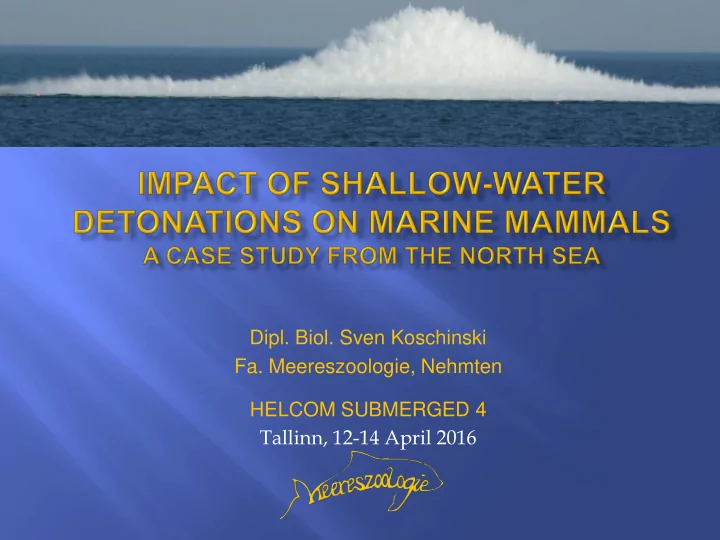
Fa. Meereszoologie, Nehmten HELCOM SUBMERGED 4 Tallinn, 12-14 April - - PowerPoint PPT Presentation
Dipl. Biol. Sven Koschinski Fa. Meereszoologie, Nehmten HELCOM SUBMERGED 4 Tallinn, 12-14 April 2016 Darber hinaus 35 "Kleinladung" (1-5 kg) 30 Vernichtungssprengung Baltic Sea (Germany) Seeminen Bundeswehr Schnhagen
„Darüber hinaus
Baltic Sea (Germany)
Thousands of mine and bomb explosions in WW1 and WW2 (Kiel Bight: ca. 3.000 explosions ), Intense combat
- perations also in the
Gulf of Riga, Irben Strait, and Gulf of Finland (Wichert 2014)
5 10 15 20 25 30 35 2007 2008 2009 2010 2011 2012 2015 "Kleinladung" (1-5 kg) Vernichtungssprengung Seeminen Bundeswehr Schönhagen
„Darüber hinaus
North Sea (Germany)
10 20 30 40 50 60 70 80 2012 2013 2014 2015 Vernichtungssprengung Seeminen
Increase of mine and bomb explosions in recent years due to offshore wind farm construction (cable laying and turbine installations)
MMS (2003): Explosive Removal of Offshore Structures, Information Synthesis Report, OCS Study MMS 2003-070, 181 pp.
Injury relevant noise parameters
- Peak pressure of noise impulse
- Rise time of noise impulse from
water pressure to maximum amplitude
- Maximum pressure variation
- Impulse duration
- Total energy content of the noise
impulse Very high peak pressure Extremely short signal rise time Maximum pressure variation Only short durations but total energy content impacts hearing Water saturated tissues behave just as water!
Foto: S. Dubpernel
Primary Blast Injury (PBI)
- heavy tissue damage
(especially gas filled organs : lung, seal ears, intestines)
- Internal bleeding (especially
brain and ears)
- damage and dislocation of
ear bones, tissue damage in inner ear (cochlea)
Photo: CSI, Woods Hole Oceanographic Institution
Acoustic trauma
- physiologic effect:
exhaustion of hearing sensory cells (TTS)
- damage of sensory
cells, nerve degeneration (PTS)
- High frequencies
- Low
frequencies
Cochlea with frequency selective basilar membrqane Hearing nerve Oval window Organ of balance
1000 2000 3000 4000 5000 6000 100 200 300 400 500 600 700 800 900 1000
Minimum distance in relation to charge weight
Example Tethered mine (300 kg)
Serious injury Thiele & Stepputat 1998: distancediver = 1500 * charge weight0,18 Charge weight(kg) Distance (m)
20 dB noise reduction by Neoprene hood Audiogram of a human diver
Increased danger close to the sea bottom!
- In the North Sea, harbour porpoises mainly feed on bottom-living fish species!
PBI (p ≥ 95%) PBI-Onset PTS-Onset TTS
SEL (dB) 1m below water surface 263 kg TNTeq. SEL (dB) 1m above bottom
aus: von Benda-Beckmann et al. 2015
- 88 UW-explosions in NL
2010-2011
- Charge weight 10-1000 kg
(most often 125-250kg)
- Noise measurements up to 2
km distance at various depths (7 detonations of 121 and 263 kg, water depth 26-28m, sand):
- Modeled source level (SEL)
relative to charge weight
- Propagation model improved
with noise measurements
- Analysis of effect radii and
harbour porpoise density (spring1.34, summer 0.6 Ind./km²)
Graph taken from: von Benda-Beckmann et al. 2015 (modified)
164 179 190 203 dB
Number of harbour porpoises (single explosion) Number of impacts (NL, 88
explosions per year)
Un- weighted threshold (SEL) All near surface All near bottom
Ø
All near surface All near bottom
Ø
Blast wave induced ear trauma very likely
203 dB 1 1 1 119 60
Permanent hearing loss very likely
190 dB 2 27 15 205 2.362 1.283
Permanent hearing loss increasingly likely
179 dB 18 106 62 1.584 9.318 5.451
Noise induced TTS very likely
164 dB 190 448 319 16.721 39.413 28.067
Data taken from : von Benda-Beckmann et al. 2015 (modified)
www.hydrotechnik-luebeck.de
r=70m Tethered mine: 350 kg
Air bubble curtain for shock wave reduction (20 m depth, Heidkate, Baltic Sea)
Air volume stream: 1m³/m*min
Schmidtke,E. Schockwellendämpfung mit einem Luftblasenschleier zum Schutz der Meeressäuger. (2010). DAGA conference 2010 Berlin, Germany
Big bubble curtain (BBC) for shock wave reduction
Pressure measured inside BBC In good agreement with literature data Pressure measured outside BBC All 3 mine explosions with BBC In mine 4 incomplete BBC reduction in peak pressure: 19 dB - 6 dB - 16 dB Noise propagation model -6,8 dB per doubling of distance: reduction in peak pressure results in reduction of injury radius by 86% - 46% - 80%, Noise propagation model -4,5 dB: 95% - 60% - 91%
Mitigation measure 1: deterrence by ~2 km
1
Number of harbour porpoises (single explosion)
Un- weighted threshold (SEL) All near surface All near bottom
Ø
Blast wave induced ear trauma very likely
203 dB 1 1
Permanent hearing loss very likely
190 dB 2 27 15
Permanent hearing loss increasingly likely
179 dB 18 106 62
Noise induced TTS very likely
164 dB 190 448 319
from: von Benda-Beckmann et al. 2015 (modified)
Mitigation measure 2: reduction of effect radii by ~ 80%
0,6 2,5 13
2 4 6 8 10 12 14 16 18 20 22 24 26 28 30 32 34 36 38 40 42 44 46 48 50 2 4 6 8 10 12 14 16 18 20 22 24 26 28 30 32 34 36 38 40 42 44 46 48 50
Without mitigation
Assumption: animals are near bottom Blast wave induced ear trauma very likely Permanent hearing loss very likely Permanent hearing loss increasingly likely TTS very likely
2 4 6 8 10 12 14 16 18 20 22 24 26 28 30 32 34 36 38 40 42 44 46 48 50 2 4 6 8 10 12 14 16 18 20 22 24 26 28 30 32 34 36 38 40 42 44 46 48 50
100% deterrence up to 2 km
Blast wave induced ear trauma very likely Permanent hearing loss very likely Permanent hearing loss increasingly likely TTS very likely
2 4 6 8 10 12 14 16 18 20 22 24 26 28 30 32 34 36 38 40 42 44 46 48 50 2 4 6 8 10 12 14 16 18 20 22 24 26 28 30 32 34 36 38 40 42 44 46 48 50
Blast wave induced ear trauma very likely Permanent hearing loss very likely Permanent hearing loss increasingly likely TTS very likely