
SLIDE 1
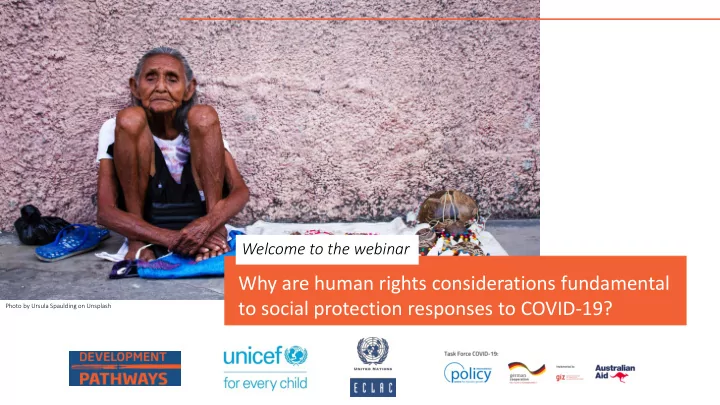
Why are human rights considerations fundamental to social protection responses to COVID-19?
Welcome to the webinar
Photo by Ursula Spaulding on Unsplash
Why are human rights considerations fundamental to social protection - - PowerPoint PPT Presentation
Welcome to the webinar Why are human rights considerations fundamental to social protection responses to COVID-19? Photo by Ursula Spaulding on Unsplash Social protection responses to #COVID19 This joint effort is inspired by colleagues and
Why are human rights considerations fundamental to social protection responses to COVID-19?
Welcome to the webinar
Photo by Ursula Spaulding on Unsplash
This joint effort is inspired by colleagues and
issemin inate and dis iscu cuss th the e mos
ecent con
esponses es to
19. The initiative has three major components:
1. A weekly special edition of a dedicated ne newsle letter, featuring a compilation of relevant information from all over the world on social protection initiatives dealing with COVID-19; 2. Weekly web ebin inars to foster discussions and exchanges; 3. An on
ine com
ity to systematise the information gathered
Photo by SJ Objio on Unsplash
#SPcovid19 #COVID19 #SPresponses
Unbundli ling th the deli livery chai ain: : prac actic ical example les of
li linkages between humanitaria ian cas ash tr transfers an and soc socia ial l protection fr from ac across th the glo globe
Thursday, 16 July – 1 PM (GMT+1)
Managin ing con
inuit ity an and preparedness of
school l feeding programmes under COVID-19 an and th the So South-South Cooperatio ion role le
Tuesday, 21 July - 9 AM (EDT/GMT-4)
So Socia ial exp xpenditure, leg legisla lativ ive fr frameworks an and fin findings of
imp impact evalu luatio ions of
socia ial l protectio ion in in So South Asi Asia
Thursday, 23 July – 9 AM (EDT/GMT-4)
Next webinars at socialprotection.org:
USDA photo by Tom Witham / Flickr / CC0
socialprotection.org presents:
Panellists: Abdul Alim, Social Policy Advisor, Unicef South Asia Alexandra Barrantes, Senior Social Protection Specialist, Development Pathways Simone Cecchini, Senior Social Affairs Officer, ECLAC Moderator: Shea McClanahan, Senior Social Protection Specialist, Development Pathways
Why are human rights considerations fundamental to social protection responses to COVID-19?
Why are human rights considerations fundamental to social protection responses to COVID-19?
Panellist
Abdul Alim
UNICEF South Asia
Abdul Alim is currently the Regional Advisor for Social Policy covering South Asia for Abdul Alim is currently the Regional Advisor for Social Policy covering South Asia for UNICEF and is based in Kathmandu. For the last 20 years he has worked with the United Nations Children’s Fund in developing world covering countries in South Asia, South East Asia, CEE/ CIS and the Middle East. His major interest is in the application of results-based management and Human Rights based approach to reform social policy and planning with an emphasis on social service delivery. He is a member of the UN Development Policy Network.
Why are human rights considerations fundamental to social protection responses to COVID-19?
Panellist
Alexandra Barrantes
Development Pathways
Senior Social Policy Specialist at Development Pathways with more than 20 years’ experience in social protection, poverty reduction, inequality, economic, social and cultural rights, and
poverty field with a track record in providing advice on a rights-based and equity approach to social protection. Experienced Team Lead responsible for some of the largest Development Pathways assignments in the design of social protection schemes, linkages to other policies and sectors, policy advice and operational support, and coordinates the training portfolio. Alexandra has formed part of several International technical Working Groups on poverty, social protection, SDGs, and social rights with key international stakeholders (including WB, UNICEF, ILO, UNRISD, ECLAC, OPHI, CGAP, among others). She has extensive publications in her field of work.
Why are human rights considerations fundamental to social protection responses to COVID-19?
Panellist
Simone Cecchini
ECLAC
Simone Cecchini is Senior Social Affairs Officer and Officer in Charge of the Social Development Division of the United Nations Economic Commission for Latin America and the Caribbean (ECLAC), based in Santiago, Chile. At ECLAC he leads research and advises governments on poverty and inequality, the design and implementation of social protection policies and programmes and the assessment
social
focus on equality and human rights.
Why are human rights considerations fundamental to social protection responses to COVID-19?
Moderator
Shea McClanahan
Development Pathways
Shea has extensive experience in the fields of social policy and social protection, focusing on the intersection between social insurance and tax financed benefits (“multi-tiered social security”) for achieving more equitable outcomes in a context of changing labour markets, including from a gender perspective. She has wide ranging thematic experience and has actively engaged in key social policy research at the UN, including at UNRISD, ILO, the International Social Security Association (ISSA), UNICEF and UNDESA. At Development Pathways, Shea leads projects on the extension of social protection to workers in the informal economy, design of social protection schemes, and social protection system assessment and development, including coordination and governance.
type them in the chat bar Also, interact with us on Twitter (@SP_Gateway):
Why are human rights considerations fundamental to social protection responses to COVID-19?
#SPorgWebinar #SPcovid19 #COVID19 #SPresponses
Fulfilling Citizen’s Rights to Strengthen the Social Contract across South Asia is the best way forward to address COVID emergency and achieve sustainable development
Rights and Duties Rights and Obligations Life Cycle Inclusive Social Protection Taxes, Public Services etc.
State Nations in South Asia are in a vicious low equilibrium cycle of low revenue, low social investment and low human capital. State capacity has slowly eroded along with concomitant democratic deficit. Rights violations have undermined trust and social capital with decades of low social investment. Manifestation of this are low revenues, high poverty, informalization, migration elite capture, and persistent inequality.
States are built on trustworthy and strong social contract. One important and critical intervention is to build trust by increased investments in social protection while improving taxation and supply side of services. SP systems remain inadequate, discriminatory (high exclusion errors in targeting) and conditional (stigmatizing). There is a need to switch to inclusive, universal SP interventions to improve demand and build trust at household level
Universal and inalienable, Interdependent and indivisible, Equal and non- discriminatory
Why are human rights considerations vital for social protection responses to COVID-19?
Alexandra Barrantes
What does a rights-based approach entail?
Development Pathways 12
binding; requires adequate legal and institutional framework.
agents from the receiving end.
human right.
Social security as a human right to address lifecycle challenges
Development Pathways 13
Universal Declaration of Human Rights (1948) Article 22: “Everyone, as a member of society, has the right to social security and is entitled to realization, through national effort and international cooperation and in accordance with the organization and resources of each state, of the economic, social and cultural rights indispensable for his dignity and the free development of his personality.” Article 25: “(1) Everyone has the right to a standard of living adequate for the health and well-being of himself and of his family, including food, clothing, housing and medical care and necessary social services, and the right to security in the event of unemployment, sickness, disability, widowhood, old age or other lack of livelihood in circumstances beyond his control. (2) Motherhood and childhood are entitled to special care and assistance. All children, whether born in
International Covenant on Economic, Social and Cultural Rights Article 9: “The States Parties to the present Covenant recognize the right of everyone to social security, including social insurance.” National constitutions: many countries have constitutional provisions for the right to social security.
Legally binding by signatory countries
Continuation
Development Pathways 14
Convention on the Rights of the Child Article 26: States Parties shall recognize for every child the right to benefit from social security, including social insurance, and shall take the necessary measures to achieve the full realization of this right in accordance with their national law. Social Protection Floors Recommendation, No. 202 (2012) Reaffirms the human right to social security. New international consensus on the crucial role of social protection in furthering human dignity, social cohesion, equality, social justice, as well as sustainable social and economic development. SDGs (2015) Recognises that ending poverty and ensuring healthy lives requires universal social protection systems ensuring adequate protection throughout the life cycle. Dignity at the core. General Comment No. 19: The right to social security (Art. 9 of the Covenant), CESCR Right to social protection: Right to social security + the right to an adequate standard of living.
Dignity at the core
Development Pathways 15
“All human beings are born free and equal in dignity and rights” (Article 1, Universal Declaration of Human Rights)
“Dignity: The state or quality of being worthy of honour or respect”(Oxford English Dictionary)
Why are HR considerations fundamental to inclusive SP systems in times of COVID-19?
OUTCOMES
Development Pathways 16
(Beyond the small detail of being legally binding… unfortunately, the legal framework is necessary, but not enough)…
Development Pathways 17
What to bring to the table: practical approach for the design and implementation of SP programmes
Development Pathways 18
What do some HR standards & principles entail in practice?
Development Pathways 19 States must ensure access to accountability mechanisms, independent and effective complaints procedures, and effective remedies.
08 02 01 05 04 06 07 03
Adaptability Adequacy of the benefit Right to privacy Participation Accessibility Accountability Dignity & autonomy of individuals Equality & non-discrimination
Social protection schemes should be available to all, and states should ensure that nobody is discriminated against in programmes and services. Social protection should be free from barriers, inclusive, and ensure equal
require special measures for particular categories of the population who face additional barriers, such as persons with disabilities. States must guarantee that social protection schemes are adapted to the needs of applicants and recipients. Social protection schemes must respect the inherent dignity of all individuals, while avoiding stigmatisation and prejudice. Social protection schemes must respect the right to privacy and international standards on confidentiality when collecting and sharing information identifying beneficiaries. All citizens must have the right and ability to participate in all stages of social protection schemes. Social protection benefits should ensure effective access to essential goods and services, and at a minimum, secure protection against poverty, vulnerability and social exclusion and enable a life in health and dignity.
Development Pathways 20
Development Pathways 21
Who does COVID-19 affect/put at risk?
Development Pathways 22
Child benefit Unemployment benefit
Old Age Pension
Maternity benefit
Survivors’ benefit
Disability benefit Poor Relief
With human rights and equity considerations across the whole design & implementation process
Individuals of all ages are rightsholders and vulnerable to shocks and risks
Lifecyle perspective
Development Pathways 23
Inclusivity
Development Pathways 24
Based on solidarity and entitlements
Human rights - Citizenship: SP for all Charity: for “the others”
Based on an unequal relationship and the deserving poor
Othering & deservingness
Development Pathways 25
“a set of dynamics, processes, and structures that engender marginality and persistent inequality across any of the full range
& Menendian, 2016)
What are some of the SP no-nos in terms of HR and inclusivity? (also in the midst of COVID-19)
Development Pathways 26
STEPS BACK FROM A HUMAN RIGHTS APPROACH
Development Pathways 27
Shock-responsiveness
coverage: more effective response to widespread shocks.
strengthen national core social protection system by developing an effective, lifecycle system that guarantees all citizens regular and predictable income transfers.
best way forward since pandemics do not choose who falls sick depending on an abstract construct of deservingness.
Development Pathways 28
NOT JUST THE POLICY OUTCOMES
Development Pathways 29
Beyond the ends, the process is also important
Development Pathways 30
Poverty targeting: Focused solely on outcomes, not process
Development Pathways 31
Targeting is a means toward the end, which is poverty reduction (Coady, Grosh, &
Hoddinott, 2004:83)
Policies based on HR: importance of focusing on implementation process too, as a way of working towards the progressive achievement
Poverty targeting “This is no time to be worrying about “targeting the poor.” Fine targeting in poor places is over-rated in normal times. Now it makes little sense.” Source: Martin Ravallion, 2020,
https://economicsandpoverty.com/2020/04/02/on-the-virus-and-poor-people-in-the-world/
Development Pathways 32
undeserving poor”, palliative poverty-targeted schemes, and old
(services for the poorest, the non-poor, those more prone to shocks and risks, etc.).
responses.
programmes? Strengthen the national core social protection system by developing an effective, lifecycle system that guarantees all citizens regular and predictable income transfers.
Development Pathways 33
Amid the COVID-19 pandemic, Governments & development partners should:
Why are human rights considerations fundamental to social protection responses to COVID-19? A Latin American Perspective Simone Cecchini
Officer in charge Social Development Division ECLAC
Socialprotection.org Webinar July 14, 2020
The rights-based approach does not prescribe the precise content of social protection policies. It offers direction through key principles
▪ Equality and non-discrimination ▪ Progressiveness and non-regressiveness ▪ Use of maximum available resources ▪ Comprehensiveness ▪ Legal and institutional framework ▪ Participation ▪ Transparency and access to information ▪ Accountability ▪ The rationale behind economic and social rights is to reduce inequalities between the haves and the have-nots and place growing numbers of people
Because of its high levels of inequality, in Latin America middle-income households account for a small and vulnerable share of the total population
PER CAPITA GDP, BY REGION, 2018 (dollars at constant 2010 prices)
Source: ECLAC, on the basis of World Bank: http://datatopics.worldbank.org/world-development-indicators.
LATIN AMERICA: SHARE OF POPULATION AND AVERAGE YEARLY PER CAPITA INCOME,BY INCOME STRATUM, 2017 (Percentages and dollars at constant 2010 prices)
Source: ECLAC. The figure includes data from 18 countries: Argentina, Venezuela, Brazil, Chile, Colombia, Costa Rica, the Dominican Republic, Ecuador, El Salvador, Guatemala, Honduras, Mexico, Nicaragua, Panama, Paraguay, Peru, Bolivia and Uruguay.
Latin America and the Caribbean has become a hotspot of the coronavirus pandemic, exacerbated by weak social protection, fragmented health systems and profound inequalities
▪ The first cases of COVID-19 occurred in groups and urban areas with higher incomes, more resources and better health conditions ▪ New cases are being recorded in low-income areas, which are more economically vulnerable and have less access to health services ▪ Quarantines have more adverse domestic, social and economic consequences for the poor and informal workers (mainly women, young people, indigenous people, Afrodescendants and migrants), who are unable to generate income and lack savings to face the crisis ▪ The impossibility of working from home, overcrowded conditions and lack of access to water and sanitation increase the risk of infection of the poor and vulnerable, who are also at greater risk of death because of pre-existing conditions, and lack of access to medical care
Different socioeconomic effects reflect the social inequality matrix
POPULATIONS MOST AFFECTED BY THE SOCIOECONOMIC IMPACTS OF COVID-19
⚫ Women ⚫ Low- and lower-middle income strata ⚫ Informal workers ⚫ Female paid domestic workers ⚫ Children and adolescents ⚫ Young people ⚫ Older persons ⚫ Rural population ⚫ Indigenous peoples ⚫ Afrodescendants ⚫ Persons with disabilities ⚫ Migrants ⚫ Homeless persons
Population Area affected by the pandemic
sanitation, electricity, gas, digital technologies)
▪ Inequalities accumulate, strengthen and interact, causing forms of discrimination that lead to differences in the exercise of rights ▪ In a context of confinement, unpaid domestic work and violence against women, girls, and adolescent girls increases ▪ Poorer children and adolescents: increase in child labour
30.2 11.0
37.3 15.5
5 10 15 20 25 30 35 40
Poverty Extreme poverty 2019 2020
Source: ECLAC, on the basis of Household Survey Data Bank (BADEHOG).
a Projections.
LATIN AMERICA (17 COUNTRIES): PROJECTIONS OF PEOPLE LIVING IN POVERTY IN 2020 (PERCENTAGES) 2019 2020 2020 2019
▪ Unemployment will rise from 8.1% in 2019 to 13.5% in 2020 ▪ Gini coefficient will increase between 1% and 8% ▪ The number of people living in poverty is expected to increase from 186 million to 231 million ▪ The number of people living in extreme poverty is expected to rise from 68 million to 96 million
ECLAC projects the worst recession in Latin America’s history (-9.1% of GDP in 2020). Poverty is expected to rise to 37%
Source: ECLAC, on the basis of the Household Survey Data Bank (BADEHOG).
67 96 118 135 158 148 125 112 97 85 28 25
19 18
100 200 300 400 500 600 700
2019 2020
Extreme poor Non-extreme poor Low-income Non-poor Lower-middle Intermediate-middle Upper-middle High-income
Low-income strata Middle-income strata
470 million (77%) 491 million (79%)
▪ Sharp deterioration of living conditions in the middle-income strata ▪ 491 million people (79% of the region’s population) live with incomes up to three poverty lines ▪ Not enough savings to weather a crisis
Large sections of the region’s population are living in chronic economic insecurity and are highly vulnerable to the loss of labour income
LATIN AMERICA (18 COUNTRIES): POPULATION SIZE AND TRENDS BY PER CAPITA INCOME STRATA, 2019 AND 2020 (Millions of persons)
Countries have adopted five types of measures to address income loss especially among the most vulnerable
LATIN AMERICA AND THE CARIBBEAN: SOCIAL PROTECTION MEASURES ANNOUNCED IN RESPONSE TO THE COVID-19 PANDEMIC
Source: Economic Commission for Latin America and the Caribbean (ECLAC).
Cash transfers
programmes:
In-kind transfers
Provision of basic services
Suspension or waiver of bill payment for:
Internet, TV)
Social protection for formal workers
(teleworking)
employment protection
insurance
Other direct support to individuals or families
mortgage payment facilities
Short-term response: ECLAC proposes transfers to broaden transfers for an amount at least equal to one poverty line for six months
Source: Economic Commission for Latin America and the Caribbean (ECLAC).
a Estimate based on a 9.1% drop in GDP in 2020 and considering a population living in poverty of 214.7 million in the same year. The administrative costs required to make the transfers have not been taken into account.
LATIN AMERICA (18 COUNTRIES): ESTIMATED ADDITIONAL COST OF CASH TRANSFERS EQUIVALENT TO ONE POVERTY LINE TO ADDRESS THE IMPACT OF THE COVID-19 PANDEMIC, BY DURATIONa (Percentages of GDP)
▪ Existing transfer amounts are
basic needs ▪ Additional expenditure
persons who will be living in poverty in 2020 for 6 months
The long-term strategic objective: strengthening the welfare state and establishing a universal basic income
▪ Safeguard rights by strengthening the welfare State and universal social protection, introducing a care system ▪ Move gradually towards a universal basic income, within a defined period and in accordance with the circumstances of each country. Search for sustainable innovative funding mechanisms ▪ Given the increasing incidence of poverty among children, a universal child grant could be an appropriate stepping stone ▪ Take into account international instruments aimed at strengthening social protection: the 2030 Agenda; International Labour Organization Social Protection Floors Recommendation, 2012 (No. 202); and in LAC the Regional Agenda for Inclusive Social Development
Building the welfare State and universal social protection systems in order to avoid another lost decade
Source: Economic Commission for Latin America and the Caribbean (ECLAC).
a Figures for 2019 are preliminary. Figures for 2020 are projections.LATIN AMERICA AND THE CARIBBEAN (18 COUNTRIES): PER CAPITA GDP AND POVERTY LEVELS, 1980–2020A
led to significant increases in poverty levels
to return to pre-crisis levels of poverty
projected for 2020 signifies a 14-year setback
$4,339 $4,085 $4,038 $4,339 $4,533 $4,657 $4,592 $4,957 $5,523 $5,390 $5,940 $6,047 $5,843 40.5 43.3 48.4 45.7 43.5 42.5 45.6 42.6 40.0 35.8 32.5 28.7 27.8 37.3 a/
25 30 35 40 45 50 3800 4200 4600 5000 5400 5800 6200 6600
1980 1981 1982 1983 1984 1985 1986 1987 1988 1989 1990 1991 1992 1993 1994 1995 1996 1997 1998 1999 2000 2001 2002 2003 2004 2005 2006 2007 2008 2009 2010 2011 2012 2013 2014 2015 2016 2017 2018 2019 2020
Poverty rate GDP per capita
Per capita GDP Persons living in poverty Years taken to regain previous GDP per capita level: 14 Years taken to regain previous poverty level: 25 Setback in poverty reduction: 14 years
A fiscal compact to underpin the welfare State: reducing tax evasion and avoidance
Source: ECLAC, Fiscal Panorama of Latin America and the Caribbean 2020
▪ The amount of tax evasion and avoidance (6.1% of regional GDP) is equivalent to three times the spending required for six months’ coverage of all persons who will be living in poverty in 2020 Opportunities to boost income: ▪ Reduce tax evasion ▪ Improve the progressiveness of the tax structure by strengthening direct personal income taxes, especially for the richest 1% ▪ Reassess tax incentives (3.7% of regional GDP) to support productive and social investment ▪ Develop a new generation of taxes on the digital economy, environmentally harmful activities, tobacco and other factors related to public health
LATIN AMERICA: INCOME TAX AND VALUE ADDED TAX NON- COMPLIANCE, 2018 (Percentages of GDP)
The pandemic has exposed structural problems of the economic model and the shortcomings of social protection systems and welfare regimes
▪ Rethink the development model and consolidate the economic, social and environmental dimensions of sustainable development, ensuring that no one is left behind (2030 Agenda for Sustainable Development) ▪ Consolidate universal social protection systems, including universal health systems, that are sensitive to differences and rooted in a rights-based approach ▪ Develop labour inclusion strategies in the recovery period ▪ Resolve the fragmentation, hierarchization and commodification
▪ Move forward with a social compact focused on well-being and rights ▪ Implement universal, redistributive and solidarity-based policies
Why are human rights considerations fundamental to social protection responses to COVID-19? responses to COVID-19?
Resources:
contributory-within-a-citizenship-paradigm/
more-than-ever-human-rights-considerations-are-vital-for-social-protection-responses-to-covid-19/
https://www.developmentpathways.co.uk/publications/why-are-human-rights-considerations-fundamental-to-inclusive-and-lifecycle-social-protection-systems/
content/uploads/2020/07/Audiogram-Alex-HR-together2.mp4
approach-to-development/
https://www.developmentpathways.co.uk/publications/emergency-universal-child-benefits-addressing-the-social-and-economic-consequences-of-the-covid-19-crisis-in- south-asia/
http://repositorio.cepal.org/bitstream/handle/11362/45093/1/S1901140_en.pdf Development Pathways 49
Unbundli ling th the deli livery chai ain: : prac actic ical example les of
li linkages between humanitaria ian cas ash tr transfers an and soc socia ial l protection fr from ac across th the glo globe
Thursday, 16 July – 1 PM (GMT+1)
Managin ing con
inuit ity an and preparedness of
school l feeding programmes under COVID-19 an and th the So South-South Cooperatio ion role le
Tuesday, 21 July - 9 AM (EDT/GMT-4)
So Socia ial exp xpenditure, leg legisla lativ ive fr frameworks an and fin findings of
imp impact evalu luatio ions of
socia ial l protectio ion in in So South Asi Asia
Thursday, 23 July – 9 AM (EDT/GMT-4)
Next webinars at socialprotection.org:
USDA photo by Tom Witham / Flickr / CC0
Make sure to answer our webinar survey, available after the session!