THE INTERNATIONAL HUMAN RIGHTS FRAMEWORK TO PROTECT THE RIGHTS OF - - PowerPoint PPT Presentation

the international human rights framework to protect the
SMART_READER_LITE
LIVE PREVIEW

THE INTERNATIONAL HUMAN RIGHTS FRAMEWORK TO PROTECT THE RIGHTS OF - - PowerPoint PPT Presentation

THE INTERNATIONAL HUMAN RIGHTS FRAMEWORK TO PROTECT THE RIGHTS OF OLDER PERSONS 71 st Anniversary of the United Nations Universal Declaration of Human Rights NGO Committee on Human Rights UN Church Center, New York, 9 December 2019 Overview of

slide-1
SLIDE 1

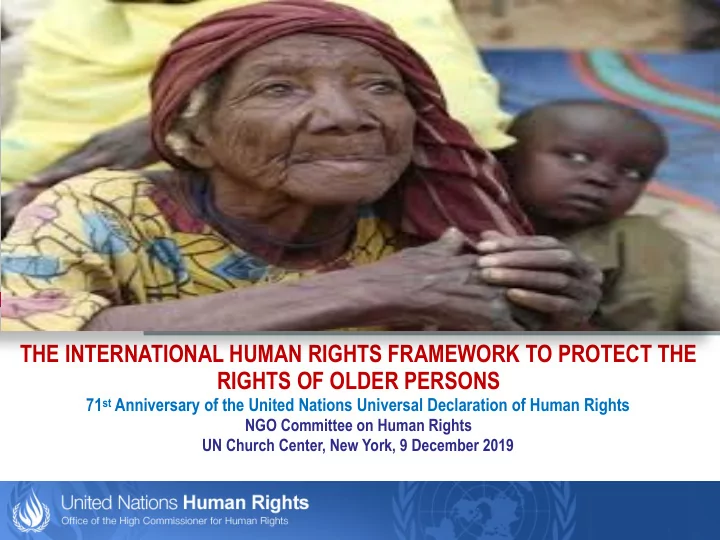
THE INTERNATIONAL HUMAN RIGHTS FRAMEWORK TO PROTECT THE RIGHTS OF OLDER PERSONS

71st Anniversary of the United Nations Universal Declaration of Human Rights

NGO Committee on Human Rights UN Church Center, New York, 9 December 2019

slide-2
SLIDE 2

Overview of international human rights treaties

International Covenant on Civil and Political Rights International Covenant on Economic, Social and Cultural Rights

International Convention on the Elimination of All Forms

  • f Racial

Discrimination

Universal Declaration of Human Rights

Specific phenomena Specific groups

Convention against Torture and other Inhuman, Degrading Treatment or Punishment Convention on Enforced Disappearances International Convention on the Elimination of All Forms

  • f Discrimination

against Women Convention on the Rights of the Child Convention the rights of Migrant Workers and members of their families Convention the rights of persons with disabilities

slide-3
SLIDE 3

The international human rights mechanisms

Treaty-based Bodies

CESCR CEDAW CRPD

Charter- based Bodies (Human Rights Council)

Universal Periodic Review Special Procedures

ILO

Conventions

Regional

mechanisms

slide-4
SLIDE 4

How to access them to protect older persons?

➢Complaint mechanisms of treaty bodies (e.g. OP CCPR, OP CESCR) ➢State/Shadow reports for Treaty Body country reviews ➢Universal Periodic Review submissions ➢IE Older Persons has a mandate to receive complaints and undertake country visits

slide-5
SLIDE 5

Limitations of existing UN human rights mechanisms to protect older persons

  • Lacking specificity
  • Lack of agreed international

standards

  • Uneven coverage by UN HR

mechanisms

  • Lack comprehensive national legal

and policy framework focused on

  • lder persons
  • Lack of disaggregated data
  • Weak accountability system
slide-6
SLIDE 6

Normative progress in strengthening the human rights of older persons

2010: GA Open-ended Working Group on Ageing – to consider “proposals for an international legal instrument to promote and protect the rights and dignity of older persons” 2013: HRC Independent Expert

  • n HR of Older persons

2015: Inter-American Convention

  • n Protecting the Human Rights of

Older Persons 2016: Protocol to the African Charter of Human and People’s Rights on the Rights

  • f Older Persons in Africa

Strengthened Protection of HR of

  • lder persons
slide-7
SLIDE 7

Why an international treaty on

  • lder persons?

➢To provide a comprehensive and systematic framework for the protection and promotion of all our human rights in older age ➢To articulate how each human right specifically applies to us in older age ➢Older persons as rights-holders ➢To inform and bring closer alignment among varying national legal and policy frameworks ➢To provide for a strong implementation, monitoring and accountability system

slide-8
SLIDE 8

What normative changes would provide clearer and more effective protection and enjoyment of the rights of older persons?

slide-9
SLIDE 9

Discrimination

Existing IHRs framework: ➢ Founding principle that “all human beings are born free and equal in rights and dignity” (Art. 1 UDHR) ➢ Absence of explicit provisions

  • n age discrimination in core

international human rights conventions ➢ Discrimination based on age is

  • nly explicitly prohibited in

the International Convention

  • n Migrants (art. 1.1 and 7)

➢ Limited visibility and protection against age discrimination What is needed: ➢ International recognition that all people of any age are equal before and under the law ➢ Prohibition and guarantee of effective legal protection against all forms of discrimination on the basis of age, including intersectional discrimination

slide-10
SLIDE 10

Autonomy and Independence

  • Existing

international human rights treaties do not provide a clear definition of these rights

Need for normative provisions that recognizes older persons right to:

  • Personal autonomy and independence
  • ver all aspects of their lives on an

equal basis with others

  • Choose where and with whom to live
  • An independent living and full inclusion

and participation in the community

  • Enjoy and exercise legal capacity and

to make own decisions

  • Policies on public and private financing
  • f continuing support services
slide-11
SLIDE 11

Violence, Neglect and Abuse

  • Human rights mechanisms

have recognized older persons as a vulnerable group requiring special measures of protection against violence and abuse

  • Invisibility and inadequate

attention given to the phenomenon of violence against older persons and age-sensitive responses

  • The need to define how the

right to freedom from violence and abuse specifically applies to

  • lder persons and in old age
  • Adoption of legal provisions to

prevent, investigate, punish, and eradicate acts of violence against older persons, and reparation

  • Prohibition of harmful traditional

practices against older women

  • Effective complaint mechanisms
slide-12
SLIDE 12

Social Protection

In most instruments, e.g. UDHR, ICESCR, formulated in general terms:

  • Right to adequate standard of

living, social security and social protection, including right to income security through employment, access to health care and services, and social services

  • Encompasses the right to access

and maintain benefits, whether in cash or in kind, without discrimination in order to secure protection, inter alia from (a) lack

  • f work-related income caused by

(…) old age (…) GC 19

  • The normative

international framework should focused on progressively achievement

  • f universal coverage and

guarantee adequate old-age benefits to ensure access to necessary goods and services and allow life in dignity

  • Contributory and non-

contributory schemes should be in place. Non- contributory pension schemes as an effective tool for poverty reduction

slide-13
SLIDE 13

Health and Social Care

  • The right to health is

recognized by numerous international human rights instruments.

  • Article 12 of the

ICESCRs: The right of everyone to the enjoyment of the highest attainable standard of physical and mental health.

  • Lack of specific

provisions on older persons, such as those which exist for other groups: women, children, persons with disabilities, and migrants

Need for definition on how the right to health specifically applies to older people and in old age, addressing:

  • accessible, available, acceptable and affordable

quality health services, including long-term care and access to essential drugs and medicines

  • non-discriminatory allocation and prioritization of

health resources;

  • Long-term care and palliative care
  • Access to timely, comprehensive, holistic and

available palliative care services consistent with the needs, will and preferences of the older persons

  • primary health care and chronic illness
  • special programmes tailored to the physical and

mental health needs of older women.

slide-14
SLIDE 14

The way forward

❖ Elaboration of an international human rights legal instrument on

  • lder persons

❖ Integration of human rights of older persons in UPR/treaty body reporting and in Special Procedures’ work ❖ Implementation of regional mechanisms on the human rights of

  • lder persons

❖ Adequate national legislation in line with human rights legal framework

slide-15
SLIDE 15

Many thanks!

Denise Hauser

Equality, Non-discrimination, and Rule of Law Section – OHCHR NY hauser@un.org