
SLIDE 1
Do we live in Peace? Human Rights Cities, Democracy and Practice
2017 World Human Rights Cities Forum, Gwangju
Local voices for Human Rights
#Cities4Rights
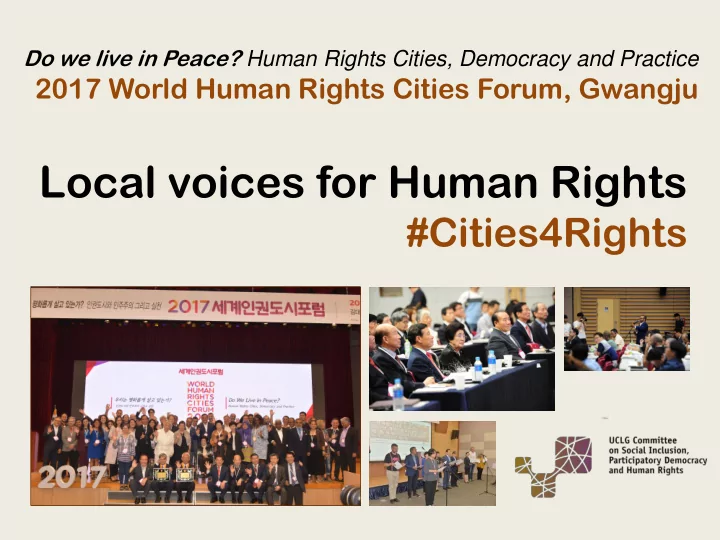
Local voices for Human Rights #Cities4Rights Gwangju Guiding - - PowerPoint PPT Presentation
Do we live in Peace? Human Rights Cities, Democracy and Practice 2017 World Human Rights Cities Forum, Gwangju Local voices for Human Rights #Cities4Rights Gwangju Guiding Principles for a Human Rights Cities 1) Right to the City 2)
Do we live in Peace? Human Rights Cities, Democracy and Practice
2017 World Human Rights Cities Forum, Gwangju
#Cities4Rights
The World ld Human an Righ ghts ts Citi ties es Forum um is an international forum held annually in Gwangju, aimed at promoting the world human rights cities network and the values of the “Gwangju Guiding Principles for a Human Rights City”
Gwangju Guiding Principles for a Human Rights Cities 1) Right to the City 2) Non-discrimination and affirmative action 3) Social Inclusion and Cultural Diversity 4) Participatory Democracy and Accountable Governance 5) Social justice, solidarity and sustainability 6) Political leadership 7) Human Rights mainstreaming 8) Effectiveness and Policy coordination 9) Education and training 10) Right to remedy Know more about the Forum Read the principles
What is the Gwangju Spirit?
Gwangju is a city known for its public spirit and strong commitment with human
such as the 1980 Gwangju uprising: a mass protest against South Korea’s military government that gathered nearly a quarter of a million people.
The Gwangj gju u Human n Rights ts Offic ice was the first office of its kind in Korea. It has created a master plan for a "Human Rights City" including the vision, strategy and practical tasks for its development.
“Although brutally repressed and initially unsuccessful in bringing about democratic reform, the 1980 uprising is considered to have been a pivotal moment in the South Korean struggle for democracy”
Encyclo lopa paedia edia Brit itann nnic ica
Know more e about t the May 18 Uprising sing
What is the
Yoon Jang Hyeon
Mayor of Gwangju “Gwangju brings with pride the spirit
promotion of Human Rights, peace and democracy through all its history; that is why we promote the World Human Rights Cities Forum, to demonstrate that cities are key to defend and fulfil Human Rights”
Read Mayor Yoon speech on the Right to participate and see our full news about it
2017 edition: Do we live in peace?
The WHRCF 2017 edition gathered more than 700 participants. It hosted two wo plenary sessions, nine thematic sessions and seven special sessions and events focused on “exploring implementable measures to expand and strengthen participatory democracy and civil autonomy as a practical mechanism for guaranteeing human rights” as well as on “seeking a human rights- based approach to the right to the city (…) as a way to overcome social conflicts and to build tolerant cities” Check the overview to the 2017 edition Check the programme Check the Forum’s final declaration in
French Spanish English
Irene Escorihuela
Directress at the Observatori DESC on Social, Economic and Cultural Rights
“The Right to the City has become a shared vision for local governments and civil society organizations where to work together for the same goals; nonetheless, strong social movements are still necessary to fight for social, economic and cultural rights such as the Right to Housing”
Explore the work of the Barcelona-based Observatori DESC
Anton Salman
Mayor of Bethlehem (Palestine)
“Bethlehem, the city that spreads peace, love and justice to the whole world, does not live in peace due to the arbitrary measures of Israeli occupation; walled with discrimination, continuous land confiscation and multiple checkpoints along the way, our daily life is drastically affected”
Read Mayor Salman speech on Palestinian cities under Israeli occupation
This plenary session gathered local authorities from Indonesia and France, as well as scholars and activists from Korea’s Candlelight Movement, Spain’s Right to Housing movement and the Global Platform for the Right to the City. It aimed at discussing how can local governments and civil society collaborate in advancing participatory democracy at the local level in a moment where “human rights are threatened by neoliberalism, authoritarianism and militarism” all over the world. Read the session’s concept paper
Fatou Houel
UN Office of the High Commissioner on Human Rights
“The Office of the High Commissioner has already stressed the importance
implementing human rights. In the following years it will continue to engage with them and their representing network, UCLG, supporting all their initiatives aimed at making cities places to live in security, dignity and peace”
Read the Human Rights Council Report “Local Administration and Human Rights”
Bernard Macret
Deputy Mayor of Grenoble on International Relations
“Grenoble resists and wants to be a welcoming and solidary city towards migrant population. The City Council has created a Foreign Residents’ Consultative Council to enhance their participation in local decision-making on the basis of
guide has also been published to brief migrants on the universal rights they hold”
Know more about the Conseil Consultatif des Résidents Étrangers Grenoblois
The Forum was a good opportunity to bring forward the human rights cities agenda in
South Korea, Indonesia, Japan, Nepal and India were well represented in the Forum. A motion was adopted denouncing the situation of Rohingya people and human rights defenders in the Philippines, calling for the international community’s
diplomatic resolution of the conflict between the United States and North Korea, as well as to advance the agenda for peace and reconciliation between the two
Human Rights Charter (1998) was advanced in several meetings during the Forum and received wide attention by worldwide local leaders and press.
Stefany Campins Social Development Secretariat of Mexico City “Global problems demand local actions: in Mexico City we approved a new Constitution that is based on Human Rights and the Right to the City, mainstreaming these values into all our local action. Our city is equally engaged in fulfilling Sustainable Development Goals at the local level”
Read Mexico City’s 2016 Constitution
Mauricio Valiente
Deputy Mayor of Madrid on Human Rights
“Human Rights should be a priority for every local administration; because when we speak about rights we speak about daily needs of our citizens (…) In Madrid we developed a Strategic Plan for Human Rights in the City aimed at mainstreaming the Human Rights approach into local action in order to turn citizens from policy recipients into human rights holders”
See Madrid’s Strategic Plan for Human Rights in the City
The 2017 Forum hosted up to nine thematic sessions with representatives of more than twenty nationalities. These thematic sessions where focused on (T1) City and gender, (T2) Social Economy and Community Vitalization, (T3) City and Elderly, (T4) City and Child, (T5) Village Democracy, (T6) City and Environment, (T7) State Violence and Human Rights, (T8) Disability and Human Rights, (T9) Migrants, refugees and Human Rights.
Read the concept notes of all thematic sessions
Magali Fricaudet
Coordinator of the UCLG Committee on Social Inclusion, Participatory Democracy and Human Rights
“For local governments, Human Rights are strong principles for democracy and
this regard constitutes the basis for a renewed social contract between elected
When calling for more decentralization, local governments should also reclaim all the necessary resources to be able to fulfil these
budgetary cuts, this would actually threat human rights fulfilment”
Explore the work
Committee
Emmanuel Carroz Deputy Mayor of Grenoble on Rights Equality
“Local authorities face restrictive control mechanisms from the national level preventing them from developing an inclusive idea of local democracy (…) We only want our country to respect the first sentence
that people born and live equal in
a woman, a migrant or LGBTI, we just want this sentence to be true”
Read Grenoble’s guide on foreign residents’ Rights
The Village and Democracy session explored concrete ways to implement participatory democracy mechanisms at the city level, with a special focus on the Korean scenario after the Candlelight Movement. The Korean WAGL platform and Decide Madrid were presented as
positive examples in this regard. Miguel Arana, from Decide Madrid, noted how “citizen participation is deeply related with Human Rights, that is why Madrid developed its Plan for Human Rights in the City hand by hand with its citizens”
See our full interview with Miguel Arana on Decide Madrid
Michael Scott
United States Human Rights Cities Alliance
“Although Human Rights are
we have also seen an increase of local mobilization and the importance of local administration in promoting Human Rights. More space and concrete participation mechanisms should be cleared for civil society organizations in this regard”
Know more about the National Human Rights Alliance
Kaori Cabrera
Kota Kita Foundation (Indonesia)
Explore the work of Kota Kita Foundation and its outcome of the 2017 WHRCF
“It is vital that the Right to the City and Human Rights are well included in global agendas for sustainable development; in order to make them effective on the ground, however, we must count with communities participation, encouraging and recognizing their
governments have a key role to play in tackling this gap”
A Plenary Session was devoted to showcase the Swedish system of Human Rights protection. It counted with a varied representation of Diplomats, a representative from the city of Lund, as well as scholars and activists from organizations such as the Raoul Wallenberg Institute for Human Rights, the Centre for Corporate Social Responsibility and the University of Gothenburg.
Mugiyanto
Senior programme officer at INFID (Indonesia) and representative of Asia Democracy Network
“Several factors pervade Human Rights fulfillment at the local level: corruption, lack of corporate accountability in the light of human rights as well as weak institutional
commitment between communities, local governments and the national level can effectively tackle these phenomena and build sustainable human rights cities’ systems”
Know more about INFID and Asia Democracy Network
Sources: UCLG Committee on Social Inclusion, Participatory Democracy and Human Rights & World Human Rights Cities Forum Follow Gwangju’s World Human Rights Cities Forum Community
Follow