
SLIDE 1
3/3/2017 1
Examining the Evidence for Music Therapy with Individuals with ASD & DD Examining the Evidence for Music Therapy with Individuals with ASD & DD
Pierre Brennan, MM, MT-BC, BCBA Pierre Brennan, MM, MT-BC, BCBA
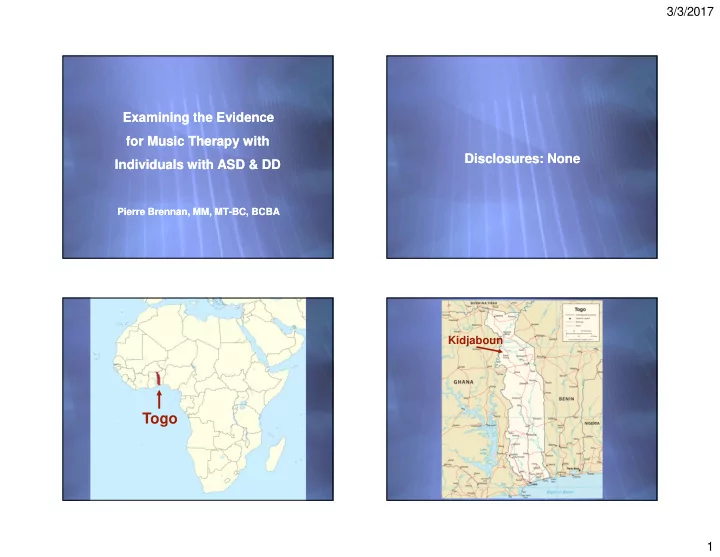
Togo 1 3/3/2017 AUDITORY INTEGRATION THERAPY (AIT) Despite - - PowerPoint PPT Presentation
3/3/2017 Examining the Evidence Examining the Evidence for Music Therapy with for Music Therapy with Disclosures: None Disclosures: None Individuals with ASD & DD Individuals with ASD & DD Pierre Brennan, MM, MT-BC, BCBA Pierre
Pierre Brennan, MM, MT-BC, BCBA Pierre Brennan, MM, MT-BC, BCBA
AUDITORY INTEGRATION THERAPY (AIT)
“Despite approximately one decade of practice in this country, this method has not met scientific standards for efficacy and safety that would justify its inclusion as a mainstream treatment for these disorders.” (ASHA, 2004) American Academy of Audiology (1993) American Academy of Pediatrics (1998) Educational Audiology Association (1997) New York State Department of Health (1999) concluded that AIT not be used as an intervention for young children with autism.
Gabrielle “Gabby” Giffords
Social Communication Emotional Regulation Motor Pre-academic Academic Cognitive Musical Social Communication Emotional Regulation Motor Pre-academic Academic Cognitive Musical
Using photographs, picture symbols,
participation and understanding.
ANTECEDENT
BEHAVIOR CONSEQUENCE
32
35
Speech perception relies on higher temporal resolution of complex stimuli, making the deficit in ASD a timing problem, where slower, repetitive sounds, like in music, remain intact. Speech perception relies on higher temporal resolution of complex stimuli, making the deficit in ASD a timing problem, where slower, repetitive sounds, like in music, remain intact.
(Kraus & Chandrarasekaran, 2010)
Auditory processing structures in the brain respond in similar ways to both speech and music.
(Zatorre, Evans, Meyer, & Gjedde, 1992)
Phonemes: basic sound units Syntax: how sound units are organized Semantics: meaning that is assigned to sound sequences Pragmatics:
rules that define effective communicative interactions
The set of principles that governs the combination of discrete elements into meaningful structural sequences
(Jackendoff, 2002)
When given a choice between listening to their mothers’ voice and the unintelligible noise of superimposed voices generated by a noisy crowd, children with autism showed either no preference for either auditory stimulus, or a preference for the noise of a crowd, whereas typically developing children and children with intellectual disability preferred their mother’s voice (Klin, 1991, 1992).
When given a choice between listening to American children’s music and music from Africa of similar tempo, orchestration, and form, children with autism will not show a bias for American children’s music when compared to the results of typically developing children and children with intellectual disability matched for chronological age. When given a choice between listening to American children’s music and music from Africa of similar tempo, orchestration, and form, children with autism will not show a bias for American children’s music when compared to the results of typically developing children and children with intellectual disability matched for chronological age.
AUTISM TYPICALLY DEVELOPING INTELLECTUAL DISABILITY
Pie graphs for percentages of average individual listening times for each type
music selected: American children’s music and African music.
Shared Syntactic Integration Resource Hypothesis
Although the processing of musical and linguistic syntax use different cognitive operations, these two domains share
information in working memory. These shared syntactic processes in frontal brain areas and domain-specific syntactic representations in more posterior brain regions are implicated in the accessing and processing of rule-governed information (Patel, 1998).
Kunert, Willems, Casasanto, Patel & Hagoort, 2015
Listening to music recruits attention and working memory circuits (Janata, Tillmann & Bhurucha, 2002) Music training improves verbal memory (Chan, Ho & Cheung, 1998) Verbal learning with a musical template increases neuronal synchronization and approves verbal memory (McInotsh, Peterson, Thaut, 2006)
55