L14. Sound Detector + Localization 2 - delay r ( ) f ( t - - PDF document

l14 sound
SMART_READER_LITE
LIVE PREVIEW

L14. Sound Detector + Localization 2 - delay r ( ) f ( t - - PDF document

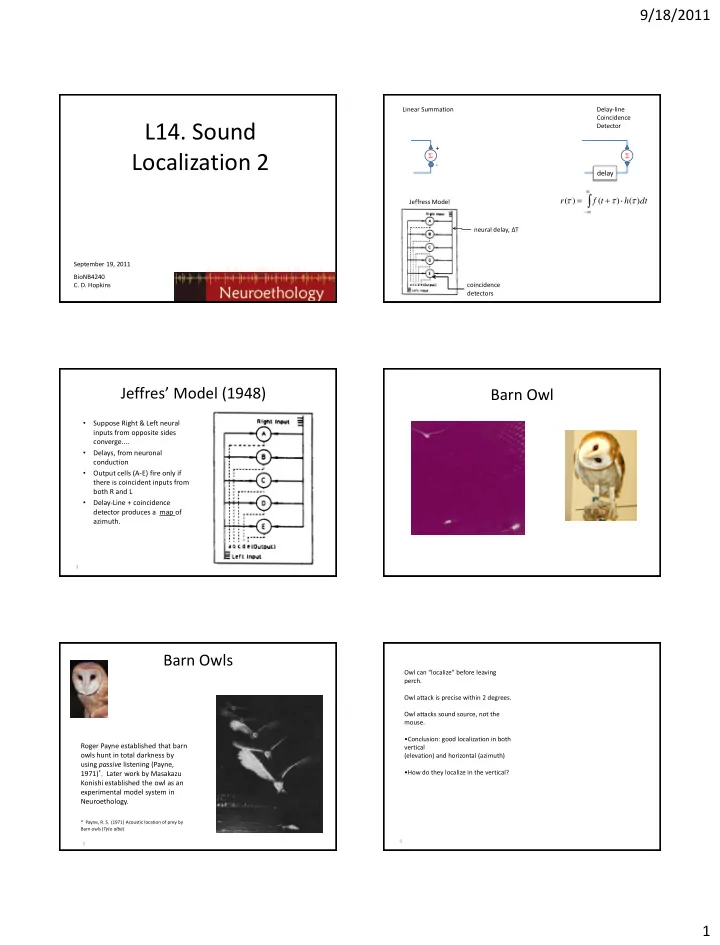
9/18/2011 Linear Summation Delay-line Coincidence L14. Sound Detector + Localization 2 - delay r ( ) f ( t ) h ( ) dt Jeffress Model neural delay, T September 19, 2011 BioNB4240 C. D. Hopkins coincidence 1 detectors


slide-1
SLIDE 1

9/18/2011 1

1

  • L14. Sound

Localization 2

September 19, 2011 BioNB4240

  • C. D. Hopkins

Linear Summation Delay-line Coincidence Detector

delay

+

  • dt

h t f r ) ( ) ( ) (

Jeffress Model neural delay, ΔT coincidence detectors

3

Jeffres’ Model (1948)

  • Suppose Right & Left neural

inputs from opposite sides converge....

  • Delays, from neuronal

conduction

  • Output cells (A-E) fire only if

there is coincident inputs from both R and L

  • Delay-Line + coincidence

detector produces a map of azimuth.

Barn Owl

5

Barn Owls

Roger Payne established that barn

  • wls hunt in total darkness by

using passive listening (Payne, 1971)*. Later work by Masakazu Konishi established the owl as an experimental model system in Neuroethology.

* Payne, R. S. (1971) Acoustic location of prey by Barn owls (Tyto alba) 6

Owl can “localize” before leaving perch. Owl attack is precise within 2 degrees. Owl attacks sound source, not the mouse.

  • Conclusion: good localization in both

vertical (elevation) and horizontal (azimuth)

  • How do they localize in the vertical?
slide-2
SLIDE 2

9/18/2011 2

7

In barn owls, asymmetric ear placement converts IID into map of elevation

Right ear Left ear

0.5 1
  • 1
  • 0.8
  • 0.6
  • 0.4
  • 0.2
0.2 0.4 0.6 0.8 1

y= x2

8

Barn owl can locate speaker in two dimensions

Masakazu Konishi

9

Head turning does not depend on feedback

  • Short sounds: head turn

begins after the sound.

  • Magnitude of turn is

correct for sounds of different directions.

  • Accuracy is 1 to 2 degrees.
  • Ballistic movement, no

feedback needed.

10

ILD Mapped

  • Microphones in ear canals used to map difference in sound intensity

11

Map of ITD

12

Discovery:

“A Neural Map of Auditory Space”

BioNB424

slide-3
SLIDE 3

9/18/2011 3

13

Individual neurons in inferior colliculus are “space-tuned”. Their receptive fields are oval shaped, tuned for sound direction.

Knudsen & Konishi (1978)

14

Receptive field Tuning to ITD Tuning to ILD

Tuning is determined by two different sensory cues: ITD and ILD.

15

A map of auditory space

Knudsen & Konishi (1978)

16

Single Cells in the IC

  • space-tuned

receptive fields

  • arranged in a map
  • f auditory space
  • map is a

“computational map” not a map of a sensory surface.

17

Top Down Case in Point

While I was waiting for the large anechoic room that was to be assembled in my laboratory, I worked on the owl’s visual Wulst with Jack Pettigrew. After one year of exciting research with Jack, he asked me what I was going to do with the auditory system. Since I was impressed by the selectivity of visual neurons for space, I told him that I would like to map the spatial receptive fields of auditory neurons. He enthusiastically endorsed this idea and paid for the necessary instruments to be built by the legendary designer and machinist Herb Adams. The idea was to deliver sounds from various directions to plot the distribution of neuronal responses in space. About this time, Eric Knudsen asked me if he could join me as a postdoc. Eric and I met in a café or hamburger joint in Manhattan to discuss our project. When he asked me what I was looking for, I answered "a map of auditory space," because the owl can rapidly pin point sound sources as if it were using a look-up table. Eric said that he would expect a map without any reason. We were naive and ignorant because we did not know Arnold Starr’s review* in which he pointed

  • ut that neither spatial receptive field or maps should exist in

the auditory system because space is not mapped in the inner ear. Mark Konishi

*Starr, A (1974) Fed Proc 1974 Aug;33(8):1911-4 Neurophysiological mechanisms of sound localization.

18

We did find neurons with spatial receptive fields first in the forebrain auditory area. We could not, however, recognize any map of auditory space. Eric suggested that we go to the inferior colliculus. Since we could not afford to kill an owl to make a brain atlas, we used the head of a frozen owl. We cut it with a band saw and look at unstained sections to determine the coordinates of the inferior colliculus. In the first multiunit recording, we saw a cluster of neurons responding only to sound coming from a particular

  • direction. As I was leaving for somewhere, Eric

continued to record further. He later reported to me that the preferred sound direction changed systematically as he moved the electrode. We worked very hard for about three months to find a map of auditory space. Eric and I celebrated this occasion with a bottle of champagne. - Mark Konishi ISN Newsletter March 1999 http://www.neurobio.arizona.edu/isn/Newsletters/isn.n ews.mar99.sec2.html#2 Eric Knudsen Roger( )

slide-4
SLIDE 4

9/18/2011 4

19

Behavioral Test of ILD

  • Trained owls
  • Right ear plugged: owl

turns down

  • Left ear plugged, turns

up

20

Behavioral Test of ITD

  • Owl presented with an

artificial ITD from two earphones.

  • Owl turns head after

training to locate sounds at different azimuths

  • Main cue: ongoing

disparity of sound times (ITD)

21

ITD Test

  • Behavioral test, trained owl.
  • ITD manipulated with stereo

headphones.

  • Owl turns toward time-

advanced sound.

  • 10 microsec sensitivity.

22

Hypothesis

  • Vertical axis coded by IID
  • Horizontal axis coded by ITD

23

Time pathway in the owl (blue)

24

Cells in nucleus magnocellularis project to nucleus laminaris both ipsilaterally and contralerally. Ipsilateral axons enter dorsally; contralateral axons enter ventrally.

NL: azimuth maps onto depth in nucleus NL analogous function to MSO in mammal

Carr, CE & Konishi, M 1988

1 mm

slide-5
SLIDE 5

9/18/2011 5

25

  • C. Carr and M. Konishi find cells in nucleus magnocellularis that could

generate a map of azimuth

NL: nucleus laminaris NM: nucleus magnocellularis Carr, CE & Konishi, M 1990

1 mm

26

  • C. Carr and M. Konishi find cells in nucleus magnocellularis that could

generate a map of azimuth

NL: nucleus laminaris NM: nucleus magnocellularis Carr, CE & Konishi, M 1990

1 mm

27

Sullivan, W. E. and Konishi, M. find neural map of ITD in owl

28

Konishi, 2006

29

Map of Interaural Level Differences?

VLVp (nucleus Ventralis Lemnisci Lateralis pars posterior)

Takahashi, Barbarini, and Keller (1995) J. Comp. Neurol. 358:294

30

slide-6
SLIDE 6

9/18/2011 6

31

Injections of tracer in the Right VLVp reveals terminals in the left dorsal VLVp VLVp VLVp injection site

32

Injections of tracer in the Right VLVp reveals terminals in the left dorsal VLVp

Takahashi, T., C. L. Barberini, et al. (1995). "An anatomical substrate for the inhibitory gradient in the VLVp of the Owl " Journal of Comparative Neurology 359: 294-304.

33

Time and Amplitude Pathways Converge in the IC

34

The two cochlear nuclei specialized for either time encoding or ampltiude encoding

  • N. magnocellularis:

– TIME PATHWAY – thick axons; heavy myelin – endbulb of Held – adendritic cell

  • N. anguilaris

– AMPLITUDE PATHWAY – small boutons – diffuse arbor

35

Vision guides plasticity

stimulus stimulus

  • E. Knudsen, 1999

now owl responds normally to sound, but makes 23 deg error to visual stim After 42 days, the response to sound is also displaced

Sound Loclization_scenes.swf Sound Loclization_scenes.swf

36

Q? How does the ITD map get calibrated in development?

PNAS (1984)

slide-7
SLIDE 7

9/18/2011 7

37

Head size is changing

PNAS (1984)

38

The Auditory Map is Plastic

1. Earplugs cause localization errors toward plugged ear. 2. These errors are temporary: after 2-3 weeks with earplugs, owls learn correct sound location. 3. After removal of ear plugs,

  • wls again make errors.

4. These post-removal errors are also reversible (in young owls) 5. However, adults do not compensate for ear plugs.

Knudsen (1983)

39

Vision is important in re-adjusting the auditory map

  • Errors corrected after

ear plug removal (A, B)

  • No correction if

blinders are placed on

  • wl after plug removal

(C).

  • No correction if vision

is displaced using prisms (D) Knudsen and Knudsen (1985)

40

Vision guides plasticity

stimulus stimulus

  • E. Knudsen, 1999

now owl responds normally to sound, but makes 23 deg error to visual stim After 42 days, the response to sound is also displaced

41

Vision guides plasticity

stimulus stimulus

  • E. Knudsen, 1999

now owl responds normally to sound, but makes 23 deg error to visual stim After 42 days, the response to sound is also displaced

42

When recording from neurons in Optic tectum, ITD from a neuron in the 0 degree azimuth part of the map is tuned to 0 degrees azimuth. After 8 weeks with L23 prisms, a neuron in the zero degree part

  • f map is now tuned to 50

microsecond ITD. (the map has become displaced)

slide-8
SLIDE 8

9/18/2011 8

43 44 45 46

Spectral cues (used for vertical localization by humans) are shifted by modified pinna (using ear molds). Relearning sound localization with new ears. Hofman PM, Van Riswick JG, Van Opstal AJ. Nat Neurosci. 1998 Sep;1(5):417-21. Plot shows monaural sensitivity as function

  • f frequency and

sound elevation (control listening above, with modified pinna shape (ear mold)).

47

Errors in elevation estimation caused by insertion of earmolds are gradually corrected (over 39 days). Removal of earmold results in instantaneous recovery

  • f elevation accuracy.

48

Lessons from Owls

1. Barn owls are “champions” at sound localization. Their auditory system is specialized for this function both in terms of accuracy and the fact that it is a 2-D system that uses cues for both azimuth and elevation. 2. There are two parallel auditory systems in the owl: one specialized for analysis of ITD, the other for analysis of IID. These parallel pathways are specialized. For for encoding and preserving time one for encoding and preserving amplitude. 3. Combined in the midbrain, the owl generates an computational map

  • f auditory space. (Computational: does not exist in the periphery)

4. ITD pathway generates a place map using delay-line + coincidence

  • detectors. The place map was predicted by L. Jeffress (1948).

5. Alignment of the auditory map with the visual map in the optic tectum is plastic. In young owls it can be re-aligned by early experience. 6. Realignment of the map requires re-wiring of the neurons in the optic tectum by growth of dendrites and formation of new synapses.

slide-9
SLIDE 9

9/18/2011 9

Literature

Carr, C. E., Fujita, I. and Konishi, M. (1989). Distribution of GABAergic neurons and terminals in the auditory system of the barn owl. J Comp Neurol 286, 190-207. Carr, C. E. and Konishi, M. (1988a). Axonal delay lines for time measurement in the owl's brainstem. Proc Natl Acad Sci U S A 85, 8311-5. Carr, C. E. and Konishi, M. (1988b). Axonal delay lines for time measurement in the owl's brainstem. Proc. Natl. Acad.

  • Sci. USA 85, 8311-8315.

Knudsen, E. I. (1975). Spatial aspects of electric fields generated by weakly electric fish. J. Comp. Physiol. 99, 193-118. Knudsen, E. I. (1980). Sound localization in birds. In Compartive Studies of Hearing in Vertebrates, eds. A. N. Popper and R. R. Fay), pp. 289-322. New York: Springer-Verlag. Knudsen, E. I. (1982). Auditory and visual maps of space in the optic tectum of the owl. Journal of Neuroscience 2, 1177- 1194. Knudsen, E. I., Knudsen, P. K. and Masino, T. (1993). Parallel pathways mediating both sound localization and gaze control in the forebrain and midbrain of the barn owl. Journal of Neuroscience 13, 2837-2852. Knudsen, E. I. and Konishi, M. (1978a). Center-surround organization of auditory receptive fields in the owl. Science 202, 778-80. Knudsen, E. I. and Konishi, M. (1978b). A neural map of auditory space in the owl. Science 200, 795-7. Knudsen, E. I. and Konishi, M. (1978c). Space and frequency are represented separately in auditory midbrain of the owl. J Neurophysiol 41, 870-84. Knudsen, E. I. and Konishi, M. (1980). Monaural occlusion shifts receptive-field locations of auditory midbrain units in the

  • wl. J Neurophysiol 44, 687-95.

Knudsen, E. I., Konishi, M. and Pettigrew, J. D. (1977). Receptive fields of auditory neurons in the owl. Science 198, 1278-80. Konishi, M. (1977). Spatial localization of sound. In Recognition of Complex Acoustic Signals., (ed. T. H. Bullock). Berlin: Dahlem Konferenzen. Konishi, M. (1983). Neuroethology of acoustic prey localization in the barn owl. In Neuroethology and Behavioral Physiology, eds. F. Huber and H. Markl), pp. 303-317. Berlin: Springer-Verlag. Konishi, M. (1990). The neural algorithm for sound localization in the owl. Harvey Lect 86, 47-64. Konishi, M. (1993a). Listening with two ears. Sci. American 268, 66-73. Konishi, M. (1993b). Similar neural algorithms in owls and electric fish. Journal of Comparative Physiology A 173, 698- 700.

49

Konishi, M. (2003). Coding of auditory space. Annu. Rev. Neurosci. 26, 31-55. Margoliash, D. and Konishi, M. (1985). Auditory representation of autogenous song in the song system of white-crowned sparrows. Proc Natl Acad Sci U S A 82, 5997-6000. Middlebrooks, J. C. and Knudsen, E. I. (1984). A neural code for auditory space in the cat's superior

  • colliculus. Journal of Neuroscience 4, 2621-2634.

Moiseff, A. and Konishi, M. (1981). Neuronal and behavioral sensitivity to binaural time differences in the

  • wl. J Neurosci 1, 40-8.

Moiseff, A. and Konishi, M. (1983). Binaural characteristics of units in the owl's brainstem auditory pathway: precursors of restricted spatial receptive fields. J Neurosci 3, 2553-62. Takahashi, T. and Konishi, M. (1986). Selectivity for interaural time difference in the owl's midbrain. J Neurosci 6, 3413-22. Takahashi, T., Moiseff, A. and Konishi, M. (1984). Time and intensity cues are processed independently in the auditory system of the owl. J Neurosci 4, 1781-6. Takahashi, T. T., Carr, C. E., Brecha, N. and Konishi, M. (1987). Calcium binding protein-like immunoreactivity labels the terminal field of nucleus laminaris of the barn owl. J Neurosci 7, 1843-56. Takahashi, T. T. and Konishi, M. (1988a). Projections of nucleus angularis and nucleus laminaris to the lateral lemniscal nuclear complex of the barn owl. J Comp Neurol 274, 212-38. Takahashi, T. T. and Konishi, M. (1988b). Projections of the cochlear nuclei and nucleus laminaris to the inferior colliculus of the barn owl. J Comp Neurol 274, 190-211. Volman, S. F. and Konishi, M. (1989). Spatial selectivity and binaural responses in the inferior colliculus of the great horned owl. J Neurosci 9, 3083-96. Volman, S. F. and Konishi, M. (1990). Comparative physiology of sound localization in four species of owls. Brain Behav Evol 36, 196-215. Wagner, H., Takahashi, T. and Konishi, M. (1987). Representation of interaural time difference in the central nucleus of the barn owl's inferior colliculus. J Neurosci 7, 3105-16.

THE END