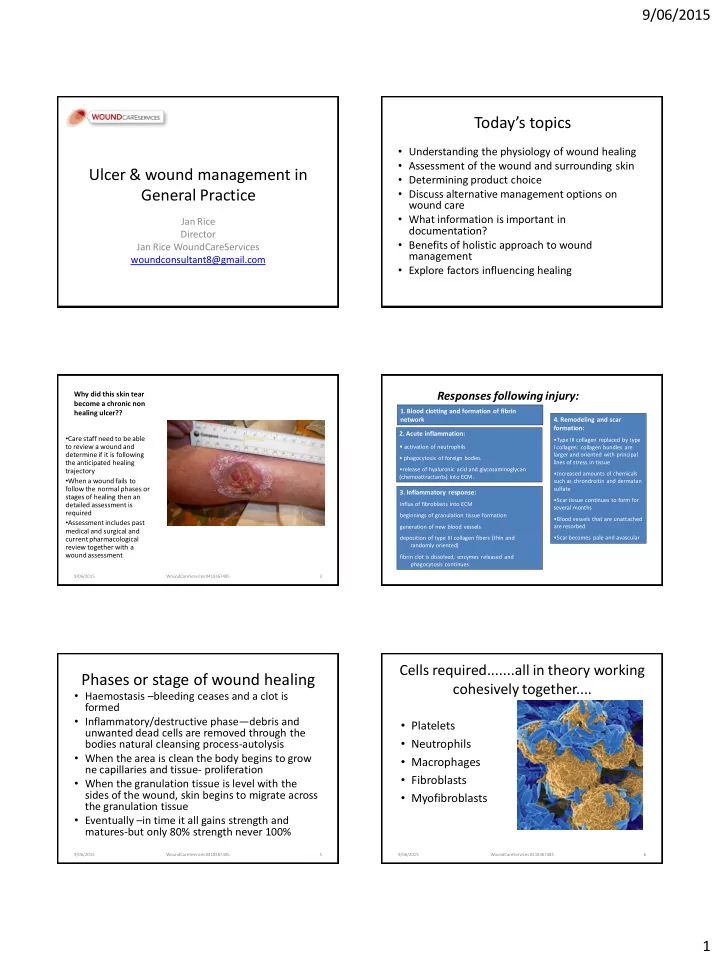
Todays topics Understanding the physiology of wound healing - - PDF document

today s topics
SMART_READER_LITE
LIVE PREVIEW

Todays topics Understanding the physiology of wound healing - - PDF document

9/06/2015 Todays topics Understanding the physiology of wound healing Assessment of the wound and surrounding skin Ulcer & wound management in Determining product choice General Practice Discuss alternative management


slide-1
SLIDE 1

9/06/2015 1

Ulcer & wound management in General Practice

Jan Rice Director Jan Rice WoundCareServices woundconsultant8@gmail.com

Today’s topics

  • Understanding the physiology of wound healing
  • Assessment of the wound and surrounding skin
  • Determining product choice
  • Discuss alternative management options on

wound care

  • What information is important in

documentation?

  • Benefits of holistic approach to wound

management

  • Explore factors influencing healing

Why did this skin tear become a chronic non healing ulcer??

  • Care staff need to be able

to review a wound and determine if it is following the anticipated healing trajectory

  • When a wound fails to

follow the normal phases or stages of healing then an detailed assessment is required

  • Assessment includes past

medical and surgical and current pharmacological review together with a wound assessment

9/06/2015 WoundCareServices 0418367485 3

Responses following injury:

  • 2. Acute inflammation:
  • activation of neutrophils
  • phagocytosis of foreign bodies
  • release of hyaluronic acid and glycosaminoglycan

(chemoattractants) into ECM.

  • 3. Inflammatory response:

influx of fibroblasts into ECM beginnings of granulation tissue formation generation of new blood vessels deposition of type III collagen fibers (thin and randomly oriented) fibrin clot is dissolved, enzymes released and phagocytosis continues

  • 1. Blood clotting and formation of fibrin

network

  • 4. Remodeling and scar

formation:

  • Type III collagen replaced by type

I collagen: collagen bundles are larger and oriented with principal lines of stress in tissue

  • Increased amounts of chemicals

such as chrondroitin and dermatan sulfate

  • Scar tissue continues to form for

several months

  • Blood vessels that are unattached

are resorbed

  • Scar becomes pale and avascular

Phases or stage of wound healing

  • Haemostasis –bleeding ceases and a clot is

formed

  • Inflammatory/destructive phase—debris and

unwanted dead cells are removed through the bodies natural cleansing process-autolysis

  • When the area is clean the body begins to grow

ne capillaries and tissue- proliferation

  • When the granulation tissue is level with the

sides of the wound, skin begins to migrate across the granulation tissue

  • Eventually –in time it all gains strength and

matures-but only 80% strength never 100%

9/06/2015 WoundCareServices 0418367485 5

Cells required.......all in theory working cohesively together....

  • Platelets
  • Neutrophils
  • Macrophages
  • Fibroblasts
  • Myofibroblasts

9/06/2015 WoundCareServices 0418367485 6

slide-2
SLIDE 2

9/06/2015 2

Not to forget also ....

  • The role of

growth factors and cytokines

  • Proteases

and inhibitors of proteases

9/06/2015 WoundCareServices 0418367485 7

Physiological processes predominating in the different types of wound healing

Type of healing Healing mechanism Primary Secondary Superficial wounds Formulation of granulation tissue + ++

  • Formulation of

new connective tissue +++ ++

  • Contraction
  • +++
  • Epithelialisation

+ + +++

9/06/2015 WoundCareServices 0418367485 8

Yes wound healing and the understanding of this is complex

  • Not all wounds follow the

sequence we expect

  • It is up to the clinician
  • verseeing care to pick up

that something is not right

  • Close supervision of

wounds is essential

  • Staff should seek help if

they feel out of their depth!

9/06/2015 WoundCareServices 0418367485 9

What changes for chronic wounds?

  • Wound fluid studies show:

–Increased pro-inflammatory cytokines –Imbalance between matrix metalloproteinases (MMP9, MMP2)and the tissue inhibitors of metalloproteinases

  • Swab/biopsy studies show:

–Presence of a biofilm –Inflammation of vessel intima

9/06/2015 WoundCareServices 0418367485 10

http://topnews.co.uk/images/imagecache/main_image/pathology- services08.jpg

So as a clinician what should you be asking?

Why is this wound ‘over-inflammed’????

9/06/2015 WoundCareServices 0418367485 11

What may cause this increase in pro- inflammatory cytokines? Some suggestions may include:

  • Bacterial contamination ( discuss this later)
  • Repeated trauma
  • Ischaemia
  • Underlying diseases—including mal nutrition

9/06/2015 WoundCareServices 0418367485 12

http://www.emc.maricopa.edu/faculty/farabee/bi

  • bk/Bacteria.GIF
slide-3
SLIDE 3

9/06/2015 3 Consider trauma when removing this type of dressing

9/06/2015 WoundCareServices 0418367485 13

Let’s start with the basics that we all need to heal a wound...

  • A healthy body
  • Good food and fluids, no illicit drugs, including

nicotine!

  • Stay young!
  • Healthy body shape!
  • No infection
  • No trauma on the wound itself
  • No dangerous chemicals placed on the skin or wound
  • A wound free of debris and other unwanted substances

9/06/2015 WoundCareServices 0418367485 14

Yes nearly impossible to achieve in this group... But we must try

9/06/2015 WoundCareServices 0418367485 15

Wounds in these vulnerable people require you to .......

  • Provide good food and fluids regularly
  • Ensure the vulnerable skin is not roughly

handled-take care to prevent skin tears, wipe creases dry without causing more damage

  • If you wear gloves to remove dirty dressings then

remove those gloves –wash your hands and then begin the clean procedure

  • Learn about dressings and their function
  • Learn how to clean a wounds not just give it a

‘lick and a flick’

9/06/2015 WoundCareServices 0418367485 16 9/06/2015 WoundCareServices 0418367485 17

Normal recommended daily intake for a healthy person versus those with wounds

Energy Protein Vitamin C Zinc Iron 8- 10Cal/kg 25- 30 cal /kg 50g 1.2- 2g/kg /day 40 mg 100- 200mg 12- 15mg 15- 25mg 12- 16mg 10- 30mg

9/06/2015 WoundCareServices 0418367485 18

For your free copy contact 1800 671 628 and also ask for the recipes using Arginaid extra and ask for the new patient guide- Support wound healing from the inside out. Mini-nutritional assessment scale- available from www.mna-elderly.com

slide-4
SLIDE 4

9/06/2015 4

9/06/2015 WoundCareServices 0418367485 19

Some supplements

  • TwoCal, Ensure Plus, by Abbott 1800 225 311
  • Arginaid, Arginaid Extra by Nestlé1800 671 628
  • Cubitan, Fortisip by Nutricia 1800 060 057
  • Pro-Form by Meiji-MGC Diary Co 1300 362 774
  • Enprocal Repair-Prime nutrition-1800631103

9/06/2015 WoundCareServices 0418367485 20

Ageing

There are many body systems that begin to fail or function less efficiently as the ageing process takes over

Skin Care

  • Consider the skin as a brick wall– a wall of

defense-and this certainly changes as you age!!

9/06/2015 21 WoundCareServices 0418367485

Functions of the skin

  • 1. Protection from–
  • The entry of foreign material
  • Mechanical or thermic impact – i.e. pressure, heat, cold
  • UV-radiation
  • Microorganisms – i.e. bacteria, viruses
  • Water loss
  • 2. Sensation – Reacts to heat and cold, touch, pressure, vibration etc.
  • 3. Temperature regulation – Controls the transfer of heat across the body’s surface,

letting it in or out as necessary

  • 4. Communication – Others see our skin and can assess our mood, physical state (i.e.

paling or blushing) and attractiveness

  • 5. Storage – Storage centre for lipids and water
  • 6. Synthesis – Produces vitamin D through exposure to UV radiation in sunlight
  • 7. Excretion – Releases wastes including water, salts and toxins
  • 8. Absorption – Oxygen, nitrogen and carbon dioxide diffuse into the epidermis in small
  • amounts. Medicine can also be administered through the skin by ointments or by an

adhesive patch

  • 9. Water resistance – Prevents body fluid and essential nutrients from being washed out
  • f the body.

9/06/2015 22 WoundCareServices 0418367485

Changes in the skin of the elderly

  • Dermis loses 80% of its original thickness
  • 40% less collagen
  • Sebum and sweat production is reduced
  • Epidermal layer separates more easily from the

dermis

  • Elastin fibres decrease in number but increase in

size

  • Decrease in Langerhan cells
  • Small blood vessels diminish by 40%

9/06/2015 WoundCareServices 0418367485 23

Skin care

  • Cleanse, pat dry no rubbing
  • Apply moisturiser immediately cleansing and
  • nce or twice again in a 24hr period
  • www.woundsinternational.com/pdf/content_

10608.pdf

  • Best practice statement for Emollient therapy-

www.bdn.org.uk

9/06/2015 24 WoundCareServices 0418367485

slide-5
SLIDE 5

9/06/2015 5 The difference between emollient and moisturisers

  • Emollients- lipids that
  • cclude the skin surface

thus preventing water loss from the stratum corneum

  • Moisturisers – are lipid

emulsions that actively hydrate the skin by application of a humectant to the skin

9/06/2015 25 WoundCareServices 0418367485 9/06/2015 26 WoundCareServices 0418367485

Common products

9/06/2015 27 WoundCareServices 0418367485

Other systems influenced by the ageing process

  • Neurological
  • Respiratory
  • Cardiac
  • Renal
  • Gastro
  • Skeletal

9/06/2015 WoundCareServices 0418367485 28

Body build

Obese patients are less mobile, have poor oxygen

delivery due to the fact that adipose tissue is poorly

  • vascularised. They also have increased risk of wound

dehiscence and hernia formation, together with increased moisture in skin folds and thus infections.

  • Always think fungal skin infection when dealing with
  • bese patients and skin rashes

9/06/2015 WoundCareServices 0418367485 29 9/06/2015 WoundCareServices 0418367485 30

Body build

Emaciated and thin

people however have less protection against pressure, less insulator properties and lack of energy stores to maintain metabolic processes which results in early breakdown of protein.

slide-6
SLIDE 6

9/06/2015 6

Mechanical stresses on the skin or wound

mechanical stress can be caused by:

  • Pressure
  • Shear
  • Friction
  • Dressing removal
  • The patient

themselves

9/06/2015 WoundCareServices 0418367485 31

Wound debris

  • Necrotic tissue, dry scabs

and excess slough will impair epithelial migration and impair the supply of nutrients to the wound.

  • Wound debris prevents the

formation of granulation tissue and prolongs the inflammatory phase of healing.

  • Foreign material in the

wound will do the same, e.g. cotton wool fibres, dog & cat hair.

9/06/2015 WoundCareServices 0418367485 32

Maceration

  • ‘Softening and breakdown of skin

resulting from longed exposure to moisture’(Anderson 1998)

  • Difference between acute &

chronic wound exudate, the chronic can be quite harmful to surrounding tissue

  • Excessive moisture may predispose

the wound to infection, skin sensitivities and irritations

  • Apart from wound exudate other

sources of excess moisture are urinary and faecal incontinence, and wet dressings from the shower!

9/06/2015 WoundCareServices 0418367485 33

Document to read

9/06/2015 WoundCareServices 0418367485 34

Speak to your Convatec Representative for a copy of this excellent document Also available from www.woundsinternational.com

Pathogenesis of soft tissue infections

  • 1. Breach of normal skin integrity
  • 2. Alteration of normal skin floracolonization by

potentially pathogenic organisms

  • 3. Changes in the local environment of the tissues

thereby favouring the proliferation of micro-

  • rganisms, e.g. presence of devitalized tissues,

haematoma, foreign body

9/06/2015 WoundCareServices 0418367485 35

How organisms access wounds

Exogenous or Endogenous

  • Direct contact
  • [hands / equipment / environment]
  • Airborne
  • [from surrounding air]
  • Self contamination

[migration from one location in body to another]

9/06/2015 WoundCareServices 0418367485 36 Collier M. Recognition and management of wound infections.2004 p3. www.worldwidewounds.com

slide-7
SLIDE 7

9/06/2015 7 Critical colonisation/local infection

  • The inability to maintain a

balance between the increasing numbers of bacteria and an effective immune system

  • www.ewma.org position

document on infection

  • Also www.awma.com.au

document

  • Sign up for

www.woundinfection- institute.com

9/06/2015 WoundCareServices 0418367485 37 9/06/2015 WoundCareServices 0418367485 38

Wound swabbing protocol??

  • If you do not have a

protocol for swabbing wounds it is suggested that you speak with your pathology department and design one

  • There is much debate on

this issue but also a degree

  • f consensus
  • Probably the most

important thing to do is clean the wound first

9/06/2015 WoundCareServices 0418367485 39

Topical antiseptics-yes, no, sometimes?

  • Our use of antiseptics is possibly a carry over

from routine practice instituted prior to the advent of antibiotics-we must rationalize our use today

  • Bacteria cause local inflammation and are
  • leucocytotoxic. They also damage epithelium,

retard wound contraction, reduce wound tensile strength and trigger microthrombi. Therefore, the cytotoxicity of bacteria must be weighed against any possible antiseptic cytotoxicity

  • More and more new research is demonstrating

that there is a place for skin cleansing with antiseptics and in some cases cleansing wounds with antiseptics and then rinsing off with sterile saline

These wounds require more than soap

  • r soap alternative

9/06/2015 WoundCareServices 0418367485 40

There are many other factors that influence our well being and wound healing

9/06/2015 WoundCareServices 0418367485 41

  • Medications
  • Interference with

dressings (Munchausen’s syndrome)

  • Wound location
  • Smoking
  • Stress
  • Sleep deprivation
  • Depression

Smoking and wound healing

  • ONE CIGARETTE WILL REDUCE

THE PERIPHERAL BLOOD FLOW BY 50% FOR ONE HOUR

9/06/2015 WoundCareServices 0418367485 42

http://www.awma.com.au/journal/library/1403_01.pdf

slide-8
SLIDE 8

9/06/2015 8

Pain

9/06/2015 WoundCareServices 0418367485 43

www.ewma.org

Further reading... www.ewma.org

  • Wound complexity and

healing P Vowden, J Apelqvist, C Moffatt

  • Psychosocial factors and

delayed healing C Moffatt, K Vowden, P Price, P Vowden

  • Economic burden of hard-

to-heal wounds M Romanelli, JC Vuerstaek, LC Rogers, DG Armstrong, J Apelqvist

9/06/2015 WoundCareServices 0418367485 44 9/06/2015 WoundCareServices 0418367485 45

We need to look at the ‘whole’ person not the ‘hole’ in the person

9/06/2015 WoundCareServices 0418367485 46

Consider what you can do?

  • Check diet
  • Encourage mobilisation
  • Encourage other activities and social events
  • Other wound care products?
  • Biopsy?
  • Antibiotics
  • Further investigations?

Wound tissue assessment

9/06/2015 WoundCareServices 0418367485 47

Wound assessment

  • Begin by examining the

wound itself in terms of

  • C – colour of tissue
  • D – depth of wound
  • E – exudate volume
  • Measure wound and note
  • ther characteristics

9/06/2015 WoundCareServices 0418367485 48

Begin by examining the wound itself in terms of T- tissue within the wound I- inflammation or presence of infection M- moisture –balance – wet /dry E – exudate volume/type Measure wound and note other characteristics

slide-9
SLIDE 9

9/06/2015 9

Other wound characteristics that you would assess –Presence of undermining or tracking –Effects of previous treatments –Current dressing frequency and proposed frequency

9/06/2015 WoundCareServices 0418367485 49

Wound tissue by colour

  • Pink
  • Red
  • Yellow
  • Green
  • Black
  • black

(modified from Marion Laboratories 1976)

9/06/2015 WoundCareServices 0418367485 50

Wound tissue descriptor

  • Necrotic tissue—eschar or slough
  • Granulation tissue
  • Hypergranulation tissue
  • Epithelium
  • Macerated tissue

9/06/2015 WoundCareServices 0418367485 51 9/06/2015 WoundCareServices 0418367485 52

Dry hard black-almost no erythema, nil odour, ‘quiet’ DO NOT HYDRATE!!! Keep dry

Soft, boggy, offensive black

  • ften with peri wound

maceration—have someone debride but usually after a few days of antibiotics-if you debride without antibiotic coverage there is often uncontrolled bleeding

Infected wounds

These wounds have thick purulent exudate often brown/red in colour or green – requires systemic antibiotic therapy, exudate control and safe topical therapy

9/06/2015 WoundCareServices 0418367485 53

Yellow (sloughy) wounds

9/06/2015 WoundCareServices 0418367485 54

The drier yellow/brown tissue if not able to be debrided requires rehydration to assist autolytic debridement

The moist creamy yellow wet tissue requires an antimicrobial that will help to manage exudate

slide-10
SLIDE 10

9/06/2015 10 Clinicians must however be able to identify other yellow tissue…..

  • Tendon
  • Bone-creamy / white
  • Fat / Subcutaneous tissue

9/06/2015 WoundCareServices 0418367485 55 9/06/2015 WoundCareServices 0418367485 56

Healthy red (granulating)

This tissue should be almost level with the perimeter of the wound and not bleed easily when cleansed This tissue requires some moisture but not too much and it requires a dressing that will protect

Poor quality granulation tissue

  • Can present as pale tissue

with irregular tissue and copious exudate and non healing edges

  • This tissue often requires

an antimicrobial, very good cleansing and exudate management and peri wound protection

9/06/2015 WoundCareServices 0418367485 57

Hypergranulation tissue

  • Bleeds easily and raised

above side edges of wound

  • May also present as loose

‘bubbles’ of tissue within deeper wounds

  • Sometimes described as

‘Jelly like’ tissue

  • Flattens when pressed for

short length of time – The aim here is to control exudate, apply direct pressure and consider antimicrobials

9/06/2015 WoundCareServices 0418367485 58 9/06/2015 WoundCareServices 0418367485 59

Pink (epithelialising) tissue

  • This represents the wound in the

final stages of healing, it may be transparent and pearly pink

  • Young epithelium wrinkles when

pressed and has a matt finish appearance with minimal exudate

  • requires some hydration and

protection, particularly against friction and shear

A simplified approach that matches colour of tissue with product aim

  • Black---if aiming to heal—

rehydrating/cleansing/debriding dressing

  • Green ----antimicrobial dressing
  • Wet yellow---absorbent/antimicrobial dressing
  • Dry yellow---rehydrating dressing
  • Red---protective dressing
  • Hypergranulation---antimicrobial dressing
  • Pink---protective dressing

This is not a prescription but a guide as to where to start

9/06/2015 WoundCareServices 0418367485 60

slide-11
SLIDE 11

9/06/2015 11 In planning the treatment the clinician must also consider the depth of wound

  • For pressure injuries use

the pressure injury classification tools, other will be described according to the burn classifications of superficial, partial, thickness, deep partial and full thickness

  • Determining depth will

influence product choice

9/06/2015 WoundCareServices 0418367485 61

Wound exudate assessment is perhaps the final side of the triangle in product selection

Exudate is often described as , nil, minimal, moderate and heavy, but in reality these are very subjective and determined by product selection. Naturally the type of exudate needs also to be considered

9/06/2015 WoundCareServices 0418367485 62

New ‘Made Easy Document’

Wound

Wound Bed Wound Edge Peri wound skin

www.woundsinternational.com

Research for the new document

  • After reviewing 5 NHS trusts -4772 patient

files, the survey indicated that 70% of patients had surrounding skin issues that were causing the care staff concern.

  • The T.I.M.E. acronym has been used

extensively by nurses for more than 10 years however it is clear this new update may assist in an area well past the edge of the wound— the peri wound-~4cm beyond the wound edge

Wound exudate assessment

  • Dry-nil exudate
  • Minimal exudate
  • Moderate exudate
  • Heavily exuding

Remember this a very subjective area unless you are actually collecting and measuring the drainage

This excellent document is available from your Convatec Representative or from www.woundsinternational.com

Then there is the….. peri wound

  • Macerated—over hydrated keratin, usually

white

  • Dry
  • Blistered
  • Eczema
  • Oedematous
  • Inflammed

www.worldwidewounds.com

slide-12
SLIDE 12

9/06/2015 12 There are still a lot of other factors that will influence dressing product selection

Pain Odour Cost

Size and shape available

Location

Assessing if progress is being made is

  • ften done by..............
  • Calculating size change
  • Tissue type progresses

from necrotic to healthy granulation or epithelium

  • Exudate volume

decreases

  • Pain settles/ subsides
  • Peri-wound condition

appears normal

  • Malodour disappears

9/06/2015 WoundCareServices 0418367485 68

45% granulation tissue 25% epithelium 15% fibrinous tissue/slough 15% nectrotic tissue

Documentation includes

9/06/2015 WoundCareServices 0418367485 69

So making that first decision in product selection....

  • What is the aim?

Setting the aim...

  • To maintain current moisture level
  • To donate more moisture to the drying or

painful tissue-without damaging periwound

  • To manage excess moisture, while not sucking

completely dry and prevent damage to periwound

  • To aid autolytic debridement +/- also

providing antimicrobial cover

  • To provide antimicrobial properties

Winter’s research

  • Winter postulated that epithelial cells in dry

wounds have to negotiate the scab, consuming energy and time, whereas in moist wounds they migrate freely across a moist, vascular wound surface.

Formation of the scab and the rate of epithelisation of superficial wounds in the skin of the young domestic pig (Nature 193:293 1962)

  • And he used on two pigs!!-
slide-13
SLIDE 13

9/06/2015 13 H.E.I.D.I a mnemonic for holistic wound assessment

  • H- history, medical,

surgical, pharmacological, social

  • E- examination- total

body and wound

  • I- investigations, to be

attended and reviewed

  • Diagnosis-then follow an

accepted pathway

  • I- intervention, plan of

care

History

  • Wound History

– Initial injury, wound age, pain, management to date.

  • Medical history

– Chronic disease – diabetes, rheumatoid, cardiovascular – Current treatments – immunosuppression, steroids, antibiotics – Past episodes – DVT, Vascular surgery,

6/9/2015 Jan Rice 0418367485 74

Examination

  • Wound

– Wound bed, surrounding skin, oedema, exudate,

  • dour.
  • Patient

– Temp, pulses, BMI, skin/hair/nail condition, muscle mass, joint mobility, gait.

  • Social setting

– Presentation, support structures, income, interest, life foci.

6/9/2015 Jan Rice 0418367485 75

Examination

6/9/2015 76 Jan Rice 0418367485

Investigations

  • Wound swab
  • Wound tissue biopsy
  • Xray
  • Bone scan
  • MRI
  • Sinugram
  • Hand held Doppler for calculating ABPI
  • Arterial or venous duplex scan

6/9/2015 Jan Rice 0418367485 77

Diagnosis

  • Wound aetiology
  • Healing progression against know trajectories
  • Contributing factors
  • EG “venous leg ulcer with delayed healing

related to inability to tolerate short stretch compression therapy.”

6/9/2015 Jan Rice 0418367485 78

slide-14
SLIDE 14

9/06/2015 14

Intervention

  • Correcting aetiology
  • Addressing contributing factors
  • Preventative strategies

“Modified compression, patient education”

6/9/2015 Jan Rice 0418367485 79

The reason for a comprehensive examination

  • Tissue within a wound is important, but so is

also knowing just what type of wound you are dealing with

  • E.g.– tenacious slough in an abdominal wound

may require a different dressing to tenacious slough on a lower limb wound

  • Mainly because of additional fluid levels

associated with lower limb wounds

Dressing classifications

  • Low absorbent non adherent dressings
  • Impregnated mesh dressings
  • Antimicrobial impregnated mesh dressings
  • Simple absorbent pads
  • Super-absorber absorbent pads
  • Film barrier wipes and sprays
  • Polyurethane film dressings

6/9/2015 81 Jan Rice 0418367485

Dressing classifications

  • Polyurethane foams and other foams
  • Hydrocolloids and similar wafer dressings
  • Hydrogels
  • Calcium alginates
  • Polysaccharide fibre dressings-HydroFiber

6/9/2015 82 Jan Rice 0418367485

Antimicrobials

  • Cadexomer iodine– Iodosorb
  • Enzyme alginogel – Flaminal, forte and hydro
  • Antimicrobial binding dressing – Sorbact
  • Medicated honey
  • Hypertonic salt dressings- Mesalt
  • Tea Tree oil hydrogel- Wound Aid Gel
  • Silver dressings

6/9/2015 83 Jan Rice 0418367485

Another way of looking at dressings is by function

  • Wound protection product
  • Moisture retention products
  • Moisture donation products
  • Moisture management products
  • Products to manage bacteria and or aid

debriding

6/9/2015 84 Jan Rice 0418367485

slide-15
SLIDE 15

9/06/2015 15

Protection products

  • Impregnated gauzes and gauze like products
  • Low/Non adherent pads
  • Polyurethane films
  • Polyurethane foams
  • Hydrocolloids/Acrylic dressings
  • Silicone sheets

6/9/2015 85 Jan Rice 0418367485

Moisture retention products

  • Polyurethane films
  • Polyurethane foams
  • Sheet Hydrogels
  • Hydrocolloids/Acrylic dressings

6/9/2015 86 Jan Rice 0418367485

Moisture donation products

  • Saline packs
  • TenderWet
  • Hydrogels

6/9/2015 87 Jan Rice 0418367485

Moisture management products

  • Absorbent pads
  • Polyurethane foams
  • Hydrofibre
  • Combination Products and combinations
  • f products
  • TNP devices

6/9/2015 88 Jan Rice 0418367485

Products managing bacteria or aiding debridement

  • Hydrogels
  • Hydrocolloids/Acrylic dressings
  • Alginates/Hydrofiber
  • TenderWet
  • Iodosorb
  • Flaminal
  • Tea tree oil products
  • Hydrophyllic & hyrdophobic products
  • Hypertonic saline products
  • Silver products
  • Biosurgical larvae therapy

6/9/2015 89 Jan Rice 0418367485

Skin protection products

  • Film barrier wipes
  • Moisturisers by Ego, Hamilton or Dermatech,

NutriSynergy, Sukin

  • Barrier Creams e.g. Coloplast Critic Barrier

Cream and Easiclense, Triple care by S & N, Epaderm by Molnlycke

  • *** There may be others so seek advice from local wound consultant.

6/9/2015 90 Jan Rice 0418367485

slide-16
SLIDE 16

9/06/2015 16

Stimulatory products

  • Cleansing phase - Iodosorb,
  • Proliferative phase -Hydrocolloids,
  • Epithelialisation stage – Zinc products
  • There is some evidence to support the fact that these products have a direct

stimulatory effect

6/9/2015 91 Jan Rice 0418367485

The non adherent/low adherent dressings are:

  • Essentially a cellophane that has tiny invisible

holes in it to allow water vapour to pass through

  • The absorbent layer is a thin layer of cotton

wool and then the contact layer is a spun fibre sheet-cellulose

6/9/2015 92 Jan Rice 0418367485

Non/Low adherent dressings

  • Understanding the make –up of this dressings

allows you to realise that it manages only the tiniest amount of wound exudate

  • Also if it gets wet in the shower the moisture

does not vaporise off quickly so now we have a wet pad on the wound causing peri-wound maceration unless changed promptly

6/9/2015 93 Jan Rice 0418367485

Mesh Dressings

  • In early days these were hand made as the

need arose

  • A piece of gauze was opened out and then

Vaseline was massaged into the fabric until all the threads were coated

  • Today vaseline and triglcerides or silicone

form the basis of most of the coatings on fabrics

6/9/2015 94 Jan Rice 0418367485

Mesh dressings

  • The previously mentioned products can do one of

two things:

  • It can dry out- just like the vaseline you apply to

your lips and have to keep applying it or it can actually sit on the wound and create an impermeable barrier and so risk maceration

  • So this dressing is often used to protect the

healthy tissue below but unless it is a superior emollient or moisture retentive gel it may adhere to the tissue you are trying to protect or it may cause maceration of periwound

6/9/2015 95 Jan Rice 0418367485

Antimicrobial mesh dressings

  • Naturally these have the same properties as

previous except the product applied to the fabric has antimicrobial properties

  • Bactigras is chlorhexidine
  • Inadine is Iodine
  • Soframycin mesh is an antibiotic and ideally

not used as encourages antibiotic resistance

6/9/2015 96 Jan Rice 0418367485

slide-17
SLIDE 17

9/06/2015 17

Simple absorbent pads

  • These products are composed of a tricotex or

woven fabric contact layer the centre layer is sometimes a mixture of cotton wool and cellulose

  • Cellulose (wood pulp), an extender whose use in

a number of food products, from crackers and ice creams to puddings and baked goods, is now being exposed

  • Outer layer again a woven fabric to hold all in

place

6/9/2015 97 Jan Rice 0418367485

Simple absorbent pads

  • Whilst the agents used in making these

products are absorbent their actual handling properties are poor

  • So these may absorb small to medium

amounts of exudate but once wet –strike through will occur

6/9/2015 98 Jan Rice 0418367485

Superabsorbent pads

  • These are composed like the absorbent pads

except they contain polymer beads that swell and ‘lock’ the fluid in so these will absorb but also manage the exudate

  • The polymer beads are very similar in principal

to ‘wettasoil’

6/9/2015 99 Jan Rice 0418367485

Film barrier wipes

  • There are a number of these on the market

that contain alcohol as it aids evapouration but the newer ones contain other agents to ensure they dry quickly without causing a sting to the patient

  • The early days of these saw us apply egg white

to the perimeter of the wound –it would dry and seal the skin edges acting as a barrier to moisture

6/9/2015 100 Jan Rice 0418367485

Polyurethane Film

  • This product is like a cling film sheet with a

light coatings of adhesive applied

  • The sheet film has had tiny invisible

perforations placed across its surface so some water vapour will pass through

  • The issue here is just how much vapour will

pass through the tiny pores and does the viscosity of the exudate influence the transmission rate?

6/9/2015 101 Jan Rice 0418367485

Polyurethane film

  • This product therefore can protect healthy

intact tissue and perhaps allow some moisture to evapourate through the pores

  • Environment and amount of wound exudate

will influence the products ability to allow moisture vapour to pass through

6/9/2015 102 Jan Rice 0418367485

slide-18
SLIDE 18

9/06/2015 18

Polyurethane foams

  • Similar to the foams sponges you use to soak

up fluid on the kitchen

  • They all have different fluid absorbency
  • They also have different fluid handling abilities
  • Ideally the fluid is taken into the foam, locked

in the foam so it cannot be squeezed out also does not sit wet on the edges of the wound

6/9/2015 103 Jan Rice 0418367485

Hydrocolloids and similar

  • These are a mixture of thickening/setting

agents which have been made into a paste and then applied to a film backing

  • This being said the plan is when they are

warm the thickening /setting agents begin to mix with the wound exudate and thicken it up

  • The result is a moist gel like product sits on

the wound and provides the moisture for the cells

6/9/2015 104 Jan Rice 0418367485

Hydrocolloids

  • This product will then aid autolytic

debridement but once the necrotic tissue begins to break down the exudate levels will rise and so once you start autolysis you may have to then move to a product that manages the fluid better or change the product more frequently

  • Peri-wound maceration is also a risk

6/9/2015 105 Jan Rice 0418367485

Hydrogels

  • Polymer beads that have already been placed

into water and allowed to soak up to full capacity so when placed on the wound they will begin to release some fluid back into the wound

  • These are used to rehydrate dry tissue or

soothe painful tissue

6/9/2015 106 Jan Rice 0418367485

Calcium Alginates

  • Depending on the seaweed used this product

can absorb wound exudate and form a gel to keep wound moist or remain more fibrous to aid haemostasis as the exchange between calcium and sodium occurs

6/9/2015 107 Jan Rice 0418367485

Polysaccharide fibre dressings- HydroFiber-Aquacel

  • This product behaves a bit like fairy floss
  • It is dry but when it comes in contact with wound

exudate it forms a gel

  • The product only swells where there is moisture

so peri wound maceration is reduced

  • If left on a wound and the exudate dries up then

this also dries and forms a seal-trapping moisture beneath it

  • This wound be considered an exudate

management product

6/9/2015 108 Jan Rice 0418367485

slide-19
SLIDE 19

9/06/2015 19 Cadexomer iodine– Iodosorb

  • Once upon a time we used to beat sugar and

betadine together to form a paste

  • This is essentially that except that the iodine

concentration is lower-0.9% rather than the 10% in Betadine

  • So idea behind the concept-iodine kills

bacteria and sugar is osmotic so ‘pulls’ the bacteria and exudate out of the wound

6/9/2015 109 Jan Rice 0418367485

Enzyme alginogel – Flaminal, forte and hydro

  • Seaweed minced until it forms a gel and two

enzymes added to manage bacteria and aid autolytic debridement

  • So seaweed will absorb –so this product

donates moisture and absorbs moisture

  • The enzymes are in your mouth-keeping your

mouth clean so quite a natural product

6/9/2015 110 Jan Rice 0418367485

Antimicrobial binding dressing – Sorbact

  • A soft –rayon cloth which has been dipped in

dialkylcarbamoylchloride-DACC

  • This provides a ‘charge’ to the dressing and so

attracting bacteria to itself –the bacteria then cling to the fabric and cannot return to the wound tissue

  • Also the ‘charging’ also has been shown to

stimulate fibroblasts

6/9/2015 111 Jan Rice 0418367485

Medicated honey

  • Firstly we have to promote TGA approved

honey-BUT there has not been one documented case of botulism from topical honey!!

  • Not all honeys are the same and studies of an

Australian Honey(Berringa) indicate it is perhaps the highest rated Manuka honey in the world

6/9/2015 112 Jan Rice 0418367485

Hypertonic salt dressings- Mesalt

  • Salt attracts water – it has a ‘pull’ factor
  • The salt dressings available are between 15-

20% salt so these products are used to ‘pull’ slough off wounds—so used in wet yellow and green wounds

  • Because it can ‘suck’ fluid it is also used in

hypergranulation

6/9/2015 113 Jan Rice 0418367485

Tea Tree oil hydrogel- Wound Aid Gel

  • We all know the benefits of tea tree oil-

antimicrobial, anti-mitotic, anti-inflammatory

  • So a low dose –non toxic – has been combined

with a hydrogel

  • Used to manage bacterial load and donate

moisture

6/9/2015 114 Jan Rice 0418367485

slide-20
SLIDE 20

9/06/2015 20 Silver dressings

  • Not all silver dressings are the same-the

principal behind silver however is that it is an antimicrobial

  • The old adage “born with a silver spoon in

their mouths” was born out of the fact that rich people drank out silver mugs and disease did not haunt their doorsteps as opposed to poorer people

6/9/2015 115 Jan Rice 0418367485

The product list is not exclusive

  • PLEASE visit the trade displays
  • Ask a stack of questions
  • Pull dressings apart and see what they are

really made of

  • Continue to learn about dressings

6/9/2015 Jan Rice 0418367485 116

You could begin with a blank matrix- Aim

Product group Moisture manage Moisture donate Moisture retention Protection Debridement Antimicrobial Impregnated gauze x x x  x x Film x x   x x Foam  x x  x  Ag Hydrocolloid x x   possibly  Watch for maceration x Hydrogel x  x  possibly   some Calcium Alginate  Bleeding x x x x x HydroFiber  x  x   Ag

Or you could develop a matrix based

  • n tissue types

Impregnated mesh Absorbent pads Films Foams Hydrocolloids Hydrogels Epithelium       Granulation  x x   *maceration  *maceration Hypergranula tion x x x x x x Slough x x x x   Eschar x x  *mace ration x  *maceration 

Or you list the formulary you have in your facility and the various uses

Product type Function Wound type Change Impregnated meshes Protect tissue Healed wounds or very superficial wounds Change second to third daily Absorbent pads Absorbency Secondary dressing Films Protect, waterproof, Very superficial wounds or peri wound edge Weekly or 3rd daily Foams Absorbency Granulation tissue,

  • r as secondary

absorbent dressing 3rd-4th daily Hydrocolloids Moisture retention Low exuding sloughy wounds, pink wounds 3rd- 5th daily

Pink Red Yellow Black Green Tegaderm and pad or Opsite –post op, Mepore Pro, Mepore film & Pad, Cutifilm plus, Hydrofilm Change weekly Aquacel Foam/Biatain adhesive or non adhesive Change weekly Change twice weekly Flaminal –Hydro & Forte for pain relief & burns Forte for moist yellow and Hydro for dry wounds Hydro If aiming to aid autolytic debridement Iodosorb- Powder and ointment  If concerned about infection  To aid debridement  To aid debridement Aquacel Ag or Atraumann Ag  If concerned about infection or inflammation  To aid debridement  To aid debridement Aquacel Extra to manage exudate  To manage exudate Kaltostat, Algisite M for bleeding wounds

Basic dressing product guide chart—for primary dressings

slide-21
SLIDE 21

9/06/2015 21

Pink Red Yellow Black Green Mesalt  Hypergranulation  sloughy  slough DouoDerm CGF or thin, Replicare Ultra  To protect  Watch for maceration and hypergranulation  If dry yellow- to aid debridement Melolin, Telfa  To protect  To absorb minimal of exudate Sorbact  If concerned about infection  If concerned about infection  If concerned about infection Mepore, Primapore Cutiplast Sterile, Asguard Flex

To protect

To absorb minimal of exudate Mepitel, Urgotul, Hydrotul, Adaptic touch  To protect very fragile healed tissue  To protect very fragile tissue and reduce trauma on removal Atraumann, Adaptic To protect very fragile tissue and reduce trauma on removal

Basic dressing product guide chart—for primary dressings

Some cases to discuss

6/9/2015 122 Jan Rice 0418367485 6/9/2015 Jan Rice 0418367485 123

http://www.worldwidewounds.com/2002/april/Vowden/images/WBP-Figure-5b.jpg

6/9/2015 124 Jan Rice 0418367485 6/9/2015 Jan Rice 0418367485 125 6/9/2015 Jan Rice 0418367485 126

slide-22
SLIDE 22

9/06/2015 22

6/9/2015 127 Jan Rice 0418367485 6/9/2015 128 Jan Rice 0418367485 6/9/2015 129 Jan Rice 0418367485 6/9/2015 130 Jan Rice 0418367485 6/9/2015 131 Jan Rice 0418367485 6/9/2015 132 Jan Rice 0418367485

slide-23
SLIDE 23

9/06/2015 23

6/9/2015 133 Jan Rice 0418367485 6/9/2015 134 Jan Rice 0418367485 6/9/2015 135 Jan Rice 0418367485 6/9/2015 136 Jan Rice 0418367485 6/9/2015 137 Jan Rice 0418367485 6/9/2015 138 Jan Rice 0418367485

slide-24
SLIDE 24

9/06/2015 24

6/9/2015 139 Jan Rice 0418367485 6/9/2015 140 Jan Rice 0418367485 6/9/2015 Jan Rice 0418367485 141 6/9/2015 Jan Rice 0418367485 142 6/9/2015 Jan Rice 0418367485 143 6/9/2015 Jan Rice 0418367485 144

slide-25
SLIDE 25

9/06/2015 25

6/9/2015 Jan Rice 0418367485 145 6/9/2015 Jan Rice 0418367485 146 6/9/2015 147 Jan Rice 0418367485 6/9/2015 148 Jan Rice 0418367485 9/06/2015 www.worldofwounds.com 149 9/06/2015 www.worldofwounds.com 150

slide-26
SLIDE 26

9/06/2015 26

9/06/2015 www.worldofwounds.com 151

www.ewma.org

6/9/2015 152 Jan Rice 0418367485

www.awma.com.au

  • Australian and New Zealand Clinical Practice Guideline

for Prevention and Management of Venous Leg Ulcers

  • AWMA Inventory of Wound/Skin Care products and

devices

  • Bacterial impact on wound healing: From

contamination to infection

  • Clinical Practice Guidelines for the Prediction and

Prevention of Pressure Ulcers

  • Draft Pan Pacific Clinical Practice Guideline for Pressure

Injury Prevention and Management

  • Standards for Wound Management

6/9/2015 153 Jan Rice 0418367485 6/9/2015 Jan Rice 0418367485 155

Wound Management Association Contacts

  • AWMA-Victoria contact number: 03 96961210
  • www.awma.com.au go to this site for contact

details in other states

  • AWMA Vic twilight meetings

National Wound Conference

9/06/2015 156 WoundCareServices 0418367485 6/9/2015 Jan Rice 0418367485 157

Wound care manual

  • Recommended reading is:

Wound Care Manual by Keryln Carville Approx $49.50 www.silverchain.org.au