Today's Topic This part of the lecture is about Service(s) & - - PowerPoint PPT Presentation

today s topic
SMART_READER_LITE
LIVE PREVIEW

Today's Topic This part of the lecture is about Service(s) & - - PowerPoint PPT Presentation

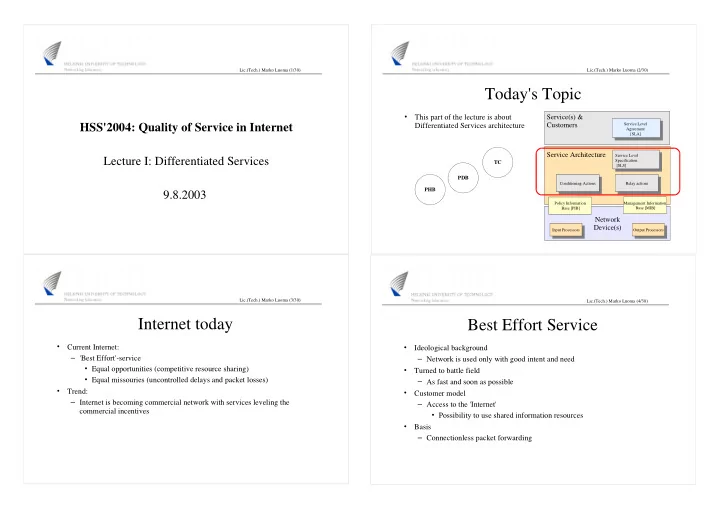
Lic.(Tech.) Marko Luoma (1/30) Lic.(Tech.) Marko Luoma (2/30) Today's Topic This part of the lecture is about Service(s) & HSS'2004: Quality of Service in Internet Differentiated Services architecture Customers Service Level


slide-1
SLIDE 1

Lic.(Tech.) Marko Luoma (1/30)

HSS'2004: Quality of Service in Internet Lecture I: Differentiated Services 9.8.2003

Lic.(Tech.) Marko Luoma (2/30)

Today's Topic

  • This part of the lecture is about

Differentiated Services architecture

Network Device(s) Service Architecture

Management Information Base [MIB] Policy Information Base [PIB] Relay actions Conditioning Actions Service Level Specification [SLS]

Service(s) & Customers

Service Level Agreement [SLA] Input Processors Output Processors

PHB PDB TC

Lic.(Tech.) Marko Luoma (3/30)

Internet today

  • Current Internet:

'Best Effort'-service Equal opportunities (competitive resource sharing) Equal missouries (uncontrolled delays and packet losses)

  • Trend:

Internet is becoming commercial network with services leveling the commercial incentives

Lic.(Tech.) Marko Luoma (4/30)

Best Effort Service

  • Ideological background

Network is used only with good intent and need

  • Turned to battle field

As fast and soon as possible

  • Customer model

Access to the 'Internet' Possibility to use shared information resources

  • Basis

Connectionless packet forwarding

slide-2
SLIDE 2

Lic.(Tech.) Marko Luoma (5/30)

Best Effort Router

  • Packets are forwarded based on their

destination address

  • Scheduling and queueing

FCFS

  • Equal treatment

Routing Forwarder Scheduler Control Plane User Plane

Lic.(Tech.) Marko Luoma (6/30)

Differentiated Services

Differentiated Services Policy Control Admission Control Queue Management Application demands Scheduling Service Models

  • Is combination of mechanisms presented

in last wednesday

  • Physically, nothing more than Best Effort
  • Logically, number of parallel Best Effort

networks

  • Packet is destined to one of the parallel

networks Packet per packet processed quality

  • f service

Connectionless architecture is still preserved

  • Each parallel network uses same routing

topology (not neccesarily)

Lic.(Tech.) Marko Luoma (7/30)

Differentiated Services

  • Identification of which parallel best

effor network packet is destined, is coded in each packet IPv4 ToS field is reformatted No routing nor precedence Generic class identifier

Versio Hlen TOS Length Flags Protocol Offset Ident Checksum TTL SourceAddr DestinationAddr Options (variable) PAD Prec. TOS DSCP CU

Lic.(Tech.) Marko Luoma (8/30)

DiffServ Router

  • Packets are forwarded based on the

destination address and class information

  • Scheduling and queueing is done

based on the class information

Routing Policy Control Classifier Scheduler Control Plane User Plane Forwarder

slide-3
SLIDE 3

Lic.(Tech.) Marko Luoma (9/30)

DiffServ Router

  • DiffServ router has one additional

element in datapath compared to basic Best Effort router: Conditioner

  • Control plane of a DiffServ router

has one extra element ie policy controller, which is responsible of internal management and configuration of conditioner and scheduler

Routing Policy Control Conditioner Scheduler Control Plane User Plane Forwarder

Lic.(Tech.) Marko Luoma (10/30)

DiffServ Conditioner

  • Traffic Conditioner is constructed a

set of Classifiers Responsible of logical separation of packet streams Meters Responsible of rate metering

  • f logical streams

Markers Responsible of actions based

  • n metering results and

predefined thresholds

BA classifier BA Metering Marking Shaping Dropping BA Marking MF classifier FA Metering Marking Shaping Dropping FA Marking FA Conditioning

1:N FA

BA Conditioning

1:M BA

Traffic Conditioning Block [TCB]

Lic.(Tech.) Marko Luoma (11/30)

DiffServ PHB

  • Per hop behavior is block which

contains queue management methods required to implement desired service Queues Queue space management algorithms Schedulers

AF1 AF2 AF21 AF22 AF23 AF11 AF12 AF13 EF PHB

MaxQSIZE MaxOUT MinOUT MaxP[OUT] 1 Pdrop AVG MaxP[IN] MinIN MaxIN

Lic.(Tech.) Marko Luoma (12/30)

DiffServ terminology

  • Workload in DiffServ is divided

between two inherently different types of routers Edge routes Core routers

  • Edge routers are on the domain edge

interfacing Customer Other ISP

  • Edge routers are responsible of

conditioning actions which eventually determine the logical network where packet is to be forwarded

Operator 1 Operator 2 DS Access router DS Core router DS border router

slide-4
SLIDE 4

Lic.(Tech.) Marko Luoma (13/30)

DiffServ terminology

  • Logical network is concatenation of PHBs which interact together.
  • These logical networks have target service called per domain behavior (PDB).
  • Target service is loose definition for the goal of the logical network when it is

provisioned and configured in a predefined way.

  • Edge router chooses PDB for each packet which comes from the customer

Marks packet with DSCP of PHB used to implement PDB

Lic.(Tech.) Marko Luoma (14/30)

DiffServ

  • Service decission in edge router can

be based on: Metering result Rate based Predefined set of filters IP address ie customer TCP/UDP port ie application User request Precoded DSCP RSVP signaling

  • Core routers do nothing but

forwarding of packets based on the extra information in DSCP field of packets

  • Requires

Classifier to detect DSCP fields PHB to implement forwarding behaviors

Lic.(Tech.) Marko Luoma (15/30)

Service classes

  • Differentiated Services is alligned

between Best Effort and IntServ

  • There is counterpart for each IntServ

service class in DiffServ Guaranteed Service <-> Expedited Service Controlled Load <-> Assured Forwarding

Variability

  • f SLA

Guarantee

  • f QoS

Static Dynamic Per Connection Strict Relative Firm EF Loose EF + BB AF + BB AF BE IntServ GS IntServ CL Poorly provisioned AF Poorly provisioned EF

Lic.(Tech.) Marko Luoma (16/30)

Expedited Forwarding (EF) [RFC2598]

  • Leased line emulation

From destined ingress point to destined egress point End-to-end service with Low loss Low latency Low jitter Assured bandwidth

Ingress point Egress point

slide-5
SLIDE 5

Lic.(Tech.) Marko Luoma (17/30)

EF

  • Service commitment is only assured

Resources inside EF class are shared Amount of other EF traffic influences to the value of delay, jitter and loss Path is freely chosen Delay constraint can not be held as the delay of paths are inherently different No reservation is done Provisioning is in the key role

Lic.(Tech.) Marko Luoma (18/30)

EF

  • Leased Line

Dedicated resources Full isolation No room for overflow

  • Virtual Leased Line

Shared resources Partial isolation From other than leased line traffic Can accommodate overflow Vague service guarantee

  • Control of service guarantee

Access control Rate control User control Provisioning At least sum of contracted rates is allocated to EF traffic High priority in the network Scheduled ahead of other traffic Starvation of lower priorities ? Only small fraction of total link capacity (10-30%)

Lic.(Tech.) Marko Luoma (19/30)

Assured Forwarding (AF) [RFC2597]

  • Four independent service classes

All packets of a flow are destined to one of the classes No association of service level between the classes

  • Three precedences in each class

Flow can have packets with different precedences Order of packets in al flow is not allowed to change Precedence can not be used to scheduling decissions inside the class

AF11 AF21 AF31 AF41 AF12 AF13 AF22 AF23 AF32 AF33 AF42 AF43

Class Precedence Lic.(Tech.) Marko Luoma (20/30)

AF

  • No end-to-end semantics

Service can be deployed as any to any service Like today Uncontrollable resource usage inside the network Very vague QoS Class / precedence in contrast to service guarantee ???

AF11 AF21 AF31 AF41 AF12 AF13 AF22 AF23 AF32 AF33 AF42 AF43

Class Precedence -> drop probability

What is the differentiation ?

slide-6
SLIDE 6

Lic.(Tech.) Marko Luoma (21/30)

AF

  • Class differentiation

Associate timing Real-time to Bulk Associate money First class to cattle class Associate user CEO to laundry man Associate protocol TCP / UDP Associate application Clustering of similar application types

  • Precende differentiation

Associate rate Under/over subscription The rest same as class based exept timing can not be used

Lic.(Tech.) Marko Luoma (22/30)

AF

  • Construct services based on previous aspects

Many dimensions of freedom How to make sure that system can not be manipulated User control vs Network control

Lic.(Tech.) Marko Luoma (23/30)

Best- Effort Service Differentiated Service Integrated Service Connectionless Connection- oriented Agregated state Local session state1 End2End session state Session signaling [RSVP] Admission control Leaky- bucket traffic control Per- flow QoS CoS Per- class and/or per- flow WFQ Per- class WFQ2

1 Border routers may keep track individual sessions if required by policing or multifield classification. 2 Scheduling depends on per hop behavior [PHB]. Minimum requirement is FIFO with multilevel RED.

Lic.(Tech.) Marko Luoma (24/30)

Based on previous

  • Based on previous

Only way the DiffServ brings something new of valuable is that traffic within the network is well engineered i.e. traffic types sharing common buffer needs to be with similar requirements Only way to achieve this is to let the network to do classification and differentiation Users are not, at large, well enough educated to make wise choices for the service classes Or they try to exploit some resource with malicious intent

slide-7
SLIDE 7

Lic.(Tech.) Marko Luoma (25/30)

Best Effort semantics

  • Best Effort -service

All packets are treated equally Forwarding is based on the destination address Packets are queued into single FIFO queue During the time of congestion packets are dropped From the tail of the queue When there is no space in the queue When agerage queue length goes above threshold Access to the network is sold to the customers

Lic.(Tech.) Marko Luoma (26/30)

Differentiated Services semantics

  • Differentiated Services

Packets are differentiated to N parallel Best Effort networks Each parallel network operates like basic Best Effort network with the exeption that there can be priorities and other semantics associated to the service. 'QoS' based network service is sold to the customer

Lic.(Tech.) Marko Luoma (27/30)

EF semantics

  • 'End-to-end' service

Single domain end-to-end Quality is defined by two constrains: Provisioning Class should be provisioned with enough resources to handle worst case aggregate Sharing No resource reservation for individual flows. Under and overflows possible Timing and delays can not be held or guaranteed

Lic.(Tech.) Marko Luoma (28/30)

AF semantics

  • No end-to-end semantics

Service can be deployed Point-to-point Any-to-any Uncontrollable resource usage inside the network Problem of commons

AF11 AF21 AF31 AF41 AF12 AF13 AF22 AF23 AF32 AF33 AF42 AF43

Class Precedence -> drop probability

slide-8
SLIDE 8

Lic.(Tech.) Marko Luoma (29/30)

What a customer wants ...

  • Lets face the music

Customer is only interested in the perceived quality How things are rolling compared Minute ago Year ago Customer is not interested in the novel technology which is behind the service This means end-to-end service quality

Lic.(Tech.) Marko Luoma (30/30)

End-to-end service

  • What prohibits ???

Structure of DiffServ is based on local control (policies) Classification based on the policies at the edge of the network Forwarding based on the policies in the core of the network We can stretch through single domain (ISP) with EF We may stretch through single domain (ISP) with AF

  • End-to-end

Is not within single ISP It is between source and destination