To Prone Summary (or not) John Turnbull, MD & Jeff Gotts, MD - - PDF document

to prone
SMART_READER_LITE
LIVE PREVIEW

To Prone Summary (or not) John Turnbull, MD & Jeff Gotts, MD - - PDF document

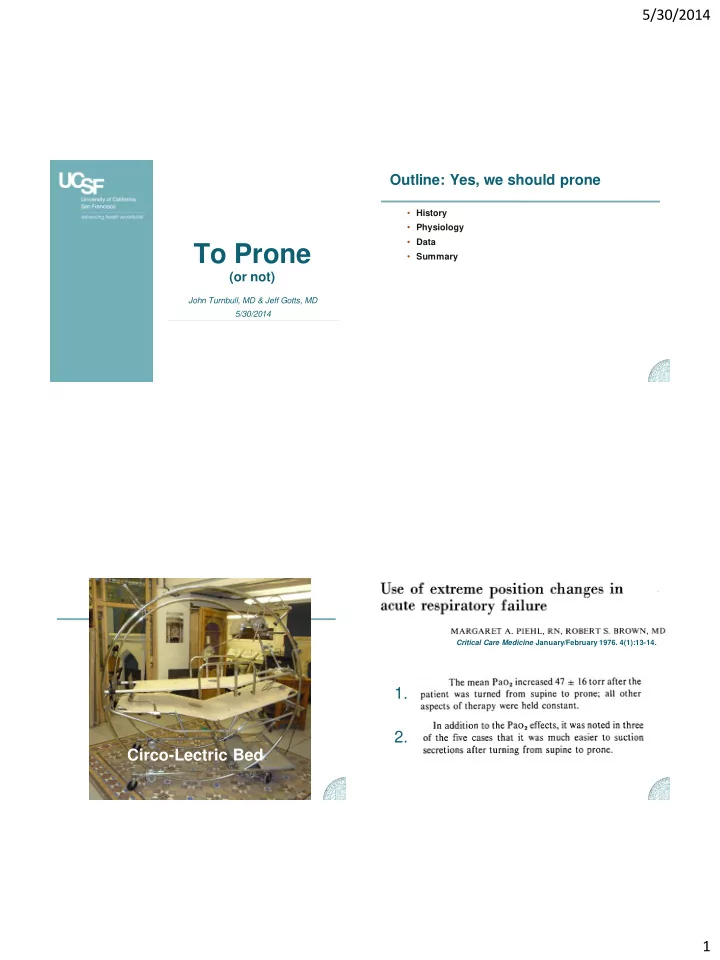
5/30/2014 Outline: Yes, we should prone History Physiology Data To Prone Summary (or not) John Turnbull, MD & Jeff Gotts, MD 5/30/2014 Critical Care Medicine January/February 1976. 4(1):13-14 . 1. 2. Circo-Lectric Bed 1


slide-1
SLIDE 1

5/30/2014 1

John Turnbull, MD & Jeff Gotts, MD 5/30/2014

To Prone

(or not)

  • History
  • Physiology
  • Data
  • Summary

Outline: Yes, we should prone

Circo-Lectric Bed 1. 2.

Critical Care Medicine January/February 1976. 4(1):13-14.

slide-2
SLIDE 2

5/30/2014 2

  • Early papers had little impact on the critical care community
  • Mid 1980s: CT scans of patients with ARDS showed

extensive areas of dorsal consolidation; compliance proportional to ventral aerated lung “baby lung”

  • Late 1980s, proning to redistribute blood to this small

ventral aerated lung, and oxygenation improved.

  • Model changed by an important study in 1991

Proning in ARDS: History

  • Anesthesiology. 1991;74(1):15-23.

Lung’s Natural Shape Adapts to Thorax No Gravity Add in Gravity SUPINE PRONE

Gattinoni L, Taccone P, Carlesso E, Marini JJ. Prone position in acute respiratory distress syndrome. Rationale, indications, and limits. Am J Respir Crit Care Med. 2013;188(11):1286-1293.

  • Blood flow distribution does not change much
  • Oxygenation improves because recruitment/aeration of

perfused dorsal lung > ventral de-recruitment

  • More even distribution of transpulmonary pressure

– May improve PEEP’s ability to recruit without hyperinflation

  • Cardiac compression, lymphatic drainage improved
  • Secretions drain from dorsal lung toward trachea (less

contamination of healthy lung)

Proning in ARDS: Physiology
slide-3
SLIDE 3

5/30/2014 3

Proning in ARDS: Clinical Trials

  • 466 ARDS patients (<36 hrs) P/F <150 on 0.6/5, 27 prone-

experienced ICUs

  • Strict 6 cc/kg, prone positioning >16 consectutive hrs (avg

17); 91% prone group paralyzed vs. 82% supine

  • Primary outcome: 28 day mortality

Proning in ARDS: Proseva/Guerin

  • Secondary outcomes: 90 day mortality (21% vs. 41%, NNT

6), more cardiac arrests in supine group, no difference ICU LOS

  • Better oxygenation, more VFDs in prone group

Proning in ARDS: Proseva/Guerin Proning in ARDS: Outlier study?

slide-4
SLIDE 4

5/30/2014 4

Beitler JR, Shaefi S, Montesi SB, et al. Prone positioning reduces mortality from acute respiratory distress syndrome in the low tidal volume era: a meta-analysis. Intensive Care Med. 2014;40(3):332- 341. Beitler JR, Shaefi S, Montesi SB, et al. Prone positioning reduces mortality from acute respiratory distress syndrome in the low tidal volume era: a meta-analysis. Intensive Care Med. 2014;40(3):332- 341.

  • Prone ventilation for ARDS has been used for over 30 years;

many centers are expert in the technique

  • It has a solid physiologic rationale
  • Strong clinical data now support early proning in patients

with severe ARDS – In centers experienced with proning patients – When strictly compliant with low tidal volume ventilation – And encouragement of early use of paralytics

Summary

slide-5
SLIDE 5

5/30/2014 5

slide-6
SLIDE 6

5/30/2014 6

What we really need is an Anti-Gravity Device