To promote understanding of Central American history and literature - - PowerPoint PPT Presentation

to promote understanding of central american history and
SMART_READER_LITE
LIVE PREVIEW

To promote understanding of Central American history and literature - - PowerPoint PPT Presentation

Central American History and Literature To promote understanding of Central American history and literature during Latino Heritage Month and all year long. TeachingforChange.org Put Central America on the map! TeachingforChange.org Country

slide-1
SLIDE 1

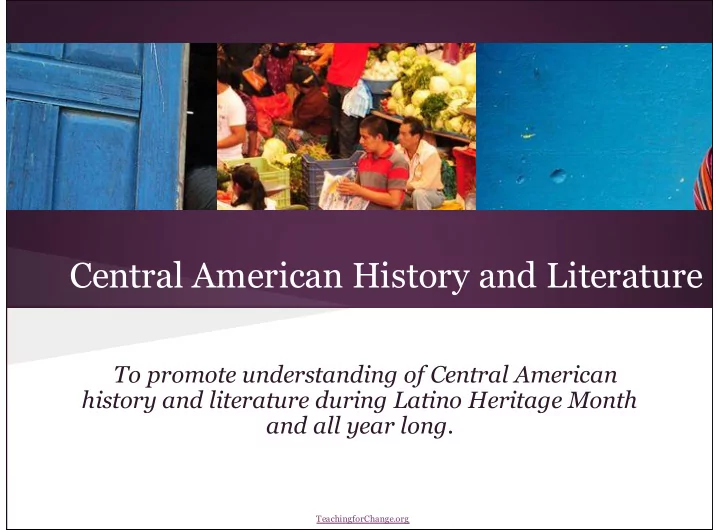
Central American History and Literature

To promote understanding of Central American history and literature during Latino Heritage Month and all year long.

TeachingforChange.org

slide-2
SLIDE 2

Put Central America on the map!

TeachingforChange.org

slide-3
SLIDE 3

Country Focus: El Salvador

TeachingforChange.org

slide-4
SLIDE 4

TeachingforChange.org

slide-5
SLIDE 5

Archbishop Oscar Romero (1917-1980): El Salvador

  • Catholic religious leader known

as the "Voice of the Voiceless"

  • Advocated for the rights of the

poor and oppressed

  • Assassinated during mass by the

US-backed Salvadoran military

Biography Video clip from Romero

TeachingforChange.org

slide-6
SLIDE 6

Archbishop Oscar Romero (1917-1980): El Salvador

"What good are beautiful highways and airports, beautiful buildings full of spacious apartments, if they are only put together with the blood of the poor, who are not going to enjoy them?“

  • July 15, 1979 sermon

TeachingforChange.org

slide-7
SLIDE 7

Archbishop Oscar Romero: The Last Sermon (1980)

  • Preached "liberation theology," a

Catholic movement calling for equality and justice for all

  • Begged the National Guard to stop

killing civilians

  • Targeted by the government for

his advocacy of the poor

Full text of sermon Definition of Liberation Theology

TeachingforChange.org

slide-8
SLIDE 8

Farabundo Marti (1893-1932): El Salvador

  • Rebel leader who dropped out
  • f college in 1920 to fight against

the corrupt dictatorship

  • Founded the Communist Party
  • f Central America
  • Organized a peasant uprising in

1932 in which he was murdered by the Salvadoran military

Biography

TeachingforChange.org

slide-9
SLIDE 9

"We should all die proud of our sacred mission, of our struggle to free an enslaved people. Long live the International Red Aid! Long live the ideal [of communism] and the Communist International!"

  • 1931

Farabundo Marti (1893-1932): El Salvador

TeachingforChange.org

slide-10
SLIDE 10

Maria Serrano (b. 1950): El Salvador

  • Organized the poor against

the El Salvadoran government

  • Fought on the front lines

with the Farabundo Marti National Liberation Front (FMLN) during the civil war in the 1980s

TeachingforChange.org

slide-11
SLIDE 11

"To tell the truth you never get used to this war. One day you are planning an attack, the next day the army has you

  • n the run. But we won't be running
  • forever. One day I'll change these old

boots for a pair of lady's shoes." Maria Serrano (b. 1950): El Salvador

TeachingforChange.org

slide-12
SLIDE 12

Maria's Story: A Documentary Portrait Of Love and Survival in El Salvador's Civil War

  • A story of Maria Serrano’s daily

life on the front lines

  • Chronicles her struggles

balancing both family and the war

  • Includes scenes from within the

FMLN guerrilla camps

Clip from the movie Link to documentary

TeachingforChange.org

slide-13
SLIDE 13

Manlio Argueta (b. 1935): El Salvador

  • Exposed the military-led

government's human rights violations during the civil war

  • Exiled for twenty years for his

revolutionary writing

  • Currently the director of the

National Library of El Salvador

Biography Excerpt from "The Export of Colors"

TeachingforChange.org

slide-14
SLIDE 14

"The problem lies in our awareness. The awareness we will have. Then life will become as clear as spring water...The problems can't be solved by a single person but only by all of us working together, the

  • humble. The clear headed ones."
  • One Day of Life, 1980

Manlio Argueta (b. 1935): El Salvador

TeachingforChange.org

slide-15
SLIDE 15

Manlio Argueta: One Day of Life

  • Historical fiction told through the

voice of a female peasant during the civil war

  • Highlights the role of the church

and military

  • Banned during the civil war

(1979-1992)

  • Won international award in 2005

One Day of Life information

TeachingforChange.org

slide-16
SLIDE 16

Roque Dalton (1935-1975): El Salvador

  • Radical poet and journalist
  • Arrested in 1959, 1960 and 1965

for Communist Party membership

  • Escaped jail in 1965 and lived in

exile for 8 years, then returned to continue fighting injustice

  • Assassinated by a rebel group

Biography

TeachingforChange.org

slide-17
SLIDE 17

"Laws are created to be followed by the poor. Laws are made by the rich to bring some order to exploitation. The poor are the only law abiders in history. When the poor make laws the rich will be no more."

  • 1974

Roque Dalton (1935-1975): El Salvador

TeachingforChange.org

slide-18
SLIDE 18

Roque Dalton: Poemas Clandestinos

  • Returned from exile in 1973 in

disguise

  • Joined the Revolutionary Army of

the People (ERP) as a soldier-poet

  • During the fight, he secretly wrote

the Clandestine Poems, a criticism

  • f the government

PDF of the poems

TeachingforChange.org

slide-19
SLIDE 19

Claribel Alegría (b. 1924): El Salvador

  • Poet, novelist and translator
  • Wrote to expose economic, social

and gender injustice to advocate for nonviolent resistance

  • Born in Nicaragua, grew up in El

Salvador, exiled in the 1980s Biography

Link to poem "Tamales from Cambray"

TeachingforChange.org

slide-20
SLIDE 20

"It's very difficult sometimes to reconcile art and reality, but I have never thought that the poet had to be in an ivory tower just thinking beautiful thoughts. When there is so much horror around you, I think you have to look at it. You have to feel it and suffer with the others and make that suffering yours."

  • 1995

Claribel Alegría (b. 1924): El Salvador

TeachingforChange.org

slide-21
SLIDE 21

Claribel Alegría: Ashes of Izalco

  • Exposed the massacre in 1932
  • f 30,000 peasants in the city
  • f Izalco, El Salvador
  • Portrayed a love story

between a Salvadoran woman and a man from the US based

  • n her own marriage

TeachingforChange.org

slide-22
SLIDE 22

Country Focus: Guatemala

TeachingforChange.org

slide-23
SLIDE 23

TeachingforChange.org

slide-24
SLIDE 24

TeachingforChange.org

slide-25
SLIDE 25

Otto René Castillo (1934-1967): Guatemala

  • Poet and revolutionary
  • Exiled for 12 years
  • Chief of Propaganda and

Education for Revolutionary Armed Forces, the leftist guerrilla army

  • Captured, tortured and murdered

by the Guatemalan government Biography

TeachingforChange.org

slide-26
SLIDE 26

"You have a gun and I am hungry You have a gun because I am hungry You have a gun therefore I am hungry You can have a gun You can have a thousand bullets and even another thousand You can waste them all on my poor body You can kill me one, two, three, two thousand, seven thousand times But in the long run I will always be better armed than you if you have a gun and I only hunger."

Otto René Castillo (1934-1967): Guatemala

TeachingforChange.org

slide-27
SLIDE 27

Otto René Castillo: Tomorrow Triumphant

  • Urged the moral necessity

for peasant revolution

  • Graphically exposed the

government imposed massacres and corruption

Poem: Tomorrow Triumphant

TeachingforChange.org

slide-28
SLIDE 28

Rigoberta Menchú (b. 1959): Guatemala

  • Quiche Mayan grassroots organizer for

women’s and labor rights

  • Inspired by her parents
  • Family murdered by the Guatemalan

army

  • Fought with rebels during the civil war
  • Won the Nobel Peace Prize for her

work advocating indigenous rights Biography

Interview with Rigoberta

TeachingforChange.org

slide-29
SLIDE 29

“My mother decided to travel...to attest to what she had seen [in Guatemala]. She said ‘As a woman it is my duty to tell my story so that other mothers don’t have to suffer like me, so that they don’t have to witness the torture and assassination of one of their children.’ ...My little sister, who was nine years old, said she was going to join the guerrillas, so that she wouldn’t die of hunger, nor wait to be killed by the troops”

Rigoberta Menchú (b. 1959): Guatemala

TeachingforChange.org

slide-30
SLIDE 30

Her book: I, Rigoberta Menchú

  • Global bestseller
  • Exposes the daily injustices of

peasants and indigenous people in Guatemala

  • Calls for universal human

rights

Quote from the first page

TeachingforChange.org

slide-31
SLIDE 31

Humberto Ak'abal (b. 1952): Guatemala

  • Mayan poet who writes in his

native tongue K’iche and Spanish

  • Wrote about the

marginalization of indigenous people Biography

TeachingforChange.org

slide-32
SLIDE 32

“Yesterday, the burial, today the whitewashing

  • f the house. If he returns he will no longer

find his way. The whiteness of the limewash, in the light of the moon, blinds the eyes of the dead”

Humberto Ak'abal (b. 1952): Guatemala

TeachingforChange.org

slide-33
SLIDE 33

Humberto Ak'abal: Drum of Stone

  • Offered a window into

Mayan culture

  • Critics found his poems

concise but profound

  • Themes include nature,

love, language, community, and politics Selection from the book

TeachingforChange.org

slide-34
SLIDE 34

Country Focus: Nicaragua

TeachingforChange.org

slide-35
SLIDE 35

TeachingforChange.org

slide-36
SLIDE 36
  • Revolutionary leader
  • Worked at a Mexican oil

company and was inspired by the labor unions’ advocacy for social equality

  • Led a rebellion against U.S.

military occupation Biography

Augusto César Sandino (1895-1934): Nicaragua

TeachingforChange.org

slide-37
SLIDE 37

“To change an oppressive social system, the only need is the existence of a man with a minimum of dignity."

Augusto César Sandino (1895-1934): Nicaragua

TeachingforChange.org

slide-38
SLIDE 38

Sergio Ramírez (b. 1942): Nicaragua

  • Political professor and

journalist

  • Leader against the Somoza

government

  • Vice President of Nicaragua

from 1984-1990 Biography

Interview with him about Nicaragua

TeachingforChange.org

slide-39
SLIDE 39

Sergio Ramírez: Adios Muchachos

  • Insider’s account of the

Sandinista revolution

  • Includes Somoza

dictatorship, war with the United States, and the Sandinista movement

Detailed description

TeachingforChange.org

slide-40
SLIDE 40

Gioconda Belli (b. 1948): Nicaragua

  • Poet, writer, and political

critic

  • Involved in the underground

resistance movement in Nicaragua from 1970-1975

  • Held government positions in

communications, journalism, and public relations Biography

TeachingforChange.org

slide-41
SLIDE 41

“Who are we? Who are these men, these women without language, scorned for their color for their skins, their feathers, and their adornments? So we would not read other than their sacred writings They burned ours in bonfires Our history, our poetry, the records of our people... They burned our writings, carefully painted by the scribes They burned the history that made us who we were.”

Gioconda Belli (b. 1948): Nicaragua

TeachingforChange.org

slide-42
SLIDE 42

Gioconda Belli: The Country Under My Skin

  • A personal narrative about her

journey from the upper class to the Sandinista revolution

  • Reflection of the social

inequalities underlying the revolution

Interview about the memoir

TeachingforChange.org

slide-43
SLIDE 43

Ernesto Cardenal (b. 1925): Nicaragua

  • Catholic priest, FSLN member,

and world-renowned poet

  • Created a community of artists

in the Solentiname Islands which originated the primitivist style of painting

  • Nicaraguan Minister of Culture

Biography

TeachingforChange.org

slide-44
SLIDE 44

“You can't be with God and be neutral. True contemplation is resistance. And poetry, gazing at clouds is resistance I found out in jail."

  • 1981

Ernesto Cardenal (b. 1925): Nicaragua

TeachingforChange.org

slide-45
SLIDE 45

Ernesto Cardenal: Zero Hour

  • A call for social justice,

deriving inspiration from biblical stories

  • Focus on politics,

history, Christianity, and indigenous peoples

TeachingforChange.org

slide-46
SLIDE 46

Rubén Darío (1867-1916): Nicaragua

  • Poet, first published at age 13
  • "Father of Modernism"- an

important Spanish-American literary movement

  • Read a poem to the Spanish

court in 1892 in protest of the conquest on the 400th anniversary

Biography

TeachingforChange.org

slide-47
SLIDE 47

“Would to God that these waters, once untouched, had never mirrored the white of Spanish sails, and that the astonished stars had never seen those caravels arriving at

  • ur shores!...

Evil mischance has placed afflictions, horrors, wars, and unending fevers in our way: Oh Christopher Columbus, unfortunate admiral, pray to God for the world you discovered!”

  • From poem read to Spanish court

Rubén Darío (1867-1916): Nicaragua

TeachingforChange.org

slide-48
SLIDE 48

Rubén Darío : Azul

  • Book of short stories

and poetry

  • Uses strong vowel

sounds contrary to the typical Spanish style of poetry

  • Themes include

suffering, love, art, and Christianity

TeachingforChange.org

slide-49
SLIDE 49

Carlos Mejia Godoy (b. 1943): Nicaragua

  • Folk musician committed to

social justice

  • Wrote political lyrics with a

sense of humor

  • Many of his songs were

written to inspire the liberation movement

Biography

TeachingforChange.org

slide-50
SLIDE 50

“If they take away our bread, we will be

  • bliged to survive as our grandparents did—

with corn fermented in the blood of our heros.”

Carlos Mejia Godoy (b. 1943): Nicaragua

TeachingforChange.org

slide-51
SLIDE 51

Song: Nicaragua, Nicaraguita

Video Managua, Nicaragua

TeachingforChange.org

slide-52
SLIDE 52

THE END

for more resources please visit www.teachingforchange.org compiled by Liz Behrens (University of Chicago Human Rights Fellow) and Teaching for Change staff

TeachingforChange.org