
SLIDE 1
1
Tirgul 6
B-Trees – Another kind of balanced trees Some notes regarding Home Work
Motivation
- Primary memory (RAM) : very fast, but costly
Secondary storage (disk) : very cheap, but slow
- Problem: a large D.B. must reside partially on disk. But disk
- perations are very slow.
- Solution: take advantage of important disk property -Basic
read/write unit is a page (2-4 Kb) - can’t read/write less.
- Thus when analyzing D.B. performance, we consider two
different measures: CPU time and number of times we need to access the disk.
- Besides, B-trees are an interesting type of balanced trees...
B-Trees
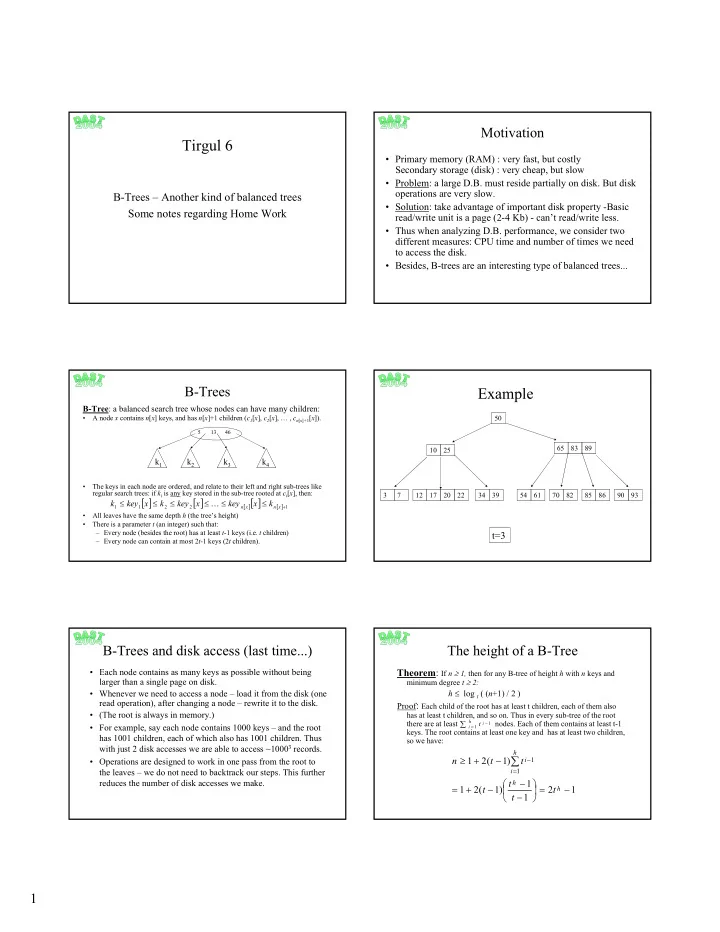
B-Tree: a balanced search tree whose nodes can have many children:
- A node x contains n[x] keys, and has n[x]+1 children (c1[x], c2[x], … , cn[x]+1[x]).
- The keys in each node are ordered, and relate to their left and right sub-trees like
regular search trees: if ki is any key stored in the sub-tree rooted at ci[x], then:
- All leaves have the same depth h (the tree’s height)
- There is a parameter t (an integer) such that:
– Every node (besides the root) has at least t-1 keys (i.e. t children) – Every node can contain at most 2t-1 keys (2t children).
[ ] [ ]
[ ][ ] [ ] 1
2 2 1 1 +
≤ ≤ ≤ ≤ ≤ ≤
x n x n
k x key x key k x key k K
5 13 46
k1 k2 k3 k4
Example
50 25 10 89 83 65 7 3 39 34 82 70 86 85 61 54 93 90 22 20 17 12
t=3
B-Trees and disk access (last time...)
- Each node contains as many keys as possible without being
larger than a single page on disk.
- Whenever we need to access a node – load it from the disk (one
read operation), after changing a node – rewrite it to the disk.
- (The root is always in memory.)
- For example, say each node contains 1000 keys – and the root
has 1001 children, each of which also has 1001 children. Thus with just 2 disk accesses we are able to access ~10003 records.
- Operations are designed to work in one pass from the root to
the leaves – we do not need to backtrack our steps. This further reduces the number of disk accesses we make.
The height of a B-Tree
Theorem: If n ≥ 1, then for any B-tree of height h with n keys and
minimum degree t ≥ 2:
h ≤ log t ( (n+1) / 2 ) Proof: Each child of the root has at least t children, each of them also
has at least t children, and so on. Thus in every sub-tree of the root there are at least nodes. Each of them contains at least t-1
- keys. The root contains at least one key and has at least two children,
so we have:
1 2 1 1 ) 1 ( 2 1 ) 1 ( 2 1
1 1
− = − − − + = − + ≥
∑
= − h h h i i
t t t t t t n
∑
= − h i i
t
1 1