Tirgul 2 Asymptotic Analysis Asymptotic Analysis Motivation: - - PDF document

tirgul 2
SMART_READER_LITE
LIVE PREVIEW

Tirgul 2 Asymptotic Analysis Asymptotic Analysis Motivation: - - PDF document

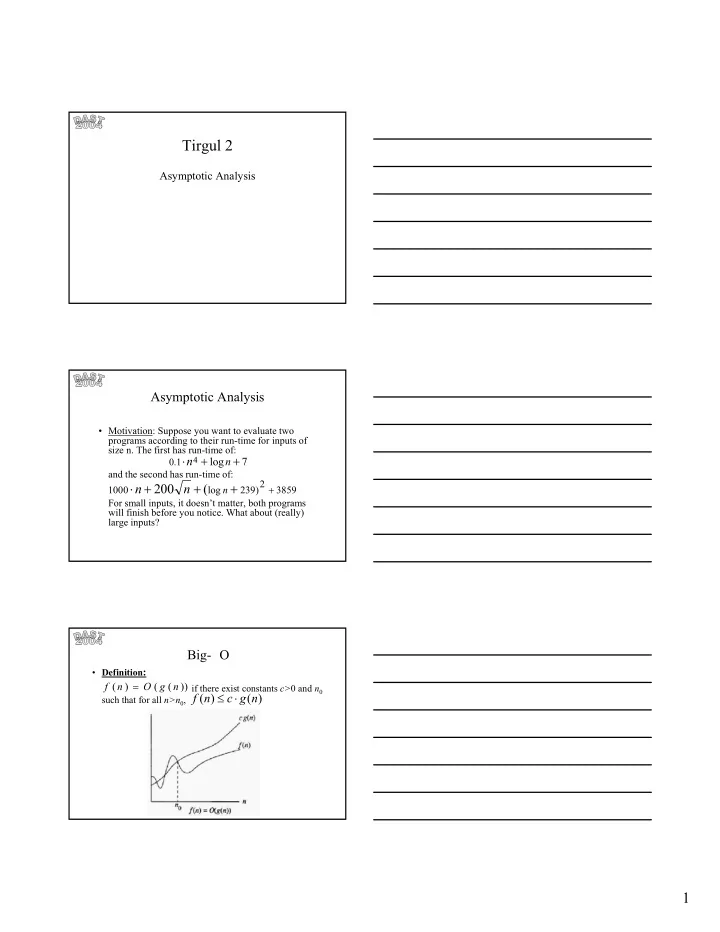
Tirgul 2 Asymptotic Analysis Asymptotic Analysis Motivation: Suppose you want to evaluate two programs according to their run-time for inputs of size n. The first has run-time of: + + n 4 0 . 1 log n 7 and the second has


slide-1
SLIDE 1

1 Tirgul 2

Asymptotic Analysis

Asymptotic Analysis

  • Motivation: Suppose you want to evaluate two

programs according to their run-time for inputs of size n. The first has run-time of: and the second has run-time of: For small inputs, it doesn’t matter, both programs will finish before you notice. What about (really) large inputs?

7 log

4

1 .

+ + ⋅

n

n

3859 2 ) 239 log 1000

( 200

+

+ + + ⋅

n

n n Big

  • O
  • Definition:

if there exist constants c>0 and n0 such that for all n>n0,

)) ( ( ) ( n g O n f =

) ( ) ( n g c n f ⋅ ≤

slide-2
SLIDE 2

2

Big

  • O
  • In other words, g(n) bounds f(n) from above (for

large n’s) up to a constant.

  • Examples:

why?) ( ) ( ) 5 ) ( ) 4 ) ( 10000 ) 3 ) ( 5 . ) 2 ) 1 ( 1000000 ) 1

2 2

n O n n O n n O n n O n O ≠ = = = =

Big

  • Omega
  • Definition:

if there exist constants c>0 and n0 such that for all n>n0,

)) ( ( ) ( n g n f Ω =

) ( ) ( n g c n f ⋅ ≥ Big

  • Omega
  • In other words, g(n) bounds f(n) from below (for large

n’s) up to a constant.

  • Examples:

) ( ) 4 ) ( ) 3 ) ( 10000 ) 2 ) ( 5 . ) 1

2 2

n n n n n n n n Ω ≠ Ω = Ω = Ω =

slide-3
SLIDE 3

3

Big

  • Theta
  • Definition:

if: and

  • This means there exist constants , and

such that for all ,

)) ( ( ) ( n g n f Ω = )) ( ( ) ( n g n f Θ = )) ( ( ) ( n g O n f =

1

c >

2

c > n n n >

( ) ( ) ( )

1 2

c g n f n c g n ≤ ⋅ ≤ ≤ ⋅

Big

  • Theta
  • In other words, g(n) is a tight estimate of f(n) (in

asymptotic terms).

  • Examples:

) ( ) 3 ) ( ) 2 ) ( 5 . ) 1

2 2

n n n n n n Θ ≠ Θ ≠ Θ =

Example 1

Question: is the following claim true? Claim: For all f, (for large enough n, i.e. n > n0) Answer : No. Proof : Look at f(n) = 1/n. Given c and n0, choose n large enough so n>n0 and 1/n < c. For this n, it holds that (f(n))2 = 1/n2 = 1/n * 1/n < c * 1/n. = c*f(n)

) ( ) (

)) ( (

2

n f

O n f =

slide-4
SLIDE 4

4

Example 1

(question 2-4-e. in Cormen)

Question: is the following claim true? Claim: If (for n>n0) then Answer: Yes. Proof: Take . Thus for n>n0,

) ( ) (

)) ( (

2

n f

O n f =

) ( > ≥α n f

α / 1 = c

)) ( (

2

) ( ) ( 1 ) ( 1 ) (

n f

c n f n f n f n f ⋅ = ⋅ ⋅ ≤ ⋅ ⋅ = α α α

Example 2

(question 2-4-d. in Cormen)

Does f(n) = O(g(n)) imply 2f(n) = O(2g(n))? Answer: No. Proof : Look at, f(n) = 2n, g(n)=n, Clearly f(n)=O(g(n)) (look at c=2 n0=1). However, given c and n0, choose n for which n > n0 and 2n > c, and then : f(n) = 22n = 2n * 2n > c * 2n = c * g(n)

Summations

(from Cormen, ex. 3.2-2., page 52)

Find the asymptotic upper bound of the sum

  • note how we “got rid” of the integer rounding
  • The first term is n so the sum is also
  • Note that the largest item dominates the growth of the term

in an exponential decrease/increase.

 

       

) ( 2 log 1 2 / 1 ) 1 (log 2 / 1 ) 1 ) 2 / (( 2 /

log log log log

n O n n n n n n n

k k n k k n k k n k n k k

= + + = + + ≤ ≤ + ≤ + ≤

∑ ∑ ∑ ∑ ∑

∞ = = = = =

log

/ 2

n k k

n

    =

   

( )

/1 / 2 / 4 /8 ... 1 n n n n + + + + +                    

) ( n Ω

slide-5
SLIDE 5

5

Summations (example 2)

(Cormen, ex. 3.1-a., page 52)

  • Find an asymptotic upper bound for the following expression:
  • (r is a constant) :

note that

  • Note that when a series increases polynomially the

upper bound would be the last element but with an exponent increased by one.

  • Is this bound tight?

=

=

n k r

k

n f

1

) (

) ( ... ) (

1 1

2 1 n n n n

r r r r r r

O n n f

+ + =

= ⋅ ≤ + + + =

) (

r r

n O n n ≠ ⋅

Example 2 (Cont.)

To prove a tight bound we should prove a lower bound that equals the upper bound. Watch the amazing upper half trick : Assume first, that n is even (i.e. n/2 is an integer) f(n) = 1r+2r+….+nr > (n/2)r+…+nr > (n/2)(n/2)r = (1/2)r+1 * nr+1 = c * nr+1 = Ω(nr+1) Technicality : n is not necessarily even. f(n) = 1r+2r+….+nr > ┌ n/2┐+ … + nr ≥ (n-1)/2 * (n/2)^r ≥ (n/2)r+1 = Ω( nr+1).

Example 2 (Cont.)

  • Thus: so our upper bound was

tight!

) ( ) (

1

nr

n f

+

Θ =

slide-6
SLIDE 6

6

Recurrences – Towers of Hanoi

  • The input of the problem is: s, t, m, k
  • The size of the input is k+3 ~ k (the number of disks).
  • Denote the size of the problem k=n.
  • Reminder:
  • What is the running time of the “Towers of Hanoi”?

H(s,t,m,k) { /* s - source, t – target, m – middle */ if (k > 1) { H(s,m,t,k-1) /* note the change, we move from the source to the middle */ moveDisk(s,t) H(m,t,s,k-1) } else { moveDisk(s,t) } }

Recurrences

  • Denote the run time of a recursive call to input with

size n as h(n)

  • H(s, m, t, k-1) takes h(k-1) time
  • moveDisk(s, t) takes h(1) time
  • H(m, t, s, k-1) takes h(k-1) time
  • We can express the running-time as a recurrence:

h(n) = 2h(n-1) + 1 h(1) = 1

  • How do we solve this ?
  • A method to solve recurrence is guess and prove by

induction.

Step 1: “guessing” the solution

h(n) = 2h(n-1) + 1 = 2[2h(n-2)+1] + 1 = 4h(n-2) + 3 = 4[2h(n-3)+1] + 3 = 8h(n-3) + 7

  • When repeating k times we get:

h(n)=2k h(n-k) + (2k - 1)

  • Now take k=n-1. We’ll get:

h(n) = 2n-1 h(n-(n-1)) + 2n-1 - 1 = 2n-1 + 2n-1 -1 =2n - 1

( )

2 2

2 2 2 1 h n = − + −

( )

3 3

2 3 2 1 h n = − + −

slide-7
SLIDE 7

7

Step 2: proving by induction

  • If we guessed right, it will be easy to prove by induction

that h(n)=2n - 1

  • For n=1 : h(1)= 2-1=1 (and indeed h(1)=1)
  • Suppose h(n-1) = 2n-1 - 1. Then,

h(n) = 2h(n-1) + 1 = 2(2n-1 - 1) + 1 = 2n -2 + 1 = 2n -1

  • So we conclude that: h(n) = O(2n)

Recursion Trees

  • For each level we write the time added due to this level. In

Hanoi, each recursive call adds one operation (plus the recursion). Thus the total is:

1 h(n) 2 h(n-1) h(n-1) 4 h(n-2) h(n-2) h(n-2) h(n-2) i . . . 2 Height i

1

2 2

1

− =

− = n n i i

The recursion tree for the “towers of Hanoi”:

Another Example for Recurrence

  • And we get: T(n) = k T(n/k)+(k-1)

For k=n we get T(n)= n T(1)+n-1=2n-1 Now proving by induction is very simple. T(n) = 2T(n/2) + 1 = 2 (2T(n/4) + 1) + 1 = 4T(n/4) + 3 = 4 (2T(n/8) + 1) + 3 = 8T(n/8) + 7 T(n) = 2 T(n/2) + 1 T(1) = 1

slide-8
SLIDE 8

8

Another Example for Recurrence

  • Another way: “guess” right away T(n) <= c n - b (for some

b and c we don’t know yet), and try to prove by induction:

  • The base case:

For n=1: T(1)=c-b, which is true when c-b=1

  • The induction step:

Assume T(n/2)=c(n/2)-b and prove for T(n). T(n) <= 2 (c(n/2) - b) + 1 = c n - 2b + 1 <= c n - b (the last step is true if b>=1). Conclusion: T(n) = O(n)

Beware of common mistake!

Lets prove that 2n=O(n) (This is wrong) For n=1 it is true that 21 = 2 = O(1). Assume true for i, we will prove for i+1: f(i+1) = 2i+1 = 2*2i = 2*f(i) = 2*O(n) = O(n). What went Wrong? We can not use the O(f(n)) in the induction, the O notation is only short hand for the definition

  • itself. We should use the definition

Beware of common mistake!(cont)

If we try the trick using the exact definition, it fails. Assume 2n=O(n) then there exists c and n0 such that for all n > n0 it holds that 2n < c*n. The induction step : f(i+1) = 2i+1=2*2i ≤ 2*c*i but it is not true that 2*c*i ≤ c*(i+1).

slide-9
SLIDE 9

9

If we have time…….

The little o(f(n)) notation

Intuitively, f(n)=O(g(n)) means “f(n) does not grow much faster than g(n)”. We would also like to have a notation for “f(n) grows slower than g(n)”. The notation is f(n) = o(g(n)). (Note the o is little o).

Little o, definition

Formally, f(n)=O(g(n)), iff For every positive constant c, there exists an n0 Such that for all n > n0, it holds that f(n) < c* g(n). For example, n = o(n2), since, Given c>0, choose n0 > 1/c, then for n > n0 f(n) = n = c*1/c*n < c*n0*n < c*n2 = c*g(n).

slide-10
SLIDE 10

10 Little o cont’

However,, n ≠ o(n), since for the constant c=2 There is no n0 from which f(n) = n > 2*n.= c*g(n). Another example, = o(n), since, Given c>0, choose n0 for which > 1/c, then for n> n0 : f(n) = = c*1/c* < c* * < c* * = c*n n

n

n n

n

n n n