Tips for Dealing with Student Academic Dishonesty in the Classroom - - PDF document

tips for dealing with student academic dishonesty in the
SMART_READER_LITE
LIVE PREVIEW

Tips for Dealing with Student Academic Dishonesty in the Classroom - - PDF document

Tips for Dealing with Student Academic Dishonesty in the Classroom Created by the Academic Honesty Subcommittee of Academic Standards, Fall 2007 1) Take a proactive stance. Make students aware of the Colleges Academic Honesty Policy (AHP) and


slide-1
SLIDE 1

1

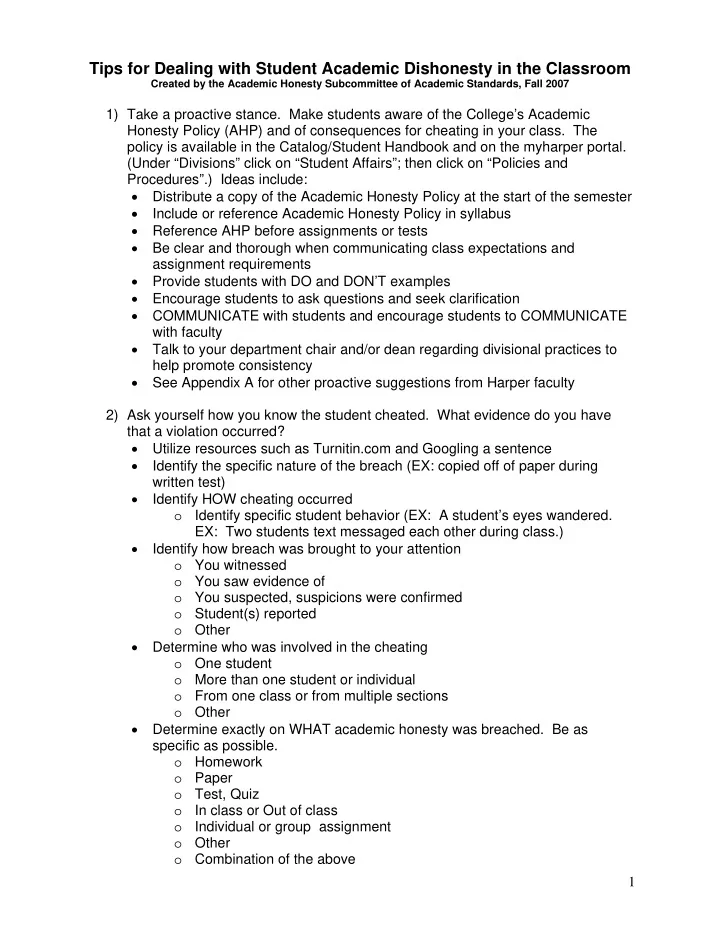
Tips for Dealing with Student Academic Dishonesty in the Classroom

Created by the Academic Honesty Subcommittee of Academic Standards, Fall 2007

1) Take a proactive stance. Make students aware of the College’s Academic Honesty Policy (AHP) and of consequences for cheating in your class. The policy is available in the Catalog/Student Handbook and on the myharper portal. (Under “Divisions” click on “Student Affairs”; then click on “Policies and Procedures”.) Ideas include:

  • Distribute a copy of the Academic Honesty Policy at the start of the semester
  • Include or reference Academic Honesty Policy in syllabus
  • Reference AHP before assignments or tests
  • Be clear and thorough when communicating class expectations and

assignment requirements

  • Provide students with DO and DON’T examples
  • Encourage students to ask questions and seek clarification
  • COMMUNICATE with students and encourage students to COMMUNICATE

with faculty

  • Talk to your department chair and/or dean regarding divisional practices to

help promote consistency

  • See Appendix A for other proactive suggestions from Harper faculty

2) Ask yourself how you know the student cheated. What evidence do you have that a violation occurred?

  • Utilize resources such as Turnitin.com and Googling a sentence
  • Identify the specific nature of the breach (EX: copied off of paper during

written test)

  • Identify HOW cheating occurred
  • Identify specific student behavior (EX: A student’s eyes wandered.

EX: Two students text messaged each other during class.)

  • Identify how breach was brought to your attention
  • You witnessed
  • You saw evidence of
  • You suspected, suspicions were confirmed
  • Student(s) reported
  • Other
  • Determine who was involved in the cheating
  • One student
  • More than one student or individual
  • From one class or from multiple sections
  • Other
  • Determine exactly on WHAT academic honesty was breached. Be as

specific as possible.

  • Homework
  • Paper
  • Test, Quiz
  • In class or Out of class
  • Individual or group assignment
  • Other
  • Combination of the above
slide-2
SLIDE 2

2 3) Consider options when determining sanctions / consequences to the cheater.

  • What does my syllabus say about consequences?
  • Is this the first occurrence in the class?
  • What was the student’s intent?
  • Is the student remorseful?
  • Is there an opportunity to make this an educational experience for the

student?

  • How have I handled similar situations in the past?
  • How have similar situations been handled by my department?
  • Consider impact of consequences
  • What is the short term impact of consequences to the cheater? To
  • thers?
  • What is the long term impact of consequences to the cheater? To
  • thers?
  • What are the consequences to the instructor?

To the department? To other faculty? Possible Consequences

(examples only; not intended to be all-inclusive)

Less Severe ________________________________________________More Severe

Verbal Warning Lower grade on assignment Lower grade in course* Redo assignment/test Fail assignment Fail course* Give an additional assignment/test Suggest student-initiated withdrawal from course * Note that per the Academic Honesty policy, “In cases of academic dishonesty, the faculty assigned grade supersedes a student- initiated withdrawal.”

4) Complete the Academic Honesty Form (on the myharper portal under “Divisions” click on “Student Affairs”; then click on “Policies and Procedures”) and communicate with the student.

  • Let the student know the outcome of your investigation and the

consequences you are imposing

  • Give the student an opportunity to explain his or her behavior if you have not

already done so

  • Provide the student with a copy of the Academic Honesty Form
  • Retain a copy of the Academic Honesty Form for your files
  • Send the original of the Academic Honesty Form to the Dean of Affairs
  • Office. Benefits of this are:
  • Centralized file created
  • Can catch repeat offenders
  • Ensures a consistent follow-up communication that informs parties of

rights/procedures such as the appeals process

  • May request that additional Student Code of Conduct charges be filed
slide-3
SLIDE 3

3 APPENDIX A The ideas below were adapted from Harper College Faculty responses to a 1999-2000 survey on academic honesty. PHYSICAL/ENVIRONMENTAL

  • 1. SEATING
  • Seat students every other seat or be sure seats are as far as possible apart.
  • Change seating during tests. Have students sit in different seats than they sit in during

class.

  • Prearrange seating – random each time.
  • Use divider panels (helpful with circular and rectangular tables – often an issue in labs).
  • Seat suspect students in front.
  • 2. COPIES OF TESTS
  • Use various copies for each administering, scramble questions or solutions for multiple

choice questions.

  • When space is very tight have 3 versions.
  • Change tests and assignments every semester.
  • Shred old exams or dispose of them properly.
  • Use only 1 copy of test but run it on multiple colors, implying they are different versions.
  • 3. SYLLABUS
  • Clearly define plagiarism/cheating.
  • Put the Academic Honesty Policy in your syllabus and discuss.
  • Be clear about the implications and consequences of cheating and that you have zero

tolerance.

  • Explain the difference between sharing ideas vs. taking someone else’s work and

submitting it as your own.

  • Print warnings of the consequences ON the tests and assignments.
  • Review the Academic Honesty Policy before each test.
  • 4. VISIBILITY OF PROFESSOR
  • Patrol the room during tests, preferably have 2 people.
  • Do not allow books, hats, bathroom breaks, phone breaks, smoking breaks, etc.
  • Eye contact is very important. Let them know you are watching.
  • 5. STRICT FOLLOWING OF PROCEDURES FOR TEST EXCEPTIONS
  • Only allow make-ups in a secure location.
  • Do not allow any make-ups. Instead allow students to drop their lowest test grade.
  • No one allowed to take a test early.
  • Use a different exam for make-ups.

ATTITUDINAL

  • 6. CLASS DISCUSSIONS
  • On the first day of class have verbal discussions and clear descriptions of cheating and

the consequences. Have students sign a contract that they understand the College policy.

slide-4
SLIDE 4

4

  • As an in class exercise have the students share reasons why cheating is not ethical and

why it hinders the learning process.

  • Test students on the content of the Academic Honesty Policy.
  • Discuss cultural attitudes/definitions of cheating.
  • Be firm about expectations and consequences of cheating.
  • When there are infractions, announce them anonymously to the entire class.
  • 7. SET A BASELINE OF YOUR STUDENTS’ STARTING ABILITIES
  • Evaluate the skills that students bring into the class.
  • Get to know your students.
  • Use in-class assignments to familiarize yourself with students’ abilities.
  • Get to know the friendships between students so you can compare work later.
  • 8. MAKE ASSIGNMENTS DIFFICULT
  • Assign individual projects that can’t allow cheating, such as something not easily found
  • n the internet.
  • Use essay only tests.
  • Employ a grading process that helps neutralize cheating effect – mix papers, quizzes,

classroom participation, etc.

  • Do a lot of in class work.
  • Measure by using ways that show students can apply skills to problems, rather than rote

learning.

  • Make students show work and how they got to the answer or show preliminary work with

the final project.

  • Arrange for take-home or collaborative assignments to have zero or minimal impact on

the overall/semester grade.

  • Make students submit two copies of their paper so one can be kept on file for future

reference if you get similar papers.

  • 9. ATTITUDE
  • Respect for teacher and peers is encouraged.
  • Let them know, “I’m here to teach. You’re here to learn.”
  • Be available to help students and steer them toward other resources so they can feel

they have a way out of temptation.

  • Let them know you believe they are honest, trust-worthy, conscientious and that they
  • nly deny themselves the learning experience when they neglect or cheat on

assignments.

  • Encourage students to ask for assistance when confused.
  • Have zero tolerance on breaches of honesty.
  • 10. OTHER
  • Allow all students to bring notes to exam. Now the cheater is on same level field with

non-cheaters.

  • Form research paper assignments so that they are weighted more heavily toward

analysis and not so much to rote research.

  • Do not store exams in an accessible computer system.