
SLIDE 1
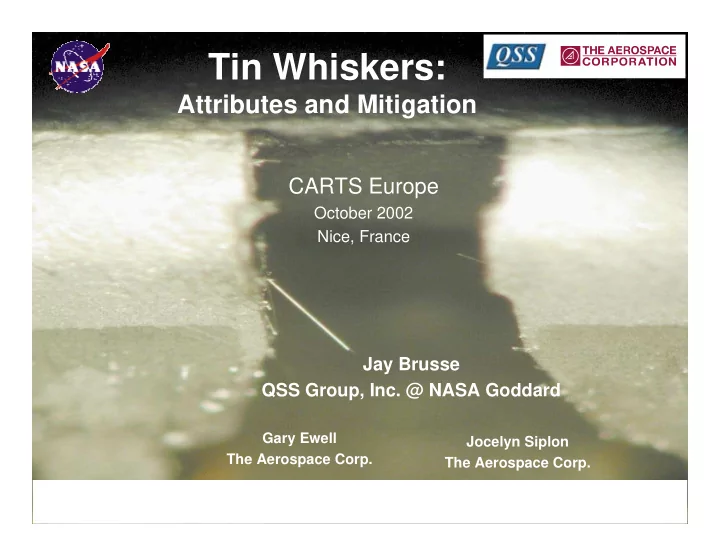
Tin Whiskers:
Attributes and Mitigation
Jay Brusse QSS Group, Inc. @ NASA Goddard
CARTS Europe
October 2002 Nice, France
Gary Ewell The Aerospace Corp. Jocelyn Siplon The Aerospace Corp.
Tin Whiskers: Attributes and Mitigation CARTS Europe October 2002 - - PowerPoint PPT Presentation
Tin Whiskers: Attributes and Mitigation CARTS Europe October 2002 Nice, France Jay Brusse QSS Group, Inc. @ NASA Goddard Gary Ewell Jocelyn Siplon The Aerospace Corp. The Aerospace Corp. Outline Why ANOTHER Paper on Tin Whiskers?
Jay Brusse QSS Group, Inc. @ NASA Goddard
October 2002 Nice, France
Gary Ewell The Aerospace Corp. Jocelyn Siplon The Aerospace Corp.
October 17, 2002 Tin Whiskers: Attributes and Mitigation 2
– Attributes – Examples – Failure Modes
October 17, 2002 Tin Whiskers: Attributes and Mitigation 3
– Tin Whiskers Known for ~60 Years – HUNDREDS of Independent Studies – Numerous Disparities Exist in Published Literature
No “Accepted” Accelerated Whisker Tests Electronics Industry Conversion to Pure Tin Finishes Due to Pending Pb-Free Legislation Lower Application Voltages No Consensus Understanding of Whisker Growth Mechanism(s) SMALLER Circuit Geometries “New” Discoveries of Whisker-Prone Items
October 17, 2002 Tin Whiskers: Attributes and Mitigation 4
Structures that May Grow from Tin Finished Surfaces
(Typically < 1mm)
µ µ µm (Typical ~ 1 µ µ µ µm)
Diffusion Processes in Tin Finish Drive Whisker “Extrusion”
Fundamental Research is INCOMPLETE
Whiskers are NOT Dendrites
October 17, 2002 Tin Whiskers: Attributes and Mitigation 5
Plating Process
High Current Density Bath Temperature Bath Agitation
Many Experiments Show Contradictory Results For These Factors
Plating Chemistry
Pure Sn Most Prone Some Alloys (Sn-Cu, Sn-Bi, rarely Sn-Pb) Use of “Brighteners” Incorporated Hydrogen Codeposited Carbon
Deposit Characteristics
Grain Size/Shape Crystal Orientation Deposit Thickness Sn Oxide Formation
In General, Factors that Increase STRESS In Tin Deposit GREATER WHISKER PROPENSITY Substrate
Material (Brass, Cu, Alloy 42, Steel, etc.) Substrate Stress (Stamped, Etched, Annealed) Intermetallic Compound Formation Substrate Element Diffusivity into Sn
Environment
Temperature Temperature Cycling (CTE Mismatch) Humidity (Oxidation, Corrosion) Applied External Stress (Fasteners, bending, scratches)
October 17, 2002 Tin Whiskers: Attributes and Mitigation 6
Initiation of growths may occur...
– As Short as a Few Days after Plating, or – – AS LONG AS MANY YEARS!!! AS LONG AS MANY YEARS!!!
– Up to 9 mm/yr – Typically Substantially SLOWER!!!
October 17, 2002 Tin Whiskers: Attributes and Mitigation 7
October 17, 2002 Tin Whiskers: Attributes and Mitigation 8
Whiskers from this Component Caused a FAILURE in the Electric Power Utility Industry > 20 YEARS!!! After Fielding the System
October 17, 2002 Tin Whiskers: Attributes and Mitigation 9
Whiskers Like these Reportedly Have Broken Loose Inside Hybrids Creating Intermittent Shorts/Field Failures Whiskers up to 2 mm Long Found Whiskers up to 2 mm Long Found Growing INSIDE Package Growing INSIDE Package
October 17, 2002 Tin Whiskers: Attributes and Mitigation 10
(Tin-Plated Terminals, Case, Header)
Whisker Shorts Between Terminal to Terminal, Terminal to Header, Case to Other Component, Whisker to Whisker!!!
October 17, 2002 Tin Whiskers: Attributes and Mitigation 11
(“AS-RECEIVED”) Whiskers up to 0.25 mm Long Inside Crimp Barrel
October 17, 2002 Tin Whiskers: Attributes and Mitigation 12
“Bright” Tin-Plated Phosphor-Bronze
(Ambient Storage)
October 17, 2002 Tin Whiskers: Attributes and Mitigation 13
“Matte” Tin-Plate Over Nickel Barrier Terminations-- Grew Whiskers after T-Cycle
October 17, 2002 Tin Whiskers: Attributes and Mitigation 14
October 17, 2002 Tin Whiskers: Attributes and Mitigation 15
Electrical Short Circuits Debris/Contamination METAL VAPOR ARC in VACUUM
Highly Conductive PLASMA of Tin Ions if V > ~18 V and I > 10’s of Amps
Whiskers BEND Due to Electrostatic Attraction
0 Volts 0 Volts 50 Volts Before After
October 17, 2002 Tin Whiskers: Attributes and Mitigation 16
Missile Program #1 Missile Program #2 Missile Program #3 Missile Program #4 Heart Pacemaker RECALL
Commercial Satellite #1
Commercial Satellite #5
Commercial Satellite #6
Commercial Satellite #4
Commercial Satellite #2 Commercial Satellite #3
Medical Application Space Application
Military Aircraft
Defense Application
October 17, 2002 Tin Whiskers: Attributes and Mitigation 17
MLCCs Have Following Attributes that make them Highly Resistant to Whisker “Large” Tin Grain, Well-Polygonized
>5 µ µ µ µm
“Thick” Matte Tin Plating
5 - 10 µ µ µ µm
Post-Plating Annealing
Promotes Grain Growth & Reduces Residual Stress
Ni-Underplate (> 2 µ µ µ µm)
Reduces Diffusion that Causes Internal Stress
Observations for MLCCs Stored Continuously at 50°C
October 17, 2002 Tin Whiskers: Attributes and Mitigation 18
PROFUSE DENSITY of Tin Whiskers Currently up to 240 µ µ µ µm Long Found on Pure Tin-Plated MLCCs after T-Cycle + Additional Ambient Storage
October 17, 2002 Tin Whiskers: Attributes and Mitigation 19
MLCCs Inside Hybrid Microcircuit After T-Cycle Cross-Section of MLCC Ceramic
(BaTiO3)
Silver Frit Nickel Tin User Application:
– Gold Plated Substrate Pads – Substrate Line Spacing 125 µm (min.)
but Supplier Shipped PURE TIN
MLCC Construction (0805 size):
17 µ µ µ µm
6.5 µ µ µ µm
6.5 µ µ µ µm
> 5 µ µ µ µm
October 17, 2002 Tin Whiskers: Attributes and Mitigation 20
Temp Cycle: -40°C / +90°C (> 200 Cycles) Followed by “Ambient” Storage for 1 Year
Whiskers ~ 100 µ µ µ µm Density > 800/mm2 Additional 1 Year Ambient Storage GROWTH Continues
Currently 240 µ
October 17, 2002 Tin Whiskers: Attributes and Mitigation 21
Whiskers AFTER Vapor Phase Installation and T-Cycle Whiskers up to 30 µm
:
Soldering Operations DO NOT Always Reflow ALL Tin Surfaces Nor Mix them with the Mounting Solder
Test Condition: Temp Cycle/Shock
Pure Tin Plated 2220 & 1812 Chip Caps Mfr “B” PCB = FR4
Solder = Sn63 / Pb37 Vapor Phase @ 217°C
October 17, 2002 Tin Whiskers: Attributes and Mitigation 22
Combine MULTIPLE Mitigation Strategies to Increase Effectiveness
Research on User-Mitigation Strategies is Limited Strategies to Consider (Complete Immunity NOT Guaranteed)
– Hot Oil Reflow / Hot Solder Dip (Preferably with Sn/Pb Solder) – High Temp Anneal Substrate and Tin Finish – Underplate with Diffusion Resistant Barrier May Delay Onset
– Conformal Coat or other Insulating Barriers – Increase Spacing of Surfaces of Opposite Polarity to > 0.5 inches
October 17, 2002 Tin Whiskers: Attributes and Mitigation 23
Whisker Nodule BENEATH 50 µ µ µ µm thick Conformal Coat
µ µ µm Thick Uralane 5750
Rate of Whisker Growth Compared to Uncoated Specimen
µ µ µm THIN Uralane 5750 After 2.5 Years of Ambient Storage
Whisker Escapes thru THIN (~2 to 6 µ µ µ µm thick) Conformal Coat “ B r i g h t ” T i n
l a t e d B r a s s S u b s t r a t e
NASA Goddard Experiments (>3 Years Observation at 50°C & Room Ambient)
October 17, 2002 Tin Whiskers: Attributes and Mitigation 24
Significant Discoveries are Made Regarding Effective Mitigation Practices
Failures Due to Tin Whiskers are STILL a Significant Problem Factors Affecting Tin Whisker Formation are NOT Completely Understood Tin-Plated Ceramic Chip Capacitors ARE Susceptible to Whisker Formation Even when PROHIBITED by Design and Procurement Practices, Pure Tin Finishes Continue to Appear in Electronic Equipment
October 17, 2002 Tin Whiskers: Attributes and Mitigation 25
– Environmental Testing vs. Finish Characterization?? – Acceleration Factors MUST be Determined – Tailorable to Assess Varied Constructions, Materials AND Applications – MORE than One Mechanism is Likely – Model Needed to have Confidence in Any Proposed Accelerated Test
Develop CONSENSUS Model(s) of Whisker Growth Mechanism(s) Develop PROVEN “Whisker Propensity” Test(s) Share Whisker Experiences and Knowledge More OPENLY Develop Whisker Risk Assessment & Mitigation Strategies
– Education vs. MIS-Information – Collaboration – Plating Chemistry/Process Suppliers – Component Mfrs – Electronic System Mfrs – End Users
October 17, 2002 Tin Whiskers: Attributes and Mitigation 26
Jay Brusse Group, Inc. (NASA Goddard) 301-286-2019 Jay.A.Brusse.1@gsfc.nasa.gov Gary Ewell 310-336-6003 Gary.J.Ewell@aero.org Jocelyn Siplon 310-336-6572 Jocelyn.P.Siplon@aero.org
NASA Goddard Tin (and Other Metal) Whisker WWW Site
October 17, 2002 Tin Whiskers: Attributes and Mitigation 27
GROWTH RINGS Tin Whiskers Grown on Ceramic Chip Capacitor Via Temp Cycling (-40°C to +90°C)
During a reliability study at NASA’s Jet Propulsion Laboratory,uniform whisker growth steps were observed and correlated with thermal
D’Agostino of the Electronic Parts Engineering Section.
Photo Courtesy of NASA Goddard Space Flight Center
October 17, 2002 Tin Whiskers: Attributes and Mitigation 28
October 17, 2002 Tin Whiskers: Attributes and Mitigation 29
Hot Solder Dip Does NOT Always Allow for COMPLETE Coverage
Component Package, etc.
October 17, 2002 Tin Whiskers: Attributes and Mitigation 30
Conformal Coat
October 17, 2002 Tin Whiskers: Attributes and Mitigation 31
4.To Relieve Stress, Whiskers EXTRUDE thru Ruptures in Sn Oxide
Sn Oxide Whisker Sn Layer IMC (e.g., Cu6Sn5) Sn Grain Boundaries
October 17, 2002 Tin Whiskers: Attributes and Mitigation 32
NASA Goddard Space Flight Center Tin Whisker Test Coupon
December 1998
Tygon tubing used
Substrate: Brass Type 260 (1” x 4” x 0.032”) Underplate: some specimens with copper strike and copper plate to 0.0001" min some specimens with NO copper underplate (i.e., tin direct on brass) Finish: “Bright” Pure Tin Electroplate (200 ± 50 microinches) Post-Plating Handling: “Intentional” Scratches (circle and perpendicular lines) NO Conformal Coat Conformal Coat 0.002” nominal thickness NASA GSFC contracted with Alexandria Metal Finishers (Lorton, VA) (703) 643-1636 to build these Test Coupons