Time Correlated Single Photon Counting Anindya Datta Department of - - PowerPoint PPT Presentation

time correlated single photon counting
SMART_READER_LITE
LIVE PREVIEW

Time Correlated Single Photon Counting Anindya Datta Department of - - PowerPoint PPT Presentation

Time Correlated Single Photon Counting Anindya Datta Department of Chemistry Indian Institute of Technology Bombay Powai, Mumbai 400 076 Fluorescence Decay Following Pulsed Excitation t * * N t N 0 exp


slide-1
SLIDE 1

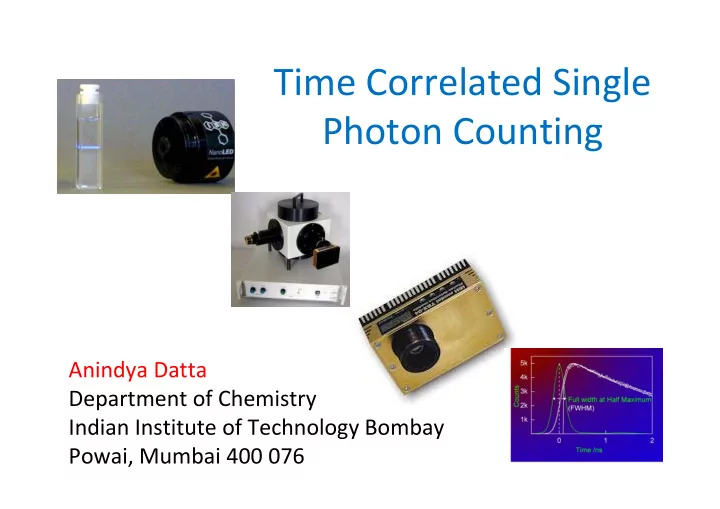
Time Correlated Single Photon Counting

Anindya Datta Department of Chemistry Indian Institute of Technology Bombay Powai, Mumbai 400 076

slide-2
SLIDE 2

Fluorescence Decay Following Pulsed Excitation

   

 

       

 

        t exp F t F t N t F t exp N t N

* * *

Multiple independent decay pathways: Multiexponential decays Where N*(t) = Population of the excited state at time t F*(t) = Fluorescence intensity at time t

   

      

i i

t a F t F  exp

slide-3
SLIDE 3

Fluorescence Lifetime and the Depopulation Rates

      

NR R

k 1 k

  • Window to excited state dynamics

Photoisomerization, Excited State Proton Transfer, Charge Transfer, Exciplexes, Energy Transfer

  • Microenvironment sensitive

Protein folding, Microheterogeneous media

  • Imaging and Microscopy

Radiative Nonradiative kR kNR

slide-4
SLIDE 4

Schematics of the Instrument

PS: Power supply, DL: Diode laser, P: Polariser CFD: Constant fraction discriminator TAC: Time to amplitude converter MCA: Multichannel annalyser

CFD CFD Sample chamber Mono- chromator Delay Stop Start TAC Computer with MCA Short Laser Pulse DL P S Sync. Trigger

TBX-04

IBH Data Station Out P P

Time Correlated Single Photon Counting

slide-5
SLIDE 5

The essence of TCSPC

CFD CFD Sample chamber Mono- chromator Delay Stop Start TAC Computer with MCA Short Laser Pulse DL P S Sync. Trigger

TBX-04

IBH Data Station Out P P

  • TAC range: Time for which TAC waits for

a STOP

  • Number of channels
slide-6
SLIDE 6

Constant Fraction Discrimination

CFD CFD Sample chamber Mono- chromator Delay Stop Start TAC Computer with MCA Short Laser Pulse DL P S Sync. Trigger

TBX-04

IBH Data Station Out P P

Timing jitter = 50 ps for CFD, 1 ns for LED

slide-7
SLIDE 7

Data Analysis: Iterative Reconvolution

     

' dt ' t P ' t t F t F

D

  Finite pulse width: Convolution

D

F

L

F

P(t′) = Impulse function at time t′ F(t‐t′) = Intensity at time t, from Exponential decay with origin at time t′ Range of t′ = Determined by shape of pulse

   

 

       

 

        t exp F t F t N t F t exp N t N

* * *

slide-8
SLIDE 8

Data Analysis: Iterative Reconvolution

slide-9
SLIDE 9

     

' dt ' t P ' t t F t F

D

 

Data Analysis: Iterative Reconvolution

P(t’) t’ t t‐t’ F(t‐t’)P(t’)

slide-10
SLIDE 10

     

' dt ' t P ' t t F t F

D

 

Data Analysis: Iterative Reconvolution

t The Guess Fitting Function is Convoluted with the Instrument Response Function and the Function thus generated is compared with the observed Decay

slide-11
SLIDE 11

Goodness of Fit

Reduced χ2: Y(i) = Experimentally obtained data at point no. i FD(i) = Fitting data after convolution N = Number of data points. P = Number of parameters Reduced χ2 should be equal to 1 for a good fit Weighted Residuals: Deviation at each point can be determined

R i

   Y i    F

D i

 

 i

 

 2  1 N  p Y i

  F

D i

 

 i

 

       

N

2

 

) i ( Y i  

 2  R i

 

2 i

slide-12
SLIDE 12

Global analysis of TCSPC data

Intensity Wavelength

Steady State Spectrum

3 ns 7 ns

   

                   

2 2 1 1

exp exp   t a t a F t F

3 ns 7 ns Global parameters Wavelength independent Local Parameters Depend on wavelength Global 2 = Average value of local 2

slide-13
SLIDE 13

Life beyond Multiexponential decays

Heterogeneous environments

  • Stretched exponential function
  • Distribution of lifetimes

I(t ) = I0 exp(‐t/τ )β  provides a measure of heterogeneity

Rouvière N, Gallay J. 2000. Cell Mol Biol 46(5):1113–1131.

slide-14
SLIDE 14

Time resolved emission spectra

Intensity Wavelength

Steady State Spectrum TCSPC

Multiexponential decay ai and i

Iss(λ)

Intensity Wavelength

t t’ Iss(λ′ ) TRES

Isoemissive point: Two state process

  • J. Chem. Phys. 2001, 115, 7094; J. Phys. Chem. A 2001, 105, 1767

Intensity Wavelength

Area Normalize t’ time

14

slide-15
SLIDE 15
slide-16
SLIDE 16