
SLIDE 1
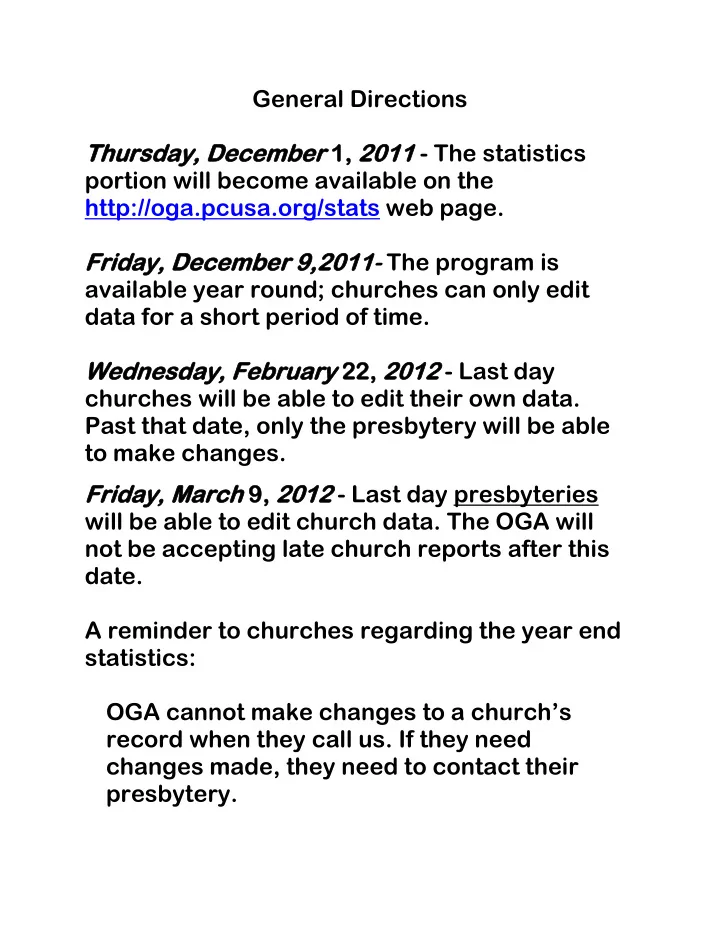
Thursday, December Thursday, December 1, 1, 2011 2011 - The - - PDF document
General Directions Thursday, December Thursday, December 1, 1, 2011 2011 - The statistics portion will become available on the http://oga.pcusa.org/stats web page. Friday, December 9,2011 Friday, December 9,2011- The program is available year
1
This workbook is designed to guide you through the statistical information that you must provide to the presbytery in accordance with G-3.0202f. The Session Report is prepared annually by the Office of the General Assembly, and the information you provide will be combined with that from other PC(USA) congregations to become the “OGA Statistics” that appear annually in the General Assembly Minutes, Part II, Statistics. PLEASE NOTE: The session needs to approve the report as early as possible after December 31, 2011. This is a session report and DOES NOT require approval at a congregational meeting. If you have any questions on how to use this workbook, please call your presbytery office. Thank you for your work and support.
2 FREQUENTLY ASKED QUESTIONS
The web address is http://oga.pcusa.org/stats. The online statistical reporting portion will become active on December 1, 2011.
Each presbytery determines their own deadline. Contact your presbytery for the specific date.
The passwords are case sensitive. Also, people confuse the letter „O‟ with the number zero „0.‟ If one doesn‟t work, try the other.
You will need to contact your presbytery if you don‟t know or have lost your login information. The Statistical Hotline will not be able to assist you with the issue.
No, you can come and go as often as you like until the deadline date or until you hit the „Submit‟ button. The program is available year-round, but you can only update statistical data for about two months or until you hit „Submit.‟
3
No problem. Call your presbytery for instructions on what to do. We can „unsubmit‟ your church easily if no data has been entered. If data has been entered, it will clear out any data you have entered.
We answer calls in the order in which they are received. If no one answers, it means we are busy helping
number to reach you. The more detail you provide will allow us to leave a message with an answer if you cannot be reached. We make every effort to return calls on the same day that they are received. The hotline is available Monday through Friday, excluding holidays from 7:00 am until 6:00 pm Eastern Standard
Yes, the program is available year round. You can view or print your data throughout the year.
late report or can’t meet the deadline? You will need to contact your presbytery regarding alternate forms of submitting your statistics. It is important for you to note that you are submitting your statistics to the presbytery not the Office of the General Assembly.
If you have already hit the „Submit‟ button you‟ll need to contact your presbytery to make a correction. Do not call the hotline, the Office of the General Assembly cannot make changes to your report.
When you make an address change, you are letting the Office of the General Assembly (OGA) know that you would like to make a change. On a daily basis, the OGA reviews the list of changes submitted. The changes are then made and reflected. It could be up to 48 hours before you see the change.
Each presbytery establishes their deadline date. You will notice that as the deadlines approach, the system will become very slow because of the increased usage. The earlier you enter your data, the faster the process will be. Remember, you do not have to enter everything at one time. Also, you can enter data before you have session approval. You will still be able to make changes until you hit the „Submit‟ button. Don‟t frustrate yourself. Remember the ten-minute rule. If after ten minutes you have a question, problem, or just need help with something, CALL 1-888-728-7228 ext 8144 or email OGARecords@pcusa.org. One last important item; this only comes once a year!
4
This is the starting point once you login. Along the top of the page are the various tabs to move around the
addresses, mailing and physical. To make changes, use the option on the right “Edit Mailing” or “Edit Physical.” You can choose either editing option to make changes to your phone/fax number, website, or email address. Changes cannot be made to your church name. You will note that we do not use the words “Presbyterian Church” after the name. The words “Presbyterian Church” are generically added to church‟s name for mailings and other
To change your password chose the option Change User Password.
5 To print or download a copy of your report press the option “Reports.” You‟ll need to work through a series of
To view or print a copy choose “Church Report.” It will then ask you for the year you would like to view. Your report will appear in a box, scroll down to view page one, then use the blue arrow buttons on the top of the page to move to the seond page. To print a page use the drop down box that reads “Select a Format.” I suggest using the Acrobat (PDF) option for a clean copy of your report. Press the Export button to download your desired format.
6 Pressing the “Clerk” tab will take you to the clerk of session page. The primary tab to make changes is the “Edit Mailing” address. You do not need to fill in the Physical address. Clerks of session can also add a phone number and email address if desired.
8 The „Tasks” area list the various statistics pages requiring entry. To save data on a page use the Accept button. The ending active membership does not automatically calculate. The page must balance in order for the changes to save.
9
BEGINNING BALANCE AS OF 12/31/10. Beginning Balance shows your church‟s active membership as of December 31 of last year (G-1.0402). This is the official membership figure that appeared in the 2010 Minutes of the General Assembly, Part II,
displayed figure, you will need to make the appropriate adjustments to “Other Gains” or “Other Losses.” MEMBERSHIP GAINES PROFESSIONS OF FAITH, REAFFIRMATION, RESTORATION. Enter the number of members received this year through the (first-time) profession of faith, reaffirmation, or restoration to the active members’ roll (G-1.0303 a & c) and
For persons aged 17 and younger &. For persons aged 18 and older
(G-1.0303b). OTHER GAINS. Enter all other additions. TOTAL GAINS. This figure will automatically calculate as you enter gains. MEMBERSHIP LOSSES
issued (G-3.0204a)
membership (D-12.0105). TOTAL LOSSES. This figure will automatically calculate as you enter losses. TOTAL ENDING ACTIVE MEMBERSHIP (12/31/2011) Add Beginning Membership and Total Gains, then subtract Total Losses. This figure should equal the number of persons (male/female) that appear on the active members roll. (This is the figure per capita is based on.) You must enter this number. It will not automatically calculate. FEMALE MEMBERS. Enter the number of females included in your total active membership. BAPTIZED MEMBERS. Enter the number of persons who appear on the baptized member‟s roll. A Baptized member of a particular church is a person who has received the Sacrament of Baptism and who has been enrolled as a baptized member by the session but who has NOT made a profession of faith in Jesus Christ as Lord and Savior. (G1.0401)] TOTAL ADHERENTS. This figure will automatically calculate. It is the sum of Total Ending Active Membership + Baptized Members.
10
11
AGE DISTRIBUTION OF ACTIVE MEMBERS. Enter the number of active members in each category. This figure needs to be equal
AVERAGE ATTENDANCE AT WORSHIP. Enter the average weekly worship attendance. AFFILIATE MEMBERS. Enter the number of persons who appear on your affiliate member rolls. An affiliate member of a particular church is an active member of another church of this denomination or of another denomination of Christian Body, who has temporarily moved from the community where the church of active membership is situated, has presented a certificate of good standing from the appropriate governing body of that church, and has been received by the session as an affiliate member (G-1.0403) Persons often in this category are college students & „Snow Birds.‟ CHRISTIAN EDUCATION ATTENDANCE BY AGE GROUP. List the number of persons in each category according to the education records for 2011. This total should include, but not be limited to, small groups, such as, Bible studies, spiritual formation groups, and youth groups. This total will automatically calculate when you hit the „Accept‟ button. Do not include Vacation Bible School.
Children (Children of believers and professions of faith by persons aged 17 and under) Adults ACTIVE OFFICERS. Enter the number of officers serving as of 12/31/11. The totals will automatically calculate when you hit the „Accept‟ button. Active Officers Men Women Session Deacons Does the session serve the Trustee‟s functions in the church? Y/N
12
13
PERSONS WITH A DISABILITY. Statistics gathered on persons with disabilities will be used by entities and committees to formulate programs and policies of the Presbyterian Church (U.S.A.), thus carrying out the mandate for inclusiveness contained in the Book of Order (G-3.0103 & F-1.0403). In order to complete this section, you (as clerk or pastor) are not expected to conduct a survey of the congregation, but to rely
persons with disabilities are those who have physical or mental disabilities that substantially limit their participation in one or more of life‟s activities. Hearing Impairment. Persons with a major hearing loss or deficiency. Mobility Impairment. Persons whose ability to move about is substantially impeded. This would include persons suffering from diseases such as arthritis and persons dependent upon canes, crutches, or wheelchairs, etc. Sight Impairment. Persons with severe visual limitations.
conditions. RACIAL ETHNIC COMPOSITION OF THE CHURCH The 202nd General Assembly (1990) instructed the Office of the General Assembly to gather information regarding Racial Ethnic Composition (Minutes, 1990, Part I, p. 282.) Inclusiveness is an important part of the life of the church, “The Presbyterian Church (U.S.A.) shall give full expression to the rich diversity within its membership and shall provide means which will assure a greater inclusiveness leading to wholeness in its emerging life.” (G-4.0403) This information is used in a variety of ways. Two of the ways in which this information is used is as follows: (1) The 208th General Assembly (1996) passed a recommendation that “1. affirms the goal of increasing the racial ethnic membership to 10 percent of the Presbyterian Church (U.S.A.) membership by the year 2005, and to 20 percent by the year 2010;” (Minutes, 1996, Part I, p. 378). (2) The General Assembly Committee on Representation (COR) uses the data at their Synod Committee on Representation Training Workshops, that are held biannually. In making the entries for this category, be guided by how an individual describes themselves. The category of Native American applies to American Indians and Eskimos. The figure entered as the total of the congregation should be equal to or less than the figure shown for Total Active Membership. The total Elders and Deacons should be equal to or less than the amounts given for Active Officers. Use numerical figures, not percentages. ENTER DATA AS WHOLE NUMBERS, NOT A PERCENTAGE. The Advocacy Committee for Women‟s Concerns (ACWC) recommended to the 219th General Assembly (2010) to do the following: Direct the Office of the General Assembly (OGA) to incorporate into the Session Annual Statistical Report (SASR) specifically by name the categories of African, African American, and Middle Eastern. Full list of Categories: Asian, African, African American, Black, Hispanic, Middle Eastern, Native American, White, Other
14 FINANCIAL INSTRUCTIONS
The Financial information you provide is used to show trends within the church. The big questions are: How does the congregation receive money? How does the congregation spend money? And, to break it down further, the General Assembly is only interested in a few ways that your church receives and spends money. This is not meant to be a balance sheet for the congregation. It will not include all moneys that are received or spent by the church. Here are two tips to help you fill out the information: 1) The difference between Local Program, Local Mission, Validated Mission, and Other Mission: Who is spending the money? Local Program - The session decides how to spend the money. General operating cost to run the church. Local Mission - The local food pantry decides how to spend the money. Validated Mission - Synod, Presbytery, or General Assembly decides how to spend the money. Other Mission - Groups not included above, ie. You send money directly to Africa. 2) Investment Income/Investment Expense Did you convert any investments to cash to help cover your budget? This would be included under Investment Income. Did you invest any new money? This would be an Investment Expense. Do not show the value of the congregation‟s investments. These figures would not reflect any changes in the investment, such as a loss of profit.
15
POTENTIAL GIVING UNITS. Total number of households in the congregation. BUDGETED INCOME & BUDGETED EXPENSE. These categories were added to obtain general information regarding a church‟s
those figures that you have been working from all year. Many churches work with a „Faith Budget,‟ meaning you only have budgeted expenses for the year. RECEIPTS
special offerings received by all treasurers (the church, all boards, and organizations of the church). DO NOT INCLUDE capital and building funds, investment income, bequest, other income, aid and subsidy. CAPITAL AND BUILDING FUNDS. Enter the total of all moneys received for capital purposes, extraordinary repairs, building funds, and equipment with anticipated useful life in excess of three years. INVESTMENT AND ENDOWMENT INCOME. Include all returns, such as interest and dividends, received from stocks, bonds, and other investments and endowments owned by the church. Also include the proceeds from the sale of investments held by the church. DO NOT INCLUDE the monetary value or principal amount of investments that continue to be held by the church.
charitable trust, life insurance), stocks, real estate, or other non-monetary gifts. OTHER INCOME. Enter the total of all other income, such as rent or other reimbursements from organizations using church
SUBSIDY OR AID. Enter the total of all moneys received from other churches or from presbytery, synod, or General Assembly agencies to be used in local mission and program. EXPENDITURES LOCAL PROGRAM. The total of all moneys, from all sources, expended for current operations of the congregation, such as salaries and wages, pension and social security payments, printing, postage, materials, utilities, insurance premiums, payments of interest and principal loans, whether or not secured by mortgage, etc. LOCAL MISSION. The total of all moneys paid for local mission programs and projects approved and directed by the session and to local ecumenical bodies. CAPITAL EXPENDITURES. The total of all moneys expended for real property, whether improved or unimproved, the construction of new buildings, extraordinary repairs or renovations of existing buildings, and equipment with anticipated useful life in excess of three years. INVESTMENT EXPENDITURES. Include the total amount of moneys newly placed into savings or investments (such as certificates of deposit, stocks, bonds, money market accounts, reinvested dividends) during the year, and remaining invested. Also included would be investment costs such as moneys expended to facilitate new investments or to maintain existing investments or endowments such as brokers‟ fees, bank charges. DO NOT INCLUDE investments made in earlier years, monies invested in earlier years that were switched from one type of investment to another (e.g., stocks to bonds, or one stock to another.) PER CAPITA APPORTIONMENT. The total of moneys expended for synod, presbytery, and General Assembly apportionment. VALIDATED MISSION PC(USA). The total of all moneys given to synod, presbytery, and General Assembly agencies, including payments toward the mission budgets of these entities. Include synod or presbytery special offerings as well as General Assembly special offerings: One Great Hour of Sharing, Christmas Joy, Peacemaking, Witness, other offerings. Include totals for mission programs and projects related to the Presbyterian Church (U.S.A.) and not already reported as Local Mission. GENERAL ASSEMBLY THEOLOGICAL EDUCATION FUND. Each congregation is requested to make a voluntary contribution of an amount equal to 1% of the figure reported for Local Program as the congregation‟s share for the support of the eleven Presbyterian theological institutions. Please take care NOT TO INCLUDE direct support of theological students, direct gifts to any theological school, or other gifts related to theological education. OTHER MISSION. Enter the total of all monies expended for mission causes not related to the Presbyterian Church (U.S.A.) and not already included under Session Local Mission.
16 The Advocacy Committee for Women‟s Concerns (ACWC) recommended to the 219th General Assembly (2010) to do the following: Direct the Office of the General Assembly (OGA) to adapt the Session Annual Statistical Report (SASR) to collect disaggregated data on age, gender, race and ethnicity.
1
CLERK’S ANNUAL QUESTIONNAIRE FOR YEAR ENDING DECEMBER 31, 2011 Return to Presbytery Clerk By 2012
NAME OF CHURCH MAILING ADDRESS OF CHURCH LOCATION OF CHURCH: CITY OR TOWN LOCATION OF CHURCH: STATE CHURCH PIN PRESBYTERY SYNOD
Clerk of Session May Find it Necessary to Consult with Pastors, Treasurers, or Other Leaders on Some Questions.
The reason for asking each question can be found on the back page.
Guest Preachers Q-1. The 1999 General Assembly urged all congregations to invite racial-ethnic ministers to preach during Sunday worship services at least annually. Did your congregation invite a racial-ethnic minister (other than your pastor if he
❑1
Yes Q-1a. If yes, on how many Sundays in 2011 did a racial-ethnic minister serve as guest preacher? (If
❑2
No all invitations were turned down, enter “0”—zero.) Q-1b. If no, when was the last time your congregation invited a racial-ethnic minister to preach there?
❑1 During 2010 ❑4 7-9 years ago ❑2 2-3 years ago ❑5 10 years ago or more ❑3 4-6 years ago ❑6 Never/don’t know
Transfer of Members Q-2. During 2010, how many new members did your congregation receive via certificate of transfer from another congregation? ______ If none, enter “0” (zero) and then skip to Q-4. Q-3. Of that number: (Numbers below should total to the number in Q-2.)
Q-4. During 2010, how many members of your congregation were dismissed to another congregation via a certificate of transfer? ______ If none, enter “0” (zero) and then skip to Q-6. Q-5. Of that number: (Numbers below should total to the number in Q-4.)
Immigrants Q-6. Indicate whether your congregation has each of the following:
Not Yes No Sure
attend worship services or other activities of your congregation ..............................................
❑1 ❑2 ❑3
native language in your facilities ...............................................................................................
❑1 ❑2 ❑3
English as a Second Language (ESL) program, a legal clinic for immigrants, an after-school program for immigrant children, sponsorship of a refugee family, etc. ...........
❑1 ❑2 ❑3
...........................
❑1 ❑2 ❑3
Q-7. If yes to any of the items in Q-6, please provide the name and e-mail address of someone in your congregation who would be able to provide more detailed information on immigrant groups and immigrant ministries in your congregation: Name of this person: ____________________________________________________ E-mail of this person: ____________________________________________________
(please print)
2
World Mission Q-8. Does your congregation have a committee that focuses some or all of its attention on world (or international) mission? ❑1 Yes Q-8a. Name of contact person for this committee: _________________________________ ❑2 No E-mail of this person: ___________________________________________________
(please print)
Q-8b. Would the contact person for this committee like to receive World Mission’s monthly electronic newsletter about Presbyterian mission work around the world? ❑1 Yes ❑2 No ❑3 Don’t know Q-9. Does your congregation have a relationship with one or more missionaries or mission workers? ❑1 Yes Q-9a. Which mission sending agency sent the missionary(ies) or mission worker(s) with which ❑2 No your congregation has a relationship? (Check all that apply.) ❑1 PC(USA) World Mission ❑2 The Antioch Partners (Presbyterian Frontier Fellowship or The Outreach Foundation) ❑3 Other agency (please specify): ________________________________________ ❑4 Independently, as a congregation ❑5 Don’t know Q-9b. How does your congregation engage in a relationship with the missionary(ies) or mission worker(s)? (Check all that apply.) ❑1 Communications (e.g., letters, blogs, e-mail, Skype) ❑2 Planning and implementing mission projects together ❑3 Engaging groups in our church to relate with him/her/them (e.g., children’s groups exchanging Christmas cards, Presbyterian Women sending a prayer shawl, etc.) ❑4 Face-to-face visits in the United States ❑5 Financial support ❑6 Prayer ❑7 Members visiting the mission site ❑8 Other (please specify): _____________________________________ Q-10. Would your congregation like to receive information about how to develop a relationship with a missionary or mission worker? ❑1 Yes Q-10a. Name of person to receive this information: ___________________________________ ❑2 No E-mail of this person: _____________________________________________________
(please print)
Self-Development of People Q-11. Self-Development of People (SDOP) is a ministry of the General Assembly Mission Council that partners with groups of poor, oppressed, and disadvantaged people to change structures that perpetuate poverty and injustice. Is there a person in your congregation who might be interested in serving as a liaison between your congregation and the SDOP national office? A liaison is someone interested in networking with SDOP who would receive and share information with the congregation about the ministry. SDOP will send this person information, at which time he/she can decide whether to become a liaison. ❑1 Yes Q-11a. Name of person to receive this information: ___________________________________ ❑2 No E-mail of this person: _____________________________________________________
(please print)
Communications and Funds Development Q-12. Would your session be willing to provide to the General Assembly Mission Council (GAMC) a copy of your church directory so that we can give your members information about Presbyterian mission and ministry on an on-going basis? ❑1 Yes Q-12a. Name of person GAMC can contact to obtain directory: __________________________ ❑2 No E-mail of this person: _____________________________________________________
(please print)
Q-13. Does your congregation have a stewardship committee? ❑1 Yes Q-13a. Please provide chair’s name and e-mail address to become part of a stewardship network: ❑2 No Chair’s name: __________________________________________________________ E-mail of this person: ____________________________________________________
(please print)
3
Q-14. Has your congregation or anyone in your congregation donated funds for disaster relief or mission work in Haiti since the earthquake there in January 2010? (Check all that apply.) ❑1 Yes, the congregation has ❑2 Yes, individuals in the congregation have ❑3 No ❑4 Don’t know Q-15. Has anyone in your congregation gone to Haiti to do disaster relief or mission work since the January 2010 earthquake there? (Check all that apply.) ❑1 Yes, the congregation has sent someone or a group to Haiti ❑2 Yes, one or more people in the congregation have gone to Haiti, but they were not officially sent by our congregation ❑3 No ❑4 Don’t know Q-16. Is your congregation or a group within it planning or considering a mission trip to Haiti in 2012 or 2013? ❑1 Yes ❑2 No ❑3 Don’t know Q-17. Would anyone in your congregation like to receive information about effective mission work in Haiti? ❑1 Yes Q-17a. Name of person to receive this information: __________________________________ ❑2 No E-mail of this person: ____________________________________________________
(please print)
Economic Issues Q-18. How would you describe the economic health of your local community? ❑1 Excellent ❑2 Good ❑3 Fair ❑4 Poor ❑5 Severely depressed Q-19. How many members are currently unemployed and looking for work or are discouraged workers who have quit looking for work? (Write in the number. Please estimate if you are not sure. Do not include retired people, students, people who do not work due to disabilities, full-time homemakers, or children under age 18.) ______ members Q-20. Did your congregation or anyone in it provide any form of financial support for one or more unemployed members during 2011? (Check all that apply.) ❑1 Yes, an individual member did with his/her own money ❑2 Yes, the pastor or other staff did, using congregational funds ❑3 Yes, the session did, using congregational funds ❑4 Yes, another church group did, using congregational funds ❑5 No ❑6 Not sure Q-21. How important is it for the church to address the Christian faith dimensions of the following economic concerns?
Very Not Very Not at All Not Important Important Important Important Sure
................. ❑1 ❑2 ❑3 ❑4 ❑5
❑2 ❑3 ❑4 ❑5
❑2 ❑3 ❑4 ❑5
.................. ❑1 ❑2 ❑3 ❑4 ❑5
❑2 ❑3 ❑4 ❑5
............................. ❑1 ❑2 ❑3 ❑4 ❑5
........................ ❑1 ❑2 ❑3 ❑4 ❑5 Q-22. To receive information on social ministry and social witness resources from the Advisory Committee on Social Witness Policy (justiceunbound.org) and the Compassion, Peace and Justice Ministry Area, please provide contact information for someone in your congregation who is involved in mission or peacemaking: Name of person to receive this information: __________________________________ E-mail of this person: ____________________________________________________
(please print)
4
Special Offerings Q-23. Please indicate whether your congregation received each of the four churchwide special offerings during 2011. Then, for each offering received, please provide the name of the committee that is responsible for interpretation and promotion of the offering, along with the name and e-mail address of the committee chair or other contact person in the congregation who is most familiar with that special offering.
Received? Committee Chair or Other Contact Person’s No Yes Name: Contact Person: E-mail Address:
....................... ❑1 ❑2 ➜ Congregational Endowments Q-24. Does your congregation have an endowment (funds or property that was donated to the church and is now a source of income)? ❑1 Yes ❑2 No ➜ Skip to Q-31 Q-25. Does your congregation have an investment policy to guide management of the endowment? ❑1 Yes ❑2 No Q-26. Who manages the endowment? (Check all that apply.) ❑1 A church committee ❑2 A financial advisor ❑3 A bank ❑4 An investment firm ❑5 The church treasurer ❑6 The Presbyterian Church (U.S.A) Foundation ❑7 Other (please specify): _______________________ Q-27. Is any of your endowment invested in stocks? ❑1 Yes ❑2 No Q-28. Is any of your endowment invested in mutual funds? ❑1 Yes ❑2 No Q-29. Does your congregation avoid investing endowment funds in certain industries or companies? ❑1 Yes ❑2 No
Don’t Not
Q-30. Do you:
Yes No Know Applicable
❑1 ❑2 ❑3 ❑4
❑1 ❑2 ❑3 ❑4 Bequests and Major Gifts Q-31. How many bequests did your congregation receive in 2011? Bequests are gifts of money, stocks, or other property left to the church through a will when someone dies. If none, write “0” (zero). Number of bequests received in 2011: Total value of these bequests: $ Q-32. How many other gifts from estates did your congregation receive in 2011? Other gifts are those that result when someone dies and has named the church as a beneficiary of a life insurance policy, retirement account, trust, or gift
Number of other gifts from estates received in 2011: Total value of all such gifts: $
5
Q-33. Does your congregation have in place a program to encourage each of the following types of giving to your congregation?
Yes No Not Sure
❑2 ❑3
................................................................................... ❑1 ❑2 ❑3
................................ ❑1 ❑2 ❑3
............. ❑1 ❑2 ❑3
❑2 ❑3 Q-34. In the last two years, has your congregation received any inquiries from members who were interested in charitable
accounts in which the congregation is the beneficiary)?
❑1
Yes
❑2
No Skip to Q-37
❑3
Not sure Q-35. How many members made such inquiries in the past two years? (Please estimate the number of people in the past two years.) _____ members Q-36. To whom were people making such inquiries referred? (Check all that apply.)
❑1
To someone on the church staff (a development officer, treasurer, etc.)
❑2
To a member of the church who is an estate or financial planner
❑3
To an estate or financial planner outside the church
❑4
To a Presbyterian Foundation development officer
❑5
To the development officer of another Christian organization
❑6
To the development officer of a secular organization
❑7
Other (please specify): ___________________________________
❑8
Not sure
❑9
No one/not referred Other Financial Information Q-37. Does your congregation have a loan or loans with any of the following groups or institutions? (Check all that apply and indicate the approximate balance and interest rate on loans in each category.)
Approximate Balance: Interest Rate (%): ❑1
Banks or financial institutions .......................................... $
❑2
Presbyterian Investment & Loan Program (PILP) ............ $
❑3
General Assembly Loan Program ..................................... $
❑4
Presbytery or synod .......................................................... $
❑5
Other (specify): ............ $
❑6
No loans Q-38. Does your congregation plan to expand or renovate your facilities within the next two years?
❑1
Yes, definitely Q-38a. What is the estimated cost of the project(s) (if known)? $
❑2
Yes, possibly
❑3
No Q-38b. Will this project require a capital campaign (a special fundraising effort)?
❑1
Yes, definitely
❑2
Yes, possibly
❑3
No
6
Q-39. Does your congregation currently have funds in any of the following financial instruments? (Check all that apply and indicate the approximate amount invested in each. Include any endowment funds noted on page 4.)
Approximate Amount Invested: ❑1
Certificates of deposit ....................................................... $
❑2
Money market accounts .................................................... $
❑3
Bonds or treasuries ........................................................... $
❑4
Stocks or mutual funds ..................................................... $
❑5
Savings accounts ............................................................... $
❑6 Other (specify):
......... $
❑7
None of the above ➜ Skip past Q-40 Q-40. Who manages your funds? (Check all that apply.)
❑1
A brokerage/investment firm
❑2
New Covenant Funds/Presbyterian Foundation
❑3
A bank
❑4
We manage them ourselves
❑5
Other (please specify): Questions? Call Research Services at 800-728-7228, ext. 2040. Thank you for completing this survey. Responses can be submitted on the web: www.pcusa.org/clerks2011 Reasons for These Questions: Guest Preachers: The Office of the General Assembly asks these questions in response to a General Assembly mandate. Transfer of Members: Research Services asks these questions to learn how many members transferring into and out
Immigrants: The Racial Ethnic and Women’s Ministries/PW ministry area asks these questions to learn about immigrant groups and immigrant ministries in congregations. World Mission: The World Mission ministry area asks these questions to be able to communicate directly with congregations regarding international mission. Self-Development of People: The Self-Development of People office asks these questions to find churches interested in the Self-Development of People ministry. Communication and Funds Development: The Communication and Funds Development office asks these questions to provide congregations with information about Presbyterian mission. Economic Issues: The Advisory Committee on Social Witness policy asks these questions to help develop, interpret, and monitor policies that encourage and challenge the church and society to act faithfully to God’s call to do justice. Special Offerings: The Mission Interpretation office asks these questions to obtain contact information for those who use special offerings materials. Congregational Endowments: The Mission Responsibility Through Investment (MRTI) office asks these questions to learn about church endowments. Bequests and Major Gifts: The Presbyterian Church Foundation asks these questions to learn about congregational giving trends and needs. Other Financial Information: The Presbyterian Investment & Loan Program asks these questions to determine which churches might benefit from PILP’s low-cost loans and investment products.