Thomas Jefferson a mere thing of wax in the hands of the judiciary, - - PowerPoint PPT Presentation

thomas jefferson
SMART_READER_LITE
LIVE PREVIEW

Thomas Jefferson a mere thing of wax in the hands of the judiciary, - - PowerPoint PPT Presentation

Thomas Jefferson a mere thing of wax in the hands of the judiciary, which they may twist and shape into any form they please. Jefferson, The Writings of Thomas Jefferson , 15:213, in a letter from Jefferson to Judge Spencer Roane on


slide-1
SLIDE 1

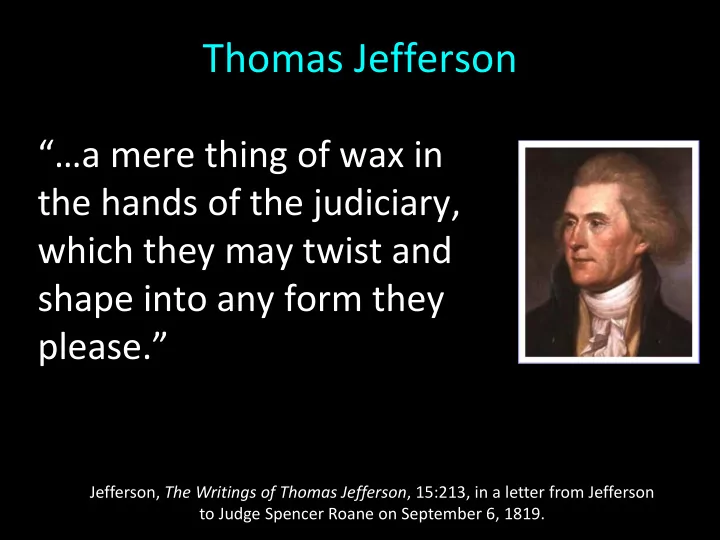
Thomas Jefferson

“…a mere thing of wax in the hands of the judiciary, which they may twist and shape into any form they please.”

Jefferson, The Writings of Thomas Jefferson, 15:213, in a letter from Jefferson to Judge Spencer Roane on September 6, 1819.

slide-2
SLIDE 2

THE BIG LIE: SEPARATION OF CHURCH AND STATE

  • Dr. Andy Woods

Power Point Update by Dr. Jim McGowan

slide-3
SLIDE 3

Engle v. Vitale, 370 U.S. 421-22 (1962). “Almighty God, we acknowledge our dependence upon Thee, and we beg thy blessings upon us, our parents, our teachers, and our country.”

slide-4
SLIDE 4

Preview

  • Read words into the first amendment that simply

are not there

  • Relied upon and took out of context a letter written

by Thomas Jefferson more than a decade after the constitution was created

  • Ignored the legislative activities of those who

authored the first amendment

  • Applied the first amendment to the states in spite
  • f the fact that the first amendment describes itself
  • nly as a limitation upon federal power
slide-5
SLIDE 5
  • Ignored the original intent of the fourteenth

amendment

  • Failed to cite a single precedent
  • Erroneously believed that Christianity causes

psychological damage

  • Acted as the constitution’s amender rather than its

interpreter

  • Selectively applied their newly created separation

doctrine only to Judeo-Christian truth while giving alternative non-Christian religions a virtual free pass.

Preview

slide-6
SLIDE 6

First Amendment

“Congress shall make no law respecting an establishment of religion, or prohibiting the free exercise there

  • f.”
slide-7
SLIDE 7

Article 124 of the Soviet Union Constitution

“In order to ensure to citizens freedom of conscience, the church in the USSR is separated from the state, and the school from the church” (italics added).

Amos J. Peaslee, Constitutions of Nations (Concord, NH: Rumford, 1950), 3:280.

slide-8
SLIDE 8

Baer v. Kolmorgen, 181 NYS 2d. 230, 237 (1958).

“Much has been written in recent years concerning Thomas Jefferson’s reference in 1802 to ‘a wall of separation between church and state...’ [It] has received so much attention that one would almost think at times that it is to be found somewhere in our Constitution.”

slide-9
SLIDE 9

Thomas Jefferson

“One passage, in the paper you enclosed me, must be corrected. It is the following, ‘and all say it was yourself more than any other individual, that planned and established it,’ i.e., the Constitution. I was in Europe when the Constitution was planned, and never saw it till after it was established.”

Thomas Jefferson, The Writings of Thomas Jefferson, 20 vols., ed. Albert Ellery Bergh (Washington D.C: Thomas Jefferson Memorial Association, 1904), 10:325, to Dr. Joseph Priestly on June 19, 1802.

slide-10
SLIDE 10

Thomas Jefferson

“It was Jefferson, after all, who approved funds for evangelizing Native Americans. It was Jefferson who attended church on federal property for most of his administration, approved still other churches on federal property, and even ordered the marine band to play in his church.”

Mansfield, Ten Tortured Words, 65.

slide-11
SLIDE 11

Declaration of Independence

“the Laws of Nature and of Nature’s God,” “we hold these truths to be self evident, that all men are created equal,” “they are endowed by their Creator with certain unalienable Rights,” “appealing to the Supreme Judge of the world for the rectitude of our intentions,” “with firm reliance on the protection of Divine Providence.”

Church of the Holy Trinity v. U.S., 143 U.S. 457, 467-68 (1892)

slide-12
SLIDE 12

Origin of Separation Between Church and State

Believing with you that religion is a matter which lies solely between a man and his God; that he owes account to none other for his faith or his worship; and that the legislative powers of government reach actions only and not opinions, I contemplate with solemn reverence the act of the whole American people which declared that their legislature should "make no law respecting an establishment of religion

  • r prohibiting the free exercise thereof," thus building

a wall of separation between Church and State (italics added).

Thomas Jefferson, Writings of Thomas Jefferson, Albert Bergh, ed. (Washington D.C.: Thomas Jefferson Memorial Association, 1904), Vol. XVI, p. 281-82, in a letter from Jefferson to the Danbury Baptist Association on January 1, 1802.

slide-13
SLIDE 13

Article III of the Northwest Ordinance

“Religion, morality, and knowledge being necessary to good government and the happiness of mankind, schools and the means of education shall forever be encouraged.”

Documents of American History, Henry S. Commager, ed., 5th ed. (NY: Appleton-Century-Crofts, Inc., 1949), 131.

slide-14
SLIDE 14
slide-15
SLIDE 15

Leviticus 25:10

“And you shall consecrate the fiftieth year, and proclaim liberty throughout [all] the land to all its

  • inhabitants. It shall be a

Jubilee for you; and each of you shall return to his possession, and each of you shall return to his family.”

slide-16
SLIDE 16

Probably at the time of the adoption of the Constitution, and of the amendment to it now under consideration [the First Amendment], the general if not the universal sentiment in America was, that Christianity ought to receive encouragement from the state so far as it was not incompatible with the private rights of conscience and the freedom of religious worship. An attempt to level all religions, and to make it a matter of state policy to hold all in utter indifference, would have created universal disapprobation, if not universal indignation.

Joseph Story, Commentaries on the Constitution of the United States: With a Preliminary Review of the Constitutional History of the Colonies and the States before the Adoption

  • f the Constitution, 5th ed., 2 vols., ed. Melville M. Bigelow (Boston, MA: Little and

Brown, 1891; reprint, Buffalo, NY: Hein, 1994), 2:630-31.

slide-17
SLIDE 17

Lemon v. Kurtzman, 403 U.S. 602 (1971).

  • A secular purpose
  • Must not advance

nor inhibit religion

  • Must not excessively

entangle government with religion.

slide-18
SLIDE 18

A Better Test

  • Compels attendance at religious

services or activities

  • Prefers a particular “church or

denomination above others”

  • Penalizes those who do not support

a specific government involvement with religion such as by “depriving them of the right to vote or hold

  • ffice.”

John Eidsmoe, The Christian Legal Advisor (Milford, MI: Mott, 1984), 147.

slide-19
SLIDE 19

Tenth Amendment

“The powers not delegated to the United States by the Constitution nor prohibited by it to the States are reserved to the States respectively or to the people.”

slide-20
SLIDE 20

Federalist # 45

“The powers delegated by the proposed Constitution to the federal government, are few and

  • defined. Those which are

to remain in the State governments are numerous and indefinite.”

Alexander Hamilton, James Madison, and John Jay, The Federalist Papers,

  • trans. Clinton Rossiter (New York, NY: Penguin, 1961), 292.
slide-21
SLIDE 21

Federalist # 51

“But what is government but the greatest of all reflections on human nature? If men were angels, no government would be necessary. If angels were to govern men, neither external nor internal controls on government would be necessary. In framing a government which is to be administered by men over men, the great difficulty lies in this: you must first enable the government to control the governed; and in the next place oblige it to control itself.”

Alexander Hamilton, James Madison, and John Jay, The Federalist Papers,

  • trans. Clinton Rossiter (New York, NY: Penguin, 1961), 322.
slide-22
SLIDE 22

Lord Acton “All power tends to corrupt and absolute power corrupts absolutely.”

slide-23
SLIDE 23

Isaiah 33:22 For the LORD is our judge, The LORD is our lawgiver, The LORD is

  • ur king
slide-24
SLIDE 24

Federalism

“When the founding generation of Americans turned to the business of creating a country, they had just fought a war against a centralized and controlling government. They had no intention of creating an American version of the same evil.”

Mansfield, Ten Tortured Words, 38.

slide-25
SLIDE 25

First Amendment

“Congress shall make no law respecting an establishment of religion, or prohibiting the free exercise there of” (italics added).

slide-26
SLIDE 26

Chief Justice John Marshall

“The Constitution was ordained and established by the people of the United States for themselves, for their own government and not for the government of the individual States.” Therefore, the Bill of Rights “contains no expression indicating an intention to apply them to the state governments.”

Barron v. Baltimore, 32 U.S. 243, 247, 250 (1833).

slide-27
SLIDE 27

14th Amendment

“All persons born or naturalized in the United States, and subject to the jurisdiction thereof, are citizens of the United States and of the State wherein they reside. No State shall make or enforce any law which shall abridge the privileges or immunities of the United States; nor shall any State deprive any person of life, liberty,

  • r property, without due process of law; nor to

deny to any person within its jurisdiction the equal protection of the laws (italics added).”

slide-28
SLIDE 28

Everson (1947)

“In the words of Jefferson, the clause against establishment of religion by law was intended to erect ‘a wall of separation between church and State’…The First Amendment has erected a wall between church and

  • state. That wall must be kept high

and impregnable. We could not approve the slightest breach.”

Everson v. Board of Education, 330 U.S. 1, 15 (1947).

slide-29
SLIDE 29

Justice Hugo Black

“His opinions sounded like Senate speeches and were unevenly

  • reasoned. Justice Harlan Fiske Stone

complained openly about Black to members of the press and even wrote Felix Frankfurter at Harvard Law School suggesting that he give Black some needed tutoring.”

Mansfield, Ten Tortured Words, 59-60.

slide-30
SLIDE 30

Justice Learned Hand

The Blaine Amendment’s defeat was a “stark testimony to the fact that the adopters of the Fourteenth Amendment never intended to incorporate the establishment clause of the First Amendment against the states.”

Jaffree v. Board of School Commissioners, 554 F. supp. 1104, 1126 (1983).

slide-31
SLIDE 31

No Precedent

“Finally, in Engel v. Vitale, only last year, these principles were so universally recognized that the court, without the citation

  • f a single case… reaffirmed

them” (italics added).

School District of Abington Township v. Schempp, 374 U.S. 203, 220-21 (1963).

slide-32
SLIDE 32

Lack of Pre-1947 Precedent

CASE DATE PRE 1947 CITATIONS POST 1947 CITATIONS

Levitt v. Committee 1973 18 Committee v. Nyquist 1973 1 99 Stone v. Graham 1980 9 Marsh v. Chambers 1982 1 32

Barton, Myth of Separation, 163-66.

slide-33
SLIDE 33

Scripture and Psychological Damage

“But if portions of the New Testament were read without explanation, they could be, and in his specific experience with children Dr. Grayzel observed, had been, psychologically harmful to the child and had caused a divisive force within the social media of the school.”

School District of Abington Township v. Schempp, 374 U.S. 203, 209 (1963).

slide-34
SLIDE 34

George Washington

“If, in the opinion of the people, the distribution or modification of the Constitutional powers be at any particular wrong, let it be corrected by an amendment the way the Constitution designates. But let there be no change by usurpation; though this may in one instance be the instrument of good, it is the customary weapon by which free governments are destroyed.”

George Washington quoted in John Eidsmoe, Christianity and the Constitution (Grand Rapids, Baker, 1987), 392-93.

slide-35
SLIDE 35

A Legislative Philosophy

“For example, Chief Justice Earl Warren had been the governor of California for ten years prior to his appointment to the court; Justice Hugo Black had been a U.S. Senator for ten years prior to his appointment; Justice Felix Frankfurter had been an assistant to the Secretary of Labor and a founding member of the ACLU; Justice Arthur Goldberg had been the Secretary

  • f Labor and ambassador to the United Nations; Justice

William Douglas was chairman of the Securities and Exchange Commission;”

Barton, Myth of Separation, 148

slide-36
SLIDE 36

“all the justices except Potter Stewart had similar political backgrounds. Justice Potter Stewart, having been a federal judge for four years prior to his appointment, was the only member of the court with extended federal constitutional experience before his appointment. Interestingly Justice Potter Stewart was the only justice who objected to the removal of prayer on the basis of precedent. He alone acted as a judge: the rest acted as politicians.”

Barton, Myth of Separation, 148

A Legislative Philosophy

slide-37
SLIDE 37

Infamous Warren Court Quip Attributed to Justice William O. Douglas

“With five votes we can do anything”

Owen M. Fiss, “Objectivity and Interpretation,” in Interpreting Law and Literature: A Hermeneutic Reader,

  • ed. Stanford Levinson and Steven Mailloux (Evanston, IL: Northwestern University Press, 1988), 244.
slide-38
SLIDE 38

New Age Proselytizing

“I am convinced that the battle for humankind’s future must be waged and won in the public school classrooms by teachers who correctly perceive their role as proselytizers of a new faith: a religion of humanity that recognizes and respects the spark of what theologians call the Divinity in every human being. These teachers must embody the same selfless dedication as the most rabid fundamentalist preachers.”

John Dunphy, “A Religion for the New Age,” The Humanist (January/February 1983): 26

slide-39
SLIDE 39

Islamic Proselytizing

In the wake of Sept. 11, an increasing number of California public school students must attend an intensive three-week course on Islam, reports ASSIST NEWS SERVICE. The course mandates that seventh- graders learn the tenets of Islam, study the important figures of the faith, wear a robe, adopt a Muslim name and stage their own jihad…students must memorize many verses in the Koran, are taught to pray “in the name of Allah, the Compassionate, the Merciful” and are instructed to chant, “Praise to Allah, Lord of Creation.”

WorldNetDaily, “Brave New Schools: Islam Required in California District; Course has 7th-Graders Memorizing Koran Verses, Praying to Allah,” online: http://www.wnd.com, accessed 12 October 2009, 1.

slide-40
SLIDE 40

“We could never teach Christianity like this,” one outraged parent told ANS… “We can’t even mentioned the name of Jesus in public schools…but…they teach Islam as the true religion, and students are taught about Islam and how to pray to Allah. Could you imagine the barrage and problems we would have from the ACLU if Christianity were taught in the public schools, and if we tried to teach about the contributions of Matthew, Mark, Luke, John, and the Apostle Paul? But when it comes to furthering the Islamic religion in public schools, there is not one word from the ACLU, People for the American Way or any body

  • else. This is hypocrisy.”

Islamic Proselytizing

WorldNetDaily, “Brave New Schools: Islam Required in California District; Course has 7th-Graders Memorizing Koran Verses, Praying to Allah,” online: http://www.wnd.com, accessed 12 October 2009, 1.

slide-41
SLIDE 41

“This is not just a class of examining culture…This course is entirely too specific. It is more about indoctrination.”…The textbook used for the Islamic course, “Across The Centuries,” is published by Houghton-Mifflin and has been adopted by the California school system. In it according to ANS, Islam is presented broadly in a completely positive manner, whereas the limited references to Christianity are “shown in a negative light, with the events such as the Inquisition, and the Salem witch hunts highlighted in bold, black type. ANS notes the portrayal of Islam leaves out word of the “wars, massacres, cruelties against Christians and other non-Muslims that Islam has consistently perpetrated over the centuries.”

Islamic Proselytizing

WorldNetDaily, “Brave New Schools: Islam Required in California District; Course has 7th-Graders Memorizing Koran Verses, Praying to Allah,” online: http://www.wnd.com, accessed 12 October 2009, 1.

slide-42
SLIDE 42

Humanist Beliefs

  • The non-existence or irrelevancy of god
  • Man as the center of all things
  • The reality of evolution
  • Man as an evolved animal rather than a

special creature made in the image of his creator

  • The absence of any absolute morals or

values

  • Confidence in the scientific method to

solve the world’s problems.

Eidsmoe, The Christian Legal Advisor, 180-87.

slide-43
SLIDE 43

Fundamental Questions Christian Answers

  • “Who am I?” - a special creation of God
  • “Where did I come from?” - from God’s

design

  • “Why am I here?” - to know and glorify

God

  • “Where am I going?” - to heaven
  • “How can I get there?” - only through

Jesus Christ

slide-44
SLIDE 44

Fundamental Questions Humanistic Answers

  • “Who am I?” - a biological accident
  • “Where did I come from?” - from the

primordial soup

  • “Why am I here?” - to fulfill self
  • “Where am I going?” - toward a

planetary new world order

  • “How can I get there?” - the scientific

method

slide-45
SLIDE 45

Humanists Call Themselves Religious

  • Advancement of a religion
  • “Religious humanists”
  • “Religious humanism.”

Kurtz, ed., Humanist Manifestos I and II, 8, 10.

slide-46
SLIDE 46
  • Dr. Norman Geisler

First of all, this is the Humanist Manifestos I and II, which were published in 1933 and 1973 respectively, and this particular edition comes from Crometheist [Prometheus] Books, which publishes a lot

  • f humanistic material. In the preface it says on the very first line of

page 3, “Humanism is a philosophical religious and moral point of view as old as human civilization itself.” Then without reading more

  • f this part I counted some 28 times in the first manifesto the use of

the word religion, most of which was a positive use describing a humanist point of view. Then if you note on page 4 in the last paragraph there about four lines down, it says, “They are not intended as new dogmas,” referring to this manifesto, “for an age of confusion, but as the expression of a quest for values and goals that we can work for and that can help us to take a new direction.

Norman Geisler, Creation & the Courts: Eighty Years of Conflict in the Classroom and the Courtroom (Wheaton, Ill: Crossway, 2007), 155-56.

slide-47
SLIDE 47

Humanists are committed to building a world that is significant, not only for the individual’s quest for meaning but for the whole human kind.” I think that’s a good description of what I discovered a religion to be. They describe it as a religion. It is a commitment to something that is of transcendent value for them. Then I noted on the first page, page 7 really, Humanist I on the bottom, it speaks several times on that page, line 2, religion, line 5 religion, down through the page about six times, and the last line refers to abiding values.

  • Dr. Norman Geisler

Norman Geisler, Creation & the Courts: Eighty Years of Conflict in the Classroom and the Courtroom (Wheaton, Ill: Crossway, 2007), 155-56.

slide-48
SLIDE 48

Then on the next page, page 8, the first full paragraph, at the end of that paragraph the third line from the end of the paragraph reads, “To establish such a religion is a major necessity of the present. It is the responsibility which rests upon this generation. We, therefore, affirm the following.” And then they give their humanistic

  • beliefs. So, the Humanistic Manifesto claims to be an

expression of a religion called Humanism that has certain component parts that they describe.

  • Dr. Norman Geisler

Norman Geisler, Creation & the Courts: Eighty Years of Conflict in the Classroom and the Courtroom (Wheaton, Ill: Crossway, 2007), 155-56.

slide-49
SLIDE 49

Torcaso v. Watkins (1961)

“Among the religions in this country which do not teach what would generally be considered a belief in the existence of God are Buddhism, Taoism, Ethical Culture, Secular Humanism and others” (italics added).

Torcaso v. Watkins, 367 U.S. 488, 495, n. 11 (1961).

slide-50
SLIDE 50

Humanist Proselytizing

“Education is thus a most powerful ally of Humanism, and every public school is a school of Humanism. What can the theistic Sunday-schools, meeting for an hour once a week, and teaching only a fraction of the children, do to stem the tide of a five- day program of humanistic teaching?”

Charles Francis Potter, Humanism: A New Religion (New York: Simon and Schuster, 1930), 128

slide-51
SLIDE 51

Review

  • Read words into the first amendment that simply

are not there

  • Relied upon and took out of context a letter

written by Thomas Jefferson more than a decade after the constitution was created

  • Ignored the legislative activities of those who

authored the first amendment

  • Applied the first amendment to the states in spite
  • f the fact that the first amendment describes

itself only as a limitation upon federal power

slide-52
SLIDE 52
  • Ignored the original intent of the fourteenth

amendment

  • Failed to cite a single precedent
  • Erroneously believed that Christianity causes

psychological damage

  • Acted as the constitution’s amender rather than its

interpreter

  • Selectively applied their newly created separation

doctrine only to Judeo-Christian truth while giving alternative non-Christian religions a virtual free pass.

Review

slide-53
SLIDE 53

Chief Justice Rehnquist

  • “The absence of a historical basis for this rigid theory of

separation”

  • “Not wholly accurate”
  • “Can only be dimly perceived”
  • “Its lack of historical support”
  • “All but useless as a guide to sound constitutional

application”

  • “It illustrates all too well Benjamin Cardozo’s
  • bservation that ‘metaphors in law are to be narrowly

watched, for starting as devices to liberate thought, they end often in enslaving it’”

Wallace v. Jaffree, 472 U.S. 38, 107 (1985).

slide-54
SLIDE 54
  • “Mischievous diversion of judges from the actual

intentions of the drafters of the Bill of Rights”

  • “No amount of repetition of historical errors in judicial
  • pinions can make the errors true”
  • “A metaphor based on bad history”
  • “A metaphor which has proved useless as a guide to

judging”

  • “It should be frankly and explicitly abandoned.”

Chief Justice Rehnquist

Wallace v. Jaffree, 472 U.S. 38, 107 (1985).

slide-55
SLIDE 55

Ann Coulter

“First they claim there is no place for religion in the public square, and then they expand the public square to include everything.”

Ann Coulter, “Foreword,” in Speechless: Silencing the Christians, ed. Donald E. Wildmon (Minneapolis, MN: Vigilante, 2009), xiii.