
SLIDE 1
Thomas Jefferson National Accelerator Facility
Operated by Jefferson Science Associates for the U.S. Department of Energy
Anthony W. Thomas New Insights into Hadron Structure
UK Annual Theory Meeting Durham : Dec 19th 2008
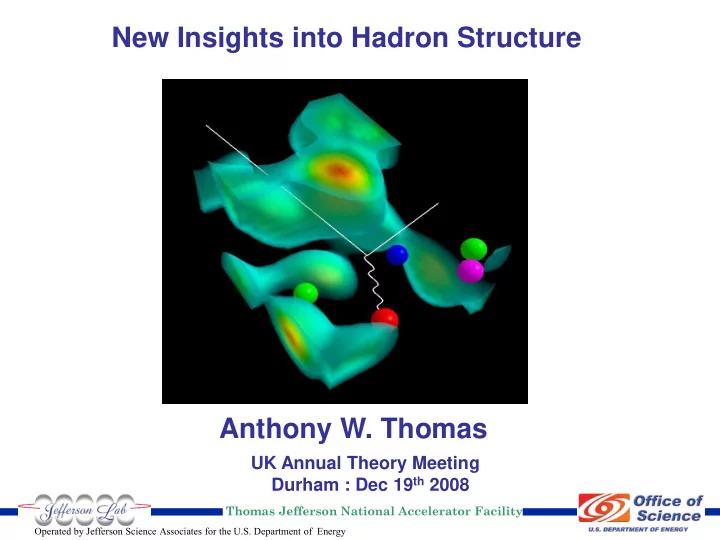
Anthony W. Thomas UK Annual Theory Meeting Durham : Dec 19 th 2008 - - PowerPoint PPT Presentation
New Insights into Hadron Structure Anthony W. Thomas UK Annual Theory Meeting Durham : Dec 19 th 2008 Thomas Jefferson National Accelerator Facility Operated by Jefferson Science Associates for the U.S. Department of Energy Outline Octet
Thomas Jefferson National Accelerator Facility
Operated by Jefferson Science Associates for the U.S. Department of Energy
UK Annual Theory Meeting Durham : Dec 19th 2008
Operated by Jefferson Science Associates for the U.S. Department of Energy
Thomas Jefferson National Accelerator Facility
Page 2
Operated by Jefferson Science Associates for the U.S. Department of Energy
Thomas Jefferson National Accelerator Facility
Page 3
experimental data
constraints than others?
structure and use them to understand nuclear structure better?
Operated by Jefferson Science Associates for the U.S. Department of Energy
Thomas Jefferson National Accelerator Facility
Page 4
2 + cLNA m 3 + c4 m 4 + cNLNA m 4 ln m + O(mπ 5)
Mass in chiral limit No term linear in m (in FULL QCD…… there is in QQCD) First (hence “leading”) non-analytic term ~ mq
3/2
( LNA) Source: N ! N ! N cLNA MODEL INDEPENDENT Another branch cut from N ! ! N
non-analytic (NLNA) cNLNA MODEL INEPENDENT
Operated by Jefferson Science Associates for the U.S. Department of Energy
Thomas Jefferson National Accelerator Facility
Page 5
2 + γ m 3 (dashed curve)
( From: Leinweber et al., Phys. Rev., D61 (2000) 074502 ) mπ
2|phys=0.02
Operated by Jefferson Science Associates for the U.S. Department of Energy
Thomas Jefferson National Accelerator Facility
Page 6
Is it believable that smooth behavior for mπ above 400 MeV is a result of a different accidental cancellation in every case?? a + b mπ
2 + c mπ 3 + d mπ 4 ln mπ + mπ 5 +….
Operated by Jefferson Science Associates for the U.S. Department of Energy
Thomas Jefferson National Accelerator Facility
Page 7
5 term!
Operated by Jefferson Science Associates for the U.S. Department of Energy
Thomas Jefferson National Accelerator Facility
Page 8
2/(32 f 2)
Operated by Jefferson Science Associates for the U.S. Department of Energy
Thomas Jefferson National Accelerator Facility
Page 9
from pion cloud 1983
(AWT, Phys. Lett. B126, 97)
model independent piece, for b>0.55fm
be distinguished from ―core‖
Operated by Jefferson Science Associates for the U.S. Department of Energy
Thomas Jefferson National Accelerator Facility
Page 10
Leinweber et al., PRL 92 (2004) 242002
Operated by Jefferson Science Associates for the U.S. Department of Energy
Thomas Jefferson National Accelerator Facility
Page 11
Leinweber, Thomas & Young, hep-lat/0501028
Operated by Jefferson Science Associates for the U.S. Department of Energy
Thomas Jefferson National Accelerator Facility
Page 12
2
Operated by Jefferson Science Associates for the U.S. Department of Energy
Thomas Jefferson National Accelerator Facility
Page 13
We fit using SU(3) expansions plus FRR loops (π, η and K)
Operated by Jefferson Science Associates for the U.S. Department of Energy
Thomas Jefferson National Accelerator Facility
Page 14
(Walker-Loud et al., arXiv:0806.4549) Young & Thomas, in preparation
SU(3) parameters plus Λ, fit to lowest 8 data points
physics to be extracted from this fit
Operated by Jefferson Science Associates for the U.S. Department of Energy
Thomas Jefferson National Accelerator Facility
Page 15
(Aoki et al., arXiv:0807.1661[hep-lat]) Young & Thomas, in preparation
Operated by Jefferson Science Associates for the U.S. Department of Energy
Thomas Jefferson National Accelerator Facility
Page 16
(of 2008 LHPC & PACS-CS data)
potential, which involves no chiral physics
Operated by Jefferson Science Associates for the U.S. Department of Energy
Thomas Jefferson National Accelerator Facility
Page 17
45 § 8 MeV (or 70?) y=0.2 § 0.2 ? Hence 110 § 110 MeV (increasing to 180 ± 180 for higher N)
As much as half the deuteron magnetic moment? As much as 10% of the spin of the proton?
Operated by Jefferson Science Associates for the U.S. Department of Energy
Thomas Jefferson National Accelerator Facility
Page 18
σ terms spin Neutralino (0.3 GeV / cc :WMAP )
Operated by Jefferson Science Associates for the U.S. Department of Energy
Thomas Jefferson National Accelerator Facility
Page 19
5) term
MN = 0.885 + 3.20m
2 – 5.6m 3 + 34 m 4 – (50-110)m 5 …
c.f. FRR fit required to include physical nucleon mass: MN = 0.897 + 2.83m
2 – 5.6m 3 + 22m 4 – (44 § 18)m 5 …
Leinweber et al., Lect. Notes in Phys. 663 (2005) 113 (hep:lat/0608002)
Operated by Jefferson Science Associates for the U.S. Department of Energy
Thomas Jefferson National Accelerator Facility
Page 20
Λ σ
Operated by Jefferson Science Associates for the U.S. Department of Energy
Thomas Jefferson National Accelerator Facility
Page 21
Need O(mπ
6) to get accurate light quark σ term
While for strange condensate expansion is useless ! BUT through FRR have closed expression and can evaluate ….
Operated by Jefferson Science Associates for the U.S. Department of Energy
Thomas Jefferson National Accelerator Facility
Page 22
(of 2008 LHPC & PACS-CS data)
Operated by Jefferson Science Associates for the U.S. Department of Energy
Thomas Jefferson National Accelerator Facility
Page 23
Operated by Jefferson Science Associates for the U.S. Department of Energy
Thomas Jefferson National Accelerator Facility
Page 24
Operated by Jefferson Science Associates for the U.S. Department of Energy
Thomas Jefferson National Accelerator Facility
Page 25
p = 2/3 up -1/3 dp + ON n = -1/3 up +2/3 dp + ON 2p +n = up +3 ON + = 2/3 u – 1/3 s + O - = -1/3 u -1/3 s + O + - - = u (and p + 2n = dp + 3 ON )
ON = 1/3 [ n + 2p – ( un / u ) (0 - -) ]
CS
(Leinweber and Thomas, Phys Rev D62 (2000)
Operated by Jefferson Science Associates for the U.S. Department of Energy
Thomas Jefferson National Accelerator Facility
Page 26
valence : QQCD Data Corrected
Lattice data from Zanotti et al. ; Chiral analysis Leinweber et al. c.f. CQM 2/3 940/540 » » 1.18
a0 + a2 m
2 + a4 m 4 + ‗al loops
Operated by Jefferson Science Associates for the U.S. Department of Energy
Thomas Jefferson National Accelerator Facility
Page 27
Universal Here!
Operated by Jefferson Science Associates for the U.S. Department of Energy
Thomas Jefferson National Accelerator Facility
Page 28
Operated by Jefferson Science Associates for the U.S. Department of Energy
Thomas Jefferson National Accelerator Facility
Page 29
QQCD Valence Full QCD Expt. p 2.69 (16) 2.94 (15) 2.86 (15) 2.79 n
+ 2.37 (11) 2.61 (10) 2.52 (10) 2.46 (10) -
0
-
up 1.66 (08) 1.85 (07) 1.85 (07) 1.81 (06) u
Operated by Jefferson Science Associates for the U.S. Department of Energy
Thomas Jefferson National Accelerator Facility
Page 30
s = -0.046
Leinweber et al., (PRL June ‘05) hep-lat/0406002
Highly non-trivial that intersection lies on constraint line!
Operated by Jefferson Science Associates for the U.S. Department of Energy
Thomas Jefferson National Accelerator Facility
Page 31
Operated by Jefferson Science Associates for the U.S. Department of Energy
Thomas Jefferson National Accelerator Facility
Page 32
Operated by Jefferson Science Associates for the U.S. Department of Energy
Thomas Jefferson National Accelerator Facility
Page 33
Projected uncertainty
Leinweber et al Q2 = 0.1 GeV2
(PVA4, G0, HAPPEx III) JLab
Courtesy of R. McKeown, R. Young, J. Liu
Operated by Jefferson Science Associates for the U.S. Department of Energy
Thomas Jefferson National Accelerator Facility
Page 34
Operated by Jefferson Science Associates for the U.S. Department of Energy
Thomas Jefferson National Accelerator Facility
Page 35
X Angle BPM
Energy: -0.25 ppb X Target: 1 nm X Angle: 2 nm Y Target : 1 nm Y Angle: <1 nm
Surpassed Beam Asymmetry Goals for Hydrogen Run Corrected and Raw
ppm micron
Total correction for beam position asymmetry on Left, Right, or ALL detector: 10 ppb from Kent Paschke
Operated by Jefferson Science Associates for the U.S. Department of Energy
Thomas Jefferson National Accelerator Facility
Page 36
Operated by Jefferson Science Associates for the U.S. Department of Energy
Thomas Jefferson National Accelerator Facility
Page 37
||
q q q q
2 2 1
N.B. At Q2 sufficiently high (>2 GeV2) the dependence on Q2 is logarithmic and described by perturbative QCD (scaling)
x = Q2 / 2 MN = fraction of proton momentum carried by the quark
Operated by Jefferson Science Associates for the U.S. Department of Energy
Thomas Jefferson National Accelerator Facility
Page 38
p (x) = ( u - d ) /12 + ( u + d – 2 s ) /36
A : from decay of n
A : hyperon decay
u ´ fraction of proton spin carried by u and anti-u quarks, etc..
Operated by Jefferson Science Associates for the U.S. Department of Energy
Thomas Jefferson National Accelerator Facility
Page 39
(93 authors)
Operated by Jefferson Science Associates for the U.S. Department of Energy
Thomas Jefferson National Accelerator Facility
Page 40
Operated by Jefferson Science Associates for the U.S. Department of Energy
Thomas Jefferson National Accelerator Facility
Page 41
At 3 GeV2 s » 0.3 and Nf = 3, so IF all of the N spin carried by quarks is cancelled by gluons: G = + 2 * * 1 » + 6 3 * 0.3 …actually G » + 4 better
for which no physical explanation was ever offered
5 g g
x
Operated by Jefferson Science Associates for the U.S. Department of Energy
Thomas Jefferson National Accelerator Facility
Page 42
Operated by Jefferson Science Associates for the U.S. Department of Energy
Thomas Jefferson National Accelerator Facility
Page 43
than 65% of the proton spin with 90% confidence
even stronger constraints on gluon polarization
G=G
GRSV-std
G=-G G=0
Projected statistical uncertainties for STAR 2006 inclusive jet ALL
jet
Operated by Jefferson Science Associates for the U.S. Department of Energy
Thomas Jefferson National Accelerator Facility
Page 44
“std” scenario, G(Q2=1GeV2)=0.4, is excluded by data on >3 sigma level
Operated by Jefferson Science Associates for the U.S. Department of Energy
Thomas Jefferson National Accelerator Facility
Page 45
CLAS precision data more than doubled the data points in the DIS region from 30 years of high energy polarized structure function measurements.
At moderate x = 0.4, the relative uncertainty of xΔG is reduced by a factor 3 and of Δs-Δs by a factor 2. The dashed lines include the CLAS data in the analysis (LSS’06).
Operated by Jefferson Science Associates for the U.S. Department of Energy
Thomas Jefferson National Accelerator Facility
Page 46
1 = 0 to x = 10-4
Operated by Jefferson Science Associates for the U.S. Department of Energy
Thomas Jefferson National Accelerator Facility
Page 47
(neither paper could explain reduction to only 14%!)
Operated by Jefferson Science Associates for the U.S. Department of Energy
Thomas Jefferson National Accelerator Facility
Page 48
Myhrer & Thomas, Phys R ev D38 (1988)
Operated by Jefferson Science Associates for the U.S. Department of Energy
Thomas Jefferson National Accelerator Facility
Page 49
Hogaasen & Myhrer, Z. Phys. C48 (1990) 295 Yamaguchi et al., Nucl. Phys. A 500 (1989) 429
F = 0.45 (fixed) D = 0.81 D = 0.74 D = 0.60
Without OGE correction MIT bag gives F = 2B0 /3, D = B0
Operated by Jefferson Science Associates for the U.S. Department of Energy
Thomas Jefferson National Accelerator Facility
Page 50
Operated by Jefferson Science Associates for the U.S. Department of Energy
Thomas Jefferson National Accelerator Facility
Page 51
Operated by Jefferson Science Associates for the U.S. Department of Energy
Thomas Jefferson National Accelerator Facility
Page 52
Myhrer & Thomas, hep-ph/0709.4067
Operated by Jefferson Science Associates for the U.S. Department of Energy
Thomas Jefferson National Accelerator Facility
Page 53
Lu+ubar Ld+dbar
Non-relativistic
1.0 Relativity (e.g. Bag) 0.46
0.65 Plus OGE 0.52
0.50 Plus pion 0.50 0.12 0.38
Operated by Jefferson Science Associates for the U.S. Department of Energy
Thomas Jefferson National Accelerator Facility
Page 54
LHPC: hep-lat/0610007
(c.f. + 0.25 and +0.06 in our ―resolution‖)
u Ld Lu d
Operated by Jefferson Science Associates for the U.S. Department of Energy
Thomas Jefferson National Accelerator Facility
Page 55
that connection between quark models and QCD must be at low-Q2
monotonically decreasing with Q2 " and in models quarks carry nearly all the momentum (used by Glück-Reya to model HERA data to very low x - 2 = 0.23 GeV2 at LO – Phys Lett 359, 205 (1995))
e.g. Schreiber et al., PR D42, 2226 (1990) : = 0.5 GeV (N.B. Using LO rather than NLO QCD changes not the results at 5-10 GeV2)
Operated by Jefferson Science Associates for the U.S. Department of Energy
Thomas Jefferson National Accelerator Facility
Page 56
Jd Lu and Ld both small and cross-over rapidly: AWT, PRL 101 (2008) 102003
Operated by Jefferson Science Associates for the U.S. Department of Energy
Thomas Jefferson National Accelerator Facility
Page 57
x
x+x x-x hard vertices
x– longitudinal momentum transfer x – quark momentum fraction –t – Fourier conjugate to transverse impact parameter
At large Q2 : QCD factorization theorem hard exclusive process can be described by 4 transitions (Generalized Parton Distributions) : Vector
Tensor
Axial-Vector : H (x, ξ, t) Pseudoscalar
Operated by Jefferson Science Associates for the U.S. Department of Energy
Thomas Jefferson National Accelerator Facility
Page 58
Upgraded JLab has complementary & unique capabilities
unique to JLab
experiments
High xB only reachable with high luminosity
H1, ZEUS
2 (Im(AB*))/ |A|21x2 |B|2x2t/4m2) - ReAB2x2 AUT Asymmetry depends linearly on the GPD E, which enters Ji‘s sum rule.
Q2 = 5GeV2
Operated by Jefferson Science Associates for the U.S. Department of Energy
Thomas Jefferson National Accelerator Facility
Page 60
From Eric Voutier (ECT* June 08)
Operated by Jefferson Science Associates for the U.S. Department of Energy
Thomas Jefferson National Accelerator Facility
Page 61
Operated by Jefferson Science Associates for the U.S. Department of Energy
Thomas Jefferson National Accelerator Facility
Page 62
Operated by Jefferson Science Associates for the U.S. Department of Energy
Thomas Jefferson National Accelerator Facility
Page 63
p
Operated by Jefferson Science Associates for the U.S. Department of Energy
Thomas Jefferson National Accelerator Facility
Page 64
Operated by Jefferson Science Associates for the U.S. Department of Energy
Thomas Jefferson National Accelerator Facility
Page 65
Operated by Jefferson Science Associates for the U.S. Department of Energy
Thomas Jefferson National Accelerator Facility
Page 66