This s Just t In: a few Fire e Science nce highl hligh ghts - - PowerPoint PPT Presentation

this s just t in a few fire e
SMART_READER_LITE
LIVE PREVIEW

This s Just t In: a few Fire e Science nce highl hligh ghts - - PowerPoint PPT Presentation

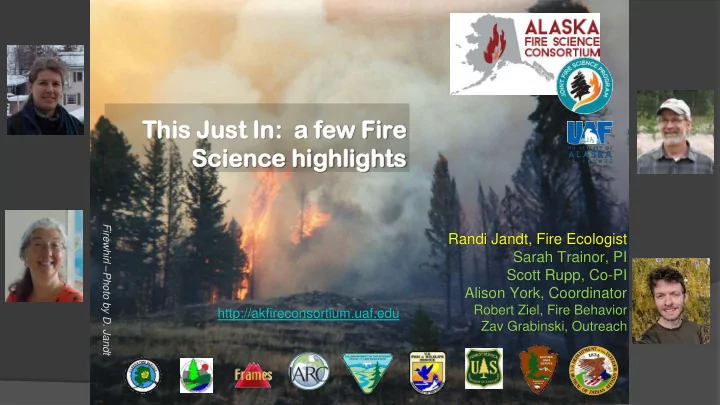
This s Just t In: a few Fire e Science nce highl hligh ghts ts Firewhirl Photo by D. Jandt Randi Jandt, Fire Ecologist Sarah Trainor, PI Scott Rupp, Co-PI Alison York, Coordinator Robert Ziel, Fire Behavior


slide-1
SLIDE 1

This s Just t In: a few Fire e Science nce highl hligh ghts ts

Firewhirl –Photo by D. Jandt

http://akfireconsortium.uaf.edu

Randi Jandt, Fire Ecologist Sarah Trainor, PI Scott Rupp, Co-PI Alison York, Coordinator

Robert Ziel, Fire Behavior Zav Grabinski, Outreach

slide-2
SLIDE 2

Boreal fire regime sensitive to T°--

https://www.ncdc.noaa.gov/cag/statewide/time-series/

Especially summer T°, and the forest floor is one big reason.

1925-2019

slide-3
SLIDE 3

Now read this:

https://uaf-iarc.org/2019/08/23/alaskas-changing-environment/

slide-4
SLIDE 4

Temperature Season Length Ignitions Rainfall Permafrost

May 2016 Ft. McMurray Fire

Photo by Jonathen Hayward, The Canadian Press

More heat = drier fuels = more combustion

slide-5
SLIDE 5

Almost no place with >10 days/yr

% change June/July lightning 1986-2015

Bieniek et al. 2019. (In Review) Lightning

variability in dynamically downscaled simulations

  • f Alaska's present and future summer climate.

Journal of Applied Meteorology and Climatology

Bu But, , so is lightnin ghtning: g:

slide-6
SLIDE 6

Veraverbeke et al., 2017 Nature Climate Change Lightning up 59% Burn Area up by 55% (or 46% with Fuels feedback)

20 40 60 80 100 120 140 160 180

1980-2004 2050-2074

Burn Area

slide-7
SLIDE 7

April 17th 2016—Fire jumped on Knik R near Palmer.

Photo Amy Breen, UAF

Longer Fire Season: Shrinking Snow Season

Statewide snowpack is 1 week later in the autumn and melts 2 weeks earlier in the spring SINCE THE 1990’s.

Source: Fig. 3.9 Ch. 3,

Brown et al., SWIPA 2017.

slide-8
SLIDE 8

Shovel Creek fire,

2019-07-09, 16:16 and 17:59. yellow: high intensity, red: low intensity The smaller pixel size reflects the position of the pixel in the swath center.

Photo: Shovel Ck Fire, June 27, 2019 by LR Swenson, NW Fire Blog.

Courtesy of Robert Ziel & Chris Waigl, UAF

slide-9
SLIDE 9

Shovel Creek fire,

2019-07-09, 16:16 and 17:59. yellow: high intensity, red: low intensity The smaller pixel size reflects the position of the pixel in the swath center. Imagery from the European Space Agency’s Sentinel Missions over the Chalkyitsik Fire Complex in Eastern Interior Alaska July 14, 2019. Heavy smoke from the fires

  • bscures the

ground in the

  • ptical imagery

(left), but has little impact on the SAR image (right).

slide-10
SLIDE 10

6/7 of the large holdover fires in agency records since 2005, were correctly classified by their new algorithm as overwintering fires. In addition, they discovered 9 large overwintering fires that were not reported by agencies between 2002 and 2018 in Alaska!! A results paper is currently in preparation.

2019 McKinley Fire ashpits: Photo: Renette Saba/Alaska IMT

Photo Amy Breen, UAF

slide-11
SLIDE 11

Carson Baughman, USGS, Alaska Science Center Rachel Loehman, USGS, Alaska Science Center

Excellent recorded presentations from the meeting on our Vimeo site! https://vimeo.com/channels/alaskafirescience

slide-12
SLIDE 12

Apr 7, 2020 11:00 am

Ben Gaglioti, UAF Webinar -The environmental legacies

  • f tundra fires in the Noatak River

Valley of Alaska

Apr 16, 2020 10:00 am

Brian Buma and Katherine Hayes, University of Colorado

Webinar - Evaluating Flammability of Reburns in the Boreal Forests of Interior Alaska

March 30th SMAP Drought Code Webinar-Discussion, with Laura Bourgeau-Chavez and team Remote Sensing Research to Operations Workshop in May- POSTPONED until 2021, with NASA ABoVE Science Meeting in Fairbanks. THANK YOU FOR JOINING THE AFSC FIRE SCIENCE WORKSHOP TODAY! Help us do better by filling out the survey which will come to your inbox.

Apr 1, 2020 11:00 am

Jen Schmidt, UAA Webinar - Arctic Urban Risks and Adaptations (AURA)