
SLIDE 1
18TH INTERNATIONAL CONFERENCE ON COMPOSITE MATERIALS
1 General Introduction The present study deals with "dynamic buckling", where a composite cylindrical shell, which is subjected to an axial impact load, loses its stability
- nce
its lateral transient behavior becomes unbounded in response to the applied impulsive
- load. Under this type of loading, a structure may
survive suddenly applied loads, the amplitudes of which may exceed by many times its static buckling capacity before reaching its critical conditions, provided the loading duration is short enough. Hence, the load intensity is loading duration dependent, where the prescribed loading amplitude determines its maximum safe time of application. In the case under consideration, triggering of "dynamic buckling" is only possible in presence of relatively small lateral initial geometric imperfections, or lateral coupled deformations stemming from the cylinder skin constitutive relations. Instability in these cases results from continuous amplification of either the imperfections or the coupled deformations
- nce they exceed permissible critical arbitrarily
prescribed values of stress/strains or deformations. Therefore, definition of "dynamic buckling" is arbitrary and consequently there is no unique criterion as yet for determination of "dynamic buckling", nor guidelines for design of dynamic buckling resistant structures exist. A criterion that lends itself to a rational definition of "dynamic buckling" has been proposed by Budiansky & Hutchinson [1, 2] and is depicted in Figs. 1&2. Following their criteria, dynamic instability will
- ccur when a very small increment in the applied
load given by
) , ( ) , ( t x q t x q
- λ
= ) ( ≥ t
(where
) , ( t x q
represents an assembly of loading histories generated by in this equation,
) , ( t x q
- is a
particular function of x
, and is a parameter) results
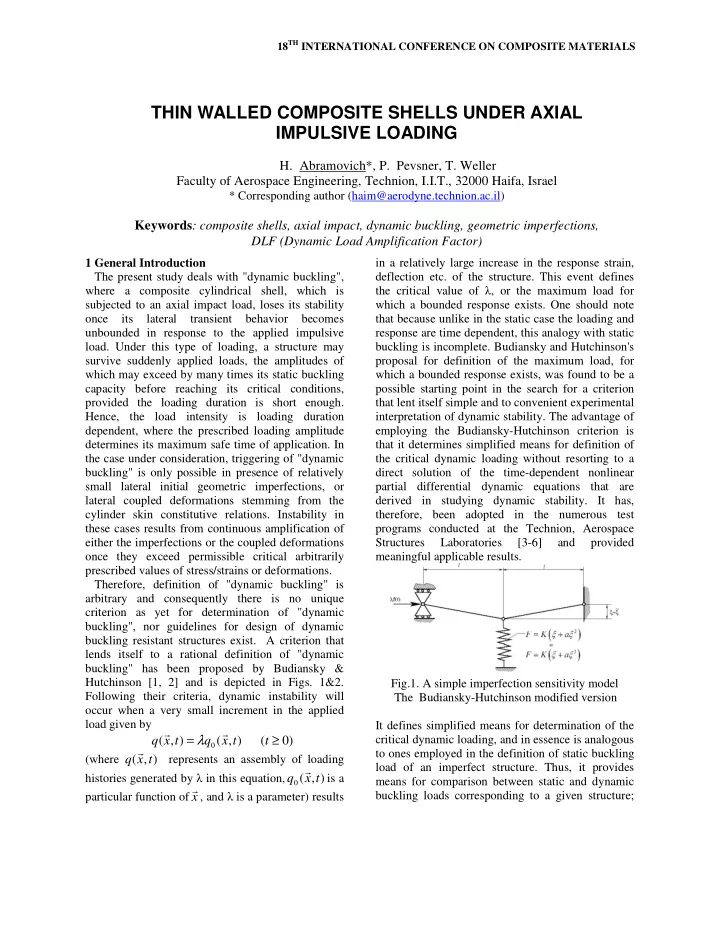
in a relatively large increase in the response strain, deflection etc. of the structure. This event defines the critical value of , or the maximum load for which a bounded response exists. One should note that because unlike in the static case the loading and response are time dependent, this analogy with static buckling is incomplete. Budiansky and Hutchinson's proposal for definition of the maximum load, for which a bounded response exists, was found to be a possible starting point in the search for a criterion that lent itself simple and to convenient experimental interpretation of dynamic stability. The advantage of employing the Budiansky-Hutchinson criterion is that it determines simplified means for definition of the critical dynamic loading without resorting to a direct solution of the time-dependent nonlinear partial differential dynamic equations that are derived in studying dynamic stability. It has, therefore, been adopted in the numerous test programs conducted at the Technion, Aerospace Structures Laboratories [3-6] and provided meaningful applicable results. Fig.1. A simple imperfection sensitivity model The Budiansky-Hutchinson modified version It defines simplified means for determination of the critical dynamic loading, and in essence is analogous to ones employed in the definition of static buckling load of an imperfect structure. Thus, it provides means for comparison between static and dynamic buckling loads corresponding to a given structure;
THIN WALLED COMPOSITE SHELLS UNDER AXIAL IMPULSIVE LOADING
- H. Abramovich*, P. Pevsner, T. Weller