
SLIDE 1
THIN SHELL STRUCTURES
ARCH 2430 Professor Aptekar
Farhana Rahman Jonathan Ramirez Michael DiCarlo Renee Fayzimatova
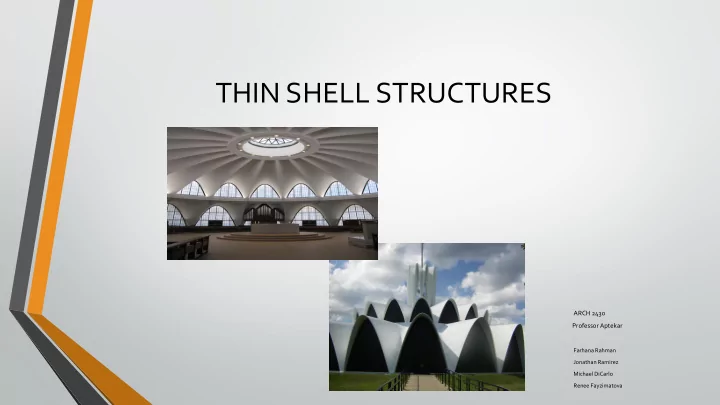
THIN SHELL STRUCTURES ARCH 2430 Professor Aptekar Farhana Rahman - - PowerPoint PPT Presentation
THIN SHELL STRUCTURES ARCH 2430 Professor Aptekar Farhana Rahman Jonathan Ramirez Michael DiCarlo Renee Fayzimatova Thin Shell Structure System spans and effective spans System spans and effective spans Span is the distance between
ARCH 2430 Professor Aptekar
Farhana Rahman Jonathan Ramirez Michael DiCarlo Renee Fayzimatova
System spans and effective spans
System spans and effective spans
intermediate supports for a structure.
flat but in many cases is dome take the form of ellipsoids or cylindrical sections, or some combination thereof
structure is in between 40 – 300 and much larger.
System spans and effective spans
beam and columns in Thin shell Structure would be different.
stay in place without column and buttresses.
Construction time and cost
Construction time and cost
concrete shell involves many problems, the design and construction of forms, reinforcement selection and placing, concrete materials and placing, and curing and decentering.
time consuming meaning curing of concrete takes long and its cost labor work is more.
Construction time and cost
to do with concrete.
then it slow down because of time it
back.
is an opera house and cultural centre in Valencia, Spain. It opened on 8 October 2005
above ground and includes three stories below ground, and height is 75 metres (246 ft), being the tallest opera house in the world.[5] Under the expansive curved-roof structure, 230 m (755 ft) in length, the 40,000 m2 (431,000 sq ft) building contains four auditoriums:
precast concrete canopies measuring 5 × 6 m (16 × 20 ft) and just 20 mm (3⁄4 in.) thick, sup- ported on single columns, provide… shelter for commuters.”
reinforced concrete (UHPFRC) materials that offer… superior technical characteristics including ductility, strength, and durability without using mild reinforcing steel,… highly moldable products with an excellent surface quality.”
canopy
was to provide commuters with weather protection, as well as give the station an aesthetic “make-over” for the sake of the local residencies
the canopies were installed on each platform, the struts were lifted into position using the assembly frame as support for the chain hoist. The struts were connected to the canopies and columns with stainless steel connec- tions. Attachment was accomplished through pinning and welding the struts to the columns and to the underside of the canopies”
thermal expansion breaks between each group of three
plate steel. A three-dimensional model of the casting and form was generated by a computer model.”
would have to rotate after casting to orientate the product with the curve down, al- lowing unrestrained shrinkage to occur while at the same time supporting the casting.”
cross on each column provided an anchor for hoisting the struts into place.”
southbound platform
While air form thin-shell concrete construction is versatile and varied, it is limited to shapes that can be
seem to be no limits on the designs.
derived from the hyperbolic shape which evenly distributes and directs loads downward all in a compressive manner
require to build this type of design
Manuel Larrosa
hyperbolic paraboloid (‘hyper’) was utilized in this project.
Plan Elevation
elevations of front and back views of precast concrete canopy and support strut.
side view of precast concrete canopy structure.
each shell and serves as a conduit for communication, security, and electrical cabling.”
Repetition of forms and connection makes for more efficient assemblies
“Eye of the Storm,” Sullivan’s Island, S.C.: prolate ellipse residence—80 ft. (24.4 m) long, 57 ft. (17.4 m) wide, and 34 ft. (10.4 m) tall. A concrete dome is nearly invulnerable to tornadoes, earthquakes, hurricanes, and other natural disasters.
by Eero Suarinen
Expressionistic
structures
concrete
concrete flat plate slab
terminal was inspired by a gothic vault to a house without column that he saw.
interior curve makes offers an interesting and dramatic space.
curves as the support element for vertical loads.
building’s load, it was easier to build a curved interior space.
visitors.
curved elements, the use of concrete as the structural system was a great choice.
concrete but it has reinforced (steel) inside it that support the roof.
which is round or square. It uses the curve shape and the concept of a column, and combine it to make a Y shape column that blends in with the interiors pace.
floor
the center of the building.
supported by the steel. As the large glass wall extend out in an angle as it meet the ceiling. The large glass allow the natural light come inside the building.
Pro
foundation
Concrete/ Steel
concrete (it makes the structure more stronger and stable)
Con
sealing and doesn’t get fixed then the rain water can get through roof and leak into the building