The weather and the city: road safety 1. Introduction perspective - - PDF document

the weather and the city road safety
SMART_READER_LITE
LIVE PREVIEW

The weather and the city: road safety 1. Introduction perspective - - PDF document

International Co-operation on Theories and Concepts in Traffic Safety International Co-operation on Theories and Concepts in Traffic Safety Presentation Structure The weather and the city: road safety 1. Introduction perspective 2. Data


slide-1
SLIDE 1

30th ICTCT Workshop 26-27 October 2017 – Olomouc. Czech Republic

International Co-operation on Theories and Concepts in Traffic Safety

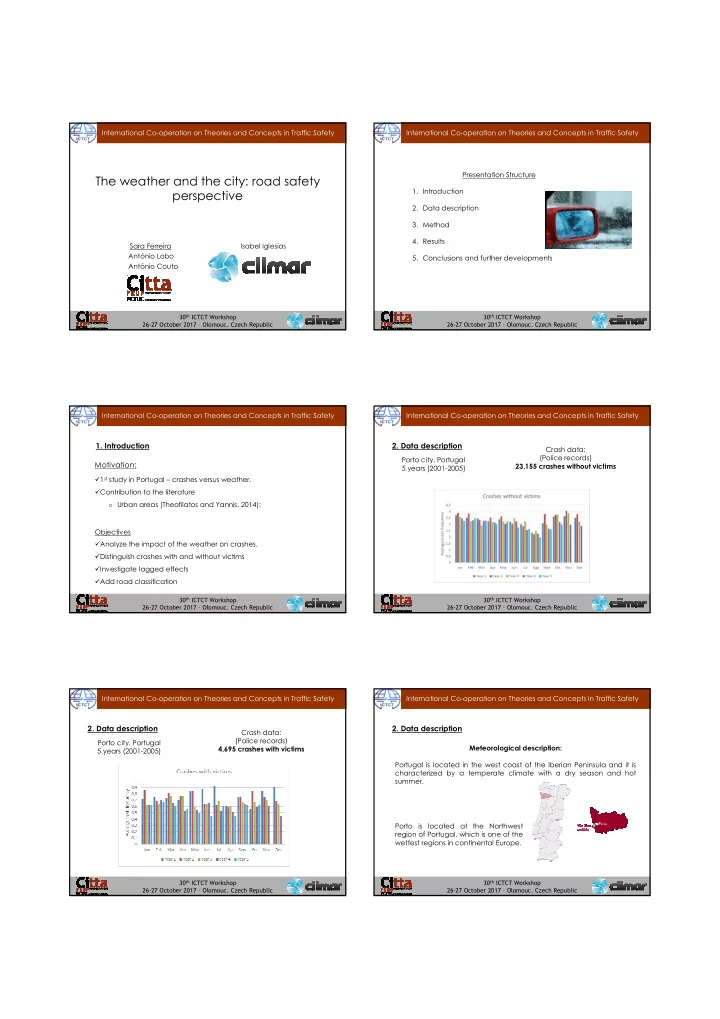
The weather and the city: road safety perspective

Sara Ferreira Isabel Iglesias António Lobo António Couto

30th ICTCT Workshop 26-27 October 2017 – Olomouc. Czech Republic

International Co-operation on Theories and Concepts in Traffic Safety Presentation Structure

  • 1. Introduction
  • 2. Data description
  • 3. Method
  • 4. Results
  • 5. Conclusions and further developments

30th ICTCT Workshop 26-27 October 2017 – Olomouc. Czech Republic

International Co-operation on Theories and Concepts in Traffic Safety 1st study in Portugal – crashes versus weather. Contribution to the literature

  • Urban areas (Theofilatos and Yannis, 2014):

Motivation:

  • 1. Introduction

Objectives Analyze the impact of the weather on crashes. Distinguish crashes with and without victims Investigate lagged effects Add road classification

30th ICTCT Workshop 26-27 October 2017 – Olomouc. Czech Republic

International Co-operation on Theories and Concepts in Traffic Safety

  • 2. Data description

Porto city, Portugal 5 years (2001-2005) Crash data: (Police records) 23,155 crashes without victims

30th ICTCT Workshop 26-27 October 2017 – Olomouc. Czech Republic

International Co-operation on Theories and Concepts in Traffic Safety

  • 2. Data description

Porto city. Portugal 5 years (2001-2005) Crash data: (Police records) 4,695 crashes with victims

30th ICTCT Workshop 26-27 October 2017 – Olomouc. Czech Republic

International Co-operation on Theories and Concepts in Traffic Safety

  • 2. Data description

Porto is located at the Northwest region of Portugal. which is one of the wettest regions in continental Europe. Meteorological description: Portugal is located in the west coast of the Iberian Peninsula and it is characterized by a temperate climate with a dry season and hot summer.

slide-2
SLIDE 2

30th ICTCT Workshop 26-27 October 2017 – Olomouc. Czech Republic

International Co-operation on Theories and Concepts in Traffic Safety Meteorological data sources: Daily Precipitation (mm) - meteorological station located at Serra do Pilar, near the city center, and belonging to the Geophysics Institute of the University of Porto. Daily mean temperature(ºC) - meteorological station of the Portuguese Institute for Sea and Atmosphere (IPMA) located at Porto Airport, in the city surroundings. Daylight duration (min) - Lisbon Astronomical Observatory (OAL)

  • pen database for the city of Porto

30th ICTCT Workshop 26-27 October 2017 – Olomouc. Czech Republic

International Co-operation on Theories and Concepts in Traffic Safety

Variable Mean Standard Deviation Minimum Maximum Number of crashes without victims per day 3.3 2.4 25 Number of crashes with victims per day 0.7 0.9 6 Daily precipitation (mm) 3.4 8.5 0.0 80.9 Daily mean temperature (ºC) 14.9 4.4 3.6 30.4 Daylight duration (min) 737.7 121.2 553.0 908.0 Weekly precipitation (mm) 23.4 34.7 0.0 279.0 Monthly precipitation (mm) 97.5 98.3 0.0 567.2

Statistical description

Weekly precipitation measures the impact of the accumulated precipitation during the previous 7 days. Monthly precipitation measures the impact of the accumulated precipitation during the previous 30 days.

Lagged effects 30th ICTCT Workshop 26-27 October 2017 – Olomouc. Czech Republic

International Co-operation on Theories and Concepts in Traffic Safety Road hierarchy classification: Arterial Principal distributor Local distributor Local access urban road diversity in terms of geometric and functional characteristics proxy of the risk exposition

30th ICTCT Workshop 26-27 October 2017 – Olomouc. Czech Republic

International Co-operation on Theories and Concepts in Traffic Safety

30th ICTCT Workshop 26-27 October 2017 – Olomouc. Czech Republic

International Co-operation on Theories and Concepts in Traffic Safety

  • 3. Method

Count model – GLM Poisson vs. Negative Binomial

~, ℎ = +ln

  • = +ln ~1

, 1

  • If reject the hypothesis of mean equal to variance, then:

30th ICTCT Workshop 26-27 October 2017 – Olomouc. Czech Republic

International Co-operation on Theories and Concepts in Traffic Safety

Crashes with victims - Poisson regression model

Variable Estimated parameter Standard Error P[Z>z] Constant

  • 0.9169

0.0978 0.0000 Arterial (reference)

  • Principal distributor

0.3636 0.0557 0.0000 Local distributor 0.7640 0.0519 0.0000 Local access 0.1011 0.0591 0.0871* Daily precipitation 0.0061 0.0021 0.0040 Weekly precipitation

  • 0.0008

0.0007 0.2521** Monthly precipitation

  • 0.0008

0.0003 0.0042 Temperature

  • 0.0121

0.0044 0.0056 Time trend (ln γ) 0.0039 0.0135 0.7742**

Number of observations = 6,912; Overdispersion parameter tests: g=μi: 2.204; g= μi2: 2.408 Value inferior to χ2

0.05GL=1(3.84) thus, the hypothesis of mean equal to variance is not reject.

Log likelihood = -5966,9; McFadden Pseudo R2 = 0,026; Akaike Information Criterion = 1.729

  • 4. Results
slide-3
SLIDE 3

30th ICTCT Workshop 26-27 October 2017 – Olomouc. Czech Republic

International Co-operation on Theories and Concepts in Traffic Safety

Crashes without victims - NB regression model

Variable Estimated parameter Standard Error P[Z>z] Constant 1.0925 0.0415 0.0000 Arterial

  • Principal distributor

0.7175 0.0224 0.0000 Local distributor 0.2078 0.0237 0.0000 Local access 0.7192 0.0216 0.0000 Daily precipitation 0.0097 0.0009 0.0000 Weekly precipitation 0.0008 0.0003 0.0042 Monthly precipitation

  • 0.0002

0.0001 0.0284 Temperature

  • 0.0153

0.0019 0.0000 Time trend (ln γ)

  • 0.0586

0.0058 0.0000

Number of observations = 6,912; Overdispersion parameter tests: g=μi: 9.504; g= μi2: 8.855 Value superior to χ2

0.05GL=1(3.84) thus, the hypothesis of mean equal to variance is reject.

Log likelihood = -14.159.24; McFadden Pseudo R2 = 0.009; Akaike Information Criterion = 4.099

30th ICTCT Workshop 26-27 October 2017 – Olomouc. Czech Republic

International Co-operation on Theories and Concepts in Traffic Safety

  • 4. Results

Increasing daily precipitation – crashes with and without victims increase too 10% daily precipitation - 0.2% c. with victims 0.3% c. without victims Increasing monthly precipitation – crashes with and without victims decrease 10% monthly precipitation - 0.7% c. with victim 0.2% c. without victims Increasing weekly precipitation – crashes without victims increase too 10% weekly precipitation - 0.2% c. without victims Increasing temperature – crashes without victims decrease 10% temperature - 2% c. without victims 30th ICTCT Workshop 26-27 October 2017 – Olomouc. Czech Republic

International Co-operation on Theories and Concepts in Traffic Safety

Crashes with victims 30th ICTCT Workshop 26-27 October 2017 – Olomouc. Czech Republic

International Co-operation on Theories and Concepts in Traffic Safety

Crashes without victims 30th ICTCT Workshop 26-27 October 2017 – Olomouc. Czech Republic

International Co-operation on Theories and Concepts in Traffic Safety

  • 5. Conclusions:

Daily precipitation affects all crashes in the same line. Daily precipitation may be associated to poor conditions (visibility, vision and friction conditions). Lagged effects are relevant to consider in the analysis of weather effects. 30th ICTCT Workshop 26-27 October 2017 – Olomouc. Czech Republic

International Co-operation on Theories and Concepts in Traffic Safety

  • 5. Conclusions:

Monthly precipitation affects all crashes in the same line. Monthly precipitation may be associated to road users’ behavior rather to any poor road condition - during the rainfall season, drivers tend to be more carefully. Weekly precipitation affects only crashes without victims – may induce in drivers a feeling of adaptation to adverse weather conditions, leading to an underestimation of the risk. Temperature affects only crashes without victims – positively associated to road conditions

slide-4
SLIDE 4

30th ICTCT Workshop 26-27 October 2017 – Olomouc. Czech Republic

International Co-operation on Theories and Concepts in Traffic Safety

  • 5. Further developments

Studies by type of crash, particularly focusing on pedestrians. National study, preferably by regions. Comparison between regions and countries (transferability). Add exposition variables

tend to be more carefulcautious

30th ICTCT Workshop 26-27 October 2017 – Olomouc. Czech Republic

International Co-operation on Theories and Concepts in Traffic Safety

Thank you for your attention!

Sara Ferreira: sara@fe.up.pt