Father Involvement and Childrens Well Being: A Focus on Language - - PowerPoint PPT Presentation

father involvement and children s well being a focus on
SMART_READER_LITE
LIVE PREVIEW

Father Involvement and Childrens Well Being: A Focus on Language - - PowerPoint PPT Presentation

Father Involvement and Childrens Well Being: A Focus on Language Development Catherine S. Tamis-LeMonda, NYU Natasha E. Cabrera, UMD Karen E. McFadden, NYU Jacqueline E. Shannon, CUNY Todays Talk Multiple aspects of father


slide-1
SLIDE 1

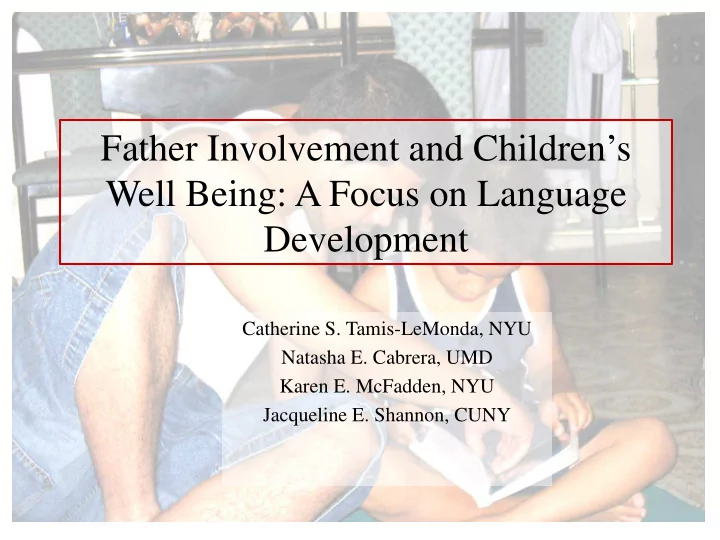
Father Involvement and Children’s Well Being: A Focus on Language Development

Catherine S. Tamis-LeMonda, NYU Natasha E. Cabrera, UMD Karen E. McFadden, NYU Jacqueline E. Shannon, CUNY
slide-2
SLIDE 2

Today’s Talk

  • Multiple aspects of father involvement in

children’s first years of life in relation to children’s language and cognitive skills

slide-3
SLIDE 3

Today’s Talk

  • Multiple aspects of father involvement in

children’s first years of life in relation to children’s language and cognitive skills

Fathers? Young Children? Language?

slide-4
SLIDE 4

Why Father Involvement?

  • Why focus on fathers?

– Critics: Mothers are primary caregivers to

  • children. What’s the added value to studying

fathers?

slide-5
SLIDE 5

Fathers & Family Systems

Mother-Child Father-Child Father-Mother

slide-6
SLIDE 6

Why Language Development?

  • Language is a tool that enables children to:

– share experiences with others – participate in cultural routines – regulate emotions and behaviors – and meet the learning requirements of school

slide-7
SLIDE 7

Why Language Development?

  • Language is a tool that enables children to:

– share experiences with others – participate in cultural routines – regulate emotions and behaviors – and meet the learning requirements of school

  • Language and cognitive skills develop through

social interactions (Vygotsky, Bruner), and fathers are a key source of the language children hear

slide-8
SLIDE 8

Why the First Years of Life?

  • Why focus on infancy and early childhood?

– Critics: Policy and educational concerns revolve around school performance and disparities – Critics: Skills from infancy to childhood are unstable or unreliable? Children will catch up

slide-9
SLIDE 9

Attachment Theory & Developmental Cascades

  • Infancy is a time when parents establish close

relationships with the baby that form the foundation for child well being

slide-10
SLIDE 10

Why the First Years of Life?

  • Infancy is a time when language and cognitive

skills rapidly develop as the building blocks to school success

– Children with strong language skills early on show an advantage in later reading, grammatical development, phonological awareness and cognitive skills years later.

slide-11
SLIDE 11

Today’s Talk: Research Foci

  • RQ1: Which aspects of father involvement are

important to children’s language and cognitive development?

  • RQ2: How and why?
slide-12
SLIDE 12

Data Sources

slide-13
SLIDE 13

Early Head Start

  • 3001 families in randomized experimental-

control design

  • Mother interviews and videorecorded with

children ages 14, 24, 36 mos & Pre-K

  • Father interviews and videorecorded with

children ages at 24, 36 mos & Pre-K

  • Nested study of fathers and mothers of

newborns at 1, 3, 6, 14, 24, 36 mos & Pre-K

slide-14
SLIDE 14

MetroBaby Project

  • 380 families recruited from 3 public hospitals

(Mexicans, Dominicans, African American & Chinese)

– Large immigrant and minority groups in the U.S.; growing populations in NYC and other urban communities – Urban poor neighborhoods with high crime rates, language barriers

  • Data collection at birth, 1, 6, 14, 24, 36, 52

months, Kindergarten & 1st grade

slide-15
SLIDE 15

RQ1: Which aspects of father involvement are important to children’s language and cognitive development?

slide-16
SLIDE 16

Direct Pathways

  • Two clear influences:

– The quality of father-child interactions (verbal responsiveness, support, use of rich language) – Fathers’ engagement of children in learning activities

slide-17
SLIDE 17

Influence #1: The Quality of the Father- Child Relationship

slide-18
SLIDE 18

Father-Toddler Interactions

slide-19
SLIDE 19

The Quality of Father-Child Interactions

  • Global coding (1-7) of fathers’ supportiveness

(sensitivity, responsiveness, positive regard), intrusiveness, negativity

  • Micro-coding of fathers’ language use (different

word types, different language functions) from transcriptions of f-c interactions

– “See the ball” (3 word types) – “Look there” (directive); “What is that?” (open ended question); “That’s a blue ball” (descriptive) (3 functions)

slide-20
SLIDE 20

The Quality of Father-Child Interactions

  • How does the quality of fathers’ interactions

compare to those of mothers on global measures and micro measures of language?

slide-21
SLIDE 21

0.5 1 1.5 2 2.5 3 3.5 4 4.5

Support Cognitive Intrusiveness Negativity

Average Rating

Mother Father

Fathers’ and Mothers’ Supportiveness and Negativity with 2- and 3-Year olds

Tamis-LeMonda et al. (2004), Child Development

slide-22
SLIDE 22

20 40 60 80 100 120 140 160 # Word Types

Mother Father

Fathers and Mothers at Play with 2-Year olds: # Word Types

Tamis-LeMonda , Baumwell, Cristofaro (in press), First Language

slide-23
SLIDE 23

5 10 15 20 # Diff Function

Mother Father

Fathers and Mothers at Play with 2-Year olds: Communicative Diversity

Tamis-LeMonda , Baumwell, Cristofaro (in press), First Language

slide-24
SLIDE 24

0.5 1 1.5 2 2.5 3 3.5 4 4.5 5 Mean Length

Mother Father

Fathers and Mothers at Play with 2-Year olds: Mean Length Utterances

Tamis-LeMonda , Baumwell, Cristofaro (in press), First Language

slide-25
SLIDE 25

How do Fathers and Mothers of the Same Child Compare in Language?

  • Children experience uniform language

environments

– Inter-parent correlations from .40 to .60 on all measures

  • The “rich get richer”

– Assortive mating – Or living together makes parents similar

  • Residency moderates mother-father correlation in word

types (relation there for resident, not non-resident)

slide-26
SLIDE 26

Language Heard by Two Children: Parents’ Communicative Diversity

2 4 6 8 10 12 14

Mother Father

# Different language Functions By Parent

A B

Tamis-LeMonda , Baumwell, Cristofaro (in press), First Language

slide-27
SLIDE 27

The Language Expressed by Two Children with Mother and with Father

2 4 6 8 10 12 14

With Mother With Father

# Different Language Functions by Child

A B

Tamis-LeMonda , Baumwell, Cristofaro (in press), First Language

slide-28
SLIDE 28

Father Involvement Matters above Mothers’ Involvement

slide-29
SLIDE 29

Fathers and Mothers at Play with 2- and 3- Year olds

36 MDI 36 PPVT Beta R2 change Beta R2 change Mother’s Supportive Parenting .20* .13*** .14+ .10*** Father’s Supportive Parenting .25** .07*** .25** .08*** Significant Demographics (Parental Education, Income) .08** .10***

+ p < .10. * p ≤ .05. ** p ≤ .01. *** p ≤ .001

Tamis-LeMonda et al. (2004), Child Develolpment

slide-30
SLIDE 30

0.1 0.2 0.3 0.4 0.5 0.6

Types Utt Diversity MLU

Mother Father

* * * * * *

Tamis-LeMonda , Baumwell, Cristofaro (2012), First Language

Bivariate Correlations

Fathers and Mothers Language: Associations with Children’s Language at 2 Years

slide-31
SLIDE 31

Father Involvement Matters for School Readiness

slide-32
SLIDE 32

Father Involvement and Children’s School Readiness

  • Participants & Procedures

– Approximately 1200 resident low-income fathers

  • f young children from a nationally representative

sample (ECLS-B) – Fathers reported on parenting behaviors when children were 9 months and 2 years of age – Children’s school readiness at preschool age

McFadden, K. E., 2012

slide-33
SLIDE 33

Father Involvement and Children’s School Readiness

  • Which set of fathering behaviors predict

children’s school readiness skills?

– Childcare (α = .86) – Learning Activities (α = .78) – Outings (α = .77) – Time with Child (α = .77) – Financial Provisioning (α = .79)

McFadden, K. E., 2012

slide-34
SLIDE 34

*p < .05, ** p < .01, *** p < .001, controlling for father race/ethnicity and time spent with child

Fathers’ Learning Activities and Children’s PreKindergarten Skills

McFadden, K. E., 2012

PPVT Reading Math Financial provisioning .09** .12** .15** Engagement in childcare .05

  • .05
  • .07*

Engagement in play activities

  • .06*

.00

  • .02

Engagement in learning activities .11** .14*** .08*

slide-35
SLIDE 35

Father Involvement Matters for Academic Skills in Early Adolescence

slide-36
SLIDE 36

Fathers’ Learning Activities and Children’s 5th Grade Academic Skills

  • Participants & Procedures

– Approximately 602 low-income fathers of young children participating in the Early Head Start National Evaluation Study – Fathers’ participation in learning activities when children 2, 3 years and in pre-school – Children assessed on receptive language (PPVT), literacy and math skills in 5th grade

McFadden, Tamis-LeMonda, Cabrera (2012), Family Science

slide-37
SLIDE 37

*p < .05, ** p < .01, *** p < .001, controlling for father race/ethnicity and time spent with child

Fathers’ Learning Activities and Children’s 5th Grade Academic Skills

McFadden, K. E., 2012

PPVT Reading Math Father Engagement in Early Learning Activities .14*** .15** .09* Child Positive Relationship with Biological Father .16** .17** .10 Child Positive Relationship with Father-Figure .09* .15*** .14** R2 .04*** .05*** .03**

slide-38
SLIDE 38

RQ2: Why do these aspects of father involvement matter?

slide-39
SLIDE 39

Pathways of Influence

  • Skill promotion:

– Support of early skills in infants and young children, which snowball to later skills (language examples)

slide-40
SLIDE 40

Emergent Skills Children’s School Performance Father Involvement

Father Pathways of Influence

slide-41
SLIDE 41

Pathways of Influence

  • Family systems:

– Fathering affects the mother-child relationship, which feeds into children’s skills

slide-42
SLIDE 42

Emergent Skills Children’s School Performance Father Involvement Mother-Child Relationship

Father Pathways of Influence

slide-43
SLIDE 43

0.1 0.2 0.3 0.4 0.5 0.6 0.7 0.8 0.9 1

Father Income Father Education Father Quality of Engagement

All Influences Significant at p < .05, .01 or .001 levels.

* * *

Fathers’ Influence on Mothers’ Sensitivity

  • Father supportiveness 2 years to mom 3 years

(N=330)

slide-44
SLIDE 44

Pathways of Influence

  • Cycle of involvement:

– Early father involvement feeds into continued involvement, which then directly affects children

slide-45
SLIDE 45

Emergent Skills Children’s School Performance Father Involvement Mother-Child Relationship

Father Pathways of Influence

Father-Child Relationship

slide-46
SLIDE 46

Example of Pathways: Fathers’ Prenatal Involvement

slide-47
SLIDE 47

Fathers’ Prenatal Involvement

  • Family system
  • Cycles of involvement
slide-48
SLIDE 48

Fathers’ Prenatal Involvement and Involvement across 5 years of Life

  • Does father see child at least a few times per

month or more, modeled at successive ages:

– Birth – 1 mo. – 14 mos. – 24 mos. – 36 mos. – Pre-K

Shannon, Cabrera, Tamis-LeMonda, & Lamb (2009), Parenting: Science & Practice

slide-49
SLIDE 49

Closer Look at Prenatal Involvement

slide-50
SLIDE 50

Fathers’ Prenatal Involvement and Involvement with 14-Month Olds

Tamis-LeMonda, Yoshikawa, Kahana-Kalman, Niwa, . (2008), Sex Roles

Mother- Father Relationship Father Involvement 14 Months Prenatal Involvement Father Involvement Infancy

slide-51
SLIDE 51

Fathers’ Prenatal Involvement and Involvement with 14-Month Olds

  • Visiting the hospital
  • Visiting the doctor
  • Seeing an ultrasound
  • Speaking to mother about

the pregnancy

  • 380 immigrant and low-income families
  • Interviews on father prenatal involvement at birth of

baby

  • Giving money to buy things

for the baby

  • Feeling the baby move
  • Attending Lamaze or other

birth classes

  • Listening to baby’s

heartbeat

Tamis-LeMonda, Yoshikawa, Kahana-Kalman, Niwa, . (2008), Sex Roles

slide-52
SLIDE 52

Fathers’ Prenatal Involvement and Involvement with 14-Month Olds

  • Father involvement in infancy (mediator)

– Daily diaries of 24-hour period in the life of the baby at 1 month & 6 months – Offered data on fathers’ time with infant and activities he engaged in with baby the prior day – Survey items asked about fathers’ engagement in childcare and play with infants

Tamis-LeMonda, Yoshikawa, Kahana-Kalman, Niwa, . (2008), Sex Roles

slide-53
SLIDE 53

Fathers’ Prenatal Involvement and Involvement with 14-Month Olds

  • Sing songs
  • Watch TV
  • Watch videos
  • Read books
  • Tell stories
  • Father involvement at 14 months (outcomes) =

time spent engaged in activities with toddler

  • Listen to music
  • Play games without toys
  • Play rough-tumble games
  • Build things with child
  • Play with ball

Tamis-LeMonda, Yoshikawa, Kahana-Kalman, Niwa, . (2008), Sex Roles

slide-54
SLIDE 54

10 20 30 40 50 60 70 80 90 100 Accessible Caregiving Social Outings

Hi Prenatal Lo Prenatal

* * N= 278, n= 200 high involvement; n= 78 low involvement based on distribution cut < 6 * * % of Fathers

Fathers’ Prenatal Involvement and Involvement in Infancy

slide-55
SLIDE 55

% of Fathers

Father Prenatal Involvement and the M-F Relationship at 1 Month

0.5 1 1.5 2 2.5 3 3.5 4 4.5 5 Quality Relation Support Conflict

Hi Prenatal Lo Prenatal

* *

Tamis-LeMonda, C. S., Yoshikawa, H., Kahana-Kalman, Niwa, E. (2008), Sex Roles

slide-56
SLIDE 56

Fathers’ Prenatal Involvement and Involvement with 14-Month Olds

Tamis-LeMonda, Yoshikawa, Kahana-Kalman, Niwa, . (2008), Sex Roles

.33* * .30* * .21* * .18* * * .33* * (.18* * )

Mother- Father Relationship Father Involvement 14 Months Prenatal Involvement Father Involvement 1 & 6 Months

slide-57
SLIDE 57

Prediction to 14-Month Involvement

Tamis-LeMonda, C. S., Yoshikawa, H., Kahana-Kalman, Niwa, E. (2008), Sex Roles

B SE B ß Father Education .079 .116 .051 Father Employment .227 .158 .113 Father Marital Status .008 .126 .005 Father Residency .058 .143 .035 Mexican Contrast

  • .165

.155 .105 Dominican Contrast

  • .038

.150

  • .024

Prenatal Involvement .771 .342 .178** Involvement 1 & 6 Months .532 .241 .184*** Mother-Father Relationship .228 .062 .303** R2 Total= .27 F (9, 143) = 5.93, p = .000

* * p < .01, * * * p < .001, two-tailed.

slide-58
SLIDE 58

Conclusions

  • Early father-child interactions and engagement in

learning activities predict children’s emerging language skills and later academic skills

  • Effect sizes for father-to-child associations are as

strong as those seen for mother-to-child associations

  • Pathways of influence include promotion of early

child skills, effects on mother-child interactions, and snowball effects of involvement over time

slide-59
SLIDE 59

Special Thanks to….

  • Administration for Children and Families
  • NICHD
  • Ford Foundation
  • National Science Foundation
  • And the fathers and families in our studies
slide-60
SLIDE 60

Fathers’ Income and Work Continue to Matter for father engagement at 2 and 3 Years and at PreK (Ns = 290; 500)

  • Tamis-LeMonda, C. S., Shannon, J. D., Cabrera,
  • N. J., & Lamb, M. E. (2004). “Fathers and

Mothers at Play with their 2- and 3-Year-Olds: Contributions to Language and Cognitive Development”, Child Development.

  • Cabrera, N., Shannon, J. D., & Tamis-LeMonda,
  • C. S. (under review).
slide-61
SLIDE 61
slide-62
SLIDE 62

Fathers’ Time and Financial Investments

  • 799 Fathers of 24-month-old children
  • Face-to-face interviews with Fathers
  • Fathers reported on their child-related

behaviors on 31 items

– included accessibility, financial responsibility, and direct engagement

McFadden, Tamis-LeMonda, Cabrera, & Howard (in progress).

slide-63
SLIDE 63

Fathers’ Time and Financial Investments

  • Factor analysis of 31 father behaviors resulted

in 5 factors:

– Childcare (α = .86) – Learning Activities (α = .78) – Outings (α = .77) – Time with Child (α = .77) – Financial (α = .79)

slide-64
SLIDE 64

Fathers’ Time and Financial Investments

slide-65
SLIDE 65

Survivor Function: Father Accessibility

0.25 0.5 0.75 1 Accessible at Birth Birth to 3 mos. 12 to 15 mos. 22 to 25 mos. 34 to 37 mos. 60 to 63 mos.

Latin American European American African American

% Fathers seeing child few times a month or more

Shannon, Cabrera, Tamis-LeMonda, & Lamb, M. E. (2009). Parenting: Science & Practice.

slide-66
SLIDE 66

Survivor Function: Father Accessibility

% of fathers dropping out

Shannon, Cabrera, Tamis-LeMonda, & Lamb, M. E. (2009). Parenting: Science & Practice.

0.02 0.04 0.06 0.08 0.1 Accessible at Birth Birth to 3 mos. 12 to 15 mos. 22 to 25 mos. 34 to 37 mos. 60 to 63 mos.

Latin American European American African American

slide-67
SLIDE 67

Prenatal Involvement and Risk

0.25 0.5 0.75 1 Accessible at Birth Birth to 3 mos. 12 to 15 mos. 22 to 25 mos. 34 to 37 mos. 60 to 63 mos.

Both Prenatal Activities One Prenatal Activity None

Shannon, Cabrera, Tamis-LeMonda, & Lamb, M. E. (2009). Parenting: Science & Practice.

% of parental involvement