The Volcano Optimizer Generator Generator: Object-oriented and - - PDF document

the volcano optimizer
SMART_READER_LITE
LIVE PREVIEW

The Volcano Optimizer Generator Generator: Object-oriented and - - PDF document

The Volcano Optimizer The Volcano Optimizer Generator Generator: Object-oriented and scientific Extensibility and database systems Allowing query optimization to be Efficient Search more tuned towards the application = Presentation:


slide-1
SLIDE 1

1

The Volcano Optimizer Generator: Extensibility and Efficient Search

Presentation: Alfred Discussion: Kati

The Volcano Optimizer Generator

Object-oriented and scientific

database systems

Allowing query optimization to be

more tuned towards the application = higher performance

(Expert) User optimize

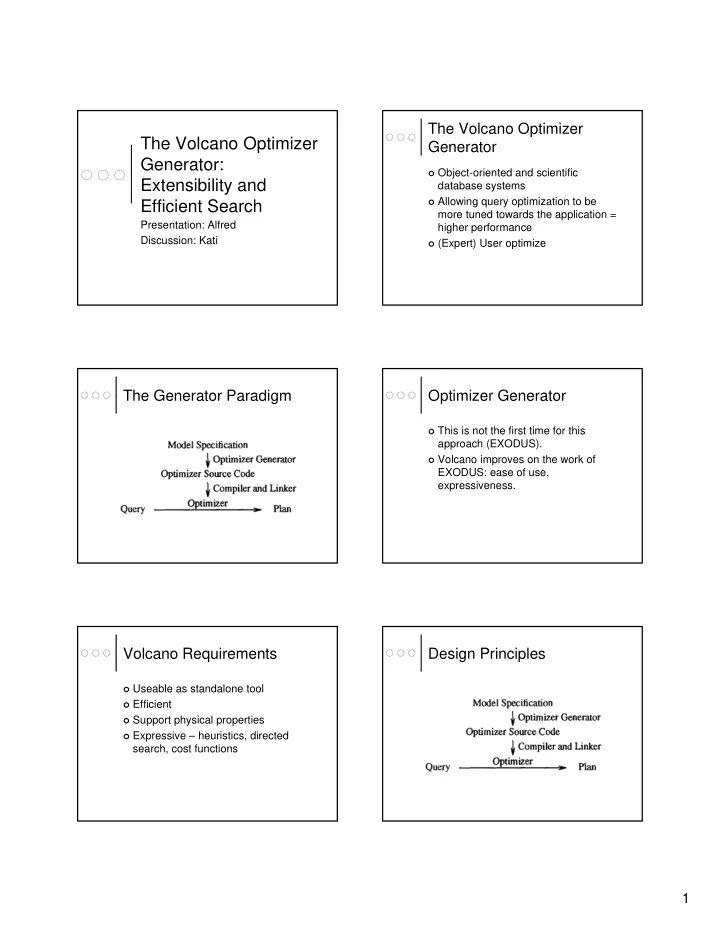
The Generator Paradigm Optimizer Generator

This is not the first time for this

approach (EXODUS).

Volcano improves on the work of

EXODUS: ease of use, expressiveness.

Volcano Requirements

Useable as standalone tool Efficient Support physical properties Expressive – heuristics, directed

search, cost functions

Design Principles

slide-2
SLIDE 2

2

Design Principles

Relational algebra (logical and

physical), especially to support OO

Rules-based => modularization Map queries to same algebraic equiv

as Volcano’s input

Rule compilation rather than

interpretation

Dynamic programming

Optimizer: Input/Output

Input: User Query => Logical algebra

expression

Output: Algorithms to access physical

storage => Physical algebra expression

How does this relate back to the

  • ptimizer generator?

Volcano: Input/Output (1)

Input: Quite a few things! Output: Generated optimizer

Volcano: Input/Output (2)

Set of logical operators Algebraic transformation rules (logical -> physical) Algorithms and enforcers Implementation rules (operators to algorithms) Cost functions Logical properties Physical property vector Applicability function for each algorithm and enforcer Property function for each operator algorithm and

enforcer

Volcano Plan Search Engine

Search engine is same for all

generated optimizers

Directed dynamic programming; goal-

  • riented (driven by needs rather than

by possibilities)

Find costs of promising moves

(transform, algorithm, or enforcer)

Volcano Plan Search Engine

EXODUS did not consider the logical

expressions together with the physical properties in the optimization costing. (Whereas Volcano does)

In OO systems, this can be used to more

properly cost access of complex objects.

Volcano algorithm is top-down (lower levels

are explored only when warranted).
slide-3
SLIDE 3

3

Comparison to Starburst

Starburst has a hierarchy of

intermediate levels; harder to see

  • interactions. Volcano uses an

algebraic approach which paper claims to be easier to understand.

Comparison to Starburst

Query rewrites in Starburst does not

include cost estimates. (Heuristic)

Although paper is critical of this,

Volcano does allow for heuristic transformations to be specified.

Discussion

Form groups and discuss: Which of the query optimizers is the most effective and why do you think so? Please write down key points either supporting Starburst or Volcano. What were the advantages/disadvantages provided by both systems? Does the authors’ criticism of Starburst have merit?

How good was it?

Comparison between Volcano and

EXODUS.

Example used a small data model,

consisting of relational select and join

  • perators only.

As similar data model descriptions as

possible were specified for Volcano and EXODUS.

How good was it?

How long did the optimization take? Did the optimizers come out with

similar estimates?

How good was it?

slide-4
SLIDE 4

4

How good was it?

Volcano took less time to optimize. EXODUS optimizer generator

measurements were quite volatile and took a lot of memory.

EXODUS’s generated optimizer and

search engine do not explore and exploit physical properties and interesting orderings.

Summary Summary

Tools not just relational databases,

but also object-oriented and scientific databases.

Extensibility using optimizer

generator.

Separation of logical and physical

algebras.

Summary

When and how to use heuristic

transforms vs. cost-sensitive

  • ptimizations

Physical properties considered

throughout the optimization, rather than considered after all logical transforms.

Discussion

The authors seem to be very proud of their

  • work. Throughout their paper it sometimes

feels as if you were reading an

  • advertisement. Are there issues you are

concerned about? Think about the user- friendliness of the system, and other things. What features do you think might have been improved by following DBMS (OO features ...)?