
SLIDE 1
University of Washington • iGEM 2008
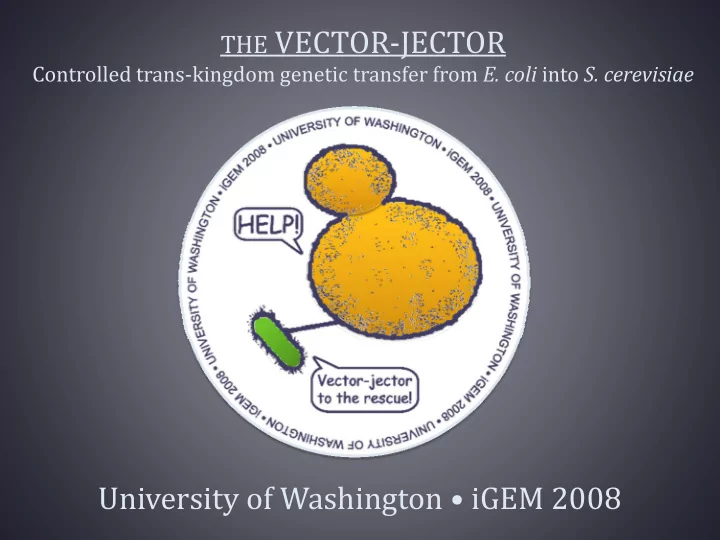
THE VECTOR‐JECTOR
Controlled trans‐kingdom genetic transfer from E. coli into S. cerevisiae
THE VECTORJECTOR Controlled transkingdom genetic transfer from E. - - PowerPoint PPT Presentation
THE VECTORJECTOR Controlled transkingdom genetic transfer from E. coli into S. cerevisiae University of Washington iGEM 2008 Gene therapy transfers functional DNA to repair a defect or confer some novel ability Here, let me Aw, man, my
University of Washington • iGEM 2008
THE VECTOR‐JECTOR
Controlled trans‐kingdom genetic transfer from E. coli into S. cerevisiae
Gene therapy transfers functional DNA to repair a defect or confer some novel ability
Aw, man, my phone won’t play this video! Here, let me send you the latest codec.
Overview
Image Placeholder for SeToB
Inspiration: Bacteria can transfer DNA to yeast by conjugation*
* Heinemann & Sprague. “Bacterial conjugative plasmids mobilize DNA transfer between bacteria and yeast.” Nature 1989.Glycobiosynthesis Research Group, Tsukuba, Japan. Turner et al. Evolution, 1998. Wadsworth Center, NY State Dept. of Health.+
Yeast Conjugation
Vector‐Jector System
Goal: Control DNA transfer from bacteria to yeast
Specifications:
required ability
to yeast
Design: Bacteria transfers DNA to yeast under certain conditions
HELP! Vector‐Jector to the rescue!
Specifics: E. coli transfers DNA to distressed
Specifications:
imparts the ability to digest lactose in yeast
to yeast when lactose is present, glucose is absent, and distressed yeast is in close proximity.
Shuttle Plasmid Transfer Conjugation Machinery Control Module
Vector‐Jector Design: High‐Level Architecture
Environment Sensing Module Signaling Module Conferred Ability Module
On/Off Signal Input [X] Input [Y] Conferred Ability ¬Glucose ¬Glucose Lactose AHL PoPS β‐galactosidase
Shuttle Plasmid Transfer Conjugation Machinery Control Module
Vector‐Jector Design: High‐Level Architecture
Environment Sensing Module Signaling Module Conferred Ability Module
On/Off Signal Input [X] Input [Y] Conferred Ability ¬Glucose ¬Glucose Lactose AHL PoPS β‐galactosidase
100% 10% 35% 50%
Challenges: Controlled DNA transfer from bacteria to yeast
Construct Signaling Module Construct Environment Sensing Module (lactose/glucose) Construct Environment Sensing Module (aTc/arabinose) Construct Conjugation Machinery Control Module Standardize bacteria‐yeast transfer plasmid Experimentally reproduce bacteria‐yeast genetic transfer Use Conferred Ability Module to digest lactose Model our system mathematically Contribute BioBricks to the Registry Characterize BioBrick parts
SeToB: Make circuit design from BioBricks easier Have fun!
Shuttle Plasmid Transfer Conjugation Machinery Control Module Environment Sensing Module Conferred Ability Module
On/Off Signal Input [X] Input [Y] Conferred Ability ¬Glucose ¬Glucose Lactose AHL PoPS β‐galactosidase
Signaling Module produces AHL distress signal in absence of glucose
Signaling Module produces AHL distress signal in the absence of glucose
¬ Glucose LuxI luxI JEN1 promoter AHL
Shuttle Plasmid Transfer Conjugation Machinery Control Module Signaling Module Conferred Ability Module
On/Off Signal Input [X] Input [Y] Conferred Ability ¬Glucose ¬Glucose Lactose AHL PoPS β‐galactosidase
Environment Sensing Module produces PoPS
On/Off Signal Input 2 Input 1
Environment Sensing Module produces PoPS
On/Off Signal Input 2 Input 1
¬Glucose Lactose AHL
AND
LuxR
AND
pLux PoPs
Environment Sensing Module produces PoPS
On/Off Signal Input 2 Input 1
Lactose AHL LuxR
Glucose‐ responsive site ‐35 ‐10 LacI binding site
LuxR generator
(B0034+C0062+B0010+B0012)
LuxR generator regulated by Lac Promoter
(K109702)
pLac
(R0010)
Glucose pLux
(R0062) ‐35 ‐10 LuxR/AHL
PoPS
luxR
Characterization of native lac promoter shows AND‐gate functionality
AND
¬Glucose Lactose GFP Glucose Lactose
CAP ‐35 ‐10 LacI
gfp GFP Measurement protocols were verified with Jason Kelly’s Measurement Kit
Alternative Environmental Sensing Module component responds to different inputs
AND
gfp GFP Arabinose aTc
AraC TetR
Arabinose aTc
"Programming gene expression with combinatorial promoters" by Robert Sidney Cox, III, Michael G Surette, and Michael B Elowitz
GFP
Shuttle Plasmid Transfer Environment Sensing Module Signaling Module Conferred Ability Module
On/Off Signal Input [X] Input [Y] Conferred Ability ¬Glucose ¬Glucose Lactose AHL PoPS β‐galactosidase
Conjugation Machinery Control Module induces conjugation in response to PoPS input
On/Off Horiz. Gene Trans.
RELAY
Conjugation Machinery Control Module induces conjugation in response to PoPS input
On/Off Horiz. Gene Trans.
pLux PoPS
KorA korA pLux
conjugation initiation
Conjugation Machinery Control Module induces conjugation in response to PoPS input
On/Off Horiz. Gene Trans.
pLux PoPS
TrbA trbA pLux
pilus construction
Conjugation Machinery Control Module induces conjugation in response to PoPS input
On/Off Horiz. Gene Trans.
pLux PoPS
Two approaches towards construction of Conjugation Machinery Control Module
conjugative plasmid pLux
Native Promoter Swapping
conjugative plasmid BioBrick plasmid pLux
Knockout and Complementation
*KorA and TrbA have been BioBricked
Conferred Ability Gene (lacZ) pAC88
Yeast Shuttle Vector requires five features for trans‐kingdom transfer
Bacterial
replication Bacterial selectable marker Yeast
replication Yeast selectable marker Origin of transfer
Standardized Yeast Shuttle Vector
Yeast Shuttle Vector requires five features for trans‐kingdom transfer
Bacterial
replication Bacterial selectable marker Yeast
replication Yeast selectable marker Origin of transfer BioBrick standard insertion site
Shuttle Plasmid Transfer Conjugation Machinery Control Module Environment Sensing Module Signaling Module
On/Off Signal Input [X] Input [Y] Conferred Ability ¬Glucose ¬Glucose Lactose AHL PoPS β‐galactosidase
Conferred Ability Module expresses lacZ gene
Shuttle Plasmid Transfer Ability to Digest Lactose
PRODUCTION OF GALACTOSIDASE
β‐Gal lacZ ADH1
Conferred Ability Module expresses lacZ gene
Shuttle Plasmid Transfer Ability to Digest Lactose
Demonstration of bacteria‐yeast conjugation: yeast gains the ability to synthesize leucine
Yeast growth!
No conjugative plasmid present in E. coli Conjugative plasmid present in E. coli
Shuttle Plasmid Transfer Conjugation Machinery Control Module
Vector‐Jector Design: High‐Level Architecture
Environment Sensing Module Signaling Module Conferred Ability Module
On/Off Signal Input [X] Input [Y] Conferred Ability ¬Glucose ¬Glucose Lactose AHL PoPS β‐galactosidase
genetic networks
at poster
Accomplishments: Controlled DNA transfer from bacteria to yeast
Construct Signaling Module Construct Environment Sensing Module (lactose/glucose) Construct Environment Sensing Module (aTc/arabinose) Construct Conjugation Machinery Control Module Standardize bacteria‐yeast transfer plasmid Experimentally reproduce bacteria‐yeast genetic transfer Use Conferred Ability Module to digest lactose Model our system mathematically Contribute BioBricks to the Registry Characterize BioBrick parts
SeToB: Make circuit design from BioBricks easier Have fun!
Acknowledgements
Graduate and Post‐Grad Advisors: ‐ Ingrid Swanson, Microbiology ‐ Rob Egbert, EE ‐ Sean Sleight PhD, BioE ‐ Kevin Schutz, Genome Sciences ‐ Josh Bishop, EE ‐ Carlos Araya, Genome Sciences ‐ Deepak Chandran, BioE ‐ Brandi House, EE Faculty: ‐ Stan Fields, Professor, Genome Sciences and Medicine ‐ Eric Klavins, Assistant Professor, EE ‐ Herbert Sauro, Associate Professor, BioE Funding Sources: ‐ Department of Microbiology, UW ‐ Department of Electrical Engineering, UW ‐Department of Computer Science and Engineering, UW ‐ Department of Bioengineering, UW ‐ National Science Foundation ‐ College of Engineering, UW ‐ Microsoft Space: ‐ Microbiology Teaching Lab, UW
Shuttle Plasmid Transfer Conjugation Machinery Control Module
THE VECTOR‐JECTOR
Environment Sensing Module Signaling Module Conferred Ability Module
On/Off Signal Input [X] Input [Y] Conferred Ability ¬Glucose ¬Glucose Lactose AHL PoPS β‐galactosidase