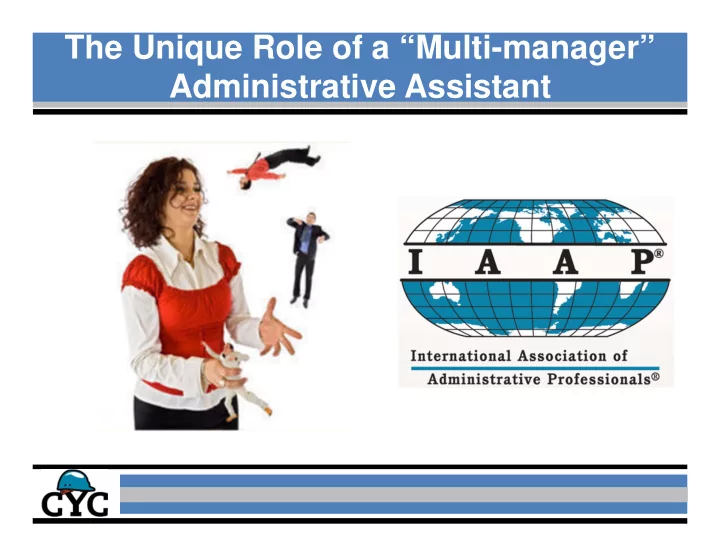
SLIDE 1
The Unique Role of a Multi-manager Administrative Assistant Intro - - PowerPoint PPT Presentation
The Unique Role of a Multi-manager Administrative Assistant Intro Learning Objectives Understand each managers unique work style. Treat each manager fairly and with respect, despite your personal preference. Recognize some of
SLIDE 2
SLIDE 3
Learning Objectives
- Understand each manager’s unique work style.
- Treat each manager fairly and with respect, despite your
personal preference.
- Recognize some of the biggest challenges for multi‐
manager admins and how to overcome them
- Understand the importance of “managing up”
- Recognize signs of multiple‐boss madness
- Identify the importance of managing office politics
- If you are not careful when dealing with multiple bosses,
you can let all of them down.
SLIDE 4
Check In
- Check in weekly with your bosses and let them know
what projects you are currently working on.
- Frequently ask which projects are a priority.
- If a conflict between 2 projects arise, have managers
speak to each other to assess which one comes first.
SLIDE 5
Four Essential Habits of Effective “Multi‐manager” Admins
- 1. A thorough understanding of what each manager
requires of your position.
- 2. The capacity to communicate clearly, concisely and
purposefully.
- 3. The skills to give and receive clear feedback
- 4. The ability to support all stakeholders to ensure
project and/or organizational success
SLIDE 6
Skills for Effective “Multi‐manager” Admins
- Except for time‐critical projects, do the senior
manager’s work first.
- If your managers are on the same level, complete
the task with the earliest due date first.
- Find out what projects are coming up so you can
plan accordingly.
- Ask your managers to give you project materials as
sections are ready. This will help prevent a last‐ minute rush.
- Communicate! Stay informed, and keep your
managers informed.
SLIDE 7
Concerns and Challenges of “Multi‐manager” Admins
Common concerns and challenges
- Uncertainty in a new, strategic role
- Difficulty in delegating due to fear of letting go
- f day‐to‐day work
- Unable to plan effectively, given needs of
multiple managers and business variables
- Uncertain where and how to spend time
SLIDE 8
Why some “Multi‐manager” Admins Fail … and How to Make Sure You Don’t
Outstanding admins:
- 1. Clearly define expectations
- 2. Focus on quality of work rather than time spent on
work
- 3. Address and solve problems immediately
- 4. Exhibit flexibility
- 5. Include all appropriate people in the dissemination
- f information
- 6. Dedicate quality “face time” with their manager(s)
SLIDE 9
Why some “Multi‐manager” Admins Fail … and How to Make Sure You Don’t (cont)
Outstanding admins:
- 6. Display consistency and fairness in delegating
- r assigning work to their support teams
- 7. Maintain positive relationships with support
team members
- 8. Balance time and support to their managers
- 9. Maintain a positive attitude and do not
complain to others about their manager(s)
10.Keep confidential information confidential
SLIDE 10
The Keys To Managing Up
- Encourage your managers to have face‐to‐face
- r telephone conversations with each other
- Ask the managers to clarify which tasks have
priority … establish a prioritizing process
- Know what your boss cares about … understand
the desired business results
- Communicate clearly, concisely and
confidentially
SLIDE 11
The Keys To Managing Up
- Share new and emerging information quickly so
your managers are never blindsided
- Have frequent and regularly scheduled meetings
with each manager
- Ask for a specific deadline for all projects and
major tasks
- Put projects on a timeline and share with all
managers
- Provide solutions, not problems
SLIDE 12
Time savers
- Pay attention – frequently check calendars, tasks to
keep from becoming derailed.
- Keep on Track – create a system (folders, trays) to keep
projects according to deadline date.
- Create more space – walls, hanging pockets, trays
- Manage time wisely‐ Allow time blocks throughout the
day to file and organize for the next day.
- Triage – Keep only those items you won’t be able to
retrieve again through other means.
SLIDE 13
Dealing Effectively With Organizational Politics
- 1. Understand your true organization chart … or
the “power” chart
- 2. Understand the social structures at work
- 3. Build interpersonal relationships.
- 4. Know your ultimate boss.
SLIDE 14
Roles & Responsibilities Org Chart
SLIDE 15
Build Relationships
- Get to know the politically powerful people in
your organization
- Develop relationships that cross the formal
pecking order
- Build strong relationships with those who have the
informal power
- Build your relationships on trust and respect.
- Don’t pick sides
- Be a part of multiple groups
SLIDE 16
Avoid Unethical Political Practices
Don’t:
- Try to speak on behalf of one boss to the
- ther—try to get them to talk with each other if
possible
- Speak poorly about one boss to another
- Discredit a rival
- Cover up the truth … for anyone
- Take undue credit
- Blackmail, slander or spread malicious gossip
SLIDE 17
Overload
SLIDE 18
Signs of Multiple‐Boss Madness
- Infighting among the various managers
- You don’t know whom to please or when
- You’re unsure about handling the conflict on
your own
- Trust is lacking; your loyalty is questioned
- Confusion reigns!
SLIDE 19
Managing the Madness
- Again, review your “true” org chart and your
social structure ‐ Who do you ultimately report to?
- Identify best practices for working with tough
and demanding managers
- Use one‐on‐one conversations as key
relationship‐building tools
SLIDE 20
Managing the Madness (cont)
- Organize a meeting with all your managers in
- rder to outline a problem and present your
solution and discuss calendars weekly.
- Be careful with your e‐mails
- Identify best practices for working with tough
and demanding managers
- Review tips on managing up
SLIDE 21