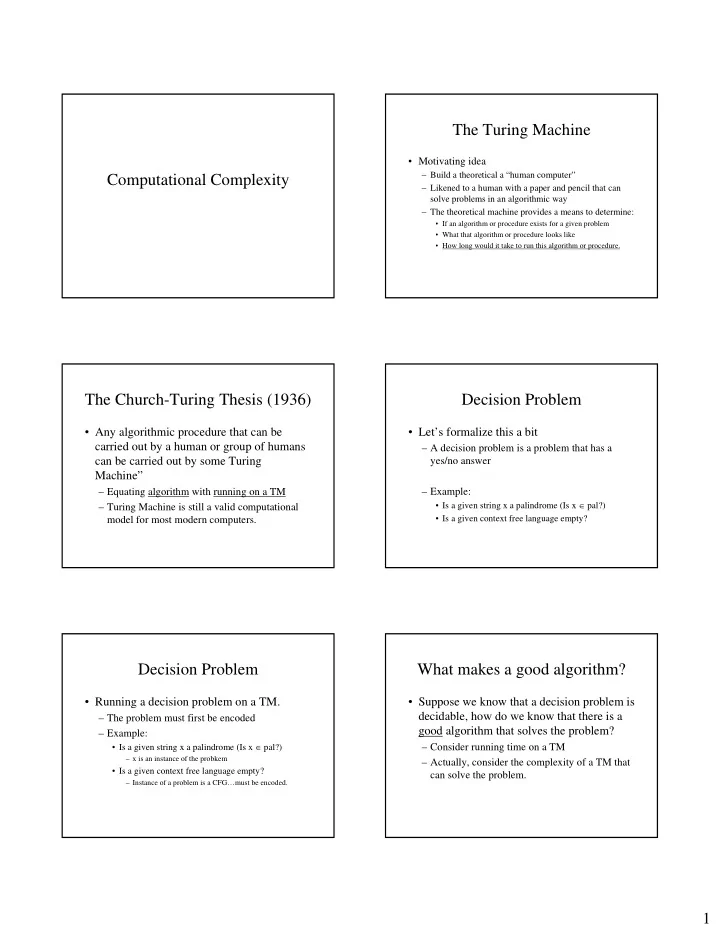
The Turing Machine Motivating idea Build a theoretical a human - - PDF document

the turing machine
SMART_READER_LITE
LIVE PREVIEW

The Turing Machine Motivating idea Build a theoretical a human - - PDF document

The Turing Machine Motivating idea Build a theoretical a human computer Computational Complexity Likened to a human with a paper and pencil that can solve problems in an algorithmic way The theoretical machine provides a


slide-1
SLIDE 1

1

Computational Complexity The Turing Machine

  • Motivating idea

– Build a theoretical a “human computer” – Likened to a human with a paper and pencil that can solve problems in an algorithmic way – The theoretical machine provides a means to determine:

  • If an algorithm or procedure exists for a given problem
  • What that algorithm or procedure looks like
  • How long would it take to run this algorithm or procedure.

The Church-Turing Thesis (1936)

  • Any algorithmic procedure that can be

carried out by a human or group of humans can be carried out by some Turing Machine”

– Equating algorithm with running on a TM – Turing Machine is still a valid computational model for most modern computers.

Decision Problem

  • Let’s formalize this a bit

– A decision problem is a problem that has a yes/no answer – Example:

  • Is a given string x a palindrome (Is x ∈ pal?)
  • Is a given context free language empty?

Decision Problem

  • Running a decision problem on a TM.

– The problem must first be encoded – Example:

  • Is a given string x a palindrome (Is x ∈ pal?)

– x is an instance of the probkem

  • Is a given context free language empty?

– Instance of a problem is a CFG…must be encoded.

What makes a good algorithm?

  • Suppose we know that a decision problem is

decidable, how do we know that there is a good algorithm that solves the problem?

– Consider running time on a TM – Actually, consider the complexity of a TM that can solve the problem.

slide-2
SLIDE 2

2

Complexity

  • Complexity refers to the rate at which the storage
  • r time grows as a function of the input to the

algorithm

– T(n) = time complexity (amount of time an algorithm will take based on input) – S(n) = space complexity (amount of space an algorithm will take based on input)

  • For the rest of this lecture, we’ll only consider

T(n) though the discussion can also be applied to S(n)

Units

  • What does T(n) return?

– A “basic operation” can be defined as a move a TM makes in accepting / rejecting a string – T(n) = number of TM moves

Asymptotic Analysis

  • Based on the idea that as the input to an

algorithm gets large

– The complexity will become proportional to a known function. – Notations:

  • O (Big-O) – upper bounds on the complexity
  • Θ (Big-Theta) – tight bounds on the complexity

Asymptotic Analysis

  • Big-O (order of)

– T(n) = O(f(n)) if and only if there are constants c0 and n0 such that

  • T(n) ≤ c0f(n) for all n ≥ n0

– What this really means

  • Eventually, when the size of the input gets large

enough, the upper bounds on the runtime will be proportional to the function f(n).

Algorithm Efficiencies Are you a good witch?

  • So what should be the cutoff between a “good”

algorithm and a “bad” algorithm?

– In the 1960s, Jack Edmonds proposed:

  • A “good” algorithm is one whose running time is a polynomial

function of the size of the input

  • Other algorithms are “bad”

– This definition was adopted:

  • A problem is called tractable if there exists a “good”

(polynomial time) algorithm that solves it.

  • A problem is called intractable otherwise.
slide-3
SLIDE 3

3

Is this a valid cutoff? The class P

  • The class P contains all decision problems

that are decidable by an “algorithm” that runs in polynomial time.

– Does this define a class of languages? – Yes…

  • The set of all problems whose encodings of “yes

instances” (a language) is recognized by a TM M

  • M recognizes the above language in Polynomial

Time.

The class P

  • If we take the Church-Turing Thesis to be

true:

– P is robust:

  • The problems contained in P remain in P even if we

change our basic model of computation.

– A basic TM – A Sun, a Mac, even a PC running Windows XP!

The class P

  • Are there actually problems in P?

– Most everyday algorithms (e.g. sorting, searching) are in P

  • Are there problems not in P:

– Yes, we know that Self-Accepting is not in P since it isn’t even solvable

  • Are there decidable problems not in P?

– Let’s take a look…

Satisfiability (SAT)

  • INSTANCE

– A Logical expression containing

  • variables xi
  • logical connectors &, |, and !
  • In conjuction normal form (C1 & C2 & C3 … & Cn)
  • PROBLEM

– Is there an assignment of truth values to each of the variables such that the expression will evaluate to true.

Satisfiability (SAT)

  • Example of an instance

– (x1 | x2 | x3 ) & (x4 | !x5) & !x6 & (x7 | x8) – One Solution:

  • x1 = true x5 = false
  • x2 = false x6 = false
  • x3 = false x7 = true
  • x4 = false x8 = false
slide-4
SLIDE 4

4

Satisfiability (SAT)

  • Naïve algorithm to solve

– Systematically consider all combinations of assignments of True and False values for all variables and test the expression – In the worst case, for n variables

  • T(n) = O (2n)

Satisfiability (SAT)

  • Can we do better?

– No known polynomial algorithm

  • Either one doesn’t exist
  • One exists and we haven’t found it yet.

Non-deterministic TM

  • Let’s reconsider the NDTM

– Same as the ordinary TM except:

  • The transition function will return a set of triplets

– (q, x, D)

  • For each state / symbol combination, 0 or more

transitions can be defined.

  • The machine can “choose” which transition to take.

Non-deterministic TM

  • If we map all paths that can possibly be

taken:

– Number of paths will be exponential – Example:

  • Suppose at each of n states, for each character, there

are 2 possible moves.

  • Number of paths 2n

Satisfiability (SAT)

  • Running SAT on a non-deterministic TM.

– Step 1: “Guess” a set of boolean assignments to each variable (this is the non-deterministic part – 2n different choices) – Step 2: Evaluate the truth of the entire expression using the guessed assignment (this part is deterministic) – Can certainly do each step in polynomial time

The class NP

  • The class NP contains all decision problems that

are decidable by a non-deterministic “algorithm” that runs in polynomial time.

  • Represents algorithms that run in exponential time

– Does this define a class of languages? -- Yes…

  • The set of all problems whose encodings of “yes instances” (a

language) is recognized by a NDTM M

  • M recognizes the above language in Polynomial Time.
  • Are there problems in NP

– Well, for one SAT is

slide-5
SLIDE 5

5

The class NP

  • Clearly P is a subset of NP

P NP Is there something in here? After 40 years of research…nobody knows

Reducing one language to another

  • Worked well for deciability…Let’s use it

here.

  • Basic idea

– Take an encoding of one problem – Convert it to another problem we know to be in P or NP – Conversion must be done in polynomial time!

Reducing one language to another

  • Formally (for complexity)

– Let L1 and L2 be languages over Σ1 and Σ2 – We say L1 is polynomial time reducible to L2 (L1 ≤p L2) if

  • There exists a Turing computable function
  • f: Σ1

* → Σ2 * such that

  • x ∈ L1 iff f(x) ∈ L2
  • f can be computed in polynomial time.

Reducing one language to another

  • Informally (for complexity)

– We can take any encoded instance of one problem

  • Use a TM to compute a corresponding encoded instance of

another problem.

– In polynomial time

  • If this other problem has a TM that recognizes the set of “yes

encodings” in polynomial time (P), we can run that TM to solve the first problem.

  • If this other problem has a NDTM that recognizes the set of

“yes encodings” in polynomial time (NP), we can run that TM to solve the first problem.

Reducing one language to another

Conversion TM TM recognizing L2 Instance

  • f P1

Corresponding Instance of P2 YES NO

Runs in Ptime Runs in Ptime

Reducing one language to another

  • Key facts:

– If L1 is reducable to L2 then

  • If L2 is P/NP-compuatble then L1 is also P/NP-compuatble
  • If L1 is not P/NP-compuatble then L2 is not P/NP-compuatble

– If P1 and P2 are decision problems with L1 and L2 the languages of “yes encodings” respectively and if L1 is reducable to L2 then

  • If P2 is in P/NP then P1 is also in P/NP
  • If P1 is not in P/NP then P2 is also not in P/NP
slide-6
SLIDE 6

6

The class NP-complete

  • The hardest of the problems in class NP are

in the class of NP-complete problems:

  • A language L is in NP if

– L ∈ NP – For every other language L1 ∈ NP

  • L1 ≤p L
  • All NP-complete problems are “equally”

difficult.

The class NP-complete

  • Implications

– Hardest problem – It’s probably not worth looking for a solution for an NP-complete problem – How do we show a problem to be NP-complete

  • Reduction
  • We need a NP-complete problem to kick things off.

The class NP-complete

  • Guess what?

– SAT can be shown to be NP-complete – We’ll show this next week.

NP-Complete and P

  • If any a polynomial algorithm is found for any

NP-complete problem

– A polynomial algorithm can be found for all NP- complete problems (via polynomial reduction).

  • In other words

– For any L ∈ NP-Complete,

  • If L ∈ P then
  • P = NP
  • Finding such a language is still an open problem.

NP-Complete and P

  • The world of NP

P NP Is there something in here? After 40 years of research…nobody knows NP-complete

Practical considerations

slide-7
SLIDE 7

7

Practical considerations Practical considerations Dealing with NP-completeness

  • Some NP-complete problems have solutions

that are, on the average, polynomial.

  • Restrict the problem
  • Approximation
  • Heuristics
  • Buy a Supercomputer

Summary

  • P
  • NP
  • NP Complete
  • Note that all are recursive!
  • Next time:

– SAT is NP-Complete