
SLIDE 1
Mechanical Turing Machine in Wood
- R. Ridel
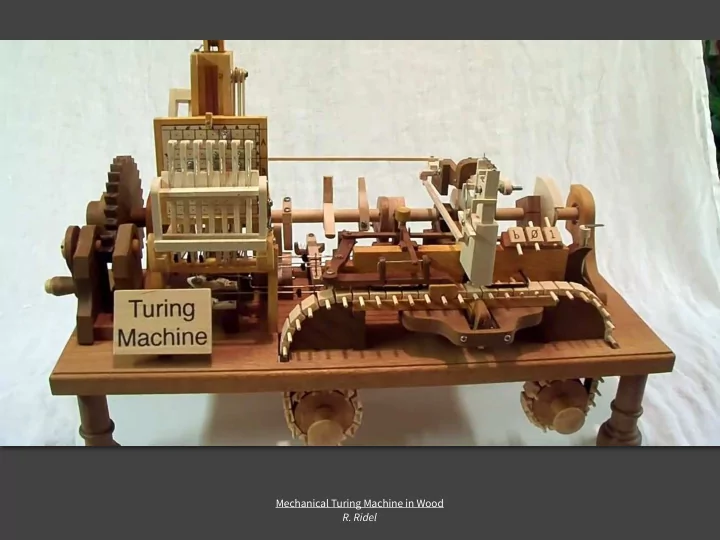
Mechanical Turing Machine in Wood R. Ridel LEGO Turing Machine - - PowerPoint PPT Presentation
Mechanical Turing Machine in Wood R. Ridel LEGO Turing Machine Built by J. van den Bos & D. Landman Video by A. Theelen Come visit the one in my office! Turing Tumble What counts as a problem? Decision problems on finite,
Mechanical Turing Machine in Wood
LEGO Turing Machine Built by J. van den Bos & D. Landman Video by A. Theelen
Turing Tumble
Come visit the one in my office!
Decision problems on finite, bitstring inputs.
What counts as a problem? What counts as a computer?
Turing Machines can solve more problems than DFAs!
(But not all decision problems)
Stored-program computers Random-access memory (RAM) Registers 1-bit memory: latches Logic gates Transistors / switches Thursday next week today
Firstname Lastname
(Your response) A boolean function is a function that takes n bits as input and returns 1 bit of output.
This truth table defines a boolean function. What does the boolean function do?
Can you describe its purpose simply, so that another person could understand?
input
x y z
1 1 1 1 1 1 1 1 1 1 1 1 1 1 1 1 We can also extend the definition of boolean functions so that they return multiple bits of output.
Firstname Lastname
Odd parity: Does the input have an odd number of bits whose value is 1 ? A boolean function is a function that takes n bits as input and returns 1 bit of output.
This truth table defines a boolean function. What does the boolean function do?
Can you describe its purpose simply, so that another person could understand?
input
x y z
1 1 1 1 1 1 1 1 1 1 1 1 1 1 1 1 We can also extend the definition of boolean functions so that they return multiple bits of output.
input
x y 1 1 1 1 1 input
x y 1 1 1 1 1 1 1 input
x 1 1
Boolean operations as gates
the building blocks of combinational logic
input
x y 1 1 1 1 1 input
x y 1 1 1 1 1 1 1 input
x 1 1
AND (⋀) OR (⋁) NOT (¬)
all inputs are 1
any inputs is 1 inverts its input
AND & OR gates can also take more than two inputs.
Great! How can we build these gates?
How to build a NOT gate with a magnet
A minterm is an AND gate connected to all input bits either directly or through a NOT gate
How many minterms in this circuit?
Given a truth table:
For each combination of values that should cause the function to
(and 0 for all other input values).
The resulting circuit implements the truth table.
input
x y 1 1 1 1 1 1
AND OR
NOT
x y AND
NOT
How to use gates to build a truth table
Do the minterm expansion version fjrst, then see if you can make the circuit better (for some defjnition of better)
input
x y z 1 1 1 1 1 1 1 1 1 1 1 1 1 1 1 1 input
x y z 1 1 1 1 1 1 1 1 1 1 1 1 1 1 1 1
Some thought experiments: What do these two functions do? Could you build your circuits without using an or gate? Could you combine these two circuits to compute binary addition?
https://www.youtube.com/watch?v=QNoQvjlmGdk
Pro tip: use “rails” to lay out your circuit
input
x y z
1 1 1 1 1 1 1 1 1 1 1 1 1 1 1 1
sums three bits of input to create two bits of output
input
x y cin cout sum 1 1 1 1 1 1 1 1 1 1 1 1 1 1 1 1 1 1 1 1
carry bits This table might look familiar. It’s the combination of the two tables we saw earlier…
zombie ripple-carry adder actual adder
The "silicon zoo": micro.magnet.fsu.edu/creatures/index.html
Functional completeness
Thank you, minterm expansion!
Functional completeness
Functional completeness
Decision problems on finite, bitstring inputs.
What counts as a problem? What counts as a computer?
Can NOT + OR + AND solve all the problems that a DFA can? How about a Turing Machine?