The Toda lattice and Bruhat interval polytopes Lauren K. Williams, - - PowerPoint PPT Presentation

the toda lattice and bruhat interval polytopes
SMART_READER_LITE
LIVE PREVIEW

The Toda lattice and Bruhat interval polytopes Lauren K. Williams, - - PowerPoint PPT Presentation

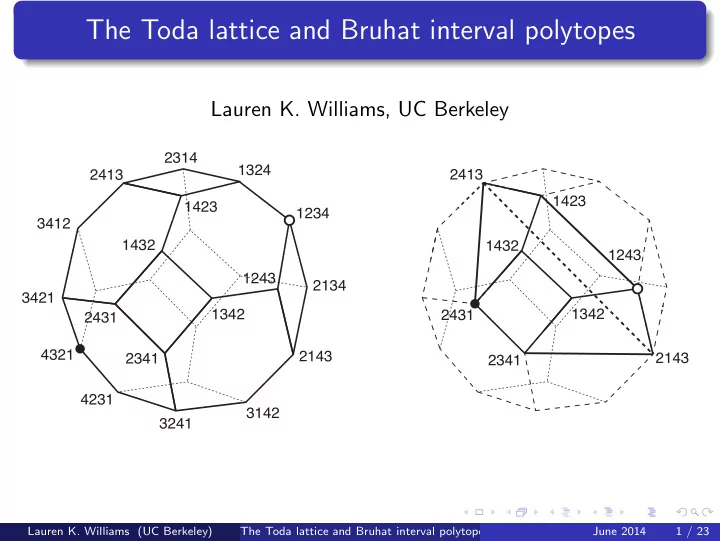
The Toda lattice and Bruhat interval polytopes Lauren K. Williams, UC Berkeley 2314 1324 2413 2413 1423 1423 1234 3412 1432 1432 1243 1243 2134 3421 1342 2431 1342 2431 4321 2143 2341 2143 2341 4231 3142 3241 Lauren K.


slide-1
SLIDE 1

2314 1324 1234 2134 2143 1423 2413 3412 3421 4321 4231 3241 3142 1432 1342 1243 2431 2341 2143 1423 2413 1342 1243 2341 2431 1432

The Toda lattice and Bruhat interval polytopes

Lauren K. Williams, UC Berkeley

Lauren K. Williams (UC Berkeley) The Toda lattice and Bruhat interval polytopes June 2014 1 / 23

slide-2
SLIDE 2

Plan of the talk

Introduction to the Toda lattice The sorting property The positive flag variety, and generalized sorting. Bruhat interval polytopes and their faces The generalized lifting property and R-polynomials Combinatorics of Bruhat interval polytopes Bruhat interval polytopes for G/P

References

(joint with Yuji Kodama) The full Kostant-Toda hierarchy on the positive flag variety, to appear in Comm. Math. Phys. (joint with Emmanuel Tsukerman) Bruhat Interval Polytopes, arXiv:1406.5202

Lauren K. Williams (UC Berkeley) The Toda lattice and Bruhat interval polytopes June 2014 2 / 23

slide-3
SLIDE 3

The Toda lattice

The Toda lattice is defined by dL dt = [π(L), L], where L = L(t) is a tridiagonal symmetric matrix and π(L) is its skew-symmetric projection: L =        b1 a1 · · · a1 b2 a2 · · · a2 b3 · · · . . . ... ... ... . . . · · · · · · an−1 bn        , π(L) =        a1 · · · −a1 a2 · · · −a2 · · · . . . ... ... ... . . . · · · · · · −an−1        . Model introduced by Toda in 1967 (Def above due to Flaschka 1974) Represents dynamics of n particles of unit mass, moving on a line under influence of exponential repulsive forces. Eigenvalues of L(t) are independent of t.

Lauren K. Williams (UC Berkeley) The Toda lattice and Bruhat interval polytopes June 2014 3 / 23

slide-4
SLIDE 4

The Toda lattice

The Toda lattice is defined by dL dt = [π(L), L], where L = L(t) is a tridiagonal symmetric matrix and π(L) is its skew-symmetric projection: L =        b1 a1 · · · a1 b2 a2 · · · a2 b3 · · · . . . ... ... ... . . . · · · · · · an−1 bn        , π(L) =        a1 · · · −a1 a2 · · · −a2 · · · . . . ... ... ... . . . · · · · · · −an−1        . Model introduced by Toda in 1967 (Def above due to Flaschka 1974) Represents dynamics of n particles of unit mass, moving on a line under influence of exponential repulsive forces. Eigenvalues of L(t) are independent of t.

Lauren K. Williams (UC Berkeley) The Toda lattice and Bruhat interval polytopes June 2014 3 / 23

slide-5
SLIDE 5

The Toda lattice

The Toda lattice is defined by dL dt = [π(L), L], where L = L(t) is a tridiagonal symmetric matrix and π(L) is its skew-symmetric projection: L =        b1 a1 · · · a1 b2 a2 · · · a2 b3 · · · . . . ... ... ... . . . · · · · · · an−1 bn        , π(L) =        a1 · · · −a1 a2 · · · −a2 · · · . . . ... ... ... . . . · · · · · · −an−1        . Model introduced by Toda in 1967 (Def above due to Flaschka 1974) Represents dynamics of n particles of unit mass, moving on a line under influence of exponential repulsive forces. Eigenvalues of L(t) are independent of t.

Lauren K. Williams (UC Berkeley) The Toda lattice and Bruhat interval polytopes June 2014 3 / 23

slide-6
SLIDE 6

The Toda lattice

The Toda lattice is defined by dL dt = [π(L), L], where L = L(t) is a tridiagonal symmetric matrix and π(L) is its skew-symmetric projection: L =        b1 a1 · · · a1 b2 a2 · · · a2 b3 · · · . . . ... ... ... . . . · · · · · · an−1 bn        , π(L) =        a1 · · · −a1 a2 · · · −a2 · · · . . . ... ... ... . . . · · · · · · −an−1        . Model introduced by Toda in 1967 (Def above due to Flaschka 1974) Represents dynamics of n particles of unit mass, moving on a line under influence of exponential repulsive forces. Eigenvalues of L(t) are independent of t.

Lauren K. Williams (UC Berkeley) The Toda lattice and Bruhat interval polytopes June 2014 3 / 23

slide-7
SLIDE 7

The Toda lattice

The Toda lattice is defined by dL dt = [π(L), L], where L = L(t) is a tridiagonal symmetric matrix and π(L) is its skew-symmetric projection: L =        b1 a1 · · · a1 b2 a2 · · · a2 b3 · · · . . . ... ... ... . . . · · · · · · an−1 bn        , π(L) =        a1 · · · −a1 a2 · · · −a2 · · · . . . ... ... ... . . . · · · · · · −an−1        . Model introduced by Toda in 1967 (Def above due to Flaschka 1974) Represents dynamics of n particles of unit mass, moving on a line under influence of exponential repulsive forces. Eigenvalues of L(t) are independent of t.

Lauren K. Williams (UC Berkeley) The Toda lattice and Bruhat interval polytopes June 2014 3 / 23

slide-8
SLIDE 8

Sorting property of the Toda lattice

Suppose the initial matrix L(0) is generic: it has distinct eigenvalues λ1 < λ2 < · · · < λn and ak(0) = 0 for all k. Then the time evolution of the Toda lattice sorts the eigenvalues of L! lim

t→−∞ L(t) =

     λ1 · · · λ2 · · · . . . . . . ... . . . · · · λn      lim

t→+∞ L(t) =

     λn · · · λn−1 · · · . . . . . . ... . . . · · · λ1     

Lauren K. Williams (UC Berkeley) The Toda lattice and Bruhat interval polytopes June 2014 4 / 23

slide-9
SLIDE 9

Sorting property of the Toda lattice

Suppose the initial matrix L(0) is generic: it has distinct eigenvalues λ1 < λ2 < · · · < λn and ak(0) = 0 for all k. Then the time evolution of the Toda lattice sorts the eigenvalues of L! lim

t→−∞ L(t) =

     λ1 · · · λ2 · · · . . . . . . ... . . . · · · λn      lim

t→+∞ L(t) =

     λn · · · λn−1 · · · . . . . . . ... . . . · · · λ1     

Lauren K. Williams (UC Berkeley) The Toda lattice and Bruhat interval polytopes June 2014 4 / 23

slide-10
SLIDE 10

Sorting property of the Toda lattice

Suppose the initial matrix L(0) is generic: it has distinct eigenvalues λ1 < λ2 < · · · < λn and ak(0) = 0 for all k. Then the time evolution of the Toda lattice sorts the eigenvalues of L! lim

t→−∞ L(t) =

     λ1 · · · λ2 · · · . . . . . . ... . . . · · · λn      lim

t→+∞ L(t) =

     λn · · · λn−1 · · · . . . . . . ... . . . · · · λ1     

Lauren K. Williams (UC Berkeley) The Toda lattice and Bruhat interval polytopes June 2014 4 / 23

slide-11
SLIDE 11

The full symmetric Toda lattice

The full symmetric Toda lattice is defined as before by dL dt = [π(L), L], but now L = L(t) is any symmetric matrix. Eigenvalues of L(t) are independent of t. In generic case, the sorting property holds (Kodama-McLaughlin ’96). In non-generic case, what can we say about limt→±∞ L(t)?

Lauren K. Williams (UC Berkeley) The Toda lattice and Bruhat interval polytopes June 2014 5 / 23

slide-12
SLIDE 12

The full symmetric Toda lattice

The full symmetric Toda lattice is defined as before by dL dt = [π(L), L], but now L = L(t) is any symmetric matrix. Eigenvalues of L(t) are independent of t. In generic case, the sorting property holds (Kodama-McLaughlin ’96). In non-generic case, what can we say about limt→±∞ L(t)?

Lauren K. Williams (UC Berkeley) The Toda lattice and Bruhat interval polytopes June 2014 5 / 23

slide-13
SLIDE 13

The full symmetric Toda lattice

The full symmetric Toda lattice is defined as before by dL dt = [π(L), L], but now L = L(t) is any symmetric matrix. Eigenvalues of L(t) are independent of t. In generic case, the sorting property holds (Kodama-McLaughlin ’96). In non-generic case, what can we say about limt→±∞ L(t)?

Lauren K. Williams (UC Berkeley) The Toda lattice and Bruhat interval polytopes June 2014 5 / 23

slide-14
SLIDE 14

The full symmetric Toda lattice

The full symmetric Toda lattice is defined as before by dL dt = [π(L), L], but now L = L(t) is any symmetric matrix. Eigenvalues of L(t) are independent of t. In generic case, the sorting property holds (Kodama-McLaughlin ’96). In non-generic case, what can we say about limt→±∞ L(t)?

Lauren K. Williams (UC Berkeley) The Toda lattice and Bruhat interval polytopes June 2014 5 / 23

slide-15
SLIDE 15

The full symmetric Toda lattice

The full symmetric Toda lattice is defined as before by dL dt = [π(L), L], but now L = L(t) is any symmetric matrix. Eigenvalues of L(t) are independent of t. In generic case, the sorting property holds (Kodama-McLaughlin ’96). In non-generic case, what can we say about limt→±∞ L(t)?

Lauren K. Williams (UC Berkeley) The Toda lattice and Bruhat interval polytopes June 2014 5 / 23

slide-16
SLIDE 16

The complete flag variety

Let G = SLn(R), B+ = B and B− be the subgroups of upper and lower triangular matrices. Then G/B is the complete flag variety. Can identify elements with flags Fln = {V1 ⊂ V2 ⊂ · · · ⊂ Vn = Rn | dim Vi = i}. Let W = Sn the symmetric group. For w ∈ W , let ˙ w denote a representative in G. Have two opposite Schubert decompositions of G/B: G/B =

  • w∈W

B ˙ wB/B =

  • v∈W

B− ˙ vB/B. Define the intersection of opposite Schubert cells (Richardson variety): Rv,w := (B ˙ wB/B) ∩ (B− ˙ vB/B) Rv,w is nonempty iff v ≤ w in Bruhat order.

Lauren K. Williams (UC Berkeley) The Toda lattice and Bruhat interval polytopes June 2014 6 / 23

slide-17
SLIDE 17

The complete flag variety

Let G = SLn(R), B+ = B and B− be the subgroups of upper and lower triangular matrices. Then G/B is the complete flag variety. Can identify elements with flags Fln = {V1 ⊂ V2 ⊂ · · · ⊂ Vn = Rn | dim Vi = i}. Let W = Sn the symmetric group. For w ∈ W , let ˙ w denote a representative in G. Have two opposite Schubert decompositions of G/B: G/B =

  • w∈W

B ˙ wB/B =

  • v∈W

B− ˙ vB/B. Define the intersection of opposite Schubert cells (Richardson variety): Rv,w := (B ˙ wB/B) ∩ (B− ˙ vB/B) Rv,w is nonempty iff v ≤ w in Bruhat order.

Lauren K. Williams (UC Berkeley) The Toda lattice and Bruhat interval polytopes June 2014 6 / 23

slide-18
SLIDE 18

The complete flag variety

Let G = SLn(R), B+ = B and B− be the subgroups of upper and lower triangular matrices. Then G/B is the complete flag variety. Can identify elements with flags Fln = {V1 ⊂ V2 ⊂ · · · ⊂ Vn = Rn | dim Vi = i}. Let W = Sn the symmetric group. For w ∈ W , let ˙ w denote a representative in G. Have two opposite Schubert decompositions of G/B: G/B =

  • w∈W

B ˙ wB/B =

  • v∈W

B− ˙ vB/B. Define the intersection of opposite Schubert cells (Richardson variety): Rv,w := (B ˙ wB/B) ∩ (B− ˙ vB/B) Rv,w is nonempty iff v ≤ w in Bruhat order.

Lauren K. Williams (UC Berkeley) The Toda lattice and Bruhat interval polytopes June 2014 6 / 23

slide-19
SLIDE 19

The complete flag variety

Let G = SLn(R), B+ = B and B− be the subgroups of upper and lower triangular matrices. Then G/B is the complete flag variety. Can identify elements with flags Fln = {V1 ⊂ V2 ⊂ · · · ⊂ Vn = Rn | dim Vi = i}. Let W = Sn the symmetric group. For w ∈ W , let ˙ w denote a representative in G. Have two opposite Schubert decompositions of G/B: G/B =

  • w∈W

B ˙ wB/B =

  • v∈W

B− ˙ vB/B. Define the intersection of opposite Schubert cells (Richardson variety): Rv,w := (B ˙ wB/B) ∩ (B− ˙ vB/B) Rv,w is nonempty iff v ≤ w in Bruhat order.

Lauren K. Williams (UC Berkeley) The Toda lattice and Bruhat interval polytopes June 2014 6 / 23

slide-20
SLIDE 20

The totally non-negative (tnn) flag variety (Lusztig)

Let U+ and U− be the subgroups of upper and lower triangular matrices in G with 1’s on diagonal. Let yi(m) ∈ U− be the element

          1 ... 1 m 1 ... 1           Let U−

≥0 of U− be the semigroup in U− generated by the yi(p) for p ∈ R>0.

The tnn flag variety (G/B)≥0 is (G/B)≥0 := { uB | u ∈ U−

≥0 },

where the closure is taken inside G/B in its real topology. For comparison: G/B = { uB | u ∈ U− }.

Lauren K. Williams (UC Berkeley) The Toda lattice and Bruhat interval polytopes June 2014 7 / 23

slide-21
SLIDE 21

The totally non-negative (tnn) flag variety (Lusztig)

Let U+ and U− be the subgroups of upper and lower triangular matrices in G with 1’s on diagonal. Let yi(m) ∈ U− be the element

          1 ... 1 m 1 ... 1           Let U−

≥0 of U− be the semigroup in U− generated by the yi(p) for p ∈ R>0.

The tnn flag variety (G/B)≥0 is (G/B)≥0 := { uB | u ∈ U−

≥0 },

where the closure is taken inside G/B in its real topology. For comparison: G/B = { uB | u ∈ U− }.

Lauren K. Williams (UC Berkeley) The Toda lattice and Bruhat interval polytopes June 2014 7 / 23

slide-22
SLIDE 22

The totally non-negative (tnn) flag variety (Lusztig)

Let U+ and U− be the subgroups of upper and lower triangular matrices in G with 1’s on diagonal. Let yi(m) ∈ U− be the element

          1 ... 1 m 1 ... 1           Let U−

≥0 of U− be the semigroup in U− generated by the yi(p) for p ∈ R>0.

The tnn flag variety (G/B)≥0 is (G/B)≥0 := { uB | u ∈ U−

≥0 },

where the closure is taken inside G/B in its real topology. For comparison: G/B = { uB | u ∈ U− }.

Lauren K. Williams (UC Berkeley) The Toda lattice and Bruhat interval polytopes June 2014 7 / 23

slide-23
SLIDE 23

The totally non-negative (tnn) flag variety (Lusztig)

Let U+ and U− be the subgroups of upper and lower triangular matrices in G with 1’s on diagonal. Let yi(m) ∈ U− be the element

          1 ... 1 m 1 ... 1           Let U−

≥0 of U− be the semigroup in U− generated by the yi(p) for p ∈ R>0.

The tnn flag variety (G/B)≥0 is (G/B)≥0 := { uB | u ∈ U−

≥0 },

where the closure is taken inside G/B in its real topology. For comparison: G/B = { uB | u ∈ U− }.

Lauren K. Williams (UC Berkeley) The Toda lattice and Bruhat interval polytopes June 2014 7 / 23

slide-24
SLIDE 24

The totally non-negative (tnn) flag variety (Lusztig)

Let U+ and U− be the subgroups of upper and lower triangular matrices in G with 1’s on diagonal. Let yi(m) ∈ U− be the element

          1 ... 1 m 1 ... 1           Let U−

≥0 of U− be the semigroup in U− generated by the yi(p) for p ∈ R>0.

The tnn flag variety (G/B)≥0 is (G/B)≥0 := { uB | u ∈ U−

≥0 },

where the closure is taken inside G/B in its real topology. For comparison: G/B = { uB | u ∈ U− }.

Lauren K. Williams (UC Berkeley) The Toda lattice and Bruhat interval polytopes June 2014 7 / 23

slide-25
SLIDE 25

The cell decomposition of the tnn flag variety

Recall: U−

≥0 of U− is the semigroup in U− generated by the yi(p) for

p ∈ R>0. The tnn flag variety (G/B)≥0 is (G/B)≥0 := { uB | u ∈ U−

≥0 }.

Rietsch’s theorem

For v, w ∈ W with v ≤ w in Bruhat order, let R>0

v,w := Rv,w ∩ (G/B)≥0.

This is a topological cell of dimension ℓ(w) − ℓ(v). So the tnn flag variety (G/B)≥0 has a cell decomposition, (G/B)≥0 =

  • w∈Sn

 

v≤w

R>0

v,w

  . (1)

Lauren K. Williams (UC Berkeley) The Toda lattice and Bruhat interval polytopes June 2014 8 / 23

slide-26
SLIDE 26

The cell decomposition of the tnn flag variety

Recall: U−

≥0 of U− is the semigroup in U− generated by the yi(p) for

p ∈ R>0. The tnn flag variety (G/B)≥0 is (G/B)≥0 := { uB | u ∈ U−

≥0 }.

Rietsch’s theorem

For v, w ∈ W with v ≤ w in Bruhat order, let R>0

v,w := Rv,w ∩ (G/B)≥0.

This is a topological cell of dimension ℓ(w) − ℓ(v). So the tnn flag variety (G/B)≥0 has a cell decomposition, (G/B)≥0 =

  • w∈Sn

 

v≤w

R>0

v,w

  . (1)

Lauren K. Williams (UC Berkeley) The Toda lattice and Bruhat interval polytopes June 2014 8 / 23

slide-27
SLIDE 27

The cell decomposition of the tnn flag variety

Recall: U−

≥0 of U− is the semigroup in U− generated by the yi(p) for

p ∈ R>0. The tnn flag variety (G/B)≥0 is (G/B)≥0 := { uB | u ∈ U−

≥0 }.

Rietsch’s theorem

For v, w ∈ W with v ≤ w in Bruhat order, let R>0

v,w := Rv,w ∩ (G/B)≥0.

This is a topological cell of dimension ℓ(w) − ℓ(v). So the tnn flag variety (G/B)≥0 has a cell decomposition, (G/B)≥0 =

  • w∈Sn

 

v≤w

R>0

v,w

  . (1)

Lauren K. Williams (UC Berkeley) The Toda lattice and Bruhat interval polytopes June 2014 8 / 23

slide-28
SLIDE 28

From (G/B)≥0 to the full symmetric Toda lattice

Fix real numbers λ1 < λ2 < · · · < λn, and let FΛ be the set of symmetric matrices with fixed eigenvalues {λ1, . . . , λn}. Let Λ := diag(λ1, . . . , λn). To each gB ∈ (G/B)≥0, we associate an initial matrix L0 ∈ FΛ as follows: Use the QR-decomposition to write g = q0b0 where q0 ∈ SOn(R) and b0 ∈ B. This uniquely defines q0. Set L0 = qT

0 Λq0 ∈ FΛ.

We can now consider the solution L(t) to the full symmetric Toda lattice, with initial data L(0) := L0.

Lauren K. Williams (UC Berkeley) The Toda lattice and Bruhat interval polytopes June 2014 9 / 23

slide-29
SLIDE 29

From (G/B)≥0 to the full symmetric Toda lattice

Fix real numbers λ1 < λ2 < · · · < λn, and let FΛ be the set of symmetric matrices with fixed eigenvalues {λ1, . . . , λn}. Let Λ := diag(λ1, . . . , λn). To each gB ∈ (G/B)≥0, we associate an initial matrix L0 ∈ FΛ as follows: Use the QR-decomposition to write g = q0b0 where q0 ∈ SOn(R) and b0 ∈ B. This uniquely defines q0. Set L0 = qT

0 Λq0 ∈ FΛ.

We can now consider the solution L(t) to the full symmetric Toda lattice, with initial data L(0) := L0.

Lauren K. Williams (UC Berkeley) The Toda lattice and Bruhat interval polytopes June 2014 9 / 23

slide-30
SLIDE 30

From (G/B)≥0 to the full symmetric Toda lattice

Fix real numbers λ1 < λ2 < · · · < λn, and let FΛ be the set of symmetric matrices with fixed eigenvalues {λ1, . . . , λn}. Let Λ := diag(λ1, . . . , λn). To each gB ∈ (G/B)≥0, we associate an initial matrix L0 ∈ FΛ as follows: Use the QR-decomposition to write g = q0b0 where q0 ∈ SOn(R) and b0 ∈ B. This uniquely defines q0. Set L0 = qT

0 Λq0 ∈ FΛ.

We can now consider the solution L(t) to the full symmetric Toda lattice, with initial data L(0) := L0.

Lauren K. Williams (UC Berkeley) The Toda lattice and Bruhat interval polytopes June 2014 9 / 23

slide-31
SLIDE 31

From (G/B)≥0 to the full symmetric Toda lattice

Fix real numbers λ1 < λ2 < · · · < λn, and let FΛ be the set of symmetric matrices with fixed eigenvalues {λ1, . . . , λn}. Let Λ := diag(λ1, . . . , λn). To each gB ∈ (G/B)≥0, we associate an initial matrix L0 ∈ FΛ as follows: Use the QR-decomposition to write g = q0b0 where q0 ∈ SOn(R) and b0 ∈ B. This uniquely defines q0. Set L0 = qT

0 Λq0 ∈ FΛ.

We can now consider the solution L(t) to the full symmetric Toda lattice, with initial data L(0) := L0.

Lauren K. Williams (UC Berkeley) The Toda lattice and Bruhat interval polytopes June 2014 9 / 23

slide-32
SLIDE 32

From (G/B)≥0 to the full symmetric Toda lattice

Fix real numbers λ1 < λ2 < · · · < λn, and let FΛ be the set of symmetric matrices with fixed eigenvalues {λ1, . . . , λn}. Let Λ := diag(λ1, . . . , λn). To each gB ∈ (G/B)≥0, we associate an initial matrix L0 ∈ FΛ as follows: Use the QR-decomposition to write g = q0b0 where q0 ∈ SOn(R) and b0 ∈ B. This uniquely defines q0. Set L0 = qT

0 Λq0 ∈ FΛ.

We can now consider the solution L(t) to the full symmetric Toda lattice, with initial data L(0) := L0.

Lauren K. Williams (UC Berkeley) The Toda lattice and Bruhat interval polytopes June 2014 9 / 23

slide-33
SLIDE 33

From (G/B)≥0 to the full symmetric Toda lattice

Fix real numbers λ1 < λ2 < · · · < λn, and let FΛ be the set of symmetric matrices with fixed eigenvalues {λ1, . . . , λn}. Let Λ := diag(λ1, . . . , λn). To each gB ∈ (G/B)≥0, we associate an initial matrix L0 ∈ FΛ as follows: Use the QR-decomposition to write g = q0b0 where q0 ∈ SOn(R) and b0 ∈ B. This uniquely defines q0. Set L0 = qT

0 Λq0 ∈ FΛ.

We can now consider the solution L(t) to the full symmetric Toda lattice, with initial data L(0) := L0.

Lauren K. Williams (UC Berkeley) The Toda lattice and Bruhat interval polytopes June 2014 9 / 23

slide-34
SLIDE 34

Theorem (Kodama-W.): generalized sorting property

Recall that (G/B)≥0 =

w∈Sn

  • v≤w R>0

v,w

  • .

Let L0 ∈ FΛ be the initial matrix associated to gB ∈ R>0

v,w, defined by:

  • Factoring g = q0b0 where q0 ∈ SOn(R) and b0 ∈ B
  • Setting L0 = qT

0 Λq0.

Then lim

t→−∞ L(t) =

     λv(1) · · · λv(2) · · · . . . . . . . . . . . . · · · λv(n)      lim

t→+∞ L(t) =

     λw(1) · · · λw(2) · · · . . . . . . . . . . . . · · · λw(n)     

Lauren K. Williams (UC Berkeley) The Toda lattice and Bruhat interval polytopes June 2014 10 / 23

slide-35
SLIDE 35

Theorem (Kodama-W.): generalized sorting property

Recall that (G/B)≥0 =

w∈Sn

  • v≤w R>0

v,w

  • .

Let L0 ∈ FΛ be the initial matrix associated to gB ∈ R>0

v,w, defined by:

  • Factoring g = q0b0 where q0 ∈ SOn(R) and b0 ∈ B
  • Setting L0 = qT

0 Λq0.

Then lim

t→−∞ L(t) =

     λv(1) · · · λv(2) · · · . . . . . . . . . . . . · · · λv(n)      lim

t→+∞ L(t) =

     λw(1) · · · λw(2) · · · . . . . . . . . . . . . · · · λw(n)     

Lauren K. Williams (UC Berkeley) The Toda lattice and Bruhat interval polytopes June 2014 10 / 23

slide-36
SLIDE 36

Theorem (Kodama-W.): generalized sorting property

Recall that (G/B)≥0 =

w∈Sn

  • v≤w R>0

v,w

  • .

Let L0 ∈ FΛ be the initial matrix associated to gB ∈ R>0

v,w, defined by:

  • Factoring g = q0b0 where q0 ∈ SOn(R) and b0 ∈ B
  • Setting L0 = qT

0 Λq0.

Then lim

t→−∞ L(t) =

     λv(1) · · · λv(2) · · · . . . . . . . . . . . . · · · λv(n)      lim

t→+∞ L(t) =

     λw(1) · · · λw(2) · · · . . . . . . . . . . . . · · · λw(n)     

Lauren K. Williams (UC Berkeley) The Toda lattice and Bruhat interval polytopes June 2014 10 / 23

slide-37
SLIDE 37

Other extensions

The full symmetric Toda hierarchy

The full symmetric Toda hierarchy has n − 1 parameters t1, . . . , tn−1, and is given by ∂L ∂tk = [π(Lk), L], for k = 1, 2, . . . , n − 1.

Theorem (Kodama - W.)

Suppose that gB ∈ R>0

v,w and consider the corresponding solution to the

full symmetric Toda hierarchy. Then for each permutation z such that v ≤ z ≤ w, there exists a direction t(s) such that L(t(s)) tends to      λz(1) · · · λz(2) · · · . . . . . . . . . . . . · · · λz(n)     

Lauren K. Williams (UC Berkeley) The Toda lattice and Bruhat interval polytopes June 2014 11 / 23

slide-38
SLIDE 38

Other extensions

The full symmetric Toda hierarchy

The full symmetric Toda hierarchy has n − 1 parameters t1, . . . , tn−1, and is given by ∂L ∂tk = [π(Lk), L], for k = 1, 2, . . . , n − 1.

Theorem (Kodama - W.)

Suppose that gB ∈ R>0

v,w and consider the corresponding solution to the

full symmetric Toda hierarchy. Then for each permutation z such that v ≤ z ≤ w, there exists a direction t(s) such that L(t(s)) tends to      λz(1) · · · λz(2) · · · . . . . . . . . . . . . · · · λz(n)     

Lauren K. Williams (UC Berkeley) The Toda lattice and Bruhat interval polytopes June 2014 11 / 23

slide-39
SLIDE 39

Bruhat interval polytopes

After analyzing the moment map images of flows in the full symmetric Toda hierarchy, we were led to study the following polytopes:

Definition (Kodama -W.)

Let u ≤ v in the Bruhat order on Sn. The Bruhat interval polytope Qu,v is Qu,v = Conv{(z(1), . . . , z(n)) | u ≤ z ≤ v}.

2314 1324 1234 2134 2143 1423 2413 3412 3421 4321 4231 3241 3142 1432 1342 1243 2431 2341 2143 1423 2413 1342 1243 2341 2431 1432

  • Prop. (K.W.): Qu,v is the Minkowski sum of n − 1 matroid (positroid)
  • polytopes. It is a generalized permutohedron (in sense of Postnikov).

Lauren K. Williams (UC Berkeley) The Toda lattice and Bruhat interval polytopes June 2014 12 / 23

slide-40
SLIDE 40

Bruhat interval polytopes

After analyzing the moment map images of flows in the full symmetric Toda hierarchy, we were led to study the following polytopes:

Definition (Kodama -W.)

Let u ≤ v in the Bruhat order on Sn. The Bruhat interval polytope Qu,v is Qu,v = Conv{(z(1), . . . , z(n)) | u ≤ z ≤ v}.

2314 1324 1234 2134 2143 1423 2413 3412 3421 4321 4231 3241 3142 1432 1342 1243 2431 2341 2143 1423 2413 1342 1243 2341 2431 1432

  • Prop. (K.W.): Qu,v is the Minkowski sum of n − 1 matroid (positroid)
  • polytopes. It is a generalized permutohedron (in sense of Postnikov).

Lauren K. Williams (UC Berkeley) The Toda lattice and Bruhat interval polytopes June 2014 12 / 23

slide-41
SLIDE 41

Bruhat interval polytopes

After analyzing the moment map images of flows in the full symmetric Toda hierarchy, we were led to study the following polytopes:

Definition (Kodama -W.)

Let u ≤ v in the Bruhat order on Sn. The Bruhat interval polytope Qu,v is Qu,v = Conv{(z(1), . . . , z(n)) | u ≤ z ≤ v}.

2314 1324 1234 2134 2143 1423 2413 3412 3421 4321 4231 3241 3142 1432 1342 1243 2431 2341 2143 1423 2413 1342 1243 2341 2431 1432

  • Prop. (K.W.): Qu,v is the Minkowski sum of n − 1 matroid (positroid)
  • polytopes. It is a generalized permutohedron (in sense of Postnikov).

Lauren K. Williams (UC Berkeley) The Toda lattice and Bruhat interval polytopes June 2014 12 / 23

slide-42
SLIDE 42

Combinatorics of Bruhat interval polytopes

Remark: Recall that the edges of the permutohedron correspond to cover relations in the weak Bruhat order. Faces of permutohedra are isomorphic to products of smaller permutohedra.

Theorem (Tsukerman-W.)

The face of every Bruhat interval polytope Qu,v has the form Qx,y where u ≤ x ≤ y ≤ v. In particular, each edge of Qu,v comes from a cover relation in the (strong) Bruhat order. Our proof uses: the classical Bjorner-Wachs theorem that the order complex of every interval in Bruhat order is homeomorphic to a sphere; a generalization of the lifting property.

Lauren K. Williams (UC Berkeley) The Toda lattice and Bruhat interval polytopes June 2014 13 / 23

slide-43
SLIDE 43

Combinatorics of Bruhat interval polytopes

Remark: Recall that the edges of the permutohedron correspond to cover relations in the weak Bruhat order. Faces of permutohedra are isomorphic to products of smaller permutohedra.

Theorem (Tsukerman-W.)

The face of every Bruhat interval polytope Qu,v has the form Qx,y where u ≤ x ≤ y ≤ v. In particular, each edge of Qu,v comes from a cover relation in the (strong) Bruhat order. Our proof uses: the classical Bjorner-Wachs theorem that the order complex of every interval in Bruhat order is homeomorphic to a sphere; a generalization of the lifting property.

Lauren K. Williams (UC Berkeley) The Toda lattice and Bruhat interval polytopes June 2014 13 / 23

slide-44
SLIDE 44

Combinatorics of Bruhat interval polytopes

Remark: Recall that the edges of the permutohedron correspond to cover relations in the weak Bruhat order. Faces of permutohedra are isomorphic to products of smaller permutohedra.

Theorem (Tsukerman-W.)

The face of every Bruhat interval polytope Qu,v has the form Qx,y where u ≤ x ≤ y ≤ v. In particular, each edge of Qu,v comes from a cover relation in the (strong) Bruhat order. Our proof uses: the classical Bjorner-Wachs theorem that the order complex of every interval in Bruhat order is homeomorphic to a sphere; a generalization of the lifting property.

Lauren K. Williams (UC Berkeley) The Toda lattice and Bruhat interval polytopes June 2014 13 / 23

slide-45
SLIDE 45

Combinatorics of Bruhat interval polytopes

Remark: Recall that the edges of the permutohedron correspond to cover relations in the weak Bruhat order. Faces of permutohedra are isomorphic to products of smaller permutohedra.

Theorem (Tsukerman-W.)

The face of every Bruhat interval polytope Qu,v has the form Qx,y where u ≤ x ≤ y ≤ v. In particular, each edge of Qu,v comes from a cover relation in the (strong) Bruhat order. Our proof uses: the classical Bjorner-Wachs theorem that the order complex of every interval in Bruhat order is homeomorphic to a sphere; a generalization of the lifting property.

Lauren K. Williams (UC Berkeley) The Toda lattice and Bruhat interval polytopes June 2014 13 / 23

slide-46
SLIDE 46

Combinatorics of Bruhat interval polytopes

Remark: Recall that the edges of the permutohedron correspond to cover relations in the weak Bruhat order. Faces of permutohedra are isomorphic to products of smaller permutohedra.

Theorem (Tsukerman-W.)

The face of every Bruhat interval polytope Qu,v has the form Qx,y where u ≤ x ≤ y ≤ v. In particular, each edge of Qu,v comes from a cover relation in the (strong) Bruhat order. Our proof uses: the classical Bjorner-Wachs theorem that the order complex of every interval in Bruhat order is homeomorphic to a sphere; a generalization of the lifting property.

Lauren K. Williams (UC Berkeley) The Toda lattice and Bruhat interval polytopes June 2014 13 / 23

slide-47
SLIDE 47

The lifting property and a generalization

Lifting property: Suppose u < v in Bruhat order and s is a simple reflection such that vs ⋖ v and us ⋗ u. Then u ≤ vs ⋖ v and u ⋖ us ≤ v. Caution: such an s may not exist. v v(ij) u(ij) u Def: Say a transposition (ij) is inversion-minimal on (u, v) if [i, j] is minimal (with respect to inclusion) such that v(ij) < v and u(ij) > u.

Theorem (T.W.) - Generalized lifting property

Suppose u < v in Bruhat order on Sn. Choose a transposition (ij) which is inversion-minimal on (u, v); one always exists. Then u ≤ v(ij) ⋖ v and u ⋖ u(ij) ≤ v.

Lauren K. Williams (UC Berkeley) The Toda lattice and Bruhat interval polytopes June 2014 14 / 23

slide-48
SLIDE 48

The lifting property and a generalization

Lifting property: Suppose u < v in Bruhat order and s is a simple reflection such that vs ⋖ v and us ⋗ u. Then u ≤ vs ⋖ v and u ⋖ us ≤ v. Caution: such an s may not exist. v v(ij) u(ij) u Def: Say a transposition (ij) is inversion-minimal on (u, v) if [i, j] is minimal (with respect to inclusion) such that v(ij) < v and u(ij) > u.

Theorem (T.W.) - Generalized lifting property

Suppose u < v in Bruhat order on Sn. Choose a transposition (ij) which is inversion-minimal on (u, v); one always exists. Then u ≤ v(ij) ⋖ v and u ⋖ u(ij) ≤ v.

Lauren K. Williams (UC Berkeley) The Toda lattice and Bruhat interval polytopes June 2014 14 / 23

slide-49
SLIDE 49

The lifting property and a generalization

Lifting property: Suppose u < v in Bruhat order and s is a simple reflection such that vs ⋖ v and us ⋗ u. Then u ≤ vs ⋖ v and u ⋖ us ≤ v. Caution: such an s may not exist. v v(ij) u(ij) u Def: Say a transposition (ij) is inversion-minimal on (u, v) if [i, j] is minimal (with respect to inclusion) such that v(ij) < v and u(ij) > u.

Theorem (T.W.) - Generalized lifting property

Suppose u < v in Bruhat order on Sn. Choose a transposition (ij) which is inversion-minimal on (u, v); one always exists. Then u ≤ v(ij) ⋖ v and u ⋖ u(ij) ≤ v.

Lauren K. Williams (UC Berkeley) The Toda lattice and Bruhat interval polytopes June 2014 14 / 23

slide-50
SLIDE 50

The lifting property and a generalization

Lifting property: Suppose u < v in Bruhat order and s is a simple reflection such that vs ⋖ v and us ⋗ u. Then u ≤ vs ⋖ v and u ⋖ us ≤ v. Caution: such an s may not exist. v v(ij) u(ij) u Def: Say a transposition (ij) is inversion-minimal on (u, v) if [i, j] is minimal (with respect to inclusion) such that v(ij) < v and u(ij) > u.

Theorem (T.W.) - Generalized lifting property

Suppose u < v in Bruhat order on Sn. Choose a transposition (ij) which is inversion-minimal on (u, v); one always exists. Then u ≤ v(ij) ⋖ v and u ⋖ u(ij) ≤ v.

Lauren K. Williams (UC Berkeley) The Toda lattice and Bruhat interval polytopes June 2014 14 / 23

slide-51
SLIDE 51

Example of the Generalized lifting property

Theorem (T.W.) - Generalized lifting property

Suppose u < v in the Bruhat order on Sn. Choose a transposition t = (ij) which is inversion-minimal on (u, v); one always exists. Then u ≤ v(ij) ⋖ v and u ⋖ u(ij) ≤ v. u = 2143 3142 2341 v = 3241 t = (24) (14) t = (24) (12)

Lauren K. Williams (UC Berkeley) The Toda lattice and Bruhat interval polytopes June 2014 15 / 23

slide-52
SLIDE 52

Example of the Generalized lifting property

Theorem (T.W.) - Generalized lifting property

Suppose u < v in the Bruhat order on Sn. Choose a transposition t = (ij) which is inversion-minimal on (u, v); one always exists. Then u ≤ v(ij) ⋖ v and u ⋖ u(ij) ≤ v. u = 2143 3142 2341 v = 3241 t = (24) (14) t = (24) (12)

Lauren K. Williams (UC Berkeley) The Toda lattice and Bruhat interval polytopes June 2014 15 / 23

slide-53
SLIDE 53

Generalization of the recurrence for R-polynomials Ru,v(q)

Kazhdan and Lusztig introduced R-polynomials as a tool for computing Kazhdan-Lusztig polynomials. Geometric interpretation: Ru,v(q) = #Ru,v(Fq), the number of Fq-points in the Richardson variety. They showed that R-polynomials can be defined by the conditions:

1

Ru,v(q) = 0, if u ≤ v.

2

Ru,v(q) = 1, if u = v.

3

If vs ⋖ v (s a simple reflection) then Ru,v(q) =

  • Rus,vs(q)

if us ⋖ u, qRus,vs(q) + (q − 1)Ru,vs(q) if us ⋗ u.

Theorem (T.W.)

Let u, v ∈ Sn with u ≤ v. Let t = (ij) be inversion-minimal on (u, v). Then Ru,v(q) = qRut,vt(q) + (q − 1)Ru,vt(q).

Lauren K. Williams (UC Berkeley) The Toda lattice and Bruhat interval polytopes June 2014 16 / 23

slide-54
SLIDE 54

Generalization of the recurrence for R-polynomials Ru,v(q)

Kazhdan and Lusztig introduced R-polynomials as a tool for computing Kazhdan-Lusztig polynomials. Geometric interpretation: Ru,v(q) = #Ru,v(Fq), the number of Fq-points in the Richardson variety. They showed that R-polynomials can be defined by the conditions:

1

Ru,v(q) = 0, if u ≤ v.

2

Ru,v(q) = 1, if u = v.

3

If vs ⋖ v (s a simple reflection) then Ru,v(q) =

  • Rus,vs(q)

if us ⋖ u, qRus,vs(q) + (q − 1)Ru,vs(q) if us ⋗ u.

Theorem (T.W.)

Let u, v ∈ Sn with u ≤ v. Let t = (ij) be inversion-minimal on (u, v). Then Ru,v(q) = qRut,vt(q) + (q − 1)Ru,vt(q).

Lauren K. Williams (UC Berkeley) The Toda lattice and Bruhat interval polytopes June 2014 16 / 23

slide-55
SLIDE 55

Generalization of the recurrence for R-polynomials Ru,v(q)

Kazhdan and Lusztig introduced R-polynomials as a tool for computing Kazhdan-Lusztig polynomials. Geometric interpretation: Ru,v(q) = #Ru,v(Fq), the number of Fq-points in the Richardson variety. They showed that R-polynomials can be defined by the conditions:

1

Ru,v(q) = 0, if u ≤ v.

2

Ru,v(q) = 1, if u = v.

3

If vs ⋖ v (s a simple reflection) then Ru,v(q) =

  • Rus,vs(q)

if us ⋖ u, qRus,vs(q) + (q − 1)Ru,vs(q) if us ⋗ u.

Theorem (T.W.)

Let u, v ∈ Sn with u ≤ v. Let t = (ij) be inversion-minimal on (u, v). Then Ru,v(q) = qRut,vt(q) + (q − 1)Ru,vt(q).

Lauren K. Williams (UC Berkeley) The Toda lattice and Bruhat interval polytopes June 2014 16 / 23

slide-56
SLIDE 56

Generalization of the recurrence for R-polynomials Ru,v(q)

Kazhdan and Lusztig introduced R-polynomials as a tool for computing Kazhdan-Lusztig polynomials. Geometric interpretation: Ru,v(q) = #Ru,v(Fq), the number of Fq-points in the Richardson variety. They showed that R-polynomials can be defined by the conditions:

1

Ru,v(q) = 0, if u ≤ v.

2

Ru,v(q) = 1, if u = v.

3

If vs ⋖ v (s a simple reflection) then Ru,v(q) =

  • Rus,vs(q)

if us ⋖ u, qRus,vs(q) + (q − 1)Ru,vs(q) if us ⋗ u.

Theorem (T.W.)

Let u, v ∈ Sn with u ≤ v. Let t = (ij) be inversion-minimal on (u, v). Then Ru,v(q) = qRut,vt(q) + (q − 1)Ru,vt(q).

Lauren K. Williams (UC Berkeley) The Toda lattice and Bruhat interval polytopes June 2014 16 / 23

slide-57
SLIDE 57

The dimension of Bruhat interval polytopes

Def/Lemma: Let u ≤ v in Sn, and let C : u = x(0) ⋖ x(1) . . . ⋖ x(ℓ) = v be any maximal chain in [u, v]. Label each edge of C by the transposition (ab) indicating the positions which are swapped. Then say a ∼ b for each edge label on C. Let Bu,v = {B1, . . . , Br} be the blocks of the equivalence relation on {1, 2, . . . , n} that ∼ generates. Then Bu,v is independent of C.

1234 1243 1324 2134 1423 1342 3124 2314 1432 2413 3142 3214 3412

Lauren K. Williams (UC Berkeley) The Toda lattice and Bruhat interval polytopes June 2014 17 / 23

slide-58
SLIDE 58

The dimension of Bruhat interval polytopes

Def/Lemma: Let u ≤ v in Sn, and let C : u = x(0) ⋖ x(1) . . . ⋖ x(ℓ) = v be any maximal chain in [u, v]. Label each edge of C by the transposition (ab) indicating the positions which are swapped. Then say a ∼ b for each edge label on C. Let Bu,v = {B1, . . . , Br} be the blocks of the equivalence relation on {1, 2, . . . , n} that ∼ generates. Then Bu,v is independent of C.

1234 1243 1324 2134 1423 1342 3124 2314 1432 2413 3142 3214 3412

Lauren K. Williams (UC Berkeley) The Toda lattice and Bruhat interval polytopes June 2014 17 / 23

slide-59
SLIDE 59

The dimension of Bruhat interval polytopes

Def/Lemma: Let u ≤ v in Sn, and let C : u = x(0) ⋖ x(1) . . . ⋖ x(ℓ) = v be any maximal chain in [u, v]. Label each edge of C by the transposition (ab) indicating the positions which are swapped. Then say a ∼ b for each edge label on C. Let Bu,v = {B1, . . . , Br} be the blocks of the equivalence relation on {1, 2, . . . , n} that ∼ generates. Then Bu,v is independent of C.

1234 1243 1324 2134 1423 1342 3124 2314 1432 2413 3142 3214 3412

Lauren K. Williams (UC Berkeley) The Toda lattice and Bruhat interval polytopes June 2014 17 / 23

slide-60
SLIDE 60

The dimension of Bruhat interval polytopes

Def/Lemma: Let u ≤ v in Sn, and let C : u = x(0) ⋖ x(1) . . . ⋖ x(ℓ) = v be any maximal chain in [u, v]. Label each edge of C by the transposition (ab) indicating the positions which are swapped. Then say a ∼ b for each edge label on C. Let Bu,v = {B1, . . . , Br} be the blocks of the equivalence relation on {1, 2, . . . , n} that ∼ generates. Then Bu,v is independent of C.

1234 1243 1324 2134 1423 1342 3124 2314 1432 2413 3142 3214 3412

Lauren K. Williams (UC Berkeley) The Toda lattice and Bruhat interval polytopes June 2014 17 / 23

slide-61
SLIDE 61

The dimension of Bruhat interval polytopes

Def/Lemma: Let u ≤ v in Sn, and let C : u = x(0) ⋖ x(1) . . . ⋖ x(ℓ) = v be any maximal chain in [u, v]. Label each edge of C by the transposition (ab) indicating the positions which are swapped. Then say a ∼ b for each edge label on C. Let Bu,v = {B1, . . . , Br} be the blocks of the equivalence relation on {1, 2, . . . , n} that ∼ generates. Then Bu,v is independent of C.

1234 1243 1324 2134 1423 1342 3124 2314 1432 2413 3142 3214 3412

Lauren K. Williams (UC Berkeley) The Toda lattice and Bruhat interval polytopes June 2014 17 / 23

slide-62
SLIDE 62

The dimension of Bruhat interval polytopes

Theorem (T.W.)

The dimension dim Qu,v of the Bruhat interval polytope Qu,v is dim Qu,v = n − #Bu,v. The equations defining the affine span of Qu,v are

  • i∈Bj

xi =

  • i∈Bj

ui(=

  • i∈Bj

vi), j = 1, 2, . . . , #Bu,v.

2314 1324 1234 2134 2143 1423 2413 3412 3421 4321 4231 3241 3142 1432 1342 1243 2431 2341 2143 1423 2413 1342 1243 2341 2431 1432

Lauren K. Williams (UC Berkeley) The Toda lattice and Bruhat interval polytopes June 2014 18 / 23

slide-63
SLIDE 63

The dimension of Bruhat interval polytopes

Theorem (T.W.)

The dimension dim Qu,v of the Bruhat interval polytope Qu,v is dim Qu,v = n − #Bu,v. The equations defining the affine span of Qu,v are

  • i∈Bj

xi =

  • i∈Bj

ui(=

  • i∈Bj

vi), j = 1, 2, . . . , #Bu,v.

2314 1324 1234 2134 2143 1423 2413 3412 3421 4321 4231 3241 3142 1432 1342 1243 2431 2341 2143 1423 2413 1342 1243 2341 2431 1432

Lauren K. Williams (UC Berkeley) The Toda lattice and Bruhat interval polytopes June 2014 18 / 23

slide-64
SLIDE 64

An inequality description for Bruhat interval polytopes

If M is a matroid on [n] and A ⊂ [n], let rM(A) denote the rank of A. Since Qu,v is a Minkowski sum of matroid polytopes, we get the following.

Theorem (T.W.)

Choose u ≤ v ∈ Sn, and for each 1 ≤ k ≤ n − 1, define the matroid Mk whose bases are B(Mk) = {I ∈ [n] k

  • | ∃z ∈ [u, v] such that I = {z(1), . . . , z(k)}}.

Then Qu,v =   x ∈ Rn |

  • i∈[n]

xi = n + 1 2

  • ,
  • i∈A

xi ≤

n−1

  • j=1

rMj(A) ∀ A ⊂ [n]   

Lauren K. Williams (UC Berkeley) The Toda lattice and Bruhat interval polytopes June 2014 19 / 23

slide-65
SLIDE 65

An inequality description for Bruhat interval polytopes

If M is a matroid on [n] and A ⊂ [n], let rM(A) denote the rank of A. Since Qu,v is a Minkowski sum of matroid polytopes, we get the following.

Theorem (T.W.)

Choose u ≤ v ∈ Sn, and for each 1 ≤ k ≤ n − 1, define the matroid Mk whose bases are B(Mk) = {I ∈ [n] k

  • | ∃z ∈ [u, v] such that I = {z(1), . . . , z(k)}}.

Then Qu,v =   x ∈ Rn |

  • i∈[n]

xi = n + 1 2

  • ,
  • i∈A

xi ≤

n−1

  • j=1

rMj(A) ∀ A ⊂ [n]   

Lauren K. Williams (UC Berkeley) The Toda lattice and Bruhat interval polytopes June 2014 19 / 23

slide-66
SLIDE 66

An inequality description for Bruhat interval polytopes

If M is a matroid on [n] and A ⊂ [n], let rM(A) denote the rank of A. Since Qu,v is a Minkowski sum of matroid polytopes, we get the following.

Theorem (T.W.)

Choose u ≤ v ∈ Sn, and for each 1 ≤ k ≤ n − 1, define the matroid Mk whose bases are B(Mk) = {I ∈ [n] k

  • | ∃z ∈ [u, v] such that I = {z(1), . . . , z(k)}}.

Then Qu,v =   x ∈ Rn |

  • i∈[n]

xi = n + 1 2

  • ,
  • i∈A

xi ≤

n−1

  • j=1

rMj(A) ∀ A ⊂ [n]   

Lauren K. Williams (UC Berkeley) The Toda lattice and Bruhat interval polytopes June 2014 19 / 23

slide-67
SLIDE 67

Bruhat interval polytopes for G/P

When G = SLn(R), the Bruhat interval polytope Qu,v has a natural interpretation in terms of the moment map µ : G/B → Rn: Qu,v = µ(Ru,v) = µ(R>0

u,v).

This leads to the notion of Bruhat interval polytope for G/P. G – a semisimple simply connected algebraic group with torus T and Weyl group W P = PJ – a parabolic subgroup of G ρJ – sum of fund. weights corresp. to J, so that G/P ֒ → P(VρJ). Choose u ≤ v in W , where v is a min-length coset rep in W /WJ. We define the Bruhat interval polytope for G/P to be QJ

u,v := Conv{z · ρJ | u ≤ z ≤ v} ⊂ t∗ R.

Lauren K. Williams (UC Berkeley) The Toda lattice and Bruhat interval polytopes June 2014 20 / 23

slide-68
SLIDE 68

Bruhat interval polytopes for G/P

When G = SLn(R), the Bruhat interval polytope Qu,v has a natural interpretation in terms of the moment map µ : G/B → Rn: Qu,v = µ(Ru,v) = µ(R>0

u,v).

This leads to the notion of Bruhat interval polytope for G/P. G – a semisimple simply connected algebraic group with torus T and Weyl group W P = PJ – a parabolic subgroup of G ρJ – sum of fund. weights corresp. to J, so that G/P ֒ → P(VρJ). Choose u ≤ v in W , where v is a min-length coset rep in W /WJ. We define the Bruhat interval polytope for G/P to be QJ

u,v := Conv{z · ρJ | u ≤ z ≤ v} ⊂ t∗ R.

Lauren K. Williams (UC Berkeley) The Toda lattice and Bruhat interval polytopes June 2014 20 / 23

slide-69
SLIDE 69

Bruhat interval polytopes for G/P

When G = SLn(R), the Bruhat interval polytope Qu,v has a natural interpretation in terms of the moment map µ : G/B → Rn: Qu,v = µ(Ru,v) = µ(R>0

u,v).

This leads to the notion of Bruhat interval polytope for G/P. G – a semisimple simply connected algebraic group with torus T and Weyl group W P = PJ – a parabolic subgroup of G ρJ – sum of fund. weights corresp. to J, so that G/P ֒ → P(VρJ). Choose u ≤ v in W , where v is a min-length coset rep in W /WJ. We define the Bruhat interval polytope for G/P to be QJ

u,v := Conv{z · ρJ | u ≤ z ≤ v} ⊂ t∗ R.

Lauren K. Williams (UC Berkeley) The Toda lattice and Bruhat interval polytopes June 2014 20 / 23

slide-70
SLIDE 70

Bruhat interval polytopes for G/P

When G = SLn(R), the Bruhat interval polytope Qu,v has a natural interpretation in terms of the moment map µ : G/B → Rn: Qu,v = µ(Ru,v) = µ(R>0

u,v).

This leads to the notion of Bruhat interval polytope for G/P. G – a semisimple simply connected algebraic group with torus T and Weyl group W P = PJ – a parabolic subgroup of G ρJ – sum of fund. weights corresp. to J, so that G/P ֒ → P(VρJ). Choose u ≤ v in W , where v is a min-length coset rep in W /WJ. We define the Bruhat interval polytope for G/P to be QJ

u,v := Conv{z · ρJ | u ≤ z ≤ v} ⊂ t∗ R.

Lauren K. Williams (UC Berkeley) The Toda lattice and Bruhat interval polytopes June 2014 20 / 23

slide-71
SLIDE 71

Bruhat interval polytopes for G/P

Bruhat interval polytopes for G/P include: Bruhat interval polytopes positroid polytopes

Theorem (T.W.)

The face of a Bruhat interval polytopes for G/P is again a Bruhat interval polytope for G/P. Tools in proof: work of Rietsh and Marsh-Rietsch, the moment map, and the Gelfand-Serganova stratification of G/P (which generalizes the matroid stratification of the Grassmannian).

Lauren K. Williams (UC Berkeley) The Toda lattice and Bruhat interval polytopes June 2014 21 / 23

slide-72
SLIDE 72

Bruhat interval polytopes for G/P

Bruhat interval polytopes for G/P include: Bruhat interval polytopes positroid polytopes

Theorem (T.W.)

The face of a Bruhat interval polytopes for G/P is again a Bruhat interval polytope for G/P. Tools in proof: work of Rietsh and Marsh-Rietsch, the moment map, and the Gelfand-Serganova stratification of G/P (which generalizes the matroid stratification of the Grassmannian).

Lauren K. Williams (UC Berkeley) The Toda lattice and Bruhat interval polytopes June 2014 21 / 23

slide-73
SLIDE 73

Bruhat interval polytopes for G/P

Bruhat interval polytopes for G/P include: Bruhat interval polytopes positroid polytopes

Theorem (T.W.)

The face of a Bruhat interval polytopes for G/P is again a Bruhat interval polytope for G/P. Tools in proof: work of Rietsh and Marsh-Rietsch, the moment map, and the Gelfand-Serganova stratification of G/P (which generalizes the matroid stratification of the Grassmannian).

Lauren K. Williams (UC Berkeley) The Toda lattice and Bruhat interval polytopes June 2014 21 / 23

slide-74
SLIDE 74

Bruhat interval polytopes for G/P

Bruhat interval polytopes for G/P include: Bruhat interval polytopes positroid polytopes

Theorem (T.W.)

The face of a Bruhat interval polytopes for G/P is again a Bruhat interval polytope for G/P. Tools in proof: work of Rietsh and Marsh-Rietsch, the moment map, and the Gelfand-Serganova stratification of G/P (which generalizes the matroid stratification of the Grassmannian).

Lauren K. Williams (UC Berkeley) The Toda lattice and Bruhat interval polytopes June 2014 21 / 23

slide-75
SLIDE 75

Bruhat interval polytopes for G/P

Bruhat interval polytopes for G/P include: Bruhat interval polytopes positroid polytopes

Theorem (T.W.)

The face of a Bruhat interval polytopes for G/P is again a Bruhat interval polytope for G/P. Tools in proof: work of Rietsh and Marsh-Rietsch, the moment map, and the Gelfand-Serganova stratification of G/P (which generalizes the matroid stratification of the Grassmannian).

Lauren K. Williams (UC Berkeley) The Toda lattice and Bruhat interval polytopes June 2014 21 / 23

slide-76
SLIDE 76

Bruhat interval polytopes for G/P

Theorem (T.W.)

The face of a Bruhat interval polytopes for G/P is again a Bruhat interval polytope for G/P. As part of the proof, we also show:

Theorem (T.W.)

Each cell of (G/P)≥0 is contained in one Gelfand-Serganova stratum.a

aThis was conjectured by Rietsch and partially proved in an unpublished

manuscript of Marsh-Rietsch.

Moreover, Rietsch’s cell decomposition of (G/B)≥0 is the restriction of the Gelfand-Serganova stratification to G/B. This is analogous to the fact that Postnikov’s cell decomposition of Gr +

k,n is the restriction of the

matroid stratification to Grk,n.

Lauren K. Williams (UC Berkeley) The Toda lattice and Bruhat interval polytopes June 2014 22 / 23

slide-77
SLIDE 77

Bruhat interval polytopes for G/P

Theorem (T.W.)

The face of a Bruhat interval polytopes for G/P is again a Bruhat interval polytope for G/P. As part of the proof, we also show:

Theorem (T.W.)

Each cell of (G/P)≥0 is contained in one Gelfand-Serganova stratum.a

aThis was conjectured by Rietsch and partially proved in an unpublished

manuscript of Marsh-Rietsch.

Moreover, Rietsch’s cell decomposition of (G/B)≥0 is the restriction of the Gelfand-Serganova stratification to G/B. This is analogous to the fact that Postnikov’s cell decomposition of Gr +

k,n is the restriction of the

matroid stratification to Grk,n.

Lauren K. Williams (UC Berkeley) The Toda lattice and Bruhat interval polytopes June 2014 22 / 23

slide-78
SLIDE 78

Bruhat interval polytopes for G/P

Theorem (T.W.)

The face of a Bruhat interval polytopes for G/P is again a Bruhat interval polytope for G/P. As part of the proof, we also show:

Theorem (T.W.)

Each cell of (G/P)≥0 is contained in one Gelfand-Serganova stratum.a

aThis was conjectured by Rietsch and partially proved in an unpublished

manuscript of Marsh-Rietsch.

Moreover, Rietsch’s cell decomposition of (G/B)≥0 is the restriction of the Gelfand-Serganova stratification to G/B. This is analogous to the fact that Postnikov’s cell decomposition of Gr +

k,n is the restriction of the

matroid stratification to Grk,n.

Lauren K. Williams (UC Berkeley) The Toda lattice and Bruhat interval polytopes June 2014 22 / 23

slide-79
SLIDE 79

Happy birthday Richard!

2314 1324 1234 2134 2143 1423 2413 3412 3421 4321 4231 3241 3142 1432 1342 1243 2431 2341 2143 1423 2413 1342 1243 2341 2431 1432

Lauren K. Williams (UC Berkeley) The Toda lattice and Bruhat interval polytopes June 2014 23 / 23