
SLIDE 1
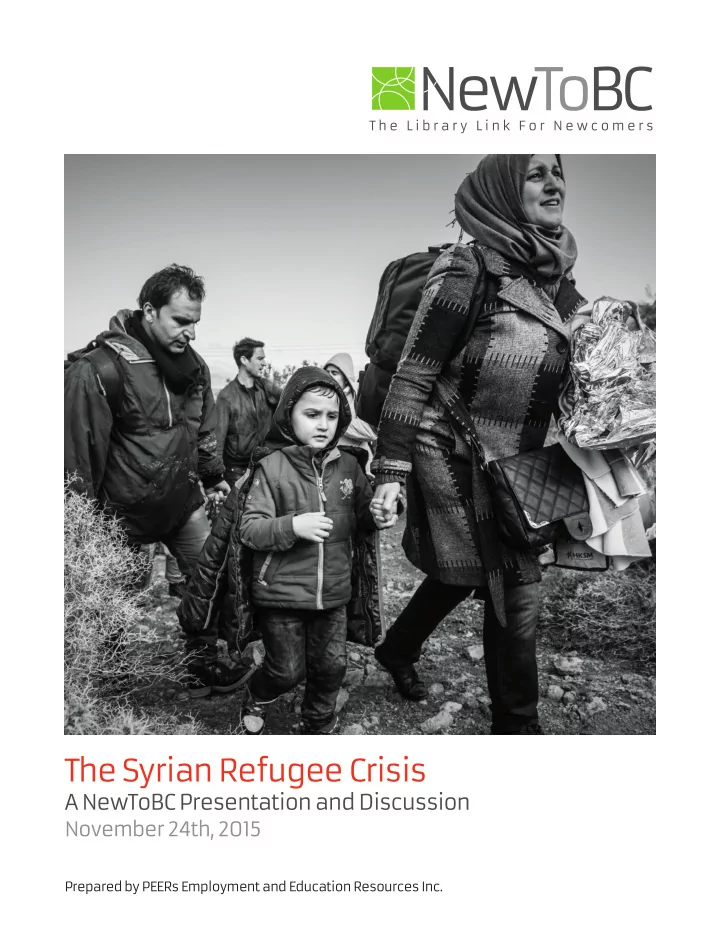
The Syrian Refugee Crisis
A NewToBC Presentation and Discussion
November 24th, 2015
Prepared by PEERs Employment and Education Resources Inc.
The Syrian Refugee Crisis A NewToBC Presentation and Discussion - - PDF document
The Syrian Refugee Crisis A NewToBC Presentation and Discussion November 24th, 2015 Prepared by PEERs Employment and Education Resources Inc. ThE SyRIAN REfugEE CRISIS A NewToBC PRESENTATIoN AND DISCuSSIoN SummARy REPoRT Summary Report of
Prepared by PEERs Employment and Education Resources Inc.
ThE SyRIAN REfugEE CRISIS A NewToBC PRESENTATIoN AND DISCuSSIoN SummARy REPoRT
Event Overview On November 24th, NewToBC hosted a three hour presentation and discussion session focused on the Syrian refugee crisis. Nearly 100 library management and staff attended from across the InterLINK library systems. Two presentations were provided by subject areas experts: Dan Hiebert, Professor of Geography at UBC and expert in the fjeld of refugee migration and Chris Friesen, Director
The presentations provided:
Syrian crisis;
and the migration of Syrian refugees;
being sponsored by Canada (both government and privately sponsored) – short term and long term projections;
into BC;
they will need and what has been put into place / what is being advocated for; and
web and other resources available to help organizations prepare. Discussion Summary
After the presentation, attendees participated in small group discussions focused on what libraries can do as individual systems or branches and what might InterLINK lead to support the settlement of Syrian refugees. The following sections provide a summary of the discussions and recommendations from the library round table examinations of the two questions provided following Dr. Dan Hiebert and Chris Friesen’s presenta-
themes with supporting information and specifjc suggestions listed below. The themes and recommendations for Question 1 should not be viewed as a checklist where all of the actions should be achieved, but rather as a reference for individual libraries and their staff to consider and plan localized responses. It is important to note that since this event, the Provincial Government has funded some initiatives to support Syrian settlement. ISSofBC has received funding to develop resources and training for community agencies and the province is in the process
the province to ensure community efforts are understood, communicated and coordinated. RRTs will include libraries and some of the suggestions below may be undertaken and / or led by the RRTs. In order to support library service and program planning and to avoid duplication, information on these initiatives has been included in the Next Steps section of this report. Responses to Question 2 are being reviewed by the NewToBC Steering Committee and the project team in consideration of the provincially funded initiatives. The Steering Committee has identifjed some potential training and resources development activities; these have been briefmy described in the Next Steps section.
ThE SyRIAN REfugEE CRISIS A NewToBC PRESENTATIoN AND DISCuSSIoN SummARy REPoRT
settlement in your community(s)?
refugees and community will be able to fjnd information
and crisis as well as information for refugees (like the Skilled Immigrant Info Centre)
material in the library
community: Who are the refugees What is the political situation How is Canada responding How can individuals help What other countries are doing Refer donors
resource guide
– event calendar: put opportunities in
refugees on website
community groups); go where they are; meet them 1st
agencies / fjnancial agencies to help refugees become aware of the services offered by the library, i.e. bank – fjnancial info. for refugees
package on how to help in conjunction with immigrant serving organization
staff with resources / facilitating tour
@ VPL; Guide in Arabic
the North Shore who are sponsoring refugees
where community partners could share resources; would need to partner with agencies; working with refugees to promote event
welcome to kindergarten)
programs (possibly through MOSIAC
and related book lists
and support refugees to fjnd / use them
with enhancing Arabic collection
ThE SyRIAN REfugEE CRISIS A NewToBC PRESENTATIoN AND DISCuSSIoN SummARy REPoRT
mentors, champions or buddies to help Syrian refugees better use the services available in local libraries and community agencies
One-on-one relationships between residents and refugees Get existing programs to discuss Organize town hall meeting
seniors, etc.) with already settled immigrants (library champions) to provide buddies, community connections etc.
“library buddy” and welcome refugees
programming - displays in multiple languages
refugees library tours
resources; give refugees tour
awareness and support to Syrian refugees
the public
to the public; develop info guide / sheets on how to help refugees (list
campaign F . Offer language support, including welcome package and signs in Arabic, translation and interpretation services
volunteer with refugees
using posters at refugee centres
forms and welcome brochures in Arabic
register for a library card, and outreach to refugee families
rary housing – bussed to the library
card: provide a temporary card where a permanent address is not required; allow an agency address to stand for an address
initial welcoming agency
months, 5 items max.)
children’s books (picture/wordless)
house where community partners could share resources; would need to partner with agencies; working with refugees to promote event
with food
ThE SyRIAN REfugEE CRISIS A NewToBC PRESENTATIoN AND DISCuSSIoN SummARy REPoRT
cies to do programs and meet clients
assistance
their story
project – to include refugees
library
from the library champions program who may be available to work with libraries to develop programs
working group
video on NewToBC.ca who is a library champion
NewToBC.ca (fjnances, food, transit, library)
inform patrons about refugees
coordinator at NewToBC
and resettlement
portable to every library for staff and for public
I help”
(ISSofBC profjles)
presentations to residents who want to volunteer
similar to what we had today
ThE SyRIAN REfugEE CRISIS A NewToBC PRESENTATIoN AND DISCuSSIoN SummARy REPoRT
their needs
sensitivity, mental health of refugees
line library staff
community resources and agencies including what immigration status the agencies serve
children’s librarians to ensure culturally appropriate programs F . Make information more accessible for Syrian refugees: enhance multilingual resources and materials; make information available graphically (animated)
refugees (bilingual)
(animated) instead of /as well as written in English
translations for signs, printable materials like welcome signs, bookmarks, etc.
across InterLINK catered to Syrian refugees
InterLINK systems welcoming refugees; with Arabic welcoming information available
– Practices, Successes, Failures
refugee centres for best ways to welcome refugees
Current Responses and Next Steps As mentioned in the Discussion Summary section of this report, since this November 24th session, the Ministry of Jobs, Tourism and Skills Training has offered fjnancial support from the BC Refugee Readiness Fund for a number of initiatives to support the resettlement of Syrian refugees. Information about these initiatives have been included in this report as an update and to avoid duplication of efforts. Below this description, the training and resource development activities currently being considered by NewToBC on behalf of InterLINK have been listed and briefly described. The following provides a brief overview of the initiatives funded by the Refugee Readiness Fund.
ThE SyRIAN REfugEE CRISIS A NewToBC PRESENTATIoN AND DISCuSSIoN SummARy REPoRT
Refugee Readiness Fund Overview
The Government of Canada has jurisdiction over the national immigration system, including refugee
global humanitarian crisis in Syria, the Government of B.C. has created the Refugee Readiness Fund (Fund), a one-time investment of $1 million to enhance federal and provincial refugee programs and provide additional resources for communities and private sponsors who are working to bring refugees to B.C. The Fund will complement rather than duplicate provincial and federal settlement and employment
communities
Initiatives Funded by the Refugee Readiness Fund
Burnaby, New Westminster, Rich- mond, Tsawassen, North Vancouver, West Vancouver, Coquitlam, Port Coquitlam, Port Moody, and area.
Delta, Langley, Maple Ridge, Pitt Meadows and area
Nanaimo
RRTs are consortia made up of multiple community partners (including libraries) and will collaborate
these needs at a community / regional level. RRTs will develop action plans and work over the next year to implement these plans. The RRTs are expected to be the local resource for information and communications about Syrian refugee resettlement. The RRTs are expected to work on initiatives within their respective communities and refmective of needs within their immediate community. It is expected that the RRTs will feed information and statistics to the Refugee Readiness Hub (see below) – a website managed by ISSofBC. Refugee Readiness Hub The Refugee Readiness Hub is a province-wide “how to help” portal. Through the Refugee Readiness Hub, visitors can learn about Syria, read the latest status of the arrival of refugees and fjnd local resettlement pro- grams and services. The Hub has just gone “live” and is a work in progress; information will be updated regularly and new sections and information will be added. Visit the hub at: http://www.issbc.org/prim-corp-nav/
ISSofBC is also developing newsletters focused on Syrian Refugee Resettlement. These newsletters will be published on a weekly basis until February and then
Hub website. Refugee Response Teams The province put out a call for proposals to establish RRTs in December 2015. Proposals are currently being evaluated and successful proponents will be notifjed shortly with the intent that the RRTs are established at the beginning of February 2016. RRTs have been funded as a one-time initiative and all activities will be completed by March 2017. Five RRTs will be put in place across the province to cover the following regions.
ThE SyRIAN REfugEE CRISIS A NewToBC PRESENTATIoN AND DISCuSSIoN SummARy REPoRT
Trauma Related Clinician Support It is anticipated that many Syrian Refugees will require
1-800 clinical consultation line, build trauma needs and vulnerability assessment tools and will facilitate trauma support groups. Refugee Readiness Workshops ISSofBC will develop and deliver fjve 2-day refugee readiness workshops (one in each of the fjve RRT regions). These will be recorded and posted as videos and / or audio presentations on the Hub. Foreign Credential Recognition and Employment Supports Credential recognition and employment supports were also identifjed as priorities and the province will be pursuing avenues outside the currently identifjed funds such as reprioritizing projects to ensure foreign credential recognition and employer and labour market needs are met. Through the Canada-BC Job Grant, up to $1.5 million will support skills training to assist refugees and new Canadians to gain employment, in partnership with sector/industry associations and
specifjcally on refugees while the second $500,000 stream will be open to refugees, protected persons entitled to work in Canada, and new immigrants (arrived within the last fjve years).
Potential Initiatives for NewToBC / InterLINK The following provides a brief overview of the training and resource development activities being considered by NewToBC.
Training / Dialogues
library staff could access training without hav- ing to commit to attending an event. Focus on refugee myth busting and information that can be posted online / shared across the various libraries.
Dialogues (5) – these would be designed and delivered in a consistent manner across Metro Vancouver and the Fraser Valley. The focus of these sessions would on identifying and explor- ing the benefjts and contributions of refugees / immigrants to Canada. The sessions would be professionally moderated, may involve expert presenters and would be for both library staff and the community at large. The sessions may be recorded as pod-casts.
a series of community dialogues – these would focus on “contextualizing” Canadian immigra- tion and obtaining a better understanding of human migration currently and historically. Resource development
progress) – this list is being developed collab-
sional designed and then distributed through the library systems and NewToBC and its social media channels.
shared across libraries – the kit would include information that provides the history / context
about arrivals in Canada as well as information about the history of immigration to Canada and human migration in general. Other ideas
Program to ensure it is inclusive of refugees.
information on refugee issues such as the trans- portation tax and its recent exemption, and the historical context of refugees an immigration to BC and Canada.