
SLIDE 1
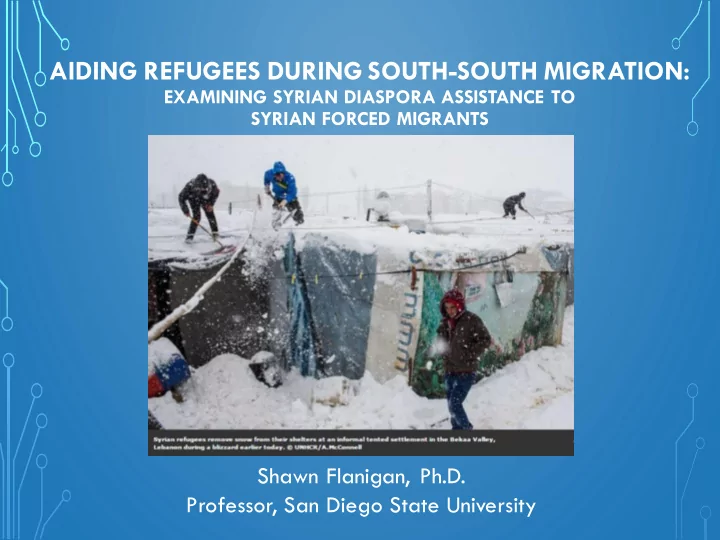
AIDING REFUGEES DURING SOUTH-SOUTH MIGRATION:
EXAMINING SYRIAN DIASPORA ASSISTANCE TO SYRIAN FORCED MIGRANTS
Shawn Flanigan, Ph.D. Professor, San Diego State University
AIDING REFUGEES DURING SOUTH-SOUTH MIGRATION: EXAMINING SYRIAN - - PowerPoint PPT Presentation
AIDING REFUGEES DURING SOUTH-SOUTH MIGRATION: EXAMINING SYRIAN DIASPORA ASSISTANCE TO SYRIAN FORCED MIGRANTS Shawn Flanigan, Ph.D. Professor, San Diego State University TODAYS PRESENTATION Examine the advantages Syrian diaspora nonprofit
AIDING REFUGEES DURING SOUTH-SOUTH MIGRATION:
EXAMINING SYRIAN DIASPORA ASSISTANCE TO SYRIAN FORCED MIGRANTS
Shawn Flanigan, Ph.D. Professor, San Diego State University
TODAY’S PRESENTATION
Examine the advantages Syrian diaspora nonprofit
to other destinations in the global South.
their social network ties
DIASPORA REMITTANCES AND DIASPORA PHILANTHROPY
Dilip Ratha, World Bank, 2014
migrants from poor countries worldwide send money to their home countries
DIASPORA REMITTANCES AND DIASPORA PHILANTHROPY
Dilip Ratha, World Bank, 2014
in 2013 in 2013
average
Dilip Ratha, World Bank, 2014
DIASPORA REMITTANCES: PROMISE AND PROBLEMS
economies
individuals and communities
are not necessarily those with most need (India)
(not addressing broader social concerns)
DIASPORA PHILANTHROPY DEFINED
Money, goods, volunteer labor, knowledge and skills, and other assets donated for the social benefit of a community broader than ones’ family members, in a country or region where there is a population with whom the donor(s) have ancestral ties.
Research on this topic is “in its infancy” (Brinkerhoff 2014)
MECHANISMS OF DIASPORA PHILANTHROPY
Donor Aggregation
Individual donor Multiple donors
Donation Size Small
Some remittances, individual donations Hometown associations, neighborhood and regional groups, ethnic and clan associations, foreign-based ethnic NGOs, online platforms, small foundations
Large
Direct donations from highly successful businesspersons, celebrities, sports stars, and large foundations started by such individuals Professional associations, family foundations, venture philanthropy funds
Adapted in part from Newland et al. 2010, p. 10
PRESUMED ADVANTAGES OF DIASPORA PHILANTHROPY
reach locations and populations
needs, and how to address them
experience = better decision making
setbacks
partners
partners
considered controversial by local population
voice to the development agenda
DRAWBACKS/CHALLENGES OF DIASPORA PHILANTHROPY
new migrants
neglect development goals
migrant involvement
misunderstand local needs
meaning but unprofessional efforts (philanthropic amateurism)
vulnerable
religions, ethnicities, or regions
conflict
THE SYRIAN MIGRANT CRISIS
OUTSIDE SYRIA
displaced to countries in the global South (including Egypt, Iraq, Jordan, Lebanon, and Turkey INSIDE SYRIA
displaced from their homes
humanitarian assistance
Women and children from Syria at a Turkish military checkpoint Bryan Denton, The New York Times, Aug 2015
MIGRANTS TO (AND WITHIN) SOUTHERN STATES
Those who remain in the global South are more likely to be:
Mahmoud, age 15 UNHCR, S. Baldwin, 2013
Syrian refugees who are able to migrate to European Union member states are often comparatively better off than other refugees.
SOUTHERN HOST STATES:
SYRIAN FORCED MIGRANTS AND THE LEBANESE CONTEXT
5.1 million + people have fled Syria (2017,
UNHCR)
13.5 million displaced within Syria (2017, UNHCR)
1/23 the size of Ghana 1/3 the size of Belgium Population 4.6 million in 2012 (United Nations, 2015) Over 1 million Syrian de facto refugees residing in Lebanon (almost 25% of current residents) (May 2015) Syrian refugees live in 2,100 communities and an additional 1,400 informal refugee settlements 70% of Syrian forced migrants live below the poverty line
Infrastructure in Lebanon was already weak prior to the Syrian conflict
Lebanon hosts the 3rd largest number of refugee of any country on Earth
THE STUDY
Semi-structured interviews with: 26 individuals in leadership roles in four Syrian diaspora nonprofits Purposive sample supplemented by snowball sampling Data collection is ongoing Leaders = ORGANIZATION FOUNDERS, BOARD MEMBERS, AND
INDIVIDUALS WHO DIRECTED KEY PROGRAMS AND INITIATIVES
All are from Syria or of Syrian descent.
Geographic dispersion of interview participants at time of interview
9-US 2- Canada 2- Germany 2- Dubai 11- Lebanon
Additional sites of work: Syria, Turkey
ADVANTAGES OF DIASPORA MOTIVATIONS FOR PHILANTHROPY
Diasporan identity as a strong motivator of philanthropy
(Best et al. 2013, Brinkerhoff 2008, Brinkerhoff 2011, Nielsen & Riddle 2009, Tchouassi & Sikod 2010, Werbner 2002)
“So at that point (when I became involved in aiding Syrian forced migrants), things had started to get bad and so I felt like I had so much that I owed to Syria, in terms of my cultural upbringing and going back there every summer. It was kind of a home away from home for me, and obviously for me, where my parents were born and my family was. So I felt like given the magnitude of what was going on there, it was really an obligation of mine to try and give back in some way, shape
that.”
ADVANTAGES OF DIASPORA MOTIVATIONS FOR PHILANTHROPY
Awareness that one’s fellow Syrians are reliant on diaspora assistance generated a sense of obligation to continue aid during challenging times (Brinkerhoff 2004, 2008, 2014, Lubkemann 2008).
“A lot of NGOs, Syrian or Lebanese or Turkish local NGOs, they are funded by a big funder like the UN and if they stop the funding, the NGO stops the project. But we have so many Syrian donors abroad, if
continue the project. Our donors are willing to stick with us even when things get hard, or there is donor fatigue with this migrant crisis.”
ADVANTAGES OF CULTURAL COMPETENCE AND FAMILIARITY
Additional cultural competency and local knowledge that supports efforts to assist Syrian forced migrants (Johnson 2007,
Newland & Patrick 2004)
“Having a board of Syrian expatriates does make a difference, I think mostly for the positive. All of the members on the board now used to visit Syria at least every other year for the summer, so they still have relatives in Syria, they know Syria, they are familiar with the culture. It’s not like they left and never went back. And this is very important because they can relate the work to their lives, they can relate to the Syrians there, and they want to work to help their fellow Syrians move
ADVANTAGES OF CULTURAL COMPETENCE AND FAMILIARITY
However, cultural competency and local knowledge varies based on country of residence.
“Definitely because (the Syrian diaspora donors) …never lived in Syria as citizens, but as expatriates, sometimes …they have expectations that are not realistic. For example, they might expect that the refugees are going to learn English in like four months, which is impossible, or expect them to know how to use the laptop. So they had to learn about the children.”
ADVANTAGES OF CULTURAL COMPETENCE AND FAMILIARITY
“We had a donor who wanted to give us fifty tablets for a more interactive classroom, but we said, “Hang on, let’s see if we can find Arabic apps first,” because most apps are very hard for us to use with
can’t read English. So we had to let (the donor) know they should let us do this research first before they go buy tablets. Plus in our tent school, there is sometimes electricity but there is no internet, so (the Syrian diaspora donor) forgot that our schools and our students are different.”
ADVANTAGES OF INFORMAL NETWORKS AND ACCOUNTABILITY
Enhanced ability to identify trustworthy partners and circumvent challenges in the operating environment, by making use of social network ties in the diaspora. (Brinkerhoff
2011, Newland & Patrick 2004).
“The organizations I work with, I know the people personally that work within the organization, so you really do know what’s going on, what the motives are, is there an agenda, is there not. Versus (another Syrian diaspora organization), the reason why we were very skeptical was because, well, we didn’t see any people that we know. It was just the idea that we’ve never seen this organization, what exactly is their agenda; you do feel skeptical when you’re not familiar.”
ADVANTAGES OF INFORMAL NETWORKS AND ACCOUNTABILITY
“Because most of the founders were involved in what’s going on in Syria so we have our networks, we have our contacts, we have our friends and our families who are part of what is going on. So this is how we start, and then the good names are easy to figure out.”
Diasporan advantage over traditional aid: Dense personal networks enable diasporans to identifying dependable partners and enforce agreements, even in places where the legal system is fragile (Brinkerhoff 2011,
Newland & Patrick 2004).
ADVANTAGES OF INFORMAL NETWORKS AND ACCOUNTABILITY
Circumventing disrupted financial systems
“So we try to send some money to some trusted affiliate NGOs in Turkey then to get the money from Turkey to Syria. This is for the North
the money to some friends or some trusted person in Lebanon, then we pay it in Lebanon so they can get it to the south. It used to be (that we had to carry cash across the border). Now we have some good networks where you can get the money whenever you want and you can pay it directly inside.”
ADVANTAGES OF INFORMAL NETWORKS AND ACCOUNTABILITY
Reputation as an accountability mechanism
“As an organization, humanitarian, your reputation is everything on the
what we do. We make sure to maintain our reputation, but also pay attention to the reputation of our partner, because who we work with is extremely important to our reputation.”
Diaspora membership raises the stakes of loss of reputation. Partners fear losing reputation not just professionally, but within larger family and friendship networks in the Syrian diaspora.
CONCLUSIONS
Diaspora aid comes with limitations
Advantages include:
as an accountability mechanism.
contexts.
members w. experience in South
THANK YOU! QUESTIONS?
shawn.flanigan@sdsu.edu
UNHCR, R. Haidar 2013