The Symmetric Two-State Chain Different Initial Distributions? Let - - PowerPoint PPT Presentation

the symmetric two state chain different initial
SMART_READER_LITE
LIVE PREVIEW

The Symmetric Two-State Chain Different Initial Distributions? Let - - PowerPoint PPT Presentation

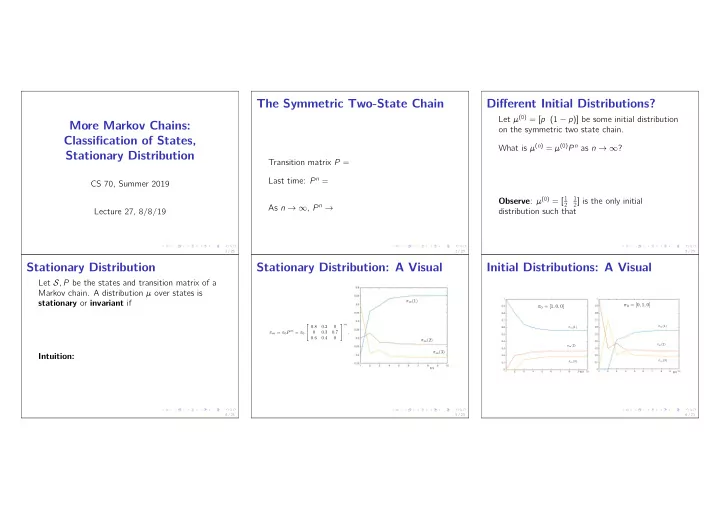
The Symmetric Two-State Chain Different Initial Distributions? Let ( 0 ) = [ p ( 1 p )] be some initial distribution More Markov Chains: on the symmetric two state chain. Classification of States, What is ( n ) = ( 0 ) P n as n


slide-1
SLIDE 1

More Markov Chains: Classification of States, Stationary Distribution

CS 70, Summer 2019 Lecture 27, 8/8/19

1 / 23

The Symmetric Two-State Chain

Transition matrix P = Last time: Pn = As n → ∞, Pn →

2 / 23

Different Initial Distributions?

Let µ(0) = [p (1 − p)] be some initial distribution

  • n the symmetric two state chain.

What is µ(n) = µ(0)Pn as n → ∞? Observe: µ(0) = [1

2 1 2] is the only initial

distribution such that

3 / 23

Stationary Distribution

Let S, P be the states and transition matrix of a Markov chain. A distribution µ over states is stationary or invariant if Intuition:

4 / 23

Stationary Distribution: A Visual

m πm(1) πm(2) πm(3) πm = π0P m = π0   0.8 0.2 0.3 0.7 0.6 0.4  

m

.

5 / 23

Initial Distributions: A Visual

m m

πm(1) πm(2) πm(3) πm(1) πm(2) πm(3)

π0 = [0, 1, 0] π0 = [1, 0, 0]

6 / 23

slide-2
SLIDE 2

Asymmetric Two State Chain

Similar example to the one before: Is there a stationary distribution? If so, what is it?

7 / 23

Loopy Two State Chain

A funny looking chain: Is there a stationary distribution? If so, what is it? Q: When do we have a stationary distribution? When do we have exactly 1?

8 / 23

Irreducibility

A Markov chain is irreducible we can go from every state i ∈ S to every other state j ∈ S, possibly in multiple steps. Are these chains irreducible: Two state asymmetric chain? Gambling chain (from yesterday)?

9 / 23

Long Run Behavior

Let I{Xm = i} be an indicator for whether Xm = i. How do we interpret the quantity below? 1 n

n−1

  • m=0

I{Xm = i} What happens as n → ∞?

10 / 23

Irreducibility Implies...

Theorem: Let S, P be an irreducible Markov chain. S is a finite set. The stationary π exists and is unique. For any initial µ(0) and all states i ∈ S:

11 / 23

Break

If you were a random variable, which one would you be and why?

12 / 23

slide-3
SLIDE 3

Non-Loopy Two State Chain

A simple looking chain: Is there a stationary distribution? If so, what is it? If X0 = a, what is X1000000? What is X1000001?

13 / 23

Two Scenarios...

14 / 23

Periodicity

For a state i, its periodicity is the gcd of the length of all tours (i.e. walks from i to i). Examples: Asymmetric two state chain? Gambling chain from yesterday?

15 / 23

Periodicity + Irreducibility

Let S, P define an irreducible Markov chain. Then, every state has the same period. If the chain is also aperiodic, then as n → ∞: P[Xn = 1] → πi

16 / 23

Cars and Trucks

Three out of every four trucks on the road are followed by a car, while only one out of every five cars is followed by a truck. What fraction of vehicles on the road are trucks? Step 1: Draw the Markov Chain.

17 / 23

Cars and Trucks

Step 2: Compute the stationary distribution.

18 / 23

slide-4
SLIDE 4

Markov Chain on a Graph

Let G be any loopless, connected graph. Each vertex represents a state, and at each vertex, we transition to a neighbor each with the same probability. Q: Is this Markov chain irreducible?

19 / 23

Markov Chain on a Graph

The unique stationary distribution π is given by: π = Can we verify this?

20 / 23

Sanity Check

Let G be a complete graph. What do we know about its long run behavior? Let G be an odd cycle. What do we know about its long run behavior?

21 / 23

Sanity Check

Let G be a hypercube. What do we know about its long run behavior? What fraction of time does it spend on strings with exactly k zeros?

22 / 23

Summary

◮ Stationary distributions do not change when

we multiply them by the transition matrix.

◮ Irreducible chains always have a unique

stationary distribution.

◮ We can say something about fraction of

time spent in state i if a chain is irreducible

◮ If an irreducible chain is also aperiodic, the

probability of being in a state at any time far enough out approaches πi. Next week: Conceptual review!

23 / 23