
SLIDE 1
Boolean Lattice and Symmetric Chain Decompositions
Yizhe Zhu
Shanghai Jiao Tong University zyzwstc@sjtu.edu.cn
December 30, 2014
Yizhe Zhu (SJTU) Symmetric Chain Decomposition December 30, 2014 1 / 47
Boolean Lattice and Symmetric Chain Decompositions Yizhe Zhu - - PowerPoint PPT Presentation
Boolean Lattice and Symmetric Chain Decompositions Yizhe Zhu Shanghai Jiao Tong University zyzwstc@sjtu.edu.cn December 30, 2014 Yizhe Zhu (SJTU) Symmetric Chain Decomposition December 30, 2014 1 / 47 Overview Boolean Lattice 1
Yizhe Zhu
Shanghai Jiao Tong University zyzwstc@sjtu.edu.cn
December 30, 2014
Yizhe Zhu (SJTU) Symmetric Chain Decomposition December 30, 2014 1 / 47
1
Boolean Lattice Definition Parenthesis Matching Conditions for an SCO
2
Necklace Poset Block Code Modified Parenthesis Matching Lyndon Rearrangement Generalization
3
Applications Symmetric Venn Diagrams Symmetric Independent Families
4
Open Problems
Yizhe Zhu (SJTU) Symmetric Chain Decomposition December 30, 2014 2 / 47
Let (P, <) be a finite poset. A chain in P is a sequence x1 < x2 < ... < xn, where each xi ∈ P. For x, y ∈ P, we say y covers x if x < y and there does not exist z ∈ P such that x < z and z < y. A saturated chain in P is a chain where each element is covered by the next. P is ranked if there exists a function r : P → Z≥0 such that x covers y implies r(y) = r(x) + 1. Suppose min{r(x)|x ∈ P} = 0, the rank of P is denoted r(P) = max{r(x)|x ∈ P}. A saturated chain x1 < x2 < ... < xn in a ranked poset P is said to be symmetric if r(x1) + r(xn) = r(P). P has a symmetric chain deomposition (SCD) if it can be written as a disjoint union of saturated, symmetric chains. A symmetric chain order (SCO) is a finite ranked poset for which there exists a symmetric chain decomposition.
Yizhe Zhu (SJTU) Symmetric Chain Decomposition December 30, 2014 3 / 47
The Boolean lattice, denoted Bn, is the power set of [n] = {1, 2, ..., n}
be viewed as an n-bit binary string whose ith bit is 1 if i ∈ A, 0 if i ∈ A.
Yizhe Zhu (SJTU) Symmetric Chain Decomposition December 30, 2014 4 / 47
parenthsis matching: start at the left, when a 1 is encounterd, it is matched to the rightmost unmatched zero (if any) with a pair of brackets. Continue in this manner until we reach the end of the string. x = 1011011100010110 the parentesis: 1(01)1(01)110(0(01)(01)1)0. U0(x) = {9, 16} unmatched zeros U1(x) = {1, 4, 7, 8} unmatched ones M(x) = {(2, 3), (5, 6), (10, 15), (11, 12), (13, 14)} matched pairs τ: change the leftmost unmatched 1 to a 0, defined on x ∈ Bn, U0(x) = ∅.
Yizhe Zhu (SJTU) Symmetric Chain Decomposition December 30, 2014 5 / 47
Theorem (Greene, Kleitman, 1976)
For x ∈ Bn with |U0(x)| = k, let Cx = {x, τ(x), τ 2(x), ..., τ k(x)}. The following is a symmetric chain decomposition of Bn: S = {Cx|x ∈ Bn, U1(x) = ∅}
Figure: the SCD of B4 by parenthesis matching
Yizhe Zhu (SJTU) Symmetric Chain Decomposition December 30, 2014 6 / 47
Given a ranked poset P, r(P) = M. Pk = {x ∈ P|r(x) = k}. rank-symmetric: |Pk| = |PM−k|. rank-unimodal: there exists j such that |P0| ≤ |P1| ≤ ... ≤ |Pj| and |Pj| ≥ |Pj+1| ≥ ... ≥ |PM|. antichain: a set of pairwise uncomparable elements of a poset strongly Sperner: for all k = 1, 2, ..., M + 1,the union of the k middle levels of P is a unition of k antichains of maximum size. A poset is Peck if it is rank-symmetric, rank-unimodal, and strongly Sperner. Given a group G of automorphisms of a poset P, a quotient poset of P under G, denoted P/G, is orderd in the following way: For orbits of G, A and B, we have A ≤ B iff there are a ∈ A, b ∈ B such that a ≤ b in P.
Yizhe Zhu (SJTU) Symmetric Chain Decomposition December 30, 2014 7 / 47
Stanley gave the necessary condition for an SCO.
Theorem (Stanley, 1984)
(1) An SCO poset P is necessarily Peck. (2) Any quotient of the Boolean lattice is a Peck poset. Griggs showed a sufficient condition for an SCO.
Theorem (Griggs, 1977)
LYM property, rank-symmetry and rank-unimodality implies that a poset P is SCO. LYM property: for every antichain F,
x∈F 1 |Pr(x)| ≤ 1.
Yizhe Zhu (SJTU) Symmetric Chain Decomposition December 30, 2014 8 / 47
rotation σ on Bn: x = (x1, x2, ..., xn), σ(x) = (xn, x1, ..., xn−1). For x, y ∈ Bn, we say x ∼ y if y = σk(x) for some k. The necklace poset Nn is the quotient poset of Bn under the equivalence relation ∼. For X, Y ∈ Nn, X ≤ Y iff there exist x ∈ X, y ∈ Y , x ≤ y. For prime p, it is known that Np satisfies the LYM property and has an
Yizhe Zhu (SJTU) Symmetric Chain Decomposition December 30, 2014 9 / 47
The explicit construction of an SCD for Np was given by the idea of block code together with parenthesis matching. A surprising application of such SCD of Np is to construct symmetric Venn diagrams.
Theorem (Griggs, Killian, Savage, 2004)
For prime n, there is a way to select a set Rn consisting of one representative from each necklace in Nn such that the induced necklace-representative subposet (Rn, ≤) of Bn has an SCD. It is a stronger than the claim that Np has an SCD.
Yizhe Zhu (SJTU) Symmetric Chain Decomposition December 30, 2014 10 / 47
block code β(x) of a binary string x: If x starts with 0 or ends with 1, β(x) = (∞). If x = 1a10b11a20b2...1at0bt, where t > 0, ai > 0, bi > 0, 1 ≤ i ≤ t, then β(x) = (a1 + b1, a2 + b2, ..., at + bt). Consider the rotation of x = 0011011, we have β(0011011) = (∞), β(0110110) = (∞), β(1101100) = (3, 4), β(1011001) = (∞), β(0110011) = (∞), β(1100110) = (4, 3), β(1001101) = (∞).
Lemma (Griggs, Killian, Savage, 2004)
If n is prime, no two strings of {0, 1}n in the same necklace have the same finite block code. The representative ρ(x) of necklace containing x is the rotation y of x for which β(y) is minimum. By the lemma, ρ(x) is the unique representative. For example, ρ(0011011) = 1101100.
Yizhe Zhu (SJTU) Symmetric Chain Decomposition December 30, 2014 11 / 47
Rn = {ρ(x)|x ∈ {0, 1}n} = {x ∈ {0, 1}n|ρ(x) = x} is a subposet of Bn, called necklace-representative poset. Consider R∗
n = Rn − {0n, 1n}, we construct an SCD for Rn by showing R∗ n
has an SCD.
Lemma (Griggs, Killian, Savage, 2004)
If x ∈ R∗
n and |U0(x)| ≥ 2, then τ(x) ∈ R∗
τ −1(x) ∈ R∗
n.
Define the set S∗ = {z ∈ R∗
n|U1(z) = {1}}. For z ∈ S∗, define the chain
Every x ∈ R∗
n is in the chain Jz for some z ∈ S∗. The set of chains
{Jz|z ∈ S∗} is an SCD of R∗
n.
Extend {Jz|z ∈ S∗} to an SCD in Rn by extending the chain 10n−1 < 110n−2 < ... < 1n−200 < 1n−10 to the chain 0n < 10n−1 < 110n−2 < ... < 1n−200 < 1n−10, 1n.
Yizhe Zhu (SJTU) Symmetric Chain Decomposition December 30, 2014 12 / 47
Yizhe Zhu (SJTU) Symmetric Chain Decomposition December 30, 2014 13 / 47
Theorem (Jiang, Savage, 2009)
Nn is an SCO for all prime n and for composite n ≤ 18. They considered the periodic block code but failed to generalize the construction for lager n.
Theorem (Jordan, 2010)
The necklace poset is a symmetric order for all n ≥ 1. The proof is constructive and the most important step is to choose the representative of each necklace.
Yizhe Zhu (SJTU) Symmetric Chain Decomposition December 30, 2014 14 / 47
Consider a set Mn consisting of x ∈ Bn such that x achieves the maximum number of unmatched ones over all rotations. Mn = {y ∈ Bn : |U1(y)| = max{|U1(σk(y))| : k = 1, 2, ..., n}}
Figure: the SCD for B6 with memebers of M6 in bold
Yizhe Zhu (SJTU) Symmetric Chain Decomposition December 30, 2014 15 / 47
Lemma (Jordan, 2010)
Let x ∈ Mn. (1)If |x| < n
2, τ i(x) ∈ Mn, 1 ≤ i ≤ n − 2|x|.
(2) If |x| > n
2, τ −i(x) ∈ Mn, 1 ≤ i ≤ 2|x| − n.
Yizhe Zhu (SJTU) Symmetric Chain Decomposition December 30, 2014 16 / 47
If x ∈ Mn and Cx is the chain containing x in the SCD of Bn, the smallest symmetric subchain of Cx containing x is also in Mn. Note that the resulting chains still contain at least one representative of each necklace.
Figure: the SCD for M6 with duplicate representatives of N6
Yizhe Zhu (SJTU) Symmetric Chain Decomposition December 30, 2014 17 / 47
Lemma (Jordan, 2010)
Let x, y ∈ Mn with x ∼ y. (1) If |x| ≥ n
2, then τ(x) ∼ τ(y) or {τ(x), τ(y)} ∩ Mn = ∅.
(2) If |x| ≤ n
2, then τ −1(x) ∼ τ −1(y) or {τ −1(x), τ −1(y)} ∩ Mn = ∅.
Lemma (Jordan, 2010)
Let x, y ∈ Bn with |x| = |y| ≤ n
2, then x ∼ y ⇔ τ n−2k(x) ∼ τ n−2k(y)
The three lemmas above are proven by the idea of circular matching.
Yizhe Zhu (SJTU) Symmetric Chain Decomposition December 30, 2014 18 / 47
C 0
x : the chain containing x in the Greene-Kleitman SCD for Bn restricted
to Mn. D0 = Mn. Before step j + 1 in the iteration, C j
x: the chain containing x.
Dj: the set
For step j + 1, let x = y ∈ Dj with x ∼ y, |x| = k. If there are no such x, y, we have an SCD for Nn. Suppose |x| ≤ n
2, and C j x is at least as long as C j y.
bottom tail T j
b = {τ −i(y)|i ≥ 0, τ −i(y) ∈ Mn}.
top tail T j
t = {τ n−2k+i(y)|i ≥ 0, τ n−2k+i(y) ∈ Mn}.
C j+1
∗
= C j
y \ (T j b ∪ T j t )
Dj+1 = Dj \ (T j
b ∪ T j t ).
For z ∈ Dj+1 \ C j
y, C j+1 z
= C j
z.
For z ∈ C j+1
∗
, C j+1
z
= C j+1
∗
. Then Dj+1 Dj and
z∈Dj+1 C j+1 z
is an SCD for Dj+1.
Yizhe Zhu (SJTU) Symmetric Chain Decomposition December 30, 2014 19 / 47
Yizhe Zhu (SJTU) Symmetric Chain Decomposition December 30, 2014 20 / 47
Yizhe Zhu (SJTU) Symmetric Chain Decomposition December 30, 2014 21 / 47
Hersh and Schilling gave an explicit construction of SCD of Nn for general n by the idea of Lyndon words. The resulting symmetric chains are different from the previous work by Jordan. Given an ordered alphabet A and a word w ∈ An, define the Lyndon rearrangement of w to be the lexicographically smallest word obtained by a rotation of the letters in w. The resulting word is called a Lyndon word. For Bn, A = {0, 1} with ordering 1 ≺ 0. Lyndon rearrangement of 0001110 is 1110000.
Yizhe Zhu (SJTU) Symmetric Chain Decomposition December 30, 2014 22 / 47
On the top half (|x| ≥ n
2) of Nn, given a word w.
(1) Cyclically rotate it into its Lyndon rearrangement. (2) Add brackets within the word by the following procedure: (i) Take any 0 that is immediately followed by 1 cyclically and match these pairs by brackets. (ii) Remove them from further consideration. Follow the process repeatedly until all unmatched elements are 1’s. For example: 1101100110 → 1)1(01)10(01)1(0 → 1)1(01)1(0(01)1)(0. We call these 01 pairs a matching pair.
Yizhe Zhu (SJTU) Symmetric Chain Decomposition December 30, 2014 23 / 47
If there is at least one unpaired 1 at the end of this process, then φ maps the word to a word in which the rightmost unpaired 1 in Lyndon expression is changed to 0. φ maps 1)1(01)1(0(01)1)(0 to 1101000110. The image of φ in Lyndon rearrangment is 1101101000 with brackets 1)1)(01)1)(01)(0(0(0. Define φ on the lower half ( |x| < n
2) of Nn by successively undoing the
most recently created matching pair by turning its letter 1 to a 0.
Yizhe Zhu (SJTU) Symmetric Chain Decomposition December 30, 2014 24 / 47
Example
Repeated application of φ to 111101100101111000 yields a symmetric chain. 1)1)1)1)(01)1(0(01)(01)1)11(0(0(0(0 → 1)1)1)1)(01)1)(0(01)(01)1)1(0(0(0(0(0 → 1)1)1)1)(01)1)(0(01)(01)1)0(0(0(0(0(0 → 1)1)1)1)(01)0(0(01)(01)1)00(0(0(0(0
Theorem (Hersh, Schilling, 2013)
The necklace poset Nn has an SCD such that u, v ∈ Nn with |u| < |v| belong to the same chain if and only if u = φr(v) for some r > 0.
Yizhe Zhu (SJTU) Symmetric Chain Decomposition December 30, 2014 25 / 47
With the application of φ we get the SCD for N5.
Yizhe Zhu (SJTU) Symmetric Chain Decomposition December 30, 2014 26 / 47
The map φ is exactly the Kashiwara lowering operator of a cyclic crystal.
Yizhe Zhu (SJTU) Symmetric Chain Decomposition December 30, 2014 27 / 47
The necklace poset Nn is the quotient of Bn under the action of the cyclic group Zn. Other results about the quotients of Bn and general poset P are as follows.
Theorem (Duffus, Mckibben-Sanders, Thayer, 2012)
(1)Let G be a subgroup of Sn generated by powers of disjoint cycles. Then the poset Bn/G is an SCO. (2)Let G be a 2-element subgroup with non-unit element a product of disjoint transpositions. Then the poset Bn/G is an SCO. (3)Let C be a chain and let K be a subgroup of Sm generated by powers
Theorem (Dhand, 2012)
Let P be a poset. If P is an SCO, then Pn/Zn is an SCO.
Yizhe Zhu (SJTU) Symmetric Chain Decomposition December 30, 2014 28 / 47
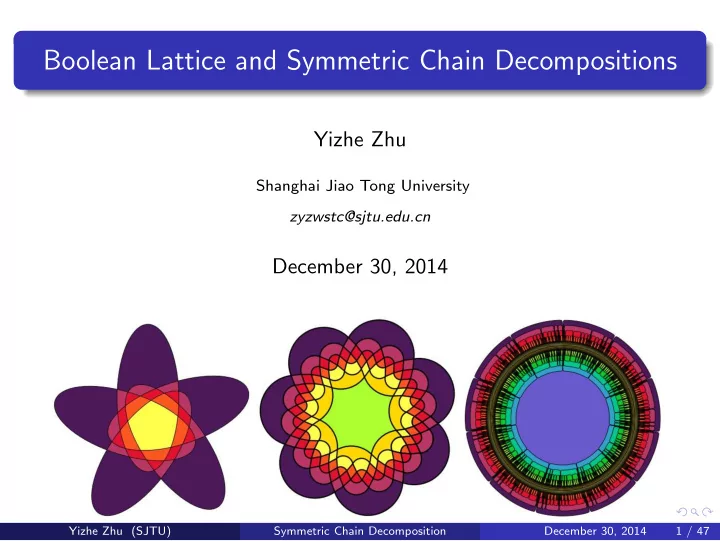
An n-Venn diagram is a collection of n simple closed curves in the plane, {Θ1, Θ2, ..., Θn} such that for each S ⊂ {1, 2, ..., n} the region
i∈S ext(Θi) is nonempty and connected. A Venn diagram
is called simple if each point of intersection has degree 4.
Yizhe Zhu (SJTU) Symmetric Chain Decomposition December 30, 2014 29 / 47
A symmetric Venn diagram is one with rotational symmetry. That is, there is a point p in the plance such that each of the n rotations of Θ1 about p by an angle of 2πi/n, 0 ≤ i ≤ n − 1, coincides with one of the curves Θ1, Θ2, ..., Θn.
Theorem (Handerson, 1963)
Symmetric Venn diagrams are not possible when n is not prime.
Theorem (Griggs, Killian, Savage, 2004)
For all prime n, there is a symmetric n-Venn diagram which can be constructed from the SCD in Rn.
Yizhe Zhu (SJTU) Symmetric Chain Decomposition December 30, 2014 30 / 47
Let C be an SCD in a poset A. Call the longest chains in C the root
root chain, there exists a chain π(C) ∈ C such that starter(C) covers an element πs(C) of π(C), terminator(C) is covered an element πt(C) of π(C). Call such a map π a chain cover map.The chain cover graph G(C, π) is shown.
Yizhe Zhu (SJTU) Symmetric Chain Decomposition December 30, 2014 31 / 47
Yizhe Zhu (SJTU) Symmetric Chain Decomposition December 30, 2014 32 / 47
Yizhe Zhu (SJTU) Symmetric Chain Decomposition December 30, 2014 33 / 47
Yizhe Zhu (SJTU) Symmetric Chain Decomposition December 30, 2014 34 / 47
Yizhe Zhu (SJTU) Symmetric Chain Decomposition December 30, 2014 35 / 47
Yizhe Zhu (SJTU) Symmetric Chain Decomposition December 30, 2014 36 / 47
Yizhe Zhu (SJTU) Symmetric Chain Decomposition December 30, 2014 37 / 47
Griggs, Killian and Savage asked in their paper: does there always exist a simple symmetric n-Venn diagram when n is prime? Examples are known only for n = 3, 5, 7. A simple symmetric Venn diagram contains 2n − 2 intersection points. Killian, Ruskey, Savage and Weston (2004) showed the method of Griggs, Killian and Savage failed to find simple symmetric Venn diagrams. They constructed the half-simple symmetric Venn diagrams: symmetric Venn diagrams with asympotically at least 2n−1 intersection points.
Yizhe Zhu (SJTU) Symmetric Chain Decomposition December 30, 2014 38 / 47
Yizhe Zhu (SJTU) Symmetric Chain Decomposition December 30, 2014 39 / 47
To date the simplest symmetric 11-Venn diagram is due to Hamburger, Petruska and Sali. Their diagram has 1837 vertices and is about 90% simple.
Yizhe Zhu (SJTU) Symmetric Chain Decomposition December 30, 2014 40 / 47
An independent family is a collection of n curves in the plane such that every subset of [n] is represented at least once in the regions formed by the intersection of the interiors of the curves. A Venn diagram is an independent family where each subset is represented once.
Theorem (Gr¨ unbaum, 1999)
(1)Any independent family of n curves must have at least 2 + n(|Nn| − 2) regions. (2) symmetric independent families of n curves exists for all n.
Theorem (Jiang, 2003)
If there exists an SCD of Rn with chain cover property, then there exits a symmetric independent family of n curves with 2 + n(|Nn| − 2) regions.
Theorem (Jordan, 2010)
There exits a symmetric independent family of n curves with 2 + n(|Nn| − 2) regions.
Yizhe Zhu (SJTU) Symmetric Chain Decomposition December 30, 2014 41 / 47
(Griggs, Killian, Savage, 2004) Construct simple symmetric n-Venn diagrams for prime n ≥ 11. (Canfield, Mason, 2006) For all subgroups G of Sn, is Bn/G an SCO? (Jordan, 2010) Consider the true necklace, meaning Bn/G, where G is the group of automorphism that includes both rotations and
(Jordan, 2010) Let G and H be two groups of automorphisms on Bn, and K the group of automorphisms generated by G and H. If Bn/G and Bn/H are SCOs, is Bn/K also an SCO? SCD for L(m, n), i.e. poset of partitions in a rectangle. SCD for poset Sn with weak order or Bruhat order.
Yizhe Zhu (SJTU) Symmetric Chain Decomposition December 30, 2014 42 / 47
Canfield, E. R., & Mason, S. (2006). When is a quotient of the Boolean lattice a symmetric chain order Preprint. Douglas B. W. (1980). A symmetric chain decomposition of L(4, n) European Journal of Combinatorics, 1(4), 379-383. Duffus, D., McKibben-Sanders, J., & Thayer, K. (2012). Some quotients of chain products are symmetric chain orders Electronic Journal of Combinatorics, 19(2), 46-57. Greene, C., & Kleitman, D. J. (1976). Strong versions of Sperner’s theorem Journal of Combinatorial Theory, Series A, 20(1), 80-88. Griggs, J. R. (1977). Sufficient conditions for a symmetric chain order SIAM Journal on Applied Mathematics, 32(4), 807-809.
Yizhe Zhu (SJTU) Symmetric Chain Decomposition December 30, 2014 43 / 47
Griggs, J., Killian, C. E., & Savage, C. D. (2004). Venn diagrams and symmetric chain decompositions in the Boolean lattice Electronic Journal Combinatorics, 11(1). Gr¨ unbaum, B. (1975). Venn diagrams and independent families of sets Mathematics Magazine, 12-23. Gr¨ unbaum, B. (1999). The search for symmetric Venn diagrams Geombinatorics, 8(4), 104-109. Hamburger, P., Petruska, G., & Sali, A. (2004). Saturated chain partitions in ranked partially ordered sets, and non-monotone symmetric 11-Venn diagrams Studia Scientiarum Mathematicarum Hungarica, 41(2), 147-192. Henderson, D. W. (1963). Venn diagrams for more than four classes American Mathematical Monthly, 424-426.
Yizhe Zhu (SJTU) Symmetric Chain Decomposition December 30, 2014 44 / 47
Hersh, P., & Schilling, A. (2013). Symmetric chain decomposition for cyclic quotients of Boolean algebras and relation to cyclic crystals International Mathematics Research Notices, 2013(2), 463-473. Jiang, Z. (2003). Symmetric chain decompositions and independent families of curves MS thesis, North Carolina State University. Jiang, Z., & Savage, C. D. (2009). On the existence of symmetric chain decompositions in a quotient of the Boolean lattice Discrete Mathematics, 309(17), 5278-5283. Jordan, K. K. (2010). The necklace poset is a symmetric chain order Journal of Combinatorial Theory, Series A, 117(6), 625-641. Killian, C. E., Ruskey, F., Savage, C. D., & Weston, M. (2004). Half-simple symmetric Venn diagrams Journal of Combinatorics, 11(3), R86.
Yizhe Zhu (SJTU) Symmetric Chain Decomposition December 30, 2014 45 / 47
Ruskey, F., & Weston, M. (1997). A survey of Venn diagrams Electronic Journal of Combinatorics, 4. Ruskey, F., Savage, C. D., & Wagon, S. (2006). The search for simple symmetric Venn diagrams Notices of the AMS, 53(11), 1304-1311. Stanley, R. P. (1984). Quotients of Peck posets Order, 1(1), 29-34. Stanley, R. P. (2011). Enumerative combinatorics (Vol. 1) Cambridge University Press. Vivek, D. (2012). Symmetric chain decomposition of necklace posets Electronic Journal of Combinatorics, 19(1), 26-40.
Yizhe Zhu (SJTU) Symmetric Chain Decomposition December 30, 2014 46 / 47
Yizhe Zhu (SJTU) Symmetric Chain Decomposition December 30, 2014 47 / 47