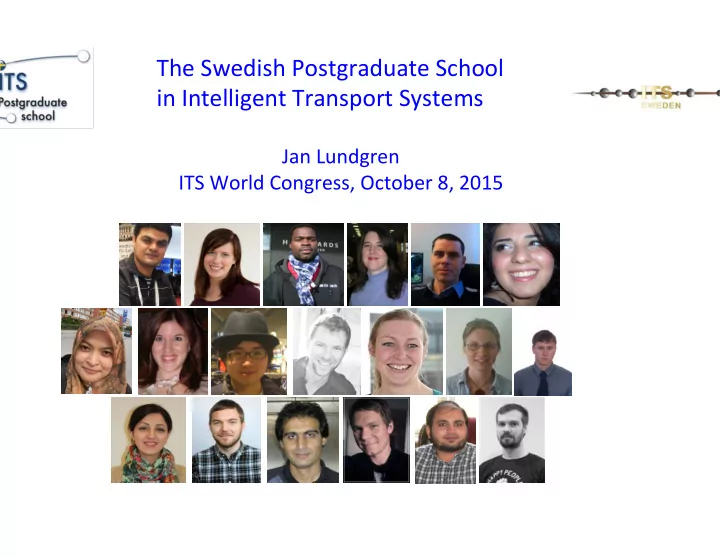
SLIDE 1
The ¡Swedish ¡Postgraduate ¡School ¡ in ¡Intelligent ¡Transport ¡Systems ¡ ¡
Jan ¡Lundgren ¡ ITS ¡World ¡Congress, ¡October ¡8, ¡2015 ¡
SLIDE 2
The ¡Swedish ¡Postgraduate ¡School ¡ in ¡Intelligent ¡Transport ¡Systems ¡
CooperaDon ¡between ¡ITS ¡Sweden ¡and ¡seven ¡universiDes ¡
¡
Supported ¡by ¡the ¡Swedish ¡Transport ¡AdministraDon ¡and ¡the ¡ ¡ Swedish ¡Governmental ¡Agency ¡for ¡InnovaDon ¡Systems ¡(VINNOVA) ¡
¡
SLIDE 3 Aim: ¡
- Improve ¡the ¡PhD-‑educaDon ¡through ¡specialised ¡
doctoral ¡courses ¡and ¡extended ¡supervision ¡of ¡students ¡ ¡
- Promote ¡academic ¡research ¡within ¡the ¡field ¡of ¡ITS ¡
relevant ¡for ¡industry ¡and ¡society ¡
- Increase ¡the ¡interest ¡and ¡focus ¡of ¡transportaDon ¡
research ¡and ¡educaDon ¡within ¡the ¡universiDes ¡ ¡
- Establish ¡networks ¡for ¡collaboraDon ¡both ¡naDonally ¡
and ¡internaDonally ¡ The ¡Swedish ¡Postgraduate ¡School ¡ in ¡Intelligent ¡Transport ¡Systems ¡
SLIDE 4
¡ ¡ ¡ ¡
Modeling ¡and ¡Simula0on ¡Study ¡of ¡ ¡ Heavy-‑Duty ¡Vehicle ¡Platooning ¡ ¡ ¡
Qichen ¡Deng ¡ ¡
KTH ¡Royal ¡InsDtute ¡of ¡Technology ¡
¡
SLIDE 5 Research ¡ques0ons ¡
- What ¡are ¡the ¡benefits ¡of ¡platooning ¡heavy-‑duty ¡
vehicles ¡on ¡highway ¡(HDVs)? ¡
- When ¡can ¡two ¡HDVs ¡form ¡a ¡platoon? ¡
SLIDE 6
Benefits ¡– ¡Improve ¡Fuel ¡Efficiency ¡of ¡HDV ¡
SLIDE 7 Benefits ¡– ¡Improve ¡Traffic ¡Efficiency ¡ ¡
50 100 150 500 1000 1500
Traffic Density [veh/lane/km] Traffic Flow Rate [veh/lane/hour]
No HDV Platooning HDV Platooning with CVS Policy 50 100 150 500 1000 1500
Traffic Density [veh/lane/km] Traffic Flow Rate [veh/lane/hour]
No HDV Platooning HDV Platooning with CVS Policy 50 100 150 500 1000 1500
Traffic Density [veh/lane/km] Traffic Flow Rate [veh/lane/hour]
No HDV Platooning HDV Platooning with CVS Policy 50 100 150 500 1000 1500
Traffic Density [veh/lane/km] Traffic Flow Rate [veh/lane/hour]
No HDV Platooning HDV Platooning with CVS Policy
(a) ¡10% ¡of ¡total ¡traffic ¡is ¡HDVs; ¡(b) ¡15% ¡of ¡total ¡traffic ¡is ¡HDVs; ¡(c) ¡20% ¡of ¡total ¡traffic ¡is ¡HDVs; ¡ (d) ¡25% ¡of ¡total ¡traffic ¡is ¡HDVs. ¡
(a) ¡ (b) ¡ (c) ¡ (d) ¡
SLIDE 8 When ¡can ¡two ¡HDVs ¡form ¡a ¡platoon? ¡
- Key ¡factors ¡affecDng ¡the ¡HDV ¡platooning ¡formaDon: ¡
- 1. Traffic ¡density ¡
- 2. Driving ¡behavior ¡of ¡passenger ¡car ¡
- 3. Speed ¡of ¡HDVs ¡
Lane 1 Lane 2
SLIDE 9 Platoon ¡Forma0on ¡of ¡Two ¡HDVs ¡on ¡a ¡Two-‑Lane ¡Highway
16 18 20 22 24 26 28 400 600 800 1000 1200 1400 1600 1800 2000 Number of Vehicles between Two HDVS plus Traffic Density of Lane 2 HDV Platoon Formation Time [s] Reference Front HDV Speed 70km/h Front HDV Speed 75km/h Front HDV Speed 80km/h
16 vehcles 1080s 18 vehicles 540s 17 vehicles 720s
SLIDE 10
¡ ¡ ¡ ¡
Coopera0ve ¡ITS ¡in ¡traffic ¡management ¡ ¡ ¡ ¡ ¡ ¡
Ellen ¡Grumert ¡
Linköping ¡University ¡
SLIDE 11 Coopera0ve ¡ITS ¡in ¡traffic ¡management ¡
Source: ¡Foto ¡taken ¡by ¡user ¡Fir0002, ¡publiced ¡at ¡www.wikipedia.org ¡(accessed ¡2014-‑09-‑21) ¡
¡ 𝒓<𝒓↓𝒅 𝒓↓𝒅 ¡
Density ¡ Flow ¡
SLIDE 12 Coopera0ve ¡ITS ¡in ¡traffic ¡management ¡
- ‑ ¡Approach ¡and ¡method ¡
InformaDon ¡ ¡ InformaDon ¡ InformaDon ¡ ¡ InformaDon ¡ InformaDon ¡från ¡ ¡ central ¡styrning ¡
Source: ¡Foto ¡taken ¡2010 ¡by ¡Holger ¡Ellgaard, ¡publiced ¡at ¡www.wikipedia.org ¡(accessed ¡ 2011-‑04-‑13) ¡
V2V ¡ I2V/V2I ¡ SUMO ¡
SLIDE 13 Coopera0ve ¡ITS ¡in ¡traffic ¡management ¡
- ‑ ¡Main ¡conclusions ¡
- The ¡performance ¡of ¡the ¡variable ¡speed ¡limit ¡systems ¡is ¡dependent ¡on ¡the ¡choice ¡of ¡
algorithm ¡for ¡deciding ¡on ¡which ¡variable ¡speed ¡limit ¡to ¡use ¡on ¡the ¡road. ¡
- CooperaDve ¡variable ¡speed ¡limit ¡systems ¡using ¡I2V ¡harmonize ¡the ¡flow ¡compared ¡to ¡
regular ¡variable ¡speed ¡limit ¡systems. ¡ ¡
- LimitaDons ¡in ¡having ¡fixed ¡measurement ¡points. ¡V2V ¡could ¡probably ¡improve ¡the ¡
performance ¡further ¡allowing ¡for ¡measurement ¡point ¡in ¡between ¡detectors. ¡
- Speed ¡limits ¡reflecDng ¡the ¡condiDons ¡on ¡the ¡road ¡gives ¡best ¡performance. ¡
- Early ¡prevision/early ¡detecDon ¡limits ¡the ¡effects ¡of ¡high ¡flows. ¡
- The ¡capacity ¡levels ¡are ¡of ¡high ¡importance ¡for ¡the ¡performance. ¡
SLIDE 14
¡ ¡ ¡ ¡
¡Performance ¡evalua0on ¡of ¡coopera0ve ¡ ¡ awareness ¡in ¡C-‑ITS ¡ ¡
Nikita ¡Lyamin ¡
Halmstad ¡University ¡
¡
SLIDE 15
Background ¡
SLIDE 16
Research ¡problems ¡
SLIDE 17
¡ ¡ ¡ ¡
Dynamic ¡Origin-‑Des0na0on ¡Matrix ¡Es0ma0on ¡ for ¡off-‑line ¡applica0ons ¡ ¡
Athina ¡Tympakianaki ¡
KTH ¡Royal ¡InsDtute ¡of ¡Technology ¡
¡
SLIDE 18 OD ¡es0ma0on ¡problem ¡
¡
- OD estimation is important in many applications
- essential input traffic simulation models (microscopic, planning models)
- traffic management (ITS systems)
- traffic prediction
- transportation planning
- evaluation of different strategies
- Find an OD matrix that best matches a set of indirect observations (e.g. counts,
speeds)
- Underdetermined problem, many unknowns fewer equations: different OD
matrices result in the same traffic counts
- Addition of more data sources reduces the set of possible solutions – requires more
general formulations of the problem and solution algorithms
- Traffic simulation is used to capture the traffic conditions resulting from different
OD matrices
SLIDE 19 Proposed ¡OD ¡es0ma0on ¡methods ¡
- 1. A gradient algorithm with formulation based on an assignment matrix that maps OD flows to
counts at sensor locations (e.g. Toledo and Kolechkina, 2013).
- 2. Cluster-based SPSA algorithm (Tympakianaki, Koutsopoulos, Jenelius, 2014) - Modification of
the commonly used SPSA (Spall, 1998) algorithm. Motivation:
- Different OD magnitudes
- Unstable performance, algorithm diverged
Modified algorithm, cluster-based SPSA:
- OD pairs are clustered based on some criteria:
§ Homogeneity within cluster § Magnitude of OD flows § Size of cluster § Number of clusters
- Gradient is approximated independently for each cluster
SLIDE 20 Case ¡study ¡– ¡synthe0c ¡data ¡
- Södermalm network, Stockholm
- 1100 urban and freeway and urban links
- ’True’ OD demand: synthetic data
- 462 OD pairs
- 7-8 a.m. study period
- 15 min time interval
- Sensor coverage: 5% of the total number of links.
- Traffic observations: counts, speeds
- Mesoscopic traffic simulation model: Mezzo ¡
¡
¡ ¡
0 ¡ 100000 ¡ 200000 ¡ 300000 ¡ 400000 ¡ 500000 ¡ 600000 ¡ 0 ¡ 200 ¡ 400 ¡ 600 ¡ 800 ¡ 1000 ¡ 1200 ¡ Objec0ve ¡func0on ¡value ¡ Number ¡of ¡func0on ¡evalua0ons ¡ SPSA ¡ c-‑SPSA ¡ 0 ¡ 10 ¡ 20 ¡ 30 ¡ 40 ¡ 50 ¡ 60 ¡ 70 ¡ IniDal ¡error ¡ SPSA ¡ c-‑SPSA ¡ RMSE ¡ OD ¡flows ¡(veh/h) ¡ Counts ¡(veh) ¡ Speeds ¡(km/h) ¡
- More robust algorithmic performance
- More accurate OD matrices
- Less sensitive to the selection of the algorithmic parameters
- Improved practical convergence
SLIDE 21 Motorway ¡applica0on ¡using ¡real ¡data ¡
How ¡well ¡does ¡the ¡ method ¡esDmates ¡ the ¡OD ¡flows ¡when ¡ an ¡incident ¡occurs? ¡ OD ¡esDmaDon: ¡
- Gradient ¡descent ¡algorithm ¡
- MCS ¡counts ¡
Counts ¡ (veh/h) ¡ IniDal ¡error ¡ Final ¡error ¡ RMSE ¡ 103 ¡ 56 ¡ ME ¡ 29,3 ¡ 0,83 ¡
0 ¡ 50 ¡ 100 ¡ 150 ¡ 200 ¡ 250 ¡ 6:00 ¡ 6:15 ¡ 6:30 ¡ 6:45 ¡ 7:00 ¡ OD ¡flow ¡change ¡(%) ¡ Time ¡(hh:mm) ¡ OD ¡pair ¡2 ¡ OD ¡pair ¡3 ¡ OD ¡pair ¡1 ¡
On-‑ramp ¡ Off-‑ramp ¡ Incident ¡ Detour ¡
Södertälje ¡-‑ ¡Bredäng ¡ 14 ¡km ¡ 14 ¡OD ¡pairs ¡
SLIDE 22
¡ ¡ ¡ ¡
Transport ¡for ¡sustainable ¡urban ¡development ¡– ¡ ¡ integrated ¡modelling ¡of ¡ ¡ walk, ¡cycle ¡and ¡public ¡transport ¡ ¡ ¡ ¡
Gerasimos ¡Loutos ¡
Linköping ¡University ¡
SLIDE 23 Project ¡View ¡
The ¡goal ¡is ¡to ¡improve ¡the ¡modeling ¡of ¡bicycle ¡ trips ¡in ¡current ¡demand ¡models ¡ AIM ¡to: ¡
- Develop ¡techniques ¡for ¡modeling ¡trips ¡chains ¡including ¡bicycle ¡and ¡public ¡
transport ¡legs. ¡
- IdenDficaDon ¡of ¡appropriate ¡level ¡of ¡detail ¡for ¡non-‑motorized ¡modes. ¡
- IdenDfy ¡factors ¡important ¡for ¡bicycle ¡mode ¡choice ¡and ¡factors ¡important ¡for ¡
policy ¡analyses. ¡
¡
SLIDE 24
Policy ¡variables ¡– ¡ ¡ Factors ¡that ¡influence ¡the ¡share ¡of ¡cyclists ¡
Built ¡environment ¡
Urban ¡form ¡(distance), ¡infrastructure ¡ ¡ and ¡faciliDes ¡at ¡work ¡
Natural ¡environment ¡
Hilliness, ¡climate ¡and ¡weather ¡
Socio-‑economics ¡
Gender, ¡age, ¡income, ¡ ¡car ¡and ¡bicycle ¡ownership, ¡ ¡ employment ¡status ¡
Psychological ¡factors ¡
Amtudes, ¡social ¡norms ¡and ¡habits ¡
Cost, ¡travel ¡0me, ¡effort ¡& ¡safety ¡
SLIDE 25
Mode ¡choice ¡models ¡
Built ¡environment ¡
Urban ¡form ¡(distance), ¡infrastructure ¡ ¡ and ¡faciliDes ¡at ¡work ¡
Natural ¡environment ¡
Hilliness, ¡climate ¡and ¡weather ¡
Socio-‑economics ¡
Gender, ¡age, ¡income, ¡ ¡car ¡and ¡bicycle ¡ownership, ¡ ¡ employment ¡status ¡
Psychological ¡factors ¡
Amtudes, ¡social ¡norms ¡and ¡habits ¡
Cost, ¡travel ¡0me, ¡effort ¡& ¡safety ¡
SLIDE 26 Mode ¡choice ¡models ¡es0ma0on ¡
Survey ¡Data ¡(Revealed ¡Preference, ¡ex. ¡RVU) ¡
- InformaDon ¡on ¡conducted ¡trips ¡& ¡socio-‑economic ¡variables ¡
- Drawback: ¡only ¡characterisDcs ¡for ¡individual’s ¡chosen ¡mode ¡
- I. ¡e. ¡Missing ¡travel ¡Dme ¡and ¡distance ¡(non-‑used) ¡alternaDves ¡
Regression ¡Models ¡ Trip ¡planning ¡applikaDon ¡
SLIDE 27 Available ¡tools ¡and ¡future ¡development ¡
Currently ¡used ¡models ¡
- Sweden: ¡SAMPERS, ¡Local ¡EMME ¡or ¡VISUM-‑models, ¡SLL ¡VISUM-‑model ¡
- Do ¡not ¡include ¡specific ¡bicycle ¡and ¡walk ¡factors ¡(e.g. ¡infra, ¡costs) ¡
- Cycity: ¡project ¡targets ¡to ¡improved ¡data ¡collecDon ¡(more ¡surveys, ¡GPS ¡data ¡
from ¡cyclists ¡etc.) ¡
- MoveMeter ¡(MoveMobility), ¡Brutus ¡(Strafica) ¡in ¡a ¡Swedish ¡semng. ¡
¡ Frame ¡a ¡new ¡transport ¡demand ¡tool ¡
- Include ¡modelling ¡trips ¡chains ¡with ¡several ¡modes ¡
- Assignment ¡of ¡trips ¡to ¡the ¡street ¡(OpenStreetMap) ¡network ¡for ¡all ¡modes ¡usin
- Time ¡table ¡data ¡for ¡public ¡transport ¡for ¡walk/PT-‑trips ¡
- Bicycle ¡rouDng ¡using ¡a ¡trip ¡planner ¡(in ¡OSM ¡network) ¡
- TradiDonal ¡car ¡assignment ¡(in ¡OSM ¡network) ¡
SLIDE 28
¡ ¡ ¡ ¡
¡ ¡ Access ¡management ¡in ¡intermodal ¡freight ¡ ¡ transporta0on ¡ ¡ ¡ ¡
Stefan ¡P ¡G ¡Jacobsson ¡
Chalmers ¡University ¡ ¡
¡ ¡
SLIDE 29 Access ¡management ¡in ¡intermodal ¡freight ¡transporta0on ¡-‑ ¡ Iden0fied ¡problems1 ¡
Decentralised Many actors Different modes Deficiencies in the interaction Practical problems in the hubs Lack of high-quality real-time data2 Decentralised Decentralised Decentralised Decentralised ________________________
1 According to Marchet et al., 2012, Perego et al., 2011, Bujis and Wortmann 2014 2 According to SteadiSeifi et al., 2014
SLIDE 30 Access ¡management ¡for ¡carrier ¡operaDons ¡in ¡intermodal ¡freight ¡transportaDon ¡ Research ¡gap ¡ Research ¡agenda ¡/ ¡ Next ¡steps ¡ (1) ¡Problem ¡ idenDficaDon ¡and ¡ moDvaDon ¡ Con-‑ versaDons ¡ Obser-‑ vaDons ¡ Literature ¡ study ¡ Bench-‑ marking ¡ (2) ¡Define ¡the ¡objecDves ¡for ¡a ¡ soluDon ¡ Access ¡management ¡ Handling ¡of ¡carrier ¡access ¡ Beper ¡understanding ¡and ¡ knowledge ¡ Literature ¡ study ¡ Con-‑ versaDons ¡ Obser-‑ vaDons ¡
Access ¡management ¡in ¡intermodal ¡freight ¡ transporta0on ¡-‑Methodology ¡
SLIDE 31
- For ¡smaller ¡actors ¡
- Use ¡already ¡exisDng ¡IT-‑systems ¡
- InteracDon ¡in ¡real-‑Dme ¡
- Qualify ¡for ¡access ¡to ¡an ¡intermodal ¡container ¡
terminal ¡
Access ¡management ¡in ¡intermodal ¡freight ¡ transporta0on ¡-‑ ¡Solu0on ¡
SLIDE 32
¡ ¡ ¡ ¡
¡Development ¡& ¡Evalua0on ¡of ¡Mobile ¡Phone ¡App ¡for ¡ ¡ Detec0ng ¡Safety ¡Cri0cal ¡Event ¡of ¡Motorcycle ¡Rider ¡ ¡
Noor ¡Azreena ¡Kamaluddin ¡
Lund ¡University ¡
¡
SLIDE 33
Introduc0on ¡
q An app for motorcyclists will be developed to register safety critical events. q Safety critical events will be identified by certain trigger variables (e.g. jerk). q The app helps to describe the course of events in a (near) accident. q The effects and rider acceptance of the system will be studied in a real life study.
SLIDE 34
Background
Ø Safety : crucial issue of motorcycle (More than 60% of fatalities, 20x higher risk) Ø Shortfalls issue – Complementary method (Reliable estimation) Ø Vital prerequisite to set-up more realistic targets for crash/casualty reduction programmes Ø No available or standard procedure in use for collecting self-reported accidents in Malaysia
¡
SLIDE 35
Objec0ves ¡
Ø Collect self-reported accidents & determine under-reporting - GAP Ø Develop & test of a mobile apps (e-Call) for motorcyclists – enrich current system Ø Identify/predict safety critical events based on sudden acceleration change (jerk) Ø Produce complementary method of accident recording system Ø Map locations with a higher single-accident risk based on the smartphone application (eCall app)
SLIDE 36
The ¡eCall ¡System ¡for ¡Motorcyclist ¡
Usefulness: Ø Send/prepare message SOS centre Ø Minimize rate of fatalitie Immediate medical assi Ø Collection of anonymou data & identify bike-acci prone area: Good basis prevention