the Subsequent Right to Contest Coverage Insurer and Policyholder - - PowerPoint PPT Presentation

the subsequent right to contest coverage
SMART_READER_LITE
LIVE PREVIEW

the Subsequent Right to Contest Coverage Insurer and Policyholder - - PowerPoint PPT Presentation

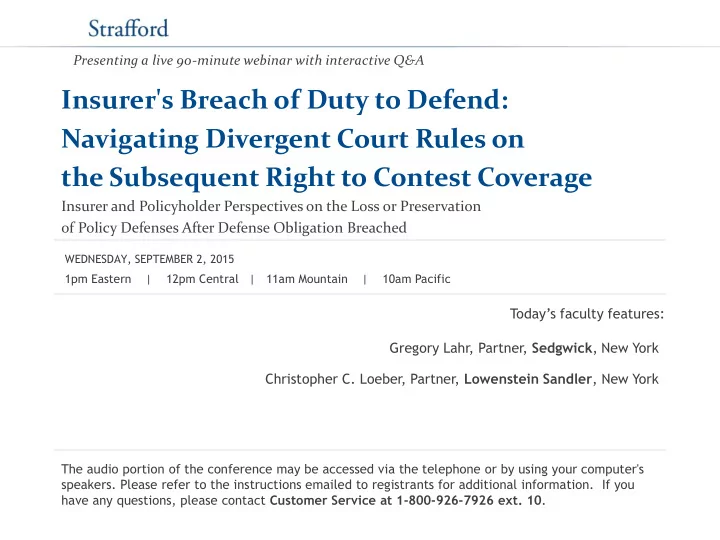
Presenting a live 90-minute webinar with interactive Q&A Insurer's Breach of Duty to Defend: Navigating Divergent Court Rules on the Subsequent Right to Contest Coverage Insurer and Policyholder Perspectives on the Loss or Preservation of


slide-1
SLIDE 1

The audio portion of the conference may be accessed via the telephone or by using your computer's

  • speakers. Please refer to the instructions emailed to registrants for additional information. If you

have any questions, please contact Customer Service at 1-800-926-7926 ext. 10.

Presenting a live 90-minute webinar with interactive Q&A

Insurer's Breach of Duty to Defend: Navigating Divergent Court Rules on the Subsequent Right to Contest Coverage

Insurer and Policyholder Perspectives on the Loss or Preservation

  • f Policy Defenses After Defense Obligation Breached

Today’s faculty features:

WEDNESDAY, SEPTEMBER 2, 2015

Gregory Lahr, Partner, Sedgwick, New York Christopher C. Loeber, Partner, Lowenstein Sandler, New York

1pm Eastern | 12pm Central | 11am Mountain | 10am Pacific

slide-2
SLIDE 2

Tips for Optimal Quality

Sound Quality If you are listening via your computer speakers, please note that the quality

  • f your sound will vary depending on the speed and quality of your internet

connection. If the sound quality is not satisfactory, you may listen via the phone: dial 1-866-927-5568 and enter your PIN when prompted. Otherwise, please send us a chat or e-mail sound@straffordpub.com immediately so we can address the problem. If you dialed in and have any difficulties during the call, press *0 for assistance. Viewing Quality To maximize your screen, press the F11 key on your keyboard. To exit full screen, press the F11 key again.

FOR LIVE EVENT ONLY

slide-3
SLIDE 3

Continuing Education Credits

In order for us to process your continuing education credit, you must confirm your participation in this webinar by completing and submitting the Attendance Affirmation/Evaluation after the webinar. A link to the Attendance Affirmation/Evaluation will be in the thank you email that you will receive immediately following the program. For additional information about CLE credit processing call us at 1-800-926-7926

  • ext. 35.

FOR LIVE EVENT ONLY

slide-4
SLIDE 4

Program Materials

If you have not printed the conference materials for this program, please complete the following steps:

  • Click on the ^ symbol next to “Conference Materials” in the middle of the left-

hand column on your screen.

  • Click on the tab labeled “Handouts” that appears, and there you will see a

PDF of the slides for today's program.

  • Double click on the PDF and a separate page will open.
  • Print the slides by clicking on the printer icon.

FOR LIVE EVENT ONLY

slide-5
SLIDE 5

STRAFFORD WEBINAR 2015

Insurer’s Breach of the Duty to Defend: Navigating Divergent Court Rules on the Subsequent Right to Contest Coverage

  • J. Gregory Lahr – Sedgwick LLP

gregory.lahr@sedgwicklaw.com Christopher C. Loeber – Lowenstein Sandler LLP cloeber@lowenstein.com

slide-6
SLIDE 6

The Duty to Defend, Generally

  • What establishes the duty to defend?

– Policy defense agreement – Insurer has the right and duty to defend. – Applies to groundless, false, or fraudulent claims.

  • Duty to defend broader than duty to indemnify. First Bank
  • f Turley v. Fidelity and Deposit Ins. Co., 928 P.2d 298

(Okla. 1996); Hanover Am. Ins. Co. v. Balfour, 594 Fed.

  • Appx. 526 (10th Cir. 2015)

– What does this mean?

6

slide-7
SLIDE 7

The Duty to Defend, Generally

  • How to determine if a defense is owed?

– 4 corners/8 corners rule (4 corners of complaint, and 4 corners of the policy). See, e.g., Standard Waste Systems v. Mid-Continent Cas. Co., 612 F.3d 394 (5th Cir. 2010). – If complaint against insured alleges facts within or potentially within the scope of the policy coverage, a defense is owed. City of College Station, Tex. v. Star Ins. Co., 735 F.3d 332 (5th Cir. 2013) – Duty to defend is triggered when the allegations of a complaint, liberally construed, suggest a reasonable possibility of coverage.

7

slide-8
SLIDE 8

The Duty to Defend, Generally

  • What about facts outside the complaint?
  • Who may rely on extrinsic evidence – insurer or insured?
  • Duty to discover reasonably attainable facts.
  • The insurer has actual knowledge of facts establishing a reasonable

possibility of coverage. Bruckner Realty, LLC v. County Oil Co., Inc., 838 N.Y.S.2d 87 (2d Dep’t 2007); Wilson Cent. School Dist. V. Utica Mut. Ins. Co., 999 N.Y.S.2d 440 (2d Dep’t 2014); Boston Symphony Orchestra Inc.

  • v. Commercial Union Ins. Co., 545 N.E.2d 1156 (Mass. 1989).
  • Facts reasonably apparent to the insurer. Esicorp, Inc. v. Liberty Mut. Ins.

Co., 193 F.3d 966 (8th Cir. 1999); Williams v. Employers Mut. Cas. Co., 2015 WL 892556 (E.D. Mo. 2015).

8

slide-9
SLIDE 9

The Duty to Defend, Generally

  • When is the duty to defend not triggered?

– Where the insurer establishes as a matter of law that there is no possible factual or legal basis upon which it might ultimately be

  • bligated to indemnify under any policy provision, the insurer is

relieved of such duty. Great Northern Ins. Co. v. Kobrand Corp., 837 N.Y.S.2d 41 (1st Dep’t 2007); Stein v. Northern Assur. Co., 2015 WL 4032613 (2d Cir. 2015).

9

slide-10
SLIDE 10

The Duty to Defend, Generally

  • If the underlying factual basis of the complaint, even if true,

would not result in coverage under the policy, then no duty to defend.

  • Look at the factual allegations alleged, or the causes of

action?

– Example, facts relating to defamation contained in the complaint, but no cause of action for defamation. – Intentional conduct cannot be done negligently. Erie Ins. Exchange

  • v. Fidler, 808 A.2d 587 (Pa. 2002).

– Intentional pollution over time is not sudden and accidental. Guar. Nat’l Ins. Co. v. Vic Mfg. Co., 143 F.3d 192 (5th Cir. 1998).

10

slide-11
SLIDE 11

The Duty to Defend, Generally

  • Whether the claimant is seeking damages based on a

reason covered by the policy, not whether the claimant could have sought damages based on a reason covered by the policy.

– Duty to defend cannot be based on speculation as to claims that could have been brought. Storek v. Fidelity & Guar. Ins. Underwriters, Inc., 504 F. Supp. 2d 803 (N.D. Cal. 2007).

11

slide-12
SLIDE 12

The Duty to Defend, Generally

  • When Can The Defense Be Withdrawn?

– Exhaustion of Limits

  • Withdrawal permitted
  • Am. States Ins. Co. of Tex. v. Arnold, 930 S.W.2d 196 (Tex. App. 1996).
  • Thompson v. Arbella Mut. Ins. Co., 1999 WL 1325975 (Mass. Super. Ct. 1999).
  • Novak v. Am. Fam. Mut. Ins. Co., 515 N.W.2d 504 (Wis. Ct. App. 1994).
  • Withdrawal denied
  • Am. Standard Ins. Co. v. Basbagill, 775 N.E.2d 255 (Ill. Ct. App. 2002).
  • Jenkins v. Ins. Co. of N. Am., 220 Cal. App. 3d 1481 (Cal. App. Ct. 1990).
  • Exch. Mut. Ins. Co. v. Geiser, 498 N.Y.S.2d 291 (NY. Sup. Ct. 1986).

Cases generally turn on precise terms such as “exhausted,” “offered” and “paid.”

12

slide-13
SLIDE 13

The Duty to Defend, Generally

– Covered Claim Resolved

  • Allstate Ins. Co. v. Mende, 575 N.Y.S.2d 520 (N.Y. App. Div. 1991)(case involved

property damage and assault stemming from an automobile accident; because assault was excluded under the policy, carrier was permitted to withdrawal defense upon settlement of property damage claims).

  • Meadowbrook Inc. v. Tower Ins. Co., 559 N.W.2d 411 (Minn. 1997) (carrier has

right to settle covered claims directly with plaintiff and withdraw from defense when those claims have been dismissed with finality).

  • Cagle v. Home Ins. Co., 483 P.2d 592 (Ariz. Ct. App. 1971) (carrier not obligated

to defend after covered claims were paid and remaining causes of action failed to bring the issue within the policy terms).

13

slide-14
SLIDE 14

Duty to Defend: Are There Sufficient Protections for the Insured?

  • Burden of proof.
  • Policy wording ambiguities.
  • Any doubt as to what is alleged.
  • Covered and uncovered claims.
  • Frivolous claims.

14

slide-15
SLIDE 15

Breach of the Duty to Defend

  • What happens if the insurer breaches the duty to defend?

– Extra-contractual (bad faith) damages? – Waive other provisions of the policy? – Attorney’s Fees? Brown v. State Auto. and Cas. Underwriters, 293 N.W.2d 822 (Minn. 1980).

15

slide-16
SLIDE 16

Attorney’s Fees – A Recent Twist

Occhifinto v. Olivo Constr. Co., 221 N.J. 443 (2015).

– Occhifinto sued the insured, Robert S. Keppler Mason Contractors, for alleged construction defects. – Mercer Mutual (Keppler’s Insurer) filed a declaratory judgment asserting it had no duty to defend or indemnify Keppler. – Occhifinto defended the declaratory judgment action on Keppler’s behalf and won summary judgment on Mercer’s duty to indemnify. Trial court reserved on Occhifinto’s claim for counsel fees. – At subsequent trial, Keppler was found not liable for damages. Occhifinto then moved to recover his counsel fees.

16

slide-17
SLIDE 17

Attorney’s Fees – A Recent Twist (cont’d)

– N.J. Rule § 4:42-9(a)(6) permits the award of attorneys’ fees to a successful claimant in an insurance coverage action. – The question was: Does a party qualify as a successful claimant when a court finds an indemnity obligation under the policy, but the insured is found not liable in the underlying action? – The trial court held Occhifinto was not a successful claimant because no indemnity coverage was paid. The Appellate Division affirmed. – The New Jersey Supreme Court reversed and granted fees because Occhifinto had successfully proven that there was coverage under Keppler’s policy.

17

slide-18
SLIDE 18

Attorney’s Fees – A Recent Twist (cont’d)

  • The New Jersey Supreme Court recognized Occhifinto as a

“successful claimant” because the declaratory judgment holding established that Occhifinto’s claims against Keppler – if proven – would have been covered.

  • The Court explicitly adopted the approach from Schmidt v.

Smith, 294 N.J. Super. 569 (App. Div. 1996) that a party to a declaratory judgment action is a successful claimant when the insurance carrier’s duty to defend is proven, even if there is no duty to indemnify.

18

slide-19
SLIDE 19

Representative Approaches in New York

  • Preservation of Right to Contest Coverage

– Servidone Constr. Corp. v. Security Ins. Co. of Hartford, 64 N.Y.2d 419, 488 N.Y.S.2d 139 (N.Y. 1985).

  • Loss of Right to Contest Coverage

– Lang v. Hanover Ins. Co., 3 N.Y.3d 350, 787 N.Y.S.2d 211 (N.Y. 2004).

19

slide-20
SLIDE 20

Preservation of Right to Contest Coverage

Servidone Constr. Corp. v. Security Ins. Co. of Hartford, 64 N.Y.2d 419 (1985). See also Am. States Ins. Co. v. Synod of the Russian Orthodox Church, 335 F.3d 493 (5th Cir. 2003).

– Employee injured during construction of a flood control project. – Employee sued the United States under Federal Tort Claims Act. – United States filed third-party action against Servidone for indemnification (common law and contract). – Servidone looked to Security Insurance for its defense.

20

slide-21
SLIDE 21

Preservation of Right to Contest Coverage (cont’d)

– Servidone’s Compensation and Liability Policy contained an exclusion for loss based upon “any obligation the insured had assumed by contract.” – Security argued that the loss was not within Servidone’s policy coverage. – Trial court found that Security breached its duty to defend, and directed that Security pay Servidone any damages flowing from the breach. – Appellate Division affirmed, imposing a duty to indemnify on the Security because, based on the claims asserted, it perceived a possibility of coverage.

21

slide-22
SLIDE 22

Preservation of Right to Contest Coverage (cont’d)

– The Court of Appeals held that:

  • An insurer's breach of duty to defend does not create coverage, there can

be no duty to indemnify unless there is first a covered loss.

  • The duty to defend is measured against the allegations of pleadings but

the duty to pay is determined by the actual basis for the insured’s liability to a third person.

  • By holding Security liable to indemnify Servidone on the mere "possibility"
  • f coverage perceived from the face of the complaint the trial court had

inappropriately enlarged the bargained-for coverage as a penalty for Security’s breach of the duty to defend.

22

slide-23
SLIDE 23

Loss of Right to Contest Coverage

Lang v. Hanover Ins. Co., 3 N.Y.3d 350 (2004)

– Lang injured by houseguest while playing paintball at friend’s home. – Hanover (friend’s insurer) disclaimed coverage for injury, arguing that houseguest was not an insured party under the terms of its policy. – Houseguest filed for chapter 7 bankruptcy. – Lang filed a declaratory judgment challenging Hanover’s disclaimer

  • f coverage; Hanover filed a motion to dismiss.

23

slide-24
SLIDE 24

Loss of Right to Contest Coverage (cont’d)

– N.Y. Insurance Law § 3420 allows a person who has obtained a judgment against an insured to sue the insured’s carrier. – The question was whether a stranger to the policy — an injured party who has sued a tortfeasor — can bring a direct action against the tortfeasor’s insurance company. – The trial court denied Hanover’s motion to dismiss. – Appellate division dismissed Lang’s declaratory judgment action because no judgment had been entered against the houseguest.

24

slide-25
SLIDE 25

Loss of Right to Contest Coverage (cont’d)

– The Court of Appeals held that:

  • Lang could not pursue a direct action against Hanover because he had

not obtained a judgment against the houseguest.

– Dicta

  • If an insurer disclaims and declines to defend in an underlying lawsuit

without seeking a declaratory judgment concerning its duty to defend or indemnify the purported insured, it takes the risk that the injured party will

  • btain a judgment against the purported insured and then seek payment

pursuant to N.Y. Insurance Law § 3420.

  • Under those circumstances, the insurance carrier may litigate only the

validity of its disclaimer and cannot challenge the liability or damages determination underlying the judgment.

25

slide-26
SLIDE 26

K2-I

K2 Inv. Grp., LLC v. Am. Guar. & Liab. Ins. Co., 21 N.Y.3d 384, 971 N.Y.S.2d 229 (N.Y. 2013)

– Two companies made loans to an LLC, loans were to be secured by mortgages. – One of the LLC’s principals (“insured”) acted as plaintiffs’ attorney in connection with loans, but failed to record mortgages. – Companies brought malpractice action against insured. – Insured notified American Guarantee (his malpractice carrier) of the claims; American Guarantee denied coverage. – Companies obtained a default judgment against insured, insured assigned companies all his rights against American Guarantee. – Companies sued American Guarantee for breach of contract and bad faith failure to settle the underlying lawsuit.

26

slide-27
SLIDE 27

K2-I (cont’d)

– American Guarantee’s malpractice liability policy excluded coverage for claims arising out of insured’s:

  • Status as “an officer, director, partner, trustee, shareholder, manager or

employee of a business enterprise”; and

  • “[A]cts or omissions . . . for any business enterprise . . . in which any

Insured has a Controlling Interest.”

– American Guarantee argued that the underlying claim arose out of insured’s “capacity or status” as a member and owner of the LLC, and out of his “acts or omissions” on the LLC’s behalf. – Trial court found that American Guarantee breached its duty to defend insured. – Appellate division ruled that the exclusions in American Guarantee policy were inapplicable to the claims against insured.

27

slide-28
SLIDE 28

K2-I (cont’d)

– The Court of Appeals held that:

  • American Guarantee breached its duty to defend insured because

plaintiffs’ complaint pleaded a claim for legal malpractice.

  • By breaching its duty to defend insured, American Guarantee lost

the right to rely on its policy exclusions in litigation over its indemnity obligation.

28

slide-29
SLIDE 29

K2-II

  • K2 Inv. Grp., LLC v. Am. Guar. & Liab. Ins. Co., 22 N.Y.3d 578, 983

N.Y.S.2d 761 (N.Y. 2014)

– Appeal from K2-I decision granted because of court’s failure to take into account Servidone precedent. – The Court of Appeals framed the question as whether the insurer may rely on policy exclusions that do not depend on facts established in the underlying litigation.

29

slide-30
SLIDE 30

K2-II (cont’d)

– The Court of Appeals held that:

  • Lang should not be read as silently overruling Servidone.
  • The companies did not present any indication that the Servidone

rule had proved unworkable, or caused significant injustice or hardship, since it was adopted.

  • American Guarantee was not barred from relying on policy

exclusions as a defense to the companies’ indemnification action.

30

slide-31
SLIDE 31

K2-II (cont’d)

– The Dissent held that:

  • The consequences of an insurer’s breach of its duty to defend

should depend on whether the insurer’s defense was based on noncoverage or a policy exclusion.

  • Noncoverage: policy does not contemplate coverage at its inception.

Insurer is free to raise any defenses if it is found to have breached its duty to defend.

  • Exclusion: claims that fall within the ambit of a policy but are otherwise

excluded by a provision. If insured is found to have breached its duty to defend, it is prohibited from raising policy provisions to escape its duty to indemnify.

31

slide-32
SLIDE 32

K2-II (cont’d)

– In the 18 months since the Court of Appeals’ decision, three cases analyzing similar situations have all followed K2-II:

  • Lee & Amtzis, LLP v. Am. Guar. & Liab, Ins. Co., 128 A.D.3d 104 (1st
  • Dept. 2015) (reversing trial court decision that relied upon K2-I).
  • Law Offices of Zachary R. Greenhill v. Lib. Ins. Underwriters, Inc., 128

A.D.3d 556 (1st Dept. 2015) (affirming trial court decision that insured’s defense cost application was premature pursuant to the holding in K2-II).

  • Erie Ins. Co. v. Travelers Prop. Cas. Co. of Am., 2014 WL 1341924

(N.D.N.Y. Apr. 4, 2014) (finding, pursuant to K2-II, that insurer could seek subrogation despite denial of duty to defend).

32

slide-33
SLIDE 33

Issues After K2-I and K2-II

  • Two Views:

– Insured has paid premiums for a defense and deserves the benefit

  • f its bargain: insurers should not be allowed to deny coverage, wait

for facts to develop in the underlying lawsuit, then argue against having to indemnify the insured with the benefit of a full record. – Consequences of insurer’s breach of duty to defend should be limited to whatever the policy says: insurer should not be precluded from raising policy provisions as defense to coverage obligation (enlarges the terms of the contract and functions as a penalty).

33

slide-34
SLIDE 34

Approach in Other Jurisdictions

  • Servidone Approach: Preserving the Right to Contest

Coverage

– Hawaii (case by case approach). – Massachusetts (remedies limited to breach of contract). – New Hampshire (relief limited to the liability covered and damages indemnified). – New York.

34

slide-35
SLIDE 35

Approach in Other Jurisdictions

  • K2-I Approach: Loss of the Right to Contest Coverage

– Illinois (Insurer estopped from raising defenses). – Connecticut (Insured entitled to full amount of reasonably incurred

  • bligations).

35

slide-36
SLIDE 36

Servidone Approach

  • Sentinel Ins. Co., Ltd. v. First Ins. Co. of Hawai’i, Ltd., 875 P.2d 894

(Haw. 1994) – Developers faced liability for construction defects in apartment complex. – Developers had occurrence policies with Sentinel and First Insurance; Sentinel defended under reservation of rights, First Insurance refused to tender defense. – Underlying litigation against the developers settled, Sentinel filed a declaratory judgment action against First Insurance. – Trial court found that First Insurance breached its duty to defend the developers.

36

slide-37
SLIDE 37

Servidone Approach (cont’d)

– Coverage under the First Insurance policies was contingent upon an

  • ccurrence resulting in property damage during the policy period.

– First Insurance argued: (1) that it had no duty to defend the Developers because the property damaged occurred during Sentinel’s policy period; and (2) that even if it breached its duty it should not be foreclosed from disputing whether it had a duty to defend. – Sentinel argued that an insurer that breaches its duty to defend is liable for any resulting settlement or judgment in the underlying action and that it may not thereafter litigate whether such settlement

  • r judgment was based on a covered risk.

37

slide-38
SLIDE 38

Servidone Approach (cont’d)

– The Court held that:

  • First Insurance breached its duty to defend because, based on the

allegations in the underlying complaint, it was possible that the Developers would be entitled to indemnification.

  • An insurer’s breach of its duty to defend does not result in an

irrebuttable presumption that the insurer is obligated to indemnify its insured.

  • The consequences of an insurer’s breach of its duty to defend

should be decided on a case-by-case basis.

38

slide-39
SLIDE 39

Servidone Approach (cont’d)

  • Polaroid Corp. v. Travelers Indem. Co., 610 N.E.2d 912 (Mass.

1993)

– Polaroid sued by EPA because of pollutants discharged by its waste processor. – Polaroid’s insurers declined coverage for liability arising out of the EPA’s claims; Polaroid commenced action against insurers to recover its remediation expenses. – The trial court held that the insurers: (1) breached their duty to defend Polaroid; and (2) had to pay Polaroid’s defense costs up to the date the court ruled that liability arising from the waste processor’s discharge was not covered under the insurers’ policies.

39

slide-40
SLIDE 40

Servidone Approach (cont’d)

– Polaroid argued that:

  • If an insurer in breach of its obligation to defend a claim declines to

defend that claim, the insurer must pay the amount of any reasonable settlement that the insured makes.

  • If a defense-defaulting insurer may raise a coverage question as to a

settled claim, the insurer runs no substantial risk in declining to defend the claim.

40

slide-41
SLIDE 41

Servidone Approach (cont’d)

–The Court held that:

  • A failure to defend does not bar an insurer from contesting its

indemnity obligation.

  • An insurer that wrongfully declines to defend a claim will have the

burden of proving that the claim was not within its policy's coverage.

41

slide-42
SLIDE 42

Servidone Approach (cont’d)

  • A.B.C. Builders, Inc. v. American Mut. Ins. Co., 661 A.2d

1187 (N.Y. 1995)

– Underlying matter involved property line dispute between adjacent landowners, and one of the landowners’ builder. – Court had to determine whether there was property damage alleged, and whether there was an occurrence. – Court ruled against insurer on both issues, finding a duty to defend. – Insurer found liable for settlement between property owners. – But, breach of duty to defend “should not be used as a method of

  • btaining coverage for the insured that the insured did not

purchase.”

42

slide-43
SLIDE 43

K2-I Approach

  • Employers Ins. of Wausau v. Ehlco Liquidating Trust, 708

N.E.2d 1122 (Ill. 1999)

– Wausau issued general liability policies to a lumber company. – Ehlco faced liability for environmental contamination at the lumber company’s facilities. – Wausau sought a declaratory judgment that it owed no duty to defend Ehlco. – Trial court found that Wausau wrongly breached its duty to defend and was estopped from asserting its defenses to coverage. – The appellate court affirmed, holding that the only defense a breaching insurer may assert in defense to coverage is that the insured did not provide timely notice of the claims against it.

43

slide-44
SLIDE 44

K2-I Approach (cont’d)

– Wausau argued that Ehlco's failure to provide timely notice of the

  • ccurrences to Wausau constituted a breach of the policies, thereby

defeating coverage. – Ehlco argued that the doctrine of estoppel barred Wausau from raising this defense.

44

slide-45
SLIDE 45

K2-I Approach (cont’d)

– The Court held that:

  • An insurer that believes that it received notice too late to trigger its
  • bligations, should defend its insured under a reservation of rights
  • r litigate the matter in a declaratory judgment action. If the

insurer fails to take either of these actions, the estoppel doctrine applies.

  • There is no exception to the estoppel doctrine for late-notice

defenses.

45

slide-46
SLIDE 46

K2-I Approach (cont’d)

  • Missionaries of Co. of Mary, Inc. v. Aetna Cas. & Sur. Co., 230 A.2d 21

(Conn. 1967).

– Aetna issued Missionaries an owners’, landlords’, and tenants’ liability policy. – Worker injured after he fell in ditch dug to house wiring; filed suit against Missionaries. – Missionaries requested that Aetna provide a defense; Aetna refused. – Trial court concluded that Aetna was obligated to defend the suit brought against Missionaries, and that, having failed to do so, the defendant was liable to Missionaries for the damages awarded in the underlying judgment.

46

slide-47
SLIDE 47

K2-I Approach (cont’d)

– Aetna’s policy excluded coverage for liabilities arising out of “structural alterations which involve changing the size of . . . buildings or other structures, new construction or demolition

  • perations, by the named Insured or his contractors or their

subcontractors.” – Aetna argued that, even though the allegations of the underlying complaint appeared to bring the case within the coverage of the policy, it was excused from defending Missionaries because the ditch was a part of the “new construction.” – Missionaries argued that Aetna confused its position with respect to its duty to defend and its duty to indemnify by injecting the indemnification issue into the issue of the duty to defend.

47

slide-48
SLIDE 48

K2-I Approach (cont’d)

– The Court held that:

  • The duty to defend does not depend on facts disclosed by the

insurer's independent investigation where the underlying complaint appears to be within the coverage.

  • Aetna having waived the opportunity to perform its contractual

duty to defend under a reservation of its right, should reimburse Missionaries for the full amount of the obligation reasonably incurred by it.

  • Aetna, after breaking the contract by its unqualified refusal to

defend, should not thereafter be permitted to seek the protection

  • f that contract in avoidance of its indemnity provisions.

48

slide-49
SLIDE 49

What Does It All Mean?

  • Should an insurer be penalized for breaching the duty to

defend, and how?

  • Current repercussions:

– Bad faith/extra-contractual damages. – Attorney’s fees in coverage action. – Limited ability to contest settlement. – Waiver of policy provisions.

49

slide-50
SLIDE 50

No Additional Damages for an Insurer

  • Current framework for determining rights and obligations of

insurers and insureds is sufficient.

  • Favorable contract interpretation for insured.
  • Additional penalties are beyond the terms of the contract.
  • Sufficient regulation of insurance policies.
  • Let the market decide.

50

slide-51
SLIDE 51

Insurer Should Face Consequences

  • Contracts of adhesion: balance of power in favor of insurer.
  • Insurer can reap benefits of insured’s defense without

paying for it.

  • Insurance policy is also “litigation insurance.”

51

slide-52
SLIDE 52

Recommendations for Insurer

  • Perform sufficient investigation of extrinsic facts.
  • Provide defense initially, then seek to withdraw (and

recoup defense costs if possible).

  • Monitor matter for potential settlement opportunity.
  • Have confidence that an early dispositive motion in a

coverage action will be successful.

52

slide-53
SLIDE 53

Recommendations for Insured

  • Don’t waive coverage (timely notice, etc.).
  • Even if defense is rejected, keep insurer apprised of the

litigation.

  • Advise insurer of settlement possibility, and ask that it

contribute.

  • Be mindful of costs of defense – reasonableness and

relatedness issues.

  • Enlist coverage counsel.

53