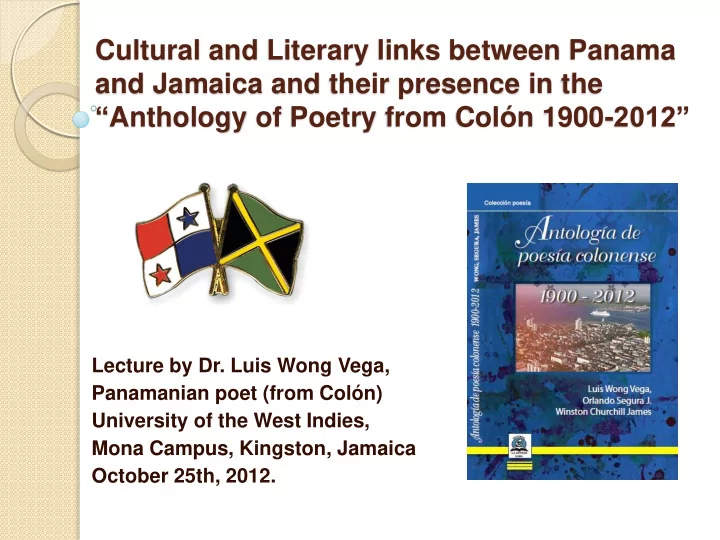
SLIDE 1 Cultural and Literary links between Panama and Jamaica and their presence in the “Anthology of Poetry from Colón 1900-2012”
Lecture by Dr. Luis Wong Vega, Panamanian poet (from Colón) University of the West Indies, Mona Campus, Kingston, Jamaica October 25th, 2012.
SLIDE 2
Panamá is physically located in Central
America, between Costa Rica and Colombia, although historically and culturally, Panamá has always been closer to the Caribbean and South America.
SLIDE 3
Panama is a multicultural country with
distinct communities, each with a historical role in the country's development.
SLIDE 4 The culture and traditions
people, Colonial African slaves and Spanish settlers and the immigrants that helped to build the isthmian railroad first and the canal after (Chinese, West Indians, Europeans) co-exist within each region of Panama.
SLIDE 5
Panamá is the gathering point for different
cultures and ethniae.
It has been and it still is an actual and
fluid racial melting pot, with around 3.3 million inhabitants.
SLIDE 6 Of these, about 10% have declared
themselves to be Afrodescendats (2010 Census), most likely an underestimated figure.
Our of that percentage, more than a half are
SLIDE 7
Afrodescendants came to Panama in
three main waves: the first one, during the Spanish colonization of the Isthmus (from 1502 to 1821) due to slavery.
SLIDE 8
The second one, along
the 1800’s (early and late), as work force for the banana and sugar plantations.
This human mass was
integrated by West Indians (mostly by Jamaicans and Barbadians)
SLIDE 9
- The third (and the larger one), during the
construction of the Panamanian railroad (mid 1850’s) and, mostly, during the construction
- f the Panama Canal (1903-1914).
SLIDE 10
Cultural influence of Jamaica in Panama
SLIDE 11 Many West Indians and their descendants remained
after completion of the Canal as workers in the Canal
- Zone. Many stayed in the country and added their
culture to that of Panama while others returned to the islands or emigrated to the United States.
SLIDE 12 During the construction
West Indians created their own institutions in the Canal Zone from community associations to businesses, publishing houses, and schools in addition to the public school provided by the Canal authorities.
SLIDE 13
West Indian schools
were renowned in the area and better than the Zone operated public schools.
So much so that
many local Panamanian pupils paid to attend them.
SLIDE 14 Jamaican National Hero
Marcus Garvey lived and worked in Panama for a newspaper in Colón and later played a part in helping the labor
via the United Negro Improvement Association (UNIA) in the late 1910s and 1920s.
SLIDE 15 Examples of Jamaican presence in Panama’s culture
are many, but one of the most notorious is the impact
- f the Jamaican Creole language on both the Spanish
and the English languages spoken in the Caribbean part of Panama, up to date.
SLIDE 16 The shift from homogeneity to variety in the study of language
has contributed to the development of sociolinguistics. This shift has also fomented the ranks of specialists in Creóle languages, a confirmed province of this science… Of these, the Jamaican dialect extended to Panamá has been a poor relation, despite its vigorous presence and special characteristics: it has thrived on the Isthmus of Panamá since 1820 where, over the years, fresh waves of West Indian native speakers have contributed to give rise to Isthmian dialects. These offshoots of Jamaican Creóle have been in close contact with other Caribbean Creóles (whether English- or French-based); with Spanish, the dominant and official language, and with American English. Scientific interest in Panamanian Creóle English has dawned late and there is still much to be done.
The English Creóle Spoken in Panamá,
by Martin Jamieson. Revista Alicantina de Estudios Ingleses 6 (1993): 219-221
SLIDE 17
West Indian cuisine
is very present in the cities of Colón, Bocas and Panamá.
Much of this cuisine
is Jamaican and, in a lesser degree, Barbadian and Trinidadian.
SLIDE 18 Religion in the Panamanian Caribbean coast has
strong presence of the religions brought by West Indians (i.e. The Anglican faith). And specifically from Jamaica, Panamá has had the permanent presence
- f the Rastafarian religion.
SLIDE 19 Panamanian Caribbean
popular music is very much West Indian.
Both Calypso and Reggae
music have strong followers in Panamá.
Spanish Reggaeton (or
Reggae in Spanish) was born in Colón, Panama.
SLIDE 20
Poetry is another area where
we can find the presence of Jamaica in Panamá (and viceversa), especially in my hometown, Colón.
We can find several
examples in our book, the “Anthology of Colonense Poetry 1900-2012”.
SLIDE 21
Colón and our Anthology
SLIDE 22 Colón is a province of Panama, in the Caribbean
side of the country. The capital is the city of Colón.
This province has traditionally been focused in
commerce (through the Colón Free Zone, Panama Canal and its banking activities), but also has natural resources that are being developed as tourist attraction, such as coral reefs and rainforests.
SLIDE 23
Most of the black population in Panama
is centered in the Province of Colón.
SLIDE 24
We are a group of poets from Colón, named
“Contemporary Colonense Poetry”.
We have been active for more than 30 years
and the members of our group have published about 20 poetry books, booklets, pamphlets, etc.
We even have some of our books listed in the
Library of Congress collection.
SLIDE 25
Our website has had almost one million hits so far. Our web address is: http://poesiacolonensecontemporanea.webnode.es
SLIDE 26 This book has been prepared by three colonense
poets: Luis Wong Vega, Orlando Segura Johnson and Winston Churchill James Jordan.
Mr. James is a West Indian descendant. Mr. Segura
is of Afro-colonial background.
SLIDE 27 This book has been published by the
Universidad Católica Santa María La Antigua (USMA, the Catholic University of Panamá), trough its publishing house, the Editorial La Antigua, directed by Prof. Ariel Barría.
SLIDE 28 After almost a year of
research, analyses and editing, the product of this effort is a book that contains works of 43 colonense poets, more than150 poems, with most poems in Spanish but also five poets writing in English.
SLIDE 29
Technical fiche…
SLIDE 30
List of Poets selected…
SLIDE 31
Out of the 43 in total, 7 are Spanish teachers,
2 English teachers and 1 a French language teacher.
These poets come from very different
professional backgrounds: we have a Jesuit priest, a Ship’s Captain, Biologists, Sociologists, Mathematicians, Nurses, Lawyers, Accountants, Engineers, Painters, Actors and so on…
Only 5 of them could be considered as
professional writers.
SLIDE 32
11 out of 43 are women. Most of them are over 40 y/o. 11 have passed away. Only 11 out of the 32 alive, still live in
Colón permanently.
6 live abroad. 16 out of 43 consider themselves as
Afrodescendants (Blacks).
SLIDE 33 The first documented poets
who lived and wrote poetry in Colón, were all foreigners:
american who arrived to the city in 1861, to work in the construction of the railroad;
colombian, who arrived by mid 1880’s and
american, who arrived to Colón by mid 1890’s y died in the city in 1906.
SLIDE 34 Tracy Robinson
published what we belive was the first poetry book ever written in Colón: “Songs of the Palm and other tropical poems…”, published by The Star & Herald Company in 1866..
The photo shows a
copy of this book, preserved at the library of the University of California at Irvine.
SLIDE 35 Antonio Olivo Pino
authored what we believe was the first poetry book published in Spanish in Colón: “La Musa Colombiana” (the Colombian Muse).
Was printed at the “El
Istmo” printing house, in Colón, in 1888.
We show here a photo
Biblioteca Nacional de Colombia.
SLIDE 36 In 1905, The Star &
Herald Company published in Colón the first edition of the book by James Stanley Gilbert: “Panama’s Patchwork”.
Gilbert was a full time
poet, who held regular literary meetings in his residence (Gilbert House).
Here’s a photo of this
book, furnished by the library of Princeton University.
SLIDE 37 Afro-Panamanian and Colonense poets
SLIDE 38
The first black
colonense poet listed in this book was Mr. José María Vásquez, a self- thaugt poet, born in 1900. He wrote two books, both in Spanish.
SLIDE 39 Father Luis Carlos
Toro, S.J. lives in El Salvador.
His poetry is centered
since he was a member of the Theology of Liberation movement.
He writes in Spanish.
SLIDE 40
Ubaldo del Cid is a
Spanish language teacher.
He wirtes short
stories, drama plays and he is a song writer.
He has published
two poetry books, both in Spanish.
SLIDE 41
Emérito Rodríguez
Ayarza is a Geological Engineer, who studied in the former Soviet Union.
He has written
about six poetry books, in Spanish.
SLIDE 42
Prof. Orlando Segura
Johnson is a college Spanish teacher.
He has published two
poetry books, both in Spanish.
He is one of the co-
authors of this Anthology.
He is of Jamaican and
Afrocolonial descent.
SLIDE 43
Creescenciano
Vásquez is a Religion, Moral and Ethics teacher.
He has published 4
poetry books and his main subject are History and patriotic themes.
He writes in Spanish
and is of Afrocolonial descent.
SLIDE 44 Boris Nolis Góndola is
also of Afrocolonial descent.
He has published
more of a dozen books (poetry, short stories, assays) centered on matters
(Panama’s afrocolonial blacks).
He writes in Spanish.
SLIDE 45 Afro-Panamanian and Colonense poets
SLIDE 46
The first black
colonense woman poet was Bárbara Michel, a long time Spanish teacher.
She wrote her
poetry in Spanish and her favorte subject had always been the city of Colón itself.
SLIDE 47 Another interesting
poet is Alfred Rowe Tutú.
He was a French
language teacher.
He migrated to the US
more than 30 years ago.
He is, still, an activist
for social and racial issues.
He wrote his poetry
both in Spanish and English.
SLIDE 48 Winston Churchill James is a
lawyer.
He was one of the first black
Panamanian poets to adhere to the “Négritude” literary and ideological movement.
His poetry has two main subjects:
existencialism and eroticism.
He writes both in Spanish and
English and he is one of the co- authors of this Anthology.
SLIDE 49
Aldo Young is a
Naval Captain who works as a pilot for the Panama Canal Authority.
Young’s poetry is
mostly lyrical and its written in Spanish.
SLIDE 50 Delia Adassa
McDonald Woolery was born in Colón, from West Indian parents, but moved to Costa Rica during her early youth.
She is of a well know
poet due to her work
culture issues.
She writes poetry in
Spanish.
SLIDE 51
Among the newest
bards in Colón is Kafú Banton, a well know reggae singer, song- writer and poet.
He writes and sings
both en Spanish and English.
SLIDE 52 The youngest poet listed in
Modestin.
She is a psychologist and a
social worker, who went to Boston to pursue her degree but has stayed living and working there.
She writes poetry in
English.
SLIDE 53 A very famous poet both
Panamanian (Colón born) and Jamaican was George Campell.
As you know, his poetry
has had much importance in modern Jamaican literature.
The Rt. Excellent Norman
Washington Manley, the co-founder of the Jamaica nation, dubbed Campbell "Poet of the Revolution."
SLIDE 54
Another famous
Panamanian (Colón born)and Jamaican poet was Andrew Felix Salkey.
Salkey’s poetry has
been translated to Spanish and through his relationship with Casa de Las Américas in Cuba, some his work has been know in Latin America.
SLIDE 55 Even though she is not
included in our Anthology, we just found out about the existance of another Jamaican poet of Panamanian background: Juliet Christie Murray, who was born in Lucea, Hanover, Jamaica 1950, the elder of two children of a Panamanian mother.
SLIDE 56 We believe that this book represents a singular
showcase of diverse and disimile socio-cultural and aesthetic forms and concepts and that it summarizes, in a singular testimonial document, the interesting diversity of poets and poems that integrate the Parnassus of the most important city of Panama´s Caribbean coast. Qualitatively uneven but always very much valuable, varied and interesting, just as the facts and things of life itself…
SLIDE 57 This Anthology shows that Colón has produced
people who love poetry and that take poetry very seriously.
We believe that the selection shown here includes
many poetic works of singular mastership and beauty, produced by Colonense men and women along the last eleven decades… by authentic poets...
SLIDE 58 Opinions…
Nos quedamos con algunas valoraciones sobre el libro, por parte de quienes ya lo han leído::
“Hermoso documento histórico y poético…” Lucy Cristina Chau (Premio Ricardo Miró en Poesía).
“Apenas recibí el ejemplar de la Antología escribí : Acabo de recibir un libro que me ha dejado azul, abrumado, sin aliento, como si fuera lunes… Sin duda un libro diferente, riquísimo, generoso. Era un libro necesario para entendernos como lo que en realidad somos. Admirable trabajo…”. Benjamín Ramón (poeta y promotor cultural).
“Es la primera obra de esa magnitud de la que se tiene conocimiento, por lo que se convierte en pionera en este tipo de acción, y en el caso de la centuria poética que presenta, en una respuesta contundente al desconocimiento y a la desvalorización de las aportaciones de los bardos colonenses. Desde luego también, es un reconocimiento a los trovadores que han mantenido viva la poesía en Colón, porque la conciencia social no se genera por espontaneidad, sino que ella está en íntima vinculación con las acciones valiosas de los hombres…” Jorge Luis Macías (académico e historiador).
SLIDE 59 Sección Mosaico, Página 8B, 09/09/2012
SLIDE 60