
THE STORMY SEAS OF CYPRUS: POETICS OF EASTERN WANDERING John Franklin Homer and the Herodotean Cypria
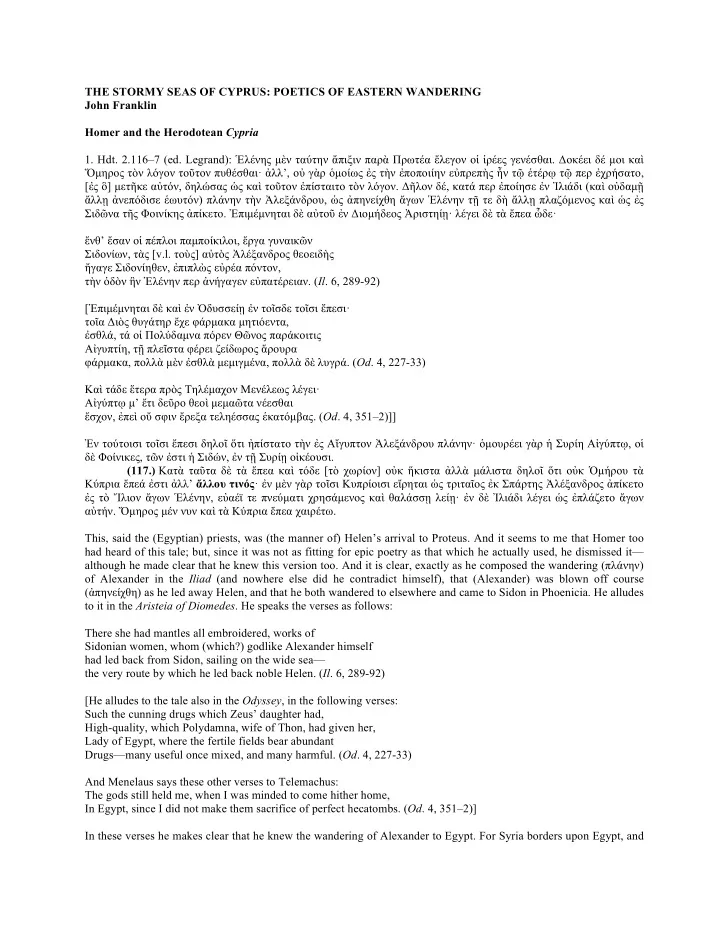
- 1. Hdt. 2.116–7 (ed. Legrand): Ἑλένης µὲν ταύτην ἄπιξιν παρὰ Πρωτέα ἔλεγον οἱ ἱρέες γενέσθαι. Δοκέει δέ µοι καὶ
Ὅµηρος τὸν λόγον τοῦτον πυθέσθαι· ἀλλ’, οὐ γὰρ ὁµοίως ἐς τὴν ἐποποιίην εὐπρεπὴς ἦν τῷ ἑτέρῳ τῷ περ ἐχρήσατο, [ἐς ὃ] µετῆκε αὐτόν, δηλώσας ὡς καὶ τοῦτον ἐπίσταιτο τὸν λόγον. Δῆλον δέ, κατά περ ἐποίησε ἐν Ἰλιάδι (καὶ οὐδαµῇ ἄλλῃ ἀνεπόδισε ἑωυτόν) πλάνην τὴν Ἀλεξάνδρου, ὡς ἀπηνείχθη ἄγων Ἑλένην τῇ τε δὴ ἄλλῃ πλαζόµενος καὶ ὡς ἐς Σιδῶνα τῆς Φοινίκης ἀπίκετο. Ἐπιµέµνηται δὲ αὐτοῦ ἐν Διοµήδεος Ἀριστηίῃ· λέγει δὲ τὰ ἔπεα ὧδε· ἔνθ’ ἔσαν οἱ πέπλοι παµποίκιλοι, ἔργα γυναικῶν Σιδονίων, τὰς [v.l. τοὺς] αὐτὸς Ἀλέξανδρος θεοειδὴς ἤγαγε Σιδονίηθεν, ἐπιπλὼς εὐρέα πόντον, τὴν ὁδὸν ἣν Ἑλένην περ ἀνήγαγεν εὐπατέρειαν. (Il. 6, 289-92) [Ἐπιµέµνηται δὲ καὶ ἐν Ὀδυσσείῃ ἐν τοῖσδε τοῖσι ἔπεσι· τοῖα Διὸς θυγάτηρ ἔχε φάρµακα µητιόεντα, ἐσθλά, τά οἱ Πολύδαµνα πόρεν Θῶνος παράκοιτις Αἰγυπτίη, τῇ πλεῖστα φέρει ζείδωρος ἄρουρα φάρµακα, πολλὰ µὲν ἐσθλὰ µεµιγµένα, πολλὰ δὲ λυγρά. (Od. 4, 227-33) Καὶ τάδε ἕτερα πρὸς Τηλέµαχον Μενέλεως λέγει· Αἰγύπτῳ µ’ ἔτι δεῦρο θεοὶ µεµαῶτα νέεσθαι ἔσχον, ἐπεὶ οὔ σφιν ἔρεξα τεληέσσας ἑκατόµβας. (Od. 4, 351–2)]] Ἐν τούτοισι τοῖσι ἔπεσι δηλοῖ ὅτι ἠπίστατο τὴν ἐς Αἴγυπτον Ἀλεξάνδρου πλάνην· ὁµουρέει γὰρ ἡ Συρίη Αἰγύπτῳ, οἱ δὲ Φοίνικες, τῶν ἐστι ἡ Σιδών, ἐν τῇ Συρίῃ οἰκέουσι. (117.) Κατὰ ταῦτα δὲ τὰ ἔπεα καὶ τόδε [τὸ χωρίον] οὐκ ἥκιστα ἀλλὰ µάλιστα δηλοῖ ὅτι οὐκ Ὁµήρου τὰ Κύπρια ἔπεά ἐστι ἀλλ’ ἄλλου τινός· ἐν µὲν γὰρ τοῖσι Κυπρίοισι εἴρηται ὡς τριταῖος ἐκ Σπάρτης Ἀλέξανδρος ἀπίκετο ἐς τὸ Ἴλιον ἄγων Ἑλένην, εὐαέϊ τε πνεύµατι χρησάµενος καὶ θαλάσσῃ λείῃ· ἐν δὲ Ἰλιάδι λέγει ὡς ἐπλάζετο ἄγων αὐτήν. Ὅµηρος µέν νυν καὶ τὰ Κύπρια ἔπεα χαιρέτω. This, said the (Egyptian) priests, was (the manner of) Helen’s arrival to Proteus. And it seems to me that Homer too had heard of this tale; but, since it was not as fitting for epic poetry as that which he actually used, he dismissed it— although he made clear that he knew this version too. And it is clear, exactly as he composed the wandering (πλάνην)
- f Alexander in the Iliad (and nowhere else did he contradict himself), that (Alexander) was blown off course
(ἀπηνείχθη) as he led away Helen, and that he both wandered to elsewhere and came to Sidon in Phoenicia. He alludes to it in the Aristeia of Diomedes. He speaks the verses as follows: There she had mantles all embroidered, works of Sidonian women, whom (which?) godlike Alexander himself had led back from Sidon, sailing on the wide sea— the very route by which he led back noble Helen. (Il. 6, 289-92) [He alludes to the tale also in the Odyssey, in the following verses: Such the cunning drugs which Zeus’ daughter had, High-quality, which Polydamna, wife of Thon, had given her, Lady of Egypt, where the fertile fields bear abundant Drugs—many useful once mixed, and many harmful. (Od. 4, 227-33) And Menelaus says these other verses to Telemachus: The gods still held me, when I was minded to come hither home, In Egypt, since I did not make them sacrifice of perfect hecatombs. (Od. 4, 351–2)] In these verses he makes clear that he knew the wandering of Alexander to Egypt. For Syria borders upon Egypt, and