The Silicon Vertex Detector of the Belle II Experiment Thomas - - PowerPoint PPT Presentation

the silicon vertex detector of the belle ii experiment
SMART_READER_LITE
LIVE PREVIEW

The Silicon Vertex Detector of the Belle II Experiment Thomas - - PowerPoint PPT Presentation

The Silicon Vertex Detector of the Belle II Experiment Thomas Bergauer (HEPHY Vienna) Vertex 2010 Loch Lomond 10 June 2010 The Silicon Vertex Detector of the Belle II Experiment Introduction Belle II: The Future Double Sided Sensors


slide-1
SLIDE 1

10 June 2010

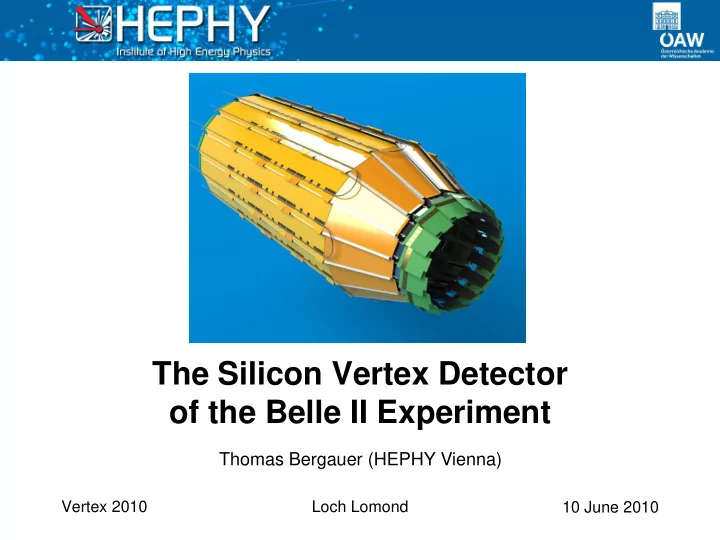
The Silicon Vertex Detector

  • f the Belle II Experiment

Vertex 2010

Thomas Bergauer (HEPHY Vienna)

Loch Lomond
slide-2
SLIDE 2

The Silicon Vertex Detector

  • f the Belle II Experiment

10 June 2010

Introduction Belle II: The Future Double Sided Sensors SVD-II Components Readout System Summary

2

  • T. Bergauer
slide-3
SLIDE 3

The Silicon Vertex Detector

  • f the Belle II Experiment

10 June 2010

Linac Belle KEKB

KEKB and Belle @ KEK

  • Asymmetric machine:

8 GeV e- on 3.5 GeV e+

  • Center of mass energy: Y(4S) (10.58 GeV)
  • High intensity beams (1.6 A & 1.3 A)
  • Integrated luminosity 1 ab-1 recorded by end of 2009

~1 km in diameter

  • Mt. Tsukuba

KEKB Belle Linac

About 60km northeast of Tokyo

3

  • T. Bergauer
slide-4
SLIDE 4

The Silicon Vertex Detector

  • f the Belle II Experiment

10 June 2010

µ / KL detection 14/15 lyr. RPC+Fe CsI(Tl) 16 X0

Si vertex detector 4 lyr. DSSD

SC solenoid 1.5 T 8 GeV e- 3.5 GeV e+ Aerogel Cherenkov counter n=1.015~1.030 Central Drift Chamber small cell +He/C2H5 TOF counter

Belle Detector (1999– 20. June 2010)

4

  • T. Bergauer
slide-5
SLIDE 5

The Silicon Vertex Detector

  • f the Belle II Experiment

10 June 2010

The Present SVD – Overview

  • 4 layers (6/12/18/18 ladders), r = 2.0…8.8 cm
  • 17°…150° polar angle coverage
  • 246 double sided silicon detectors (DSSDs), 0.5 m2 overall active

area

  • VA1TA readout chip (Viking variant; 800ns shaping time)
  • 110592 channels in total

5

  • T. Bergauer
slide-6
SLIDE 6

The Silicon Vertex Detector

  • f the Belle II Experiment

10 June 2010

Introduction Belle II: The Future Double Sided Sensors SVD-II Components Readout System Summary

6

  • T. Bergauer
slide-7
SLIDE 7

The Silicon Vertex Detector

  • f the Belle II Experiment

10 June 2010

KEKB/Belle upgrade (2010–2014)

  • Aim: super-high luminosity ~8 1035 cm-2s-1

1 1010 BB / year

  • LoI published in 2004; TDR was written in spring this year and is

presently under review

  • Refurbishment of accelerator and detector required

http://belle2.kek.jp

7

  • T. Bergauer
slide-8
SLIDE 8

The Silicon Vertex Detector

  • f the Belle II Experiment

10 June 2010

Belle II SVD Upgrade (2010–2014)

  • Present SVD limitations are

– occupancy (currently ~10% in innermost layer) need faster shaping – dead time (currently ~3%) need faster readout and pipeline

  • Needs Detector with

– high background tolerance – pipelined readout – robust tracking – low material budget in active volume (low energy machine) Current SVD is not suitable for Belle II

  • Ultimately 40-fold increase in luminosity (~8 1035 cm-2s-1)

8

  • T. Bergauer

10%

L1 L2 L3 L4

slide-9
SLIDE 9

The Silicon Vertex Detector

  • f the Belle II Experiment

10 June 2010

Present SVD Layout (until 2010)

  • 4 straight layers of 4" double-sided silicon detectors (DSSDs)
  • Outer radius of r~8.8 cm
  • Up to 3 sensors are ganged

and read out by one hybrid located outside of acceptance

10 1 2 3 4 [cm] layers [cm] 20

  • 10
  • 20
  • 30

10 20 30 40

9

  • T. Bergauer
slide-10
SLIDE 10

The Silicon Vertex Detector

  • f the Belle II Experiment

10 June 2010

10 1+2 3 4 5 6 [cm] layers [cm] 20

  • 10
  • 20
  • 30

10 20 30 40

SVD-II Layout (2014-)

  • Geometry optimization is underway
  • New central pixel double-layer using

DEPFET

  • Strip layers extend to r~14 cm
  • Every sensor is read out individually

(no ganging) to maintain good S/N chip-on-sensor concept

Double-layer of DEPFET pixels 4 layers of double- sided strip sensors

10

  • T. Bergauer
slide-11
SLIDE 11

The Silicon Vertex Detector

  • f the Belle II Experiment

10 June 2010

Introduction Belle II: The Future Double Sided Sensors SVD-II Components Readout System Summary

11

  • T. Bergauer
slide-12
SLIDE 12

The Silicon Vertex Detector

  • f the Belle II Experiment

10 June 2010

Vendors for 6” DSSD

  • Aim is to use double sided silicon detectors with AC-coupled

readout and poly-silicon resistor biasing from 6 inch wafer

12

  • T. Bergauer
  • Hamamatsu decided in the past to

abandon the production of double sided sensors

  • Thus, negotiations with Canberra,

SINTEF and Micron started

  • Finally HPK could be convinced to restart

DSSD production on 6” wafers

  • 6” prototypes ordered from

– Hamamatsu (rectangular): First batch delivered in April – Micron (trapezoidal): First batch in July

slide-13
SLIDE 13

The Silicon Vertex Detector

  • f the Belle II Experiment

13 Thomas Bergauer (HEPHY Vienna)

  • 19. Nov. 2009

SVD Layout

10 3 4 5 6 [cm] layers [cm] 20

  • 10
  • 20
  • 30

10 20 30 40

6 6 4 4 4 4 4 6 6 6 6 6 4 4 4 4 4 4 4 6 6 6 6 6 6 6 6 6

Layer # Ladders Rect. Sensors [50μm] Rect. Sensors [75μm] Wedge Sensors APVs 6 17 68 17 850 5 14 42 14 560 4 10 20 10 300 3 8 16 192 Sum: 49 16 130 41 1902

slide-14
SLIDE 14

The Silicon Vertex Detector

  • f the Belle II Experiment

First batch from HPK

  • First 20 pieces of 6’’ sensors have

been delivered in April 2010

  • Technical details:
  • Dimensions: 59.6 x 124.88 mm
  • p-side:
  • Readout pitch: 75 µm
  • 768 strips
  • n-side:
  • Readout pitch: 240 µm
  • 512 readout strips n-side
  • P-stop scheme

10 June 2010 14

  • T. Bergauer
slide-15
SLIDE 15

The Silicon Vertex Detector

  • f the Belle II Experiment

First Batch of 6” DSSD from HPK

15

  • T. Bergauer

10 June 2010

  • Electrical

Characterization

– IV, CV – Stripscan (p- and n-side) – Longterm stability vs. temperature and humidity – Inter-strip resistance and capacitance currently under investigation

  • Pull-tests to show

bondability ok

slide-16
SLIDE 16

The Silicon Vertex Detector

  • f the Belle II Experiment

10 June 2010

Trapezoidal Sensors (Micron)

  • Full wafer designed using self-developed framework
  • Including test structures and mini sensors to test different p-stop

designs

  • Delivery due July 2010

Trapezoidal sensor with test structures

17

  • T. Bergauer

Sensor “programming language”

slide-17
SLIDE 17

The Silicon Vertex Detector

  • f the Belle II Experiment

10 June 2010

Introduction Belle II: The Future Double Sided Sensors SVD-II Components Readout System Summary

18

  • T. Bergauer
slide-18
SLIDE 18

The Silicon Vertex Detector

  • f the Belle II Experiment

10 June 2010

APV25 Readout Chip

  • Developed for CMS (LHC) by IC London and RAL (70k chips installed)
  • 0.25 µm CMOS process (>100 MRad tolerant)
  • 40 MHz clock (adjustable), 128 channels
  • 192 cell analog pipeline

no dead time

  • 50 ns shaping time

low occupancy

  • Noise: 250 e + 36 e/pF

must minimize capacitive load!!!

  • Multi-peak mode (read out several samples along shaping curve)
  • Thinning to 100µm successful

Schematics of one channel

19

  • T. Bergauer
slide-19
SLIDE 19

The Silicon Vertex Detector

  • f the Belle II Experiment

10 June 2010

APV25 – Hit Time Reconstruction

  • Possibility of recording multiple samples (x) along shaped waveform

(feature of APV25)

  • Reconstruction of

peak time (and amplitude) by waveform fit

  • Will be used to

remove off-time background hits

50 100 150 200 250 300

5000 10000 15000 20000 25000 30000

S peak tpeak

Measurement

20

  • T. Bergauer
slide-20
SLIDE 20

The Silicon Vertex Detector

  • f the Belle II Experiment

Occupancy Reduction

Threshold Threshold Tim e over threshold ~ 2000ns (m easured) Tim e over threshold ~ 160ns (m easured) Sensitive tim e window ~ 20ns

VA 1TA

Tp~800ns

APV25

Tp~50ns Pulse shape processing RM S(tm ax)~3ns

G ain ~12.5 G ain ~8 Total gain ~100

10 June 2010 21

  • T. Bergauer
slide-21
SLIDE 21

The Silicon Vertex Detector

  • f the Belle II Experiment

10 June 2010

Origami – Chip-on-Sensor Concept

  • Chip-on-sensor concept for double-sided readout
  • Flex fan-out pieces wrapped to opposite side (hence “Origami“)
  • All chips aligned on one side

single cooling pipe

Prototype for 4” DSSD (later with 6” sensors) Side View (below)

zylon rib APV25 cooling pipe 3-layer kapton hybrid integrated fanout DSSD double-layer flex wrapped to p-side

APV25 (thinned to 100µm ) zylon rib cooling pipe DSSD Rohacell Kapton

22

  • T. Bergauer
slide-22
SLIDE 22

The Silicon Vertex Detector

  • f the Belle II Experiment

10 June 2010 23

4th Open Meeting of the Belle II Collaboration

First Origami Module (2009)

23

  • T. Bergauer
  • Top and bottom side Origami concept (4” sensor)
  • Prototype completed in August 2009
  • Successfully evaluated in lab and beam tests
  • Currently building module based on 6” sensor
slide-23
SLIDE 23

The Silicon Vertex Detector

  • f the Belle II Experiment

Second Origami Module (2010)

  • Now using new 6 inch sensors
  • Kapton PCB and pitch-

adapters ordered by Japanese company

– Currently under test in Vienna

  • Followed by complicated

assembly procedure

24

  • T. Bergauer

10 June 2010

slide-24
SLIDE 24

The Silicon Vertex Detector

  • f the Belle II Experiment

10 June 2010

Sketch of the Outermost Ladder (Layer 6)

  • Composed of 5 x 6” double-sided sensors
  • Center sensors have Origami structure
  • Border sensors are conventionally read out from sides

Connector (Nanonics) Structural element (CF) Cooling pipe Flex circuits Electronics for border sensor Electronics for border sensor

  • ca. 60cm

25

  • T. Bergauer
slide-25
SLIDE 25

The Silicon Vertex Detector

  • f the Belle II Experiment

10 June 2010

Ladder Mechanics (preliminary)

  • Carried by ribs made of carbon fiber

and Rohacell

  • Averaged material budget: 0.58% X0
  • Cooling options under study

– Conventional liquid cooling – CO2 cooling

26

  • T. Bergauer

Cooling Pipe Sensor Support Ribs

slide-26
SLIDE 26

The Silicon Vertex Detector

  • f the Belle II Experiment

10 June 2010

Introduction Belle II: The Future Double Sided Sensors SVD-II Components Readout System Summary

27

  • T. Bergauer
slide-27
SLIDE 27

The Silicon Vertex Detector

  • f the Belle II Experiment

10 June 2010

Readout System

  • Prototype readout system exists
  • Verified in several beam tests
  • Basis for future SVD system shown below

1902 APV25 chips Front-end hybrids Rad-hard voltage regulators Analog level translation, data sparsification and hit time reconstruction Unified Belle II DAQ system ~2m copper cable Junction box ~10m copper cable FADC+PROC COPPER Unified optical data link (>20m) Finesse Transmitter Board (FTB) 28

  • T. Bergauer
slide-28
SLIDE 28

The Silicon Vertex Detector

  • f the Belle II Experiment

10 June 2010

Prototype Readout System

Repeater Box Level translation, buffering FADC+PROC (9U VME) Digitization, zero-suppression, hit time reconstruction

29

  • T. Bergauer
slide-29
SLIDE 29

The Silicon Vertex Detector

  • f the Belle II Experiment

10 June 2010

Beam Tests

KEK (Apr 2005) PSI (Aug 2005, Aug 2006) KEK (Nov 2007, Nov 2008) CERN (June 2008, September 2009)

30

  • T. Bergauer
slide-30
SLIDE 30

The Silicon Vertex Detector

  • f the Belle II Experiment

10 June 2010

Introduction Belle II: The Future Double Sided Sensors SVD-II Components Readout System Summary

31

  • T. Bergauer
slide-31
SLIDE 31

The Silicon Vertex Detector

  • f the Belle II Experiment

10 June 2010

Summary

  • KEKB is the highest luminosity machine in the world
  • Upgrade of KEKB and Belle (2010-2014)

– 40-fold increase in luminosity – Needs upgrades of all subdetectors

  • New, enlarged Silicon Vertex Detector

– DEPFET pixel double-layer – Four strip layers

  • Strip Detector R&D

– New 6” Double Sided Strip Detectors by HPK – Origami chip-on-sensor concept for low-mass DSSD readout – Readout with hit time reconstruction for improved background tolerance (up to 100x occupancy reduction w.r.t. now)

32

  • T. Bergauer
slide-32
SLIDE 32

The Silicon Vertex Detector

  • f the Belle II Experiment

Backup Slides

10 June 2010 33

  • T. Bergauer
slide-33
SLIDE 33

Beam Parameters

KEKB Design KEKB Achieved : with crab SuperKEKB High-Current SuperKEKB Nano-Beam Energy (GeV) (LER/HER) 3.5/8.0 3.5/8.0 3.5/8.0 4.0/7.0

y * (mm)

10/10 5.9/5.9 3/6 0.27/0.42

x (nm)

18/18 18/24 24/18 3.2/2.4

y( m)

1.9 0.94 0.85/0.73 0.059

y

0.052 0.129/0.090 0.3/0.51 0.09/0.09

z (mm)

4 ~ 6 5/3 6/5 Ibeam (A) 2.6/1.1 1.64/1.19 9.4/4.1 3.6/2.6 Nbunches 5000 1584 5000 2503 Luminosity (1034 cm-2 s-1) 1 2.11 53 80

slide-34
SLIDE 34

The Silicon Vertex Detector

  • f the Belle II Experiment

KEKB accelerator upgrade

35

  • T. Bergauer

10 June 2010 Crab cavity 3.5GeV e 8GeV e New beam-pipes with ante-chamber Damping ring for e+ New IR with crab crossing and smaller y* More RF for higher beam current SR beam

slide-35
SLIDE 35

The Silicon Vertex Detector

  • f the Belle II Experiment

New dead-time-free pipelined readout and high speed computing systems

Faster calorimeter with waveform sampling and pure CsI (endcap) New particle identifier with precise Cherenkov device: (i)TOP or fDIRC. Endcap: Aerogel RICH Si vertex detector with high background tolerance (+2 layers, pixels) Background tolerant super small cell tracking detector KL/ detection with scintillator and next generation photon sensors

Belle-II

10 June 2010 36

  • T. Bergauer
slide-36
SLIDE 36

The Silicon Vertex Detector

  • f the Belle II Experiment

37 Thomas Bergauer (HEPHY Vienna)

Micron Wafer Layout

Teststructures for p-side Teststructures for n-side (no GCD) Baby sensor 1 p-side: 512 strips 50 µm pitch 1 interm. strip n-side: 512 strips 100 µm pitch 1 interm. strip atoll p-stop 3 different GCDs for the n-side Main sensor p-side: 768 strips 75-50 µm pitch 1 interm. strip n-side: 512 strips 240 µm pitch 1 interm. strip combined p-stop Quadratic baby sensors 2,3,4 p-side: 512 strips 50 µm pitch 1 interm. strip n-side: 256 strips 100 µm pitch 0 interm. strip different p-stop patterns 1) atoll p-stop varying distance from strip 2) conventional p-stop varying width 3) combined p-stop varying distance from strip 1) 2) 3)

  • 19. Nov. 2009
slide-37
SLIDE 37

The Silicon Vertex Detector

  • f the Belle II Experiment

combined

Micron: p-stop layout

38 Thomas Bergauer (HEPHY Vienna)

  • 19. Nov. 2009

p-stops connected p-stops isolated

slide-38
SLIDE 38

The Silicon Vertex Detector

  • f the Belle II Experiment

Current Barrel Layout

Slanted Sensors Origami Cooling Tubes Hybrid Boards

Layer Sensors/ Ladder Origamis/ Ladder Ladders Length [mm] Radius [mm] Slant Angle [°]

3 2 7/8 262 38 4 3 1 10 390 80 11.9 5 4 2 14 515 115 17.2 6 5 3 17 645 140 21.1

10 June 2010 39

  • T. Bergauer
slide-39
SLIDE 39

The Silicon Vertex Detector

  • f the Belle II Experiment

Comparison VA1TA – APV25

VA1TA (SVD)

  • Commercial product (IDEAS)
  • Tp = 800ns (300 ns – 1000

ns)

  • no pipeline
  • <10 MHz readout
  • 20 Mrad radiation tolerance
  • noise: ENC = 180 e + 7.5

e/pF

  • time over threshold: ~2000 ns
  • single sample per trigger

APV25 (Belle-II SVD)

  • Developed for CMS by IC

London and RAL

  • Tp = 50 ns (30 ns – 200 ns)
  • 192 cells analog pipeline
  • 40 MHz readout
  • >100 Mrad radiation tolerance
  • noise: ENC = 250 e + 36 e/pF
  • time over threshold: ~160 ns
  • multiple samples per trigger

possible (Multi-Peak-Mode)

10 June 2010 40

  • T. Bergauer
slide-40
SLIDE 40

The Silicon Vertex Detector

  • f the Belle II Experiment

10 June 2010

Measured Hit Time Precision

  • Results achieved in beam tests with several different types of Belle

DSSD prototype modules (covering a broad range of SNR)

  • 2...3 ns RMS

accuracy at typical cluster SNR (15...25)

  • Working on

implementation in FPGA (using lookup tables) – simulation successful

T im e Resolution vs. C luster S NR 1 2 3 4 5 6 7 5 10 15 20 25 30 C luster S NR [1] trm s [ns] P revious beam tests S P S 09 beam test Log-Log Fit

(TDC error subtracted) Origami Module

41

  • T. Bergauer
slide-41
SLIDE 41

The Silicon Vertex Detector

  • f the Belle II Experiment

Origami Material Budget

  • X0 comparison between conventional and chip-on-

sensor (4” sensors):

Conventional (double layer kapton)

Layer M aterial X0 [m m ] Thickness [m m ] Percentage Area coverage Averaged Percentage Sensor Silicon 93.7 0.3 0.32% 100.0% 0.320% Fanout Polyim ide (2 layer of 50um each) 300.0 0.1 0.03% 96.3% 0.032% Copper (10um ) 14.0 0.01 0.07% 50.0% 0.036% Nickel (top: 1.3um ) 14.3 0.0013 0.01% 50.0% 0.005% G old (top: 0.8um ) 3.4 0.0008 0.02% 50.0% 0.012% Ribs Zylon (0.5m m wide) 300.0 5 1.67% 3.7% 0.062% G lue Araldite 2011 / Double sided tape 335.0 0.05 0.01% 96.3% 0.014%

Total 0.480% DSSD Chip-on-Sensor (4-layer kapton)

Layer M aterial X0 [m m ] Thickness [m m ] Percentage Area coverage Averaged Percentage Sensor Silicon 93.7 0.3 0.32% 100.0% 0.320% Isolation Rohacell (Degussa) 5450.0 1 0.02% 96.3% 0.018% Hybrid Polyim ide (4 layers of 50um each) 300.0 0.2 0.07% 96.3% 0.064% Copper (4 layers of 5um each) 14.0 0.02 0.14% 64.7% 0.092% Nickel (top: 1.3um ) 14.3 0.0013 0.01% 64.7% 0.006% Flash Gold (top: 0.4um ) 3.4 0.0004 0.01% 64.7% 0.008% Flexes Polyim ide (1 layer of 25um ) 300.0 0.025 0.01% 56.3% 0.005% Copper (1 layer of 5um ) 14.0 0.005 0.04% 28.1% 0.010% Nickel (top: 1.3um ) 14.3 0.0013 0.01% 28.1% 0.003% Flash Gold (top: 0.4um ) 3.4 0.0004 0.01% 28.1% 0.003% 8 * APV25 Silicon 93.7 0.1 0.11% 21.4% 0.023% SM Ds SM D 50.0 0.4 0.80% 0.8% 0.007% Sil-Pad Sil-Pad 800 (Bergquist) 200.0 0.127 0.06% 11% 0.007% Pipe Alum inum (D=2.0m m , wall=0.2m m ) 89.0 0.56 0.63% 7% 0.047% Rib Zylon (0.5m m wide) 300.0 5 1.67% 1.9% 0.031% Glue Araldite 2011 335.0 0.2 0.06% 50% 0.030% Cooling W ater 360.5 1.26 0.35% 13% 0.047%

Total 0.719%

  • +50% increase in material, but also huge improvement in SNR
  • Trade-off between material budget and SNR
  • According to simulation, additional material is prohibitive in 2

innermost layers, but no problem for layers 3-5 OK with layout

10 June 2010 42

  • T. Bergauer
slide-42
SLIDE 42

The Silicon Vertex Detector

  • f the Belle II Experiment

Maximum Radiation Length Distribution

Kapton

10 20 30 40 50 60 0.5 1 1.5 2 2.5 3 3.5 Profile [mm] R adiation Length [%] R ib Design

CFRP Rohacell Pipe APV Coolant Sensor

10 June 2010 43

  • T. Bergauer
slide-43
SLIDE 43

The Silicon Vertex Detector

  • f the Belle II Experiment

Cooling Boundary Conditions

  • Power dissipation/APV: 0.4 W
  • 1 Origami sensor features 10 APVs
  • Total Origami power dissipation: 356 W
  • 404 W dissipated at the hybridboards
  • Total SVD power dissipation: 760 W

Origamis/ Ladder Ladders APVs Origami APVs Hybrid Layer 6 3 17 510 340 Layer 5 2 14 280 280 Layer 4 1 10 100 200 Layer 3 8 192

10 June 2010 44

  • T. Bergauer