SLIDE 1
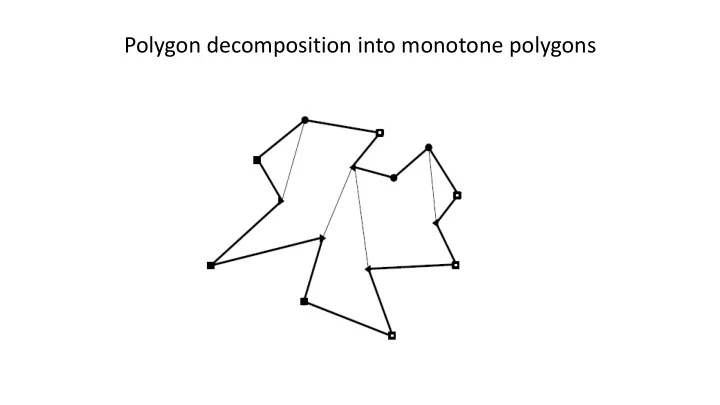
Polygon decomposition into monotone polygons Vertex types START - - PowerPoint PPT Presentation
Polygon decomposition into monotone polygons Vertex types START vertex (2 edges on the right and < ) END vertex (2 edges on the left and < ) SPLIT vertex (2 edges on the right and > ) MERGE vertex (2 edges on
SLIDE 2
SLIDE 3
Global algorithm
- 1. Sort the vertices of P in a lexicographic order (i.e. first on x and then on y) and stock them in a priority queue Q
- 2. Initialize an empty binary tree T referred to as the status
- 3. while Q is not empty
Remove the vertex 𝑤𝑗 from Q Call the appropriate procedure to handle the vertex, depending on its type (see following slides)
Decomposition of polygon P into monotone polygons
SLIDE 4
Polygon decomposition into monotone polygons
The algorithm proceeds like a planar left-to-right scan. Edges are added to and removed from the status T: For each edge 𝑓
𝑘 a corresponding vertex corr(𝑓 𝑘) exists. The corresponding vertices are defined by the algorithm
itself while it scans the polygon. NB: The corresponding vertex of an edge can change during the algorithm execution!
SLIDE 5
handle_start_vertex(𝑤𝑗) { Insert 𝑓𝑗 in T and set corr(𝑓𝑗) to 𝑤𝑗 } handle_end_vertex(𝑤𝑗) { if corr(𝑓𝑗−1) is a MERGE vertex Insert the diagonal connecting 𝑤𝑗 to corr(𝑓𝑗−1) Delete 𝑓𝑗−1 from T }
START and END vertices
SLIDE 6
handle_merge_vertex(𝑤𝑗) { if corr(𝑓𝑗−1) is a MERGE vertex Insert the diagonal connecting 𝑤𝑗 to corr(𝑓𝑗−1) Delete 𝑓𝑗−1 from T Search in T to find the edge 𝑓
𝑘 directly below 𝑤𝑗
if corr(𝑓
𝑘) is a MERGE vertex
Insert the diagonal connecting 𝑤𝑗 to corr(𝑓
𝑘)
Set corr(𝑓
𝑘) to 𝑤𝑗
} handle_split_vertex(𝑤𝑗) { Search in T to find the edge 𝑓
𝑘 directly below 𝑤𝑗
Insert the diagonal connecting 𝑤𝑗 to corr(𝑓
𝑘)
Set corr(𝑓
𝑘) to 𝑤𝑗
Insert 𝑓𝑗 in T and set corr(𝑓𝑗) to 𝑤𝑗 }
SPLIT and MERGE vertices
SLIDE 7
handle_regular_vertex(𝑤𝑗) { if the interior of P lies above vertex 𝑤𝑗 if corr(𝑓𝑗−1) is a MERGE vertex Insert the diagonal connecting 𝑤𝑗 to corr(𝑓𝑗−1) Delete 𝑓𝑗−1 from T Insert 𝑓𝑗 in T and set corr(𝑓𝑗) to 𝑤𝑗 else Search in T to find the edge 𝑓
𝑘 directly below 𝑤𝑗
if corr(𝑓
𝑘) is a MERGE vertex
Insert the diagonal connecting 𝑤𝑗 to corr(𝑓
𝑘)
Set corr(𝑓
𝑘) to 𝑤𝑗