
SLIDE 1
1
Yaron Ostrovsky-Berman, Computational Geometry, Spring 2005
1
Computational Geometry
Exercise session #5: Quadtrees
- Proof of correctness for monotone partitioning
- Quadtrees
Mesh generation for VSLI circuits QuadTrees Octrees and applications
- Homework 3 handed
Yaron Ostrovsky-Berman, Computational Geometry, Spring 2005
17
Monotone partitioning proof
- Lemma 1: a polygon is y-monotone if it has no
split or merge vertices (proven in lecture).
- Lemma 2: algorithm MakeMonotone adds a
set of non-intersecting diagonals and partitions P into monotone subpolygons.
- Proof: The pieces obtained from P have no
split or merge vertices, so by lemma 1 they are y-monotone.
Yaron Ostrovsky-Berman, Computational Geometry, Spring 2005
18
Proof of non-intersection
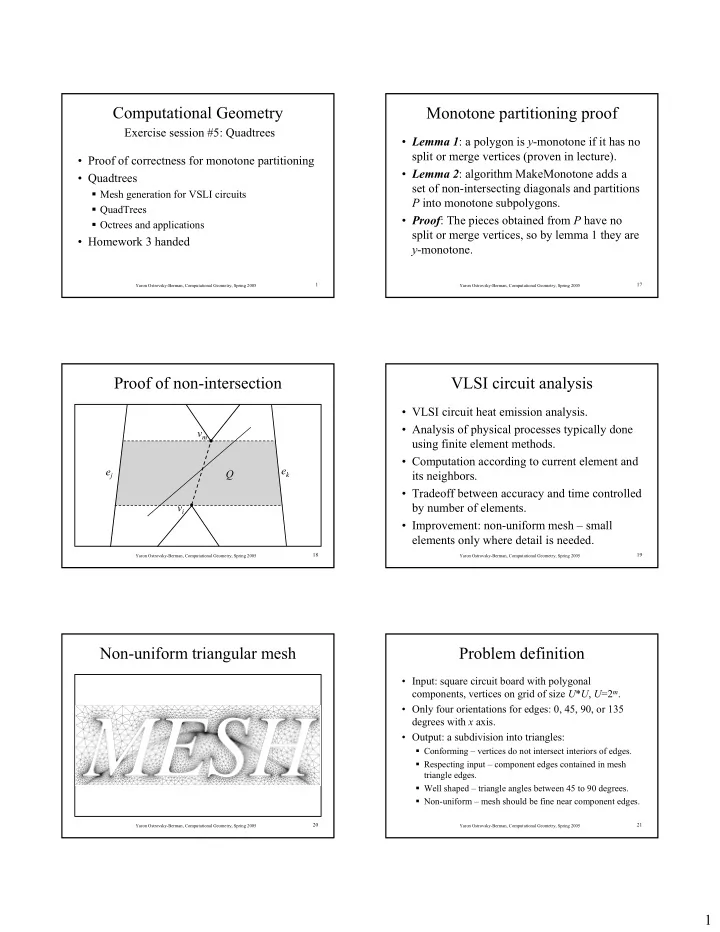
vi vm ej ek Q
Yaron Ostrovsky-Berman, Computational Geometry, Spring 2005
19
VLSI circuit analysis
- VLSI circuit heat emission analysis.
- Analysis of physical processes typically done
using finite element methods.
- Computation according to current element and
its neighbors.
- Tradeoff between accuracy and time controlled
by number of elements.
- Improvement: non-uniform mesh – small
elements only where detail is needed.
Yaron Ostrovsky-Berman, Computational Geometry, Spring 2005
20
Non-uniform triangular mesh
Yaron Ostrovsky-Berman, Computational Geometry, Spring 2005
21
Problem definition
- Input: square circuit board with polygonal
components, vertices on grid of size U*U, U=2m.
- Only four orientations for edges: 0, 45, 90, or 135
degrees with x axis.
- Output: a subdivision into triangles: