The Scientific Approach to Marketing Effectiveness Jeffrey Spiegel, - - PDF document

the scientific approach to marketing effectiveness
SMART_READER_LITE
LIVE PREVIEW

The Scientific Approach to Marketing Effectiveness Jeffrey Spiegel, - - PDF document

The Scientific Approach to Marketing Effectiveness Jeffrey Spiegel, MD, FACS Professor Boston University School of Medicine Candace A. Quinn, MM, BS Brand=Experience Questions about Advertising Should I advertise? How much should I spend?


slide-1
SLIDE 1

1

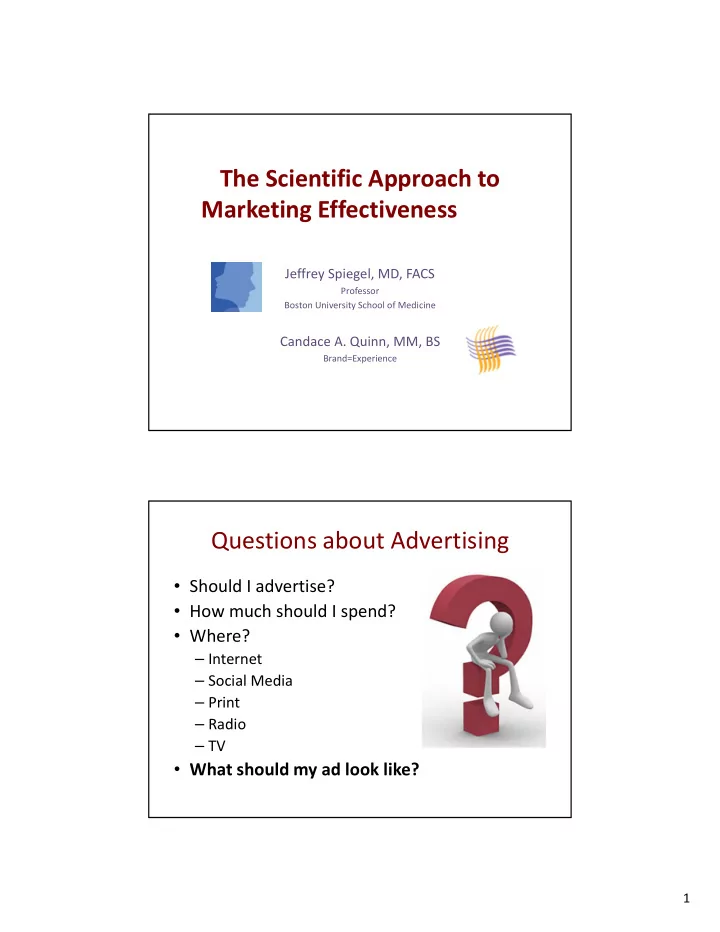
The Scientific Approach to Marketing Effectiveness

Jeffrey Spiegel, MD, FACS

Professor Boston University School of Medicine

Candace A. Quinn, MM, BS

Brand=Experience

Questions about Advertising

  • Should I advertise?
  • How much should I spend?
  • Where?

– Internet – Social Media – Print – Radio – TV

  • What should my ad look like?
slide-2
SLIDE 2

2

Social Media

  • What is it?
  • Who’s using it?

– Young, employed, educated

  • individuals. 60‐70% said they

would use the internet as a source of information on plastic surgeons and surgical procedures.

  • Wong, WW. Gupta, SC. Plastic Surgery Marketing in a Generation of “Tweeting”. Aesthetic Surgery Journal 31(8)

972‐976.

Social Media!

slide-3
SLIDE 3

3

Social Media

  • Who’s using it?

– Most: Miami, FL (50% , 46% ) – Least: Last Vegas, NV (21% ,11% )

  • What are they saying?

– NY: I was in a magazine (56%) – Beverly Hills: I was on TV! (54%)

What about Print Advertising?

  • People learn about plastic surgeons in different ways:

– Magazine Ads: 35% – Television Shows: 34% – Television Ads: 28% – Newspaper Ads: 23% – Internet: 18%

  • Where would you go to find a surgeon?

– Family / Friend: 69% – PCP: 58% – Internet: 17% – Phone Book: 1% – Television Show: 0.5%

  • Wong WW, Camp MC, Camp JS, Gupta SC. The Quality of Internet Advertising in Aesthetic Surgery: An In‐

Depth Analysis. Aesthetic Surgery Journal 30(5) 735‐743, 2010.

slide-4
SLIDE 4

4

Is Print Still Valuable?

  • Using Neuroscience to Understand the Role of Direct Mail. Millward Brown and the Centre for

Experimental Consumer Psychology at Bangor University. (2010)

– Tangible Materials leave a deeper footprint in the brain (not just because of sense of touch). – Physical Material is better connected to memory. – Physical Material involves more emotional processing – important for memory and brand associations. – Physical Materials produce more brain responses connected with internal feelings. Ads are “internalized” more.

What do patients care about?

Rank these…

  • Travel Distance
  • Years in Practice
  • Board Certification
  • Method of Referral
  • Office Décor
  • Cost
  • Waltzman JT, Scholtz T, Evans GRD. What patients look for when

choosing a plastic surgeon. Annals of Plastic Surgery. 66(6) June 2011.

slide-5
SLIDE 5

5

Does this effect your advertising?

  • Board Certification: 40%
  • Referral: 24% (MD > friend)
  • Distance: 13% (30 minutes)
  • Décor: 9%
  • Years in practice: 8%
  • Cost: 7%

(values represent relative importance)

Considerations in Construction of an Advertisement

  • Endorsement – Celebrity vs Expert (e.g. MD)
  • Framing – Positive or Negative

Positive: “Will make you look five years younger.” Negative: “If you don’t do this, you’ll look older than ever.”

  • Rewards – Extrinsic vs Intrinsic

Extrinsic: “All of your friends will be jealous.” Intrinsic: “You’ll feel better about yourself.” So what works?

slide-6
SLIDE 6

6

Want people to like your Ad?

  • Highest Ad Likability with celebrity endorser,

using positive framing and extrinsic reward.

  • Wu WY, Linn CT, Fu CS, Sukoco BM. The Role of Endorsers, Framing, and Rewards on the Effectiveness of Dietary Supplement Advertisements.

Journal of Health Communication, 16:54‐75, 2012.

What about for Cosmetic Surgery?

  • Women, aged 20‐30, were most likely to report high

“Ad Liking”, and willingness to visit for consultation when exposed to a celebrity endorser with an emotional message rather than a rational one.

  • There is a significant interaction effect
  • n intent to visit the advertised clinic for a

consultation for an ad with a celebrity spokesperson with an emotional message as opposed to an ad with a non‐celebrity spokesperson and a rational message.

  • Kang M, Goodman JR. Effects of Spokesperson and Message Type on Cosmetic Surgery Advertising Among Korean Women. American

Academy of Advertising Conference Proceedings (201).

slide-7
SLIDE 7

7

Considerations for Advertisements

  • Millward‐Brown: Engaging Consumer’s Brains: The Latest Learning, 2007.
  • Need engagement – need to have observers use

mental energy on your ad

  • Must be relevant at the time and place of observation.

– Where is your ad?

  • Consider “Content related advertising”.

– What are people looking to do while watching TV versus reading or surfing the web?

  • Entertainment vs information as a goal.
  • Getting in the way has a negative effect.
  • Don’t overwhelm… Keep it Simple.

Creating a Good Cosmetic Surgery Advertisement

  • But there’s so much more to consider!

– Color, layout, images, promotions, credentials, “before and after” pictures, model or real patients, services, discount physician image…

slide-8
SLIDE 8

8

What Features of An Advertisement are Preferred by Prospective Patients?

  • Patient Preferences in Print Advertisement

Marketing for Plastic Surgery

Akshay Sanan B.A., Candace Quinn B.S., M.M, Jeffrey Spiegel M.D.* Accepted for Publication: Aesthetic Surgery Journal

Methods

  • Paid Research Survey by Professional Market

Research Firm. Screened for likely or experienced cosmetic surgery patients in affluent areas of Atlanta, Boston, Chicago, Dallas, Denver, Las Vegas, Los Angeles, Miami, New York City, Phoenix/Scottsdale, Seattle, and Washington, DC, with the majority of participants from the NYC and LA markets.

slide-9
SLIDE 9

9

Five Published (or created) Advertisements

Demographics

  • 404 Respondents

– 80% women, typically aged 35‐65, 50% had a procedure in last 5 years, all remaining likely or very likely to have one in the next 2‐5 years. – 87% Caucasian – 71% with 4‐yr college degree or more – All household incomes >$75,000

slide-10
SLIDE 10

10

Questions

  • What is the main message of the ad?
  • Open ended Questions about the ad

– What is your overall impression? – What do you not like about the ad? – If you liked nothing about the ad, tells us why.

  • Is this ad believable?
  • Does it differentiated from other ads?
  • Does the ad have a message worth remembering?
  • Does the ad speak to things you care about?
  • Does the ad make you curious to learn more about the practice / physician?
  • Does the ad give you good reason to use this doctor group?
  • Select three words that express your emotions after reading this advertisement..
  • Give the ad an overall grade.

What is the main message here?

  • Being Beautiful is Possible (49%)
  • I could be Beautiful (31%)
  • Being Beautiful is important (21%)
slide-11
SLIDE 11

11

Overall Impression?

EveryBODY is beautiful – universal appeal. Nice colors. Nice photography of the women. Natural. Relatable. Good credentials.

What don’t you like?

Models – not real, no men, no procedure list, motto misleading.

slide-12
SLIDE 12

12

More Comments

  • Believable?

– 60% ‐ somewhat.

  • Differentiated from other ads?

– 51% ‐ somewhat.

  • Message worth remembering?

– 41% ‐ somewhat. – 39% ‐ definitely.

  • Spoke to things you care about?

– 46% ‐ somewhat. – 34% ‐ definitely.

  • Curious to learn more?

– 43% ‐ somewhat. – 34% ‐ definitely.

  • Good reason to use this doctor / group?

– 48% ‐ somewhat.

Final Impressions

  • Three words that express your

emotions after reading this ad…

– Comfortable – Hopeful – Respected – Confident – Supported

  • Describe this ad: “easy to follow”, “nice”, “fresh”,

engaging, “interesting”.

  • Overall grade: A‐
slide-13
SLIDE 13

13

What is the main message here?

  • Being Beautfiul is possible
  • I need surgery from this group
  • I could be beautiful
  • “none of the above”

Overall Impression?

Good motto, good photo, looks professional, good credentials

slide-14
SLIDE 14

14

What don’t you like?

Feels fake, feels stages, feels too professional to be real, too many men, too serious.

More comments

  • Believable?

– 50% ‐ somewhat. (60) – 40% ‐ definitely.

  • Differentiated from other ads?

– 43% ‐ somewhat. (51) – 34% definitely.

  • Message worth remembering?

– 45% ‐ somewhat. (41) – 33% ‐ definitely. (39)

  • Spoke to things you care about?

– 46% ‐ somewhat. (46)

  • Curious to learn more?

– 44 ‐ somewhat. (43)

  • Good reason to use this doctor / group?

– 45% ‐ somewhat. (48)

slide-15
SLIDE 15

15

Final Impressions

  • Three words that express your

emotions after reading this ad…

– Confident – Knowledgeable – Comfortable

  • Describe this ad: “easy to follow”, “nice”,

engaging, “interesting”.

  • Overall grade: B

What is the main message here?

  • Being Beautfiul is possible
  • Some people need surgery to be

Beautiful

  • I could be beautiful
slide-16
SLIDE 16

16

Overall Impression?

Before / after photos of real patients, physician in action is good

What don’t you like?

Before and after pictures good – but patients weren’t attractive enough before surgery, working physician too dramatic, no credentials listed

slide-17
SLIDE 17

17

More comments

  • Believable?

– 50% ‐ somewhat. (60, 50)

  • Differentiated from other ads?

– 42% ‐ somewhat. (51, 43)

  • Message worth remembering?

– 43% ‐ somewhat. (41, 45)

  • Spoke to things you care about?

– 47% ‐ somewhat. (46, 46)

  • Curious to learn more?

– 48% ‐ no.

  • Good reason to use this doctor / group?

– 49% ‐ no.

Final Impressions

  • Three words that express your

emotions after reading this ad…

– hopeful – skeptical – neutral

  • Describe this ad: “easy to follow”, “cheesy”,

“interesting”.

  • Overall grade: C+
slide-18
SLIDE 18

18

What is the main message here?

  • Being Beautiful is Possible (31%)
  • I could be Beautiful (23%)
  • Some people need surgery to be

Beautiful (16%)

  • Being Beautiful is important (16%)

Overall Impression?

Simple, short message, beautiful woman, discount, credentials, doctor seems young.

slide-19
SLIDE 19

19

What don’t you like?

Many negative comments: Distasteful representation of the woman and her breasts, scantily clad, model, distasteful and discrediting to offer a coupon.

More Comments

  • Believable?

– 52% ‐ somewhat. (60, 50, 50)

  • Differentiated from other ads?

– 52% ‐ not at all. (51, 43, 42 ‐ somewhat)

  • Message worth remembering?

– 37% ‐ somewhat. (41, 45, 43) – 43% ‐ not at all.

  • Spoke to things you care about?

– 37% ‐ somewhat. (46, 46, 47) – 48% ‐ not at all.

  • Curious to learn more?

– 53% ‐ no. (48)

  • Good reason to use this doctor / group?

– 53% ‐ no. (49)

slide-20
SLIDE 20

20

Final Impressions

  • Three words that express your

emotions after reading this ad…

– annoyed – skeptical – Neutral

  • Describe this ad: “easy to follow”, “cheesy”,

“irritating”, “disrespectful”, “forgettable”.

  • Overall grade: C+

What is the main message here?

  • Being Beautiful is Possible (51%)
  • I could be Beautiful (31%)
  • nothing(22%)
slide-21
SLIDE 21

21

Overall Impression?

Motto, comfort and privacy, color, image, procedure list, credentials, MFA seal

What don’t you like?

Old fashioned, motto too lofty, credential list too long, doctors of too many specialities.

slide-22
SLIDE 22

22

More Comments

  • Believable?

– 61% ‐ somewhat. (60, 50, 50, 52)

  • Differentiated from other ads?

– 47% ‐ not at all. (51, 43, 42 ‐ somewhat)

  • Message worth remembering?

– 46% ‐ somewhat. (41, 45, 43, 37) – 30% ‐ not at all.

  • Spoke to things you care about?

– 44% ‐ somewhat. (46, 46, 47, 37) – 30% ‐ not at all.

  • Curious to learn more?

– 40% ‐ somewhat

  • Good reason to use this doctor / group?

– 45% ‐ somewhat.

Final Impressions

  • Three words that express your

emotions after reading this ad…

– Neutral – hopeful – comfortable

  • Describe this ad: “easy to follow”,

“forgettable”, “boring”, “weak”.

  • Overall grade: C+
slide-23
SLIDE 23

23

What does it mean?

  • Ads 1 and 2 had highest overall preference.

– Similar layouts: company logo, photo, description of services. – Easy to navigate ads – Not too much information

  • Prospective patients valued the standard / common design,

balance of images and words, soft font with cursive elements.

Real Patients or Models?

  • Neither corresponds with ad likability
  • More important:

what does the person look like? Too realistic: bad. Too fake: bad.

  • Sex sells? Not here.
  • Before and after? Liked.
  • Overall: Reader must identify with person

depicted within a motivational context.

slide-24
SLIDE 24

24

Picture of the Doctor? Credentials?

  • Your picture? Maybe
  • nly if it clarifies ethnicity

(when to your advantage), gender (same). Candid but not fake.

  • No “action photos”!

List of Services

  • No list – bad.
  • Long list – bad.
  • Some listed procedures

connects the physician’s skill with the patient’s desires.

  • Minimize medical jargon.
slide-25
SLIDE 25

25

What color?

  • Cream, blue, light brown all desired.
  • Black considered “overbearing”,

“intimidating”, and “staged”

Coupons / Discounts?

  • Do not resonate.

– Seen as distasteful and discrediting. – Implied substandard quality

slide-26
SLIDE 26

26

Motto?

  • Not clearly necessary.
  • Avoid extreme claims
  • Make sure your using this as a targeted

statement of brand position.

  • Keep it Simple

Thank you for your attention!

  • Want more information?
  • Jeffrey Spiegel
  • Jeffrey.Spiegel@BMC.org