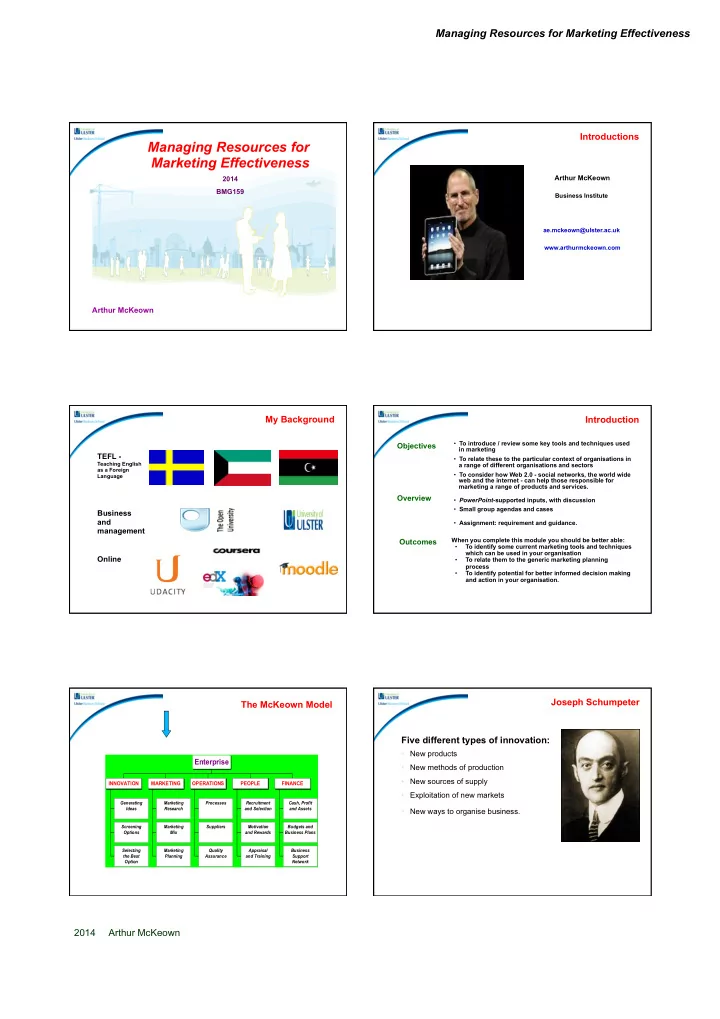
Managing Resources for Marketing Effectiveness Introductions - - PDF document

managing resources for marketing effectiveness
SMART_READER_LITE
LIVE PREVIEW

Managing Resources for Marketing Effectiveness Introductions - - PDF document

Managing Resources for Marketing Effectiveness Introductions Managing Resources for Marketing Effectiveness Arthur McKeown 2014 BMG159 Business Institute ae.mckeown@ulster.ac.uk www.arthurmckeown.com Arthur McKeown My Background


slide-1
SLIDE 1

Managing Resources for Marketing Effectiveness

2014 Arthur McKeown

Managing Resources for Marketing Effectiveness

2014 BMG159

Arthur McKeown

Arthur McKeown

Business Institute ae.mckeown@ulster.ac.uk www.arthurmckeown.com

Introductions

TEFL -

Teaching English as a Foreign Language

Business and management Online

My Background

When you complete this module you should be better able:

  • To identify some current marketing tools and techniques

which can be used in your organisation

  • To relate them to the generic marketing planning

process

  • To identify potential for better informed decision making

and action in your organisation.

  • To introduce / review some key tools and techniques used

in marketing

  • To relate these to the particular context of organisations in

a range of different organisations and sectors

  • To consider how Web 2.0 - social networks, the world wide

web and the internet - can help those responsible for marketing a range of products and services.

Overview Outcomes

Introduction

Objectives

  • PowerPoint-supported inputs, with discussion
  • Small group agendas and cases
  • Assignment: requirement and guidance.

Generating Ideas Screening Options Selecting the Best Option

INNOVATION

Marketing Research Marketing Mix Marketing Planning

MARKETING

Processes Suppliers Quality Assurance

OPERATIONS

Recruitment and Selection Motivation and Rewards Appraisal and Training

PEOPLE

Cash, Profit and Assets Budgets and Business Plans Business Support Network

FINANCE

Enterprise

The McKeown Model Joseph Schumpeter Five different types of innovation:

  • New products
  • New methods of production
  • New sources of supply
  • Exploitation of new markets
  • New ways to organise business..
slide-2
SLIDE 2

Managing Resources for Marketing Effectiveness

2014 Arthur McKeown Sister Celine Castleblayney An Entrepreneurial Nun Disruptive Innovation in Airlines Clayton Christensen

Disruptive Innovation

www.thinkers50.com

The Future of Work Marketing Mentor

User name ulster Password ulster

Some Resources www.bookboon. com

slide-3
SLIDE 3

Managing Resources for Marketing Effectiveness

2014 Arthur McKeown Mind mapping Thinkers50 (2013)

Clayton Christensen

  • W. Chan Kim

& Renée Mauborgne Roger Martin Don Tapscott Vijay Govindarajan Rita McGrath Michael Porter Linda Hill Herminia Ibarra Marshall Goldsmith Pankaj Ghemawat Jim Collins Daniel Pink Lynda Gratton Amy Edmondson

Bain 25 (2013)

  • Balanced scorecard
  • Benchmarking
  • Big data analytics
  • Business process reengineering
  • Change management programs
  • Complexity reduction
  • Core competencies
  • Customer relationship management
  • Customer segmentation
  • Decision rights tools
  • Downsizing
  • Employee engagement surveys
  • Mergers and acquisitions
  • Mission and vision statements
  • Open innovation
  • Outsourcing
  • Price optimization models
  • Satisfaction and loyalty management
  • Scenario and contingency planning
  • Social media programs
  • Strategic alliances
  • Strategic planning
  • Supply chain management
  • Total quality management
  • Zero-based budgeting

Assignment

Peter Drucker

Some significant factors in the macro environment Introduce your context: organisation, its business activities, your role, etc. Marketing plan, as pecha kucha Reflective statement Annotated bibliography

  • “The term Audience Development describes activity

which is undertaken specifically to meet the needs of existing and potential audiences and to help arts [and cultural] organisations to develop on-going relationships with audiences.

  • It can include aspects of marketing, commissioning,

programming, education, customer care and distribution.” Arts Council of England A Starting Point Some Definitions of Marketing

Marketing is the management process responsible for identifying, anticipating and satisfying customer requirements profitably.

Chartered Institute of Marketing

Selling goods and services that don’t come back to customers who do.

Anon

Marketing is the social process by which individuals and groups obtain what they need and want through creating and exchanging products and value with others.

Kotler

slide-4
SLIDE 4

Managing Resources for Marketing Effectiveness

2014 Arthur McKeown

  • Population
  • Ageing
  • Urban
  • Rise of Africa
  • Social
  • More women working
  • Technology
  • Facebook
  • iPad
  • Obesity
  • Political levelling of inequality
  • Size and role of the state
  • Rise of China
  • “Black swan”
  • Innovation in biology and health care
  • 3D printing
  • Food – more people, more demand

Megachange 2050 Political Changes

Scotland? Ukraine? Fracking

Changes in Education

Ken Robinson

Belfast’s Industrial Heritage Local entrepreneurs

William Dargan Lillian Bland

Technology

slide-5
SLIDE 5

Managing Resources for Marketing Effectiveness

2014 Arthur McKeown Richard Branson Sean Quinn Reggae Reggae Sauce The Sausage Entrepreneur

Bill O’Hagan, 1944 - 2013

FitBit

Webquest

What is FitBit? To what extent is it an example of entrepreneurship in action? 3D Printing

slide-6
SLIDE 6

Managing Resources for Marketing Effectiveness

2014 Arthur McKeown The Marketing Process

  • Inputs Find out what your customers want ...
  • Processing … then provide what your customers want ...
  • Outputs … and keep doing it - well!
  • ... getting more customers
  • … getting those we have to spend more
  • … both!

Good quality inputs The right tools and techniques Better outputs

Needs and Wants

Why people make purchases Maslow’s Hierarchy of Needs

  • Survival - Food and drink, clothes and shelter
  • Self protection - Insurance, pensions, AA
  • Social - Party dresses, sports equipment
  • Self esteem - Swanky briefcases
  • Self actualisation - Activity holidays

Some Concepts

  • Employees
  • Senior

management team

  • Customers
  • Suppliers
  • Local community
  • Government
  • Strengths
  • Weaknesses
  • Opportunities
  • Threats

Stakeholders SWOT S T E E P

  • Changing

demographics

  • Online technologies
  • Local, national and

international economy

  • Green agenda and

climate change

  • Sustainability

Types of Market Research

Primary

  • Questionnaires
  • Telephone
  • Group interviews

Secondary

  • Books and journals
  • Market reports
  • Online

The marketing research process

  • Define objectives
  • Develop the research plan
  • Collect and analyse the data
  • Interpret and report the findings

Qualitative research

  • More open-ended questions,

using:

  • Face-to-face interviews
  • Telephone interviews
  • Postal surveys
  • Group discussions in focus

groups

  • … or a mixture.

Quantitative research

  • Asks closed questions requiring specific

answers

  • Lets the user put percentage figures to

findings.

Market Research

  • Secondary
  • Key Note
  • Film Market June 2006
  • Music Industry April 2006

www.keynote.co.uk

  • Primary
  • Box office data
  • Questionnaires
  • Focus groups

SurveyMonkey William Cohen

The Marketing Mix

  • P roduct
  • What are you selling?
  • P rice
  • How much will it cost?
  • P romotion
  • How will you tell customers

about it?

  • P lace / Distribution
  • How will you get it to your

customers?

  • P eople
  • Who is involved in service

delivery?

  • P rocesses
  • How will you deliver the

services offered?

  • P hysical evidence
  • What premises, facilities, other

tangibles do you need?

slide-7
SLIDE 7

Managing Resources for Marketing Effectiveness

2014 Arthur McKeown Product / Benefits

  • The benefits
  • To the consumer
  • To the customer
  • Innovation and new product development
  • Bigger / Smaller
  • Faster
  • More healthy
  • More fashionable
  • More convenient
  • Cheaper
  • Product life cycle

Pricing

  • Cost-based
  • What does it cost to make it?
  • Material + Labour + Overheads + Profit =

Selling price

  • Customer-based
  • How much are customers prepared to pay?
  • Competitor-based
  • How much are competitors charging for the

same thing?

  • … or a mixture ...

Promotion

Options include

  • Advertising
  • Exhibitions and trade shows
  • Public relations and sponsorship
  • Personal selling

?

Advertisements

www.tv-ark.org.uk

More Advertisements Place / Distribution

  • Distribution channels
  • Wholesalers
  • Retailers
  • Direct
  • Marketing on the Internet
  • B2C - Selling to consumers
  • B2B - Business to business
slide-8
SLIDE 8

Managing Resources for Marketing Effectiveness

2014 Arthur McKeown Marketing Planning

Principal sections

  • Introduction
  • Analysis
  • STEEP analysis
  • SWOT analysis
  • Stakeholder analysis
  • Customers
  • Competitors
  • Your USP
  • The marketing mix - 4(+) Ps
  • Product
  • Pricing
  • Promotion
  • Place / Distribution
  • Recommendations for further action - with Gantt chart

Philip Kotler

Customer Journey Mapping Stage Gate Model Ansoff Matrix

Igor Ansoff

Porter’s Five Forces

Michael Porter