The Rules that Govern The Rules that Govern In the Federal courts - - PDF document

the rules that govern the rules that govern in the
SMART_READER_LITE
LIVE PREVIEW

The Rules that Govern The Rules that Govern In the Federal courts - - PDF document

What has the Fifth Circuit said on this issue? This question is familiar to most attorneys practicing within the juris- diction of the U.S. Court of Appeals for the Fifth Circuit. The import of this question will be especially familiar to


slide-1
SLIDE 1

The Rules that Govern The Rules that Govern In the Federal courts Of the Fifth Circuit

BY DAVID L. HORAN

“What has the Fifth Circuit said on this issue?” This question is familiar to most attorneys practicing within the juris- diction of the U.S. Court of Appeals for the Fifth Circuit. The import of this question will be especially familiar to jun- ior attorneys whose task it is to determine the answer for any given case that will be briefed or tried. The question admits of two basic answers: nothing or something. Nothing is a relatively rare answer. The Fifth Cir- cuit is a rather active court that produces, and historically has produced, a large number of opinions, published or

  • therwise. It is fair to say that most cases do not present true issues of first impression.

The subject of this article is the other answer to the question: specifically, what rules of law govern when the Fifth Circuit has said something — or possibly conflicting somethings — on the issue presented in a given case.

622 | Texas Bar Journal | September 2004 www.texasbar.com

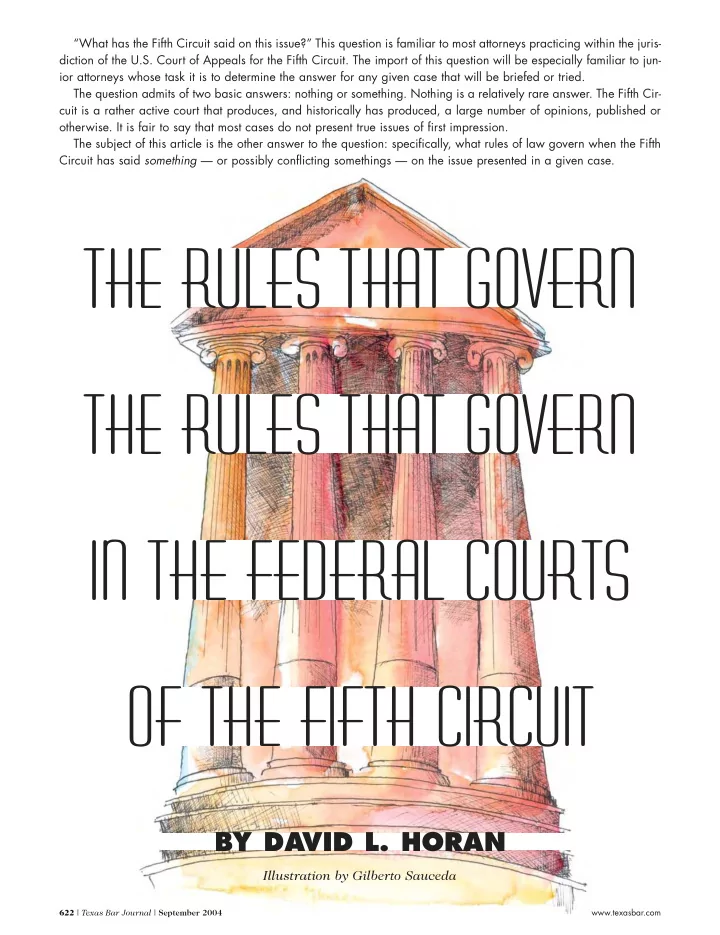
Illustration by Gilberto Sauceda

slide-2
SLIDE 2

There are rules that governs these matters, familiar in general terms to any attorney from the first year of law school: stare decisis, Erie, dicta. Most lawyers practicing in the Fifth Circuit know these rules, or at least think they do. But these rules make or break the results of cases more often than one might think, so it is worth collecting and analyzing just what the rules are for thefederal courts of the Fifth Circuit. Stare Decisis and Federal Law: When What the Fifth Circuit Said Goes1 Generally speaking, if the Fifth Cir- cuit has said something on an issue of federal law, that decision is a binding

  • precedent. The doctrine of stare decisis

— that courts abide by and adhere to their own or a higher court’s precedent from decided cases and do not disturb settled law — and its importance to common law courts is well known.2 The Fifth Circuit is a self-described “strict stare decisis court.”3 Under this doctrine, the court of appeals and the district courts of the Fifth Circuit are bound on matters of federal law by U.S. Supreme Court decisions and decisions of the Fifth Cir- cuit sitting en banc.4 Further, as is the rule in all of the federal courts of appeals, one panel of the Fifth Circuit cannot overrule a prior Fifth Circuit panel decision — right or wrong — unless and until that decision is overruled, either explicitly or implicitly, by the Supreme Court or the en banc Fifth Circuit.5 Explicit overruling occurs when the Supreme Court or en banc Fifth Circuit cites a Fifth Circuit decision and expressly overrules or disapproves

  • f it. Implicit overruling occurs when

the result of a Supreme Court or en banc Fifth Circuit decision directly contra- dicts the holding of a prior Fifth Circuit panel decision without expressly citing

  • r discussing that prior panel decision.6

Applying this rule when the en banc Fifth Circuit or the Supreme Court has explicitly overruled a prior Fifth Cir- cuit decision is easy. More often than not, the en banc Fifth Circuit will be quite explicit when overruling its own panels’ prior decisions or lines of deci-

  • sions. When the en banc court has done

so, an attorney should feel supremely confident requesting that a district court or a Fifth Circuit panel hold the prior panel decision to be overruled. However, explicit overruling by the Supreme Court of a prior court of appeals decision, when that decision is not before the court on a petition for writ

  • f certiorari, is a bit much to hope for.

Attorneys will more often find them- selves asking for a finding that the Supreme Court has implicitly over- ruled a prior Fifth Circuit panel or en banc decision. The Fifth Circuit has

  • bserved: “[F]or a panel of this court to
  • verrule a prior decision, we have required

a Supreme Court decision that has been fully heard by the Court and establishes a rule of law inconsistent with our own.”7 Moreover, the Fifth Circuit has explained: “Notwithstanding its relevance, the Supreme Court decision must be more than merely illuminating with respect to the case before us, because a panel

  • f this court can only overrule a prior

panel decision if ‘such overruling is unequivocally directed by controlling Supreme Court precedent.’”8 On the

  • ther hand, decisions of other circuits
  • r district courts can never overrule a

Fifth Circuit panel decision.9 A Fifth Circuit decision on a federal law issue will generally bind the parties and courts in the Court of Appeals and district courts of the Fifth Circuit. If neither the Supreme Court nor the en banc Fifth Circuit has explicitly or implicitly overruled the Fifth Circuit’s prior panel decision that controls an issue, an attorney seeking to escape that decision’s holding has no choice but to raise the issue before the district court or Fifth Circuit panel and, when the time is right, seek en banc rehear- ing to ask the full court of appeals to change the Fifth Circuit precedent.10 Stare Decisis and State Law: When What the Fifth Circuit Said Goes, Even If It Was Just a Guess When faced with a state law issue in a federal case, an attorney’s task in looking for controlling Fifth Circuit law does not change much from the task with regard to issues of federal law. Again, generally speaking, if the Fifth Circuit has said something on a state law issue, that decision will be a bind- ing precedent. Erie Guesses on a Clean Slate and the Decisions of the State’s Highest and Intermediate Appellate Courts Of course, the federal court’s analy- sis in the first instance is different. A federal court deciding a state law issue

TBJ | The Rules that Govern the Rules that Govern in the Federal Courts of the Fifth Circuit

624 | Texas Bar Journal | September 2004 www.texasbar.com

Med di ia at ti io

  • n

n & & Ar rb bi it tr ra at ti io

  • n

n TR RA AI IN NI IN NG G

by the

N Nat ti io

  • n

na al l M Me ed di ia at ti io

  • n

n A Ac ca ad de em my y

E Ex xp pe eri ie en nc ce ed p pr rof fe es ss si io

  • n

na al l i in ns st tr ru uc ct to

  • r

rs s wi it th h y ye ear rs s

  • f

f te eac chi in ng g e ex xp pe er ri ie en nc ce e a an nd d t th ho

  • u

us sa an nd ds s

  • f

f c ca as se es s a as s a at tt to

  • r

rn ne ey y m me ed di ia at to

  • r

rs s

  • r

r a ar rb bi it tr ra at to

  • r

rs s. . T Th he e m me ed di ia at ti io

  • n

n t tr ra ai in ni in ng g u us se es s t th he e H Ha ar rv va ar rd d L La aw S Sc cho

  • l

l M Mo

  • d

de el l a an nd d a ac ct tu ua al l t te ex xt tb bo

  • k

ks s. . B Ba as sic c c co

  • u

ur rs ses s a ar re e t ta au ug gh ht t T Th hu ur rs sd da ay y-

  • S

Su un nd da ay y. .

C Ci iv vil l an nd d C Co

  • m

mm me er rci ia al l C Cl la as ss s

Le ea arn n t to

  • M

Me ed di ia at te e Em mp pl lo

  • y

ym me en nt t, , P Per rs so

  • n

na al l I In nj ju ur ry y, , I In ns su ur ra an nc ce e, , C Co

  • n

nt tr ra ac ct t, , B Bu us si in ne es ss s, , C Ci iv vi il l R Ri ig gh ht ts s, , a an nd d C Co

  • m

mm me er rc ci ia al l D Di is sp pu ut te es s. .

F Fa am mi il ly y a an nd d I In nt te er rp pe er rs so

  • n

na al l Med di ia at ti io

  • n

n C Cl la as ss se es s

Le ea ar rn n t to

  • m

me ed di ia at te e f fa am mi il ly y, , p pa ar re en nt t

  • c

ch hi il ld d r re el la at ti io

  • n

ns shi ip p, , & & i in nt te er rp pe er rs so

  • n

na al l d di is sp pu ut te es s. .

A Ar rb bi it tr ra at ti io

  • n

n C Cl la as ss se es s

Ne ew w S St ta at te l la aw ws s a an nd d U U. .S S. . S Su up pr re em me e C Co

  • u

ur rt t C Ca as se es s a ar re e e ex xp pa an nd di in ng g t th he e u us se

  • f

f a ar rb bi it tr ra at ti io

  • n

n. . S Sp pe en nd d a a w we ee ek ke en nd d & & l le ea ar rn n a ar rb bi it tr ra at ti io

  • n

n s sk ki il ll ls s. . 4 40 h hr rs s. . M MC CL LE E C Cr re ed di it t

  • B

Ba as si ic c C Ci iv vi il l 4 40 h hr rs s. . M MC CL LE E C Cr re ed di it t

  • F

Fa am mi il ly y 1 15 5. .5 hr rs s. . MC CL LE E C Cr re ed di it t

  • A

Ar rb bi it tr ra at ti io

  • n

n T Th he e N Na at ti io

  • n

na al l M Me ed di ia at ti io

  • n

n A Ac ca ad de em my y, , I In nc c. . 6 66 68 88 8 N No

  • .

. C Ce en nt tr ra al l E Ex xp pr re es ss sw wa ay y, , S St te e. . 6 60 00 Da al ll la as s, , T TX X 7 75 52 20 06 6

P Ph h ( (21 14 4) ) 3 36 61 1-

08 81 10 0— —( (8 80 00 0) ) 6 68 85 5-

09 99 99 9

A An n A Af ff fi il li ia at te e
  • f
f N Na at ti io
  • n
na al l M Me ed di ia at ti io
  • n
n A Arb bi it tr ra at ti io
  • n
n, , I In nc c. . F Fa ax x ( (2 21 14 4) ) 3 36 61 1-
  • 2
23 34 43 3

h htt tp p: :/ // /w ww ww w. .n na at ti io

  • n

na al l-

  • m

me ed di ia at ti io

  • n

n. .c co

  • m

m

A Fifth Circuit decision on a federal law issue will generally bind the parties and courts in the Court of Appeals and district courts of the Fifth Circuit.

slide-3
SLIDE 3

under either its diversity11 or supple- mental12 jurisdiction must look to and follow the final decisions of the state’s highest court. If such a decision is not available, the court must determine in its best judgment how the state’s high- est court would decide the issue if pre- sented with the same case.13 This is the familiar “Erie guess,” so named for the Supreme Court’s seminal decision in Erie Railroad v. Tompkins.14 In making this guess, a federal court should look to the precedents of the state’s inter- mediate appellate courts for guidance and defer to those courts’ decisions unless convinced by other data that the state’s highest court would decide the case differently than these intermedi- ate courts’ decisions.15 The Effect of Intervening State Law on a Prior Panel’s State Law Determination As it turns out, the Fifth Circuit’s state law determinations, once made, are, like the Fifth Circuit’s federal law determinations, not easily overturned by subsequent panels. The Fifth Circuit’s strict stare decisis doctrine applies to a Fifth Circuit panel’s interpretation of state law no less than a prior decision applying federal law.16 A district court

  • r subsequent Fifth Circuit panel is

bound by a prior Fifth Circuit panel’s interpretation of state law, notwith- standing any alleged existing confusion in the state’s law, unless: (1) the en banc Fifth Circuit reaches a contrary interpretation17; (2) a subsequent state court decision or statutory amendment

  • r other enactment makes the prior

panel decision “clearly wrong”18; or (3) intervening decisions of intermediate state appellate courts are “clearly con- trary” to the prior panel decision.19 This standard remained rather murky in application until a Fifth Circuit panel established a cleaner and clearer rule in 1998. The panel made clear that, to render a prior Fifth Circuit panel’s inter- pretation of state law “clearly wrong,” a subsequent decision of the state’s high- est court must constitute, “at a mini- mum, a contrary ruling squarely on point,”20 or there must have been a “supervening enactment of a control- ling statute.”21 The Fifth Circuit also clarified the effect of subsequent inter- mediate state appellate court decisions

  • n the continuing effect of a prior Fifth

Circuit panel’s Erie guess. The panel held: “[W]hen our Erie analysis of con- trolling state law is conducted for the purpose of deciding whether to follow

  • r depart from prior precedent of this

circuit, and neither a clearly contrary subsequent holding of the highest court

  • f the state nor a subsequent statutory

authority, squarely on point, is avail- able for guidance, we should not disre- gard our own prior precedent on the basis of subsequent intermediate state appellate court precedent unless such precedent comprises unanimous or near-unanimous holdings from several — preferably a majority — of the inter- mediate appellate courts of the state in question.”22 For attorneys in the federal courts of the Fifth Circuit, the first source of controlling precedent on state law issues is Fifth Circuit case law. If the Fifth Circuit has spoken, attorneys must nevertheless investigate decisions from the state’s highest and intermedi- ate appellate courts or state statutory enactments that postdate the Fifth Cir- cuit’s first Erie guess on the issue. How- ever, such intervening authority can

  • nly control the outcome of the case in

the district courts and before a subse- quent Fifth Circuit panel if: (1) the new statute or a decision from the state’s highest court renders the prior panel decision “clearly wrong”; or (2) unani- mous or near-unanimous holdings from several — preferably a majority — of the state’s intermediate appellate courts are “clearly contrary” to the prior panel decision. Conflicting Prior Panel Decisions: When the Fifth Circuit Has Said Too Much The general rule is clear: panels of the Fifth Circuit cannot overrule or decide the same issue differently than a prior Fifth Circuit panel decision. A Fifth Circuit panel decision will usually The Rules that Govern the Rules that Govern in the Federal Courts of the Fifth Circuit | TBJ

www.texasbarjournal.com Volume 67 | Number 8 | 625

slide-4
SLIDE 4

control a federal or state law issue in the district courts and before a subse- quent Fifth Circuit panel. Generally, when the Fifth Circuit has said some- thing on an issue, subsequent panels facing the same issue have consistently applied the same governing rules of law. However, this usual state of affairs does not always come to pass in prac-

  • tice. Judges are human, and so are

their clerks. Furthermore, the court of appeals expects the attorneys practic- ing before it to correctly present the state of the law on an issue properly raised for decision. Therefore, the sce- nario occasionally arises in which two Fifth Circuit panel decisions or lines of decisions directly conflict on an issue. The Fifth Circuit’s strict rule in such a situation follows logically from the fundamental prior panel decision rule: the earliest decision or line of decisions controls.23 Of course, the other part of the core prior panel decision rule holds sway here, too: this “rule of orderliness has little persuasive force when the prior panel decision at issue conflicts with a Supreme Court case to which the sub- sequent panel decision is faithful.”24 It is sometimes not enough to have a Fifth Circuit panel decision on point for your position on an issue, when your

  • pponent has an earlier, contrary, on-

point decision. In this context, the rule holds that first in time is first in line. Vacated, Reversed, and Unpublished Panel Decisions: As If the Fifth Circuit Never Said a Thing A prior Fifth Circuit panel decision will not control, no matter where in time it stands relative to other deci- sions on the same issue, unless it remains a viable authority. It should go without saying that a prior panel deci- sion will not control if the decision or its holding on an issue was vacated or reversed by the en banc Fifth Circuit

  • r the Supreme Court.

Less well understood is the impor- tant distinction between reversed and vacated panel decisions. In a nutshell, when the Supreme Court reverses the judgment of a Fifth Circuit decision, that decision remains binding prece- dent on all the decision’s results, hold- ings, and explications of the governing rules of law other than the grounds on which the Supreme Court ruled and

  • reversed. However, a Fifth Circuit deci-

sion that the Supreme Court or the en banc court of appeals has vacated has no precedential value whatsoever.25 Further, a panel decision on which the Fifth Circuit grants en banc rehearing is automatically vacated by operation

  • f Fifth Circuit Local Rule 41.3.26 The

panel decision will have no preceden- tial effect, even if the en banc court of appeals reaches the same result on rehearing, unless the en banc court (or the panel on remand from the en banc court) explicitly reinstates the panel decision in whole or in part.27 Likewise, if an issue is discussed in an unpublished Fifth Circuit panel decision, attorneys must be aware that the Fifth Circuit recognizes a rather peculiar rule on the binding effect of unpublished decisions. Unpublished Fifth Circuit decisions “issued on or after

  • Jan. 1, 1996, are not precedent, except

under the doctrine of res judicata, col- lateral estoppel, or law of the case (or similarly to show double jeopardy, abuse of the writ, notice, sanctionable conduct, entitlement to attorney’s fees,

  • r the like)” but may be treated as “per-

suasive” authority.28 However, unpub- lished Fifth Circuit decisions issued before Jan. 1, 1996 are “precedent” and binding on subsequent panels.29 To make matters less clear, though, the Fifth Circuit’s Local Rule 47.5.3

  • bserves: “[B]ecause every opinion

believed to have precedential value is published, such an unpublished opin- ion should normally be cited only when the doctrine of res judicata, collateral estoppel, or law of the case is applicable (or similarly to show double jeopardy, abuse of the writ, notice, sanctionable conduct, entitlement to attorney’s fees,

  • r the like).”30 The cruel irony of this

dualistic rule for attorneys practicing in the Fifth Circuit is that unpublished

TBJ | The Rules that Govern the Rules that Govern in the Federal Courts of the Fifth Circuit

626 | Texas Bar Journal | September 2004 www.texasbar.com

slide-5
SLIDE 5

decisions became more widely and readily available after 1996 with the advent of the Internet, greater avail- ability of LexisNexis and Westlaw, and the recent publication of West Publish- ing’s Federal Appendix. Dicta, Alternative and Implicit Holdings, Silence, and Appellate Fact-finding: When It Isn’t Clear If the Fifth Circuit Has Said Something An attorney will sometimes face the question of whether a prior Fifth Cir- cuit decision that discusses or men- tions (or could have discussed or mentioned) the issue at hand has, for precedential purposes, said anything at

  • all. Some attorneys take the position

that, if the federal court of appeals took the trouble to write something in an

  • pinion, what is said controls and far

be it from them to suggest anything to the contrary. Although this cautious approach is understandable, the court

  • f appeals itself and the district courts

are likely to be more discriminating and to pay more attention to concepts like dicta and alternative holdings. The question for an attorney seeking to answer what the Fifth Circuit has said

  • n an issue thus often becomes what in

a prior Fifth Circuit panel decision con- trols the decisions of later panels or district courts. Generally speaking, sub- sequent panels and district courts are bound by prior panel decisions’ results, holdings (i.e., those parts of the deci- sions that are necessary to those results), and explications of the govern- ing rules of law.31 Conversely, dicta from a panel deci- sion will not bind later panels or dis- trict courts,32 but may be treated as persuasive authority.33 The foundation for this rule lies in the nature of dicta: a dictum is language that “could have been deleted without seriously impairing the analytical foundations of the hold- ing” and “being peripheral, may not have received the full and careful consid- eration of the court that uttered it.”34 But a panel decision’s alternative holdings, though strictly speaking not necessary to the panel’s decision, are precedent, not dicta, and will bind future panels and district courts.35 A district court or Fifth Circuit panel is bound by a prior panel’s alternative rationales for the result the panel reached just as if each rationale was the only reason the prior panel offered for its decision.36 Likewise, a prior panel’s implicit holdings, which are necessary but are not stated explicitly, are binding on future panels.37 At the same time, a prior panel’s silence on an issue, partic- ularly an issue that was not raised by the parties before that panel, is not binding on subsequent panels or dis- trict courts squarely faced with decid- ing the issue.38 Finally, apparent factual findings or

  • ther statements of fact from prior

Fifth Circuit decisions or even Supreme Court decisions are merely dicta and will not dispose of factual issues in the decisions of later Fifth Circuit panels or district courts.39 Appellate courts do not properly engage in fact-finding,40 and any such fact-finding is not binding under the doctrine of stare decisis.41 The Rules that Govern the Rules that Govern in the Federal Courts of the Fifth Circuit An attorney seeking to answer the question “What has the Fifth Circuit said on this issue?” must do more than simply find a Fifth Circuit panel deci- sion that discusses or mentions the

  • issue. There are rules that govern the

rules of law that govern federal and state law issues in the federal courts of the Fifth Circuit (and, for that matter, every circuit). As basic as the doctrines

  • f stare decisis and Erie may seem

when they are mentioned in cocktail- party conversations, attorneys practic- ing in Texas do well to keep them ever in mind as they brief and try their cases in the federal courts.

Notes

  • 1. This article does not discuss other, more case-

specific doctrines such as collateral estoppel, res judicata, law of the case, or the mandate rule.

  • 2. See generally Planned Parenthood v. Casey,

TBJ | The Rules that Govern the Rules that Govern in the Federal Courts of the Fifth Circuit

628 | Texas Bar Journal | September 2004 www.texasbar.com

slide-6
SLIDE 6

505 U.S. 833, 854-55, 865-69 (1992) (dis- cussing the importance of and reasons for adherence to precedent in accordance with the doctrine of stare decisis).

  • 3. FDIC v. Abraham, 137 F.3d 264, 268 (Fifth
  • Cir. 1998).
  • 4. Transcontinental Gas Pipe Line Corp. v.

Transportation Ins. Co., 953 F.2d 985, 988 (Fifth Cir. 1992).

  • 5. Central Pines Land Co. v. United States, 274

F.3d 881, 893 (Fifth Cir. 2001), cert. denied, 537 U.S. 822 (2002). Although sometimes referred to as “intra-circuit stare decisis,” e.g., Billiot v. Puckett, 135 F.3d 311, 316 (Fifth Cir. 1998), the Central Pines panel explained that this rule is “easily confused with traditional stare decisis” but actually “serves a somewhat different purpose of institutional orderliness,” Central Pines Land Co. v. United States, 274 F.3d 881, 893 (Fifth Cir. 2001), cert. denied, 537 U.S. 822 (2002) (quoting Montesano v. Seafirst Commercial Corp., 818 F.2d 423, 425- 26 (Fifth Cir. 1987) (“But our rule that one panel cannot overturn another serves a some- what different purpose of institutional orderli- ness, a distinction evidenced by our insistence that, in the absence of intervening Supreme Court precedent, one panel cannot overturn another panel, regardless of how wrong the earlier panel decision may seem to be.”)).

  • 6. See Heidtman v. County of El Paso, 171 F.3d

1038, 1042 n.4 (Fifth Cir. 1999) (“In setting forth the legal standards on which it based its decision to award liquidated damages, the dis- trict court stated, ‘a lack of good faith is only shown when an employer ‘‘knew or suspected that [its] actions might violate the [Act] … .’’ Reeves v. International Tel. & Tel. Corp., 616 F.2d 1342, 1353 (Fifth Cir. 1980) (quoting Coleman v. Jiffy June Farms, 458 F.2d 1139, 1142 (Fifth Cir. 1971)).’ The district court’s reliance on Reeves and Jiffy June is misplaced. The Supreme Court has specifically overruled Jiffy June, and in doing so implicitly overruled Reeves.”); see also Brabham v. A.G. Edwards & Sons Inc., No. 03-60679, 2004 U.S. App. LEXIS 13365 at *8 n.3 (Fifth Cir. June 28, 2004).

  • 7. Causeway Med. Suite v. Ieyoub, 109 F.3d

1096, 1103 (Fifth Cir. 1997), overruled on

  • ther grounds by Okpalobi v. Foster, 244 F.3d

405, 427 n.35 (Fifth Cir. 2001) (en banc).

  • 8. Martin v. Medtronic, Inc., 254 F.3d 573, 577

(Fifth Cir. 2001), cert. denied, 534 U.S. 1078 (2002) (quoting United States v. Zuniga-Sali- nas, 945 F.2d 1302, 1306 (Fifth Cir. 1991)).

  • 9. See Oncale v. Sundowner Offshore Servs., 83

F.3d 118, 119 (Fifth Cir. 1996) (“Although our analysis in Garcia has been rejected by vari-

  • us district courts, we cannot overrule a prior

panel’s decision.”) (footnote omitted), rev’d on

  • ther grounds, 523 U.S. 75 (1998). Even in the

absence of a prior Fifth Circuit panel decision

  • n point, the court of appeals does not observe

a rule of inter-circuit stare decisis. Taylor v. Charter Med. Corp., 162 F.3d 827, 832 (Fifth

  • Cir. 1998). Nevertheless, on an issue of first

impression in the Fifth Circuit, a panel of the court of appeals as a practical matter will not lightly create a inter-circuit conflict and is like- ly to follow the majority rule of its sister cir-

  • cuits. Indeed, the Fifth Circuit follows a policy
  • f circulating draft panel decisions that would

create a circuit split to the entire court of appeals to solicit a request for en banc consid-

  • eration. See Estate of Farrar v. Cain, 941 F.2d

1311, 1316 n.22 (Fifth Cir. 1991), aff’d sub nom., Farrar v. Hobby, 506 U.S. 103 (1992).

  • 10. Cf. United States v. Tompkins, 130 F.3d 117,

121 n.14 (Fifth Cir. 1997) (“Given our adher- ence to the maxim of stare decisis within our

  • wn court, this panel could not change the stan-

dard of review for voluntariness of consent — or anything else, for that matter — when, as here, doing so would constitute failure to follow precedent established in an earlier decision. The most that we could do if we agreed with Tompkins — which we do not — would be to follow existing precedent, note our concerns, and suggest (or let Tompkins suggest) rehear- ing en banc.”)

  • 11. 28 U.S.C. § 1332.
  • 12. 28 U.S.C. § 1367.
  • 13. American Int’l Specialty Lines Ins. Co. v.

Canal Indem. Co., 352 F.3d 254, 260 (Fifth

  • Cir. 2003).
  • 14. 304 U.S. 64 (1938).
  • 15. Webb v. City of Dallas, 314 F.3d 787, 795

(Fifth Cir. 2002); Herrmann Holdings Ltd. v. Lucent Techs., Inc., 302 F. 3d 552, 558 (Fifth

  • Cir. 2002); Holden v. Connex-Metalna Mgmt.

Consulting GmBH, 302 F.3d 358, 364-65 (Fifth

  • Cir. 2002). This rule follows from the funda-

mental fact that a federal court’s goal in apply- ing state law pursuant to Erie is to predict (if necessary) and apply existing state law, not to create or modify it. Holden v. Connex-Metalna

  • Mgmt. Consulting GmBH, 302 F.3d 358, 365

(Fifth Cir. 2002).

  • 16. American Int’l Specialty Lines Ins. Co. v.

Canal Indem. Co., 352 F.3d 254, 270 n.4 (Fifth

  • Cir. 2003).
  • 17. It is worth noting that, as a practical reality,

the Fifth Circuit almost never grants en banc consideration of state law issues.

  • 18. American Int’l Specialty Lines Ins. Co. v.

Canal Indemnity Co., 352 F.3d 254, 270 n.4 (Fifth Cir. 2003).

  • 19. FDIC v. Abraham, 137 F.3d 264, 269 (Fifth
  • Cir. 1998).
  • 20. FDIC v. Abraham, 137 F.3d 264, 269 (Fifth
  • Cir. 1998).
  • 21. Woodfield v. Bowman, 193 F.3d 354, 360 n.15

(Fifth Cir. 1999).

  • 22. FDIC v. Abraham, 137 F.3d 264, 269 (Fifth
  • Cir. 1998). Of course, the federal court could

choose to adhere to the prior panel decision if it is convinced by other persuasive data that the state’s highest court would decide the case differently than even a majority of the state’s intermediate appellate courts. See FDIC v. Abraham, 137 F.3d 264, 268 (Fifth Cir. 1998).

  • 23. Southwestern Bell Tel. Co. v. El Paso County

Water Improvement Dist. No. 1, 243 F.3d 936, 940 (Fifth Cir. 2001).

  • 24. Kennedy v. Tangipahoa Parish Library Bd.,

224 F.3d 359, 370 n.13 (Fifth Cir. 2000) .

  • 25. Central Pines Land Co. v. United States, 274

F.3d 881, 893 n.57 (Fifth Cir. 2001), cert. denied, 537 U.S. 822 (2002).

  • 26. Fifth Cir. Local R. 41.3.
  • 27. See Soffar v. Cockrell, 300 F.3d 588, 590 (Fifth
  • Cir. 2002)(en banc); Burdine v. Johnson, 262

F.3d 336, 338 n.1 (Fifth Cir. 2001) (en banc),

  • cert. denied, 535 U.S. 1120 (2002).
  • 28. Fifth Cir. Local R. 47.5.4; Hawthorne Land Co.
  • v. Equilon Pipeline Co., 309 F.3d 888, 892 n.3

(Fifth Cir. 2002).

  • 29. Fifth Cir. Local R. 47.5.3; Weaver v. Ingalls

Shipbuilding, Inc., 282 F.3d 357, 359 & n.3 (Fifth Cir. 2002).

  • 30. Fifth Cir. Local R. 47.5.3. But see Weaver v.

Ingalls Shipbuilding, Inc., 282 F.3d 357, 359 n.3 (fifth Cir. 2002).

  • 31. Gochicoa v. Johnson, 238 F.3d 278, 286 n.11

(Fifth Cir. 2000).

  • 32. Id.
  • 33. Ayoub v. INS, 222 F.3d 214, 215 (Fifth Cir.

2000).

  • 34. United States ex rel. Rural Utils. Serv. v. Cajun
  • Elec. Power Corp. (In re Cajun Elec. Power

Coop.), 109 F.3d 248, 256 (Fifth Cir. 1997) (quoting Sarnoff v. American Home Prods. Corp., 798 F.2d 1075, 1084 (Seventh Cir. 1986)); see also Centennial Ins. Co. v. Ryder Truck Rental, Inc., 149 F.3d 378, 385-86 (Fifth

  • Cir. 1998).
  • 35. Kanida v. Gulf Coast Med. Personnel L.P., 363

F.3d 568, 574 (Fifth Cir. 2004).

  • 36. See Pruitt v. Levi Strauss & Co., 932 F.2d 458,

465 (Fifth Cir. 1991).

  • 37. See Hollis v. Provident Life & Accident Ins.

Co., 259 F.3d 410, 415 (Fifth Cir. 2001), cert. denied, 535 U.S. 986 (2002) (recognizing and following a prior Fifth Circuit panel decision’s implicit holding); Albarado v. Southern Pac.

  • Transp. Co., 199 F.3d 762, 766 (Fifth Cir.

1999) (applying the rule of orderliness to determine whether an implicit holding of a prior panel decision controls in the face of explicit holdings of earlier decisions).

  • 38. Macktal v. U.S. Dep’t of Labor, 171 F.3d 323,

329 (Fifth Cir. 1999).

  • 39. Wooden v. Missouri Pac. R.R., 862 F.2d 560,

563-64 (Fifth Cir. 1989).

  • 40. Allen v. R & H Oil & Gas Co., 63 F.3d 1326,

1336 n.15 (Fifth Cir. 1995).

  • 41. Tennard v. Cockrell, 284 F.3d 591, 598 n.9

(Fifth Cir. 2002) (Dennis, J., dissenting), rev’d

  • n other grounds sub nom., Tennard v.

Dretke, 124 S. Ct. 2562 (U.S. 2004).

The Rules that Govern the Rules that Govern in the Federal Courts of the Fifth Circuit | TBJ

As basic as the doctrines of stare decisis and Erie may seem when they are mentioned in cocktail- party conversations, attorneys practicing in Texas do well to keep them ever in mind as they brief and try their cases in the federal courts.

David L. Horan is an associate with Hughes & Luce, L.L.P, where he is a member of the firm’s appellate practice group. A graduate of Yale Law School, he clerked for the Hon. Patrick E. Higginbotham of the U.S. Court of Appeals for the Fifth Circuit in 2001-02.

www.texasbarjournal.com Volume 67 | Number 8 | 629