The Role of Organic Acids in the Diagnosis of Peroxisomal - - PowerPoint PPT Presentation
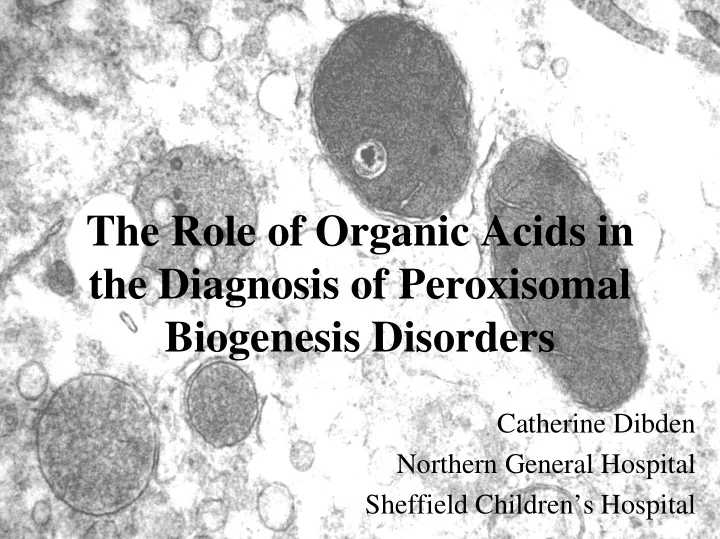
The Role of Organic Acids in the Diagnosis of Peroxisomal Biogenesis Disorders Catherine Dibden Northern General Hospital Sheffield Childrens Hospital Peroxisomes Small sub-cellular organelles Present in all eukaryotic cells
Peroxisomes
- Small sub-cellular organelles
- Present in all eukaryotic cells
- Abundant in tissues actively involved in
lipid metabolism
– Liver – Kidney – Nervous tissue
Functions of Peroxisomes
- Fatty acid β-oxidation
- Fatty acid α-oxidation
- Ether-phospholipid biosynthesis
- H2O2 metabolism
- L-pipecolate degradation
- Glutaryl-CoA metabolism
- Glyoxylate detoxification
- Isoprenoid biosynthesis
Peroxisomal Biogenesis
- Three steps:
– Formation of lipid bilayer – Incorporation of membrane-bound peroxisomal proteins – Import of matrix proteins into the peroxisome
- PEX genes encode proteins required for assembly
- f the peroxisomal membrane and support the
import of matrix proteins
- Protein products known as peroxins
Peroxisomal Disorders
- Single peroxisomal protein deficiencies
- Peroxisomal biogenesis disorders:
– Rhizomelic Chondrodysplasia Punctata (RCDP) phenotype – Zellweger Spectrum:
- Zellweger syndrome (ZS)
- Neonatal adrenoleukodystrophy (NALD)
- Infantile Refsum disease (IRD)
Gould S.J., Raymond G.V., Valle D., 2001. The Peroxisome Biogenesis Disorders, in: C.R. Scriver, A.L. Beaudet, W.S. Sly, D. Valle (Eds.), The Metabolic & Molecular Bases of Inherited Disease. McGraw-Hill, New York
Zellweger syndrome
- Presents at birth
- Reduction or absence of peroxisomes
- Clinical phenotype:
– Craniofacial dysmorphism – Hypotonia – Impaired hearing/eye abnormalities – Psychomotor retardation, neonatal seizures – Liver disease – Calcific stippling of epiphyses – Renal cysts
- Death usually occurs within 6 months
Zellweger syndrome (2)
- Biochemical phenotype:
– Plasma: increased very long chain fatty acids (VLCFA), phytanic acid, pipecolic acid, and bile acid intermediates DHCA and THCA – Erythrocytes: reduced plasmalogen synthesis – Fibroblast cultures: reduced dihydroxyacetone phosphate acyltransferase (DHAPAT) activity – Urine: increased pipecolic acid and bile acid intermediates
- Diagnosis: abnormal plasma VLCFA levels,
confirmed by DHAPAT activity
Problems with Diagnosis of PBD
- Plasma VLCFA are not part of routine ‘metabolic
screen’ in most metabolic laboratories
- Clinicians unfamiliar with rare disorders may not
request VLCFA examination
- Urine most commonly submitted specimen type
for metabolic screening Therefore patients with an undiagnosed PBD may be missed when being screened for a metabolic disease
Role of Organic Acids
- GC-MS analysis of urinary organic acids commonly
included in the routine ‘metabolic screen’
- Characteristic organic aciduria of PBDs has been
reported, showing increased excretion of:
– 3,6-epoxydicarboxylic acids (C10, C12, C13, C14) – Odd-chain C7 – C15 dicarboxylic acids – 2-hydroxydecanedioate – Saturated and unsaturated C6 - C10 dicarboxylic acids – C10:C6 and C8:C6 dicarboxylic acid ratios >1 – 4-hydroxyphenyllactic and 4-hydroxyphenylacetic acid
Korman et al, 2000. J.Inherit. Metab. Dis. 23: 425 – 428
Aim of Study
- To look for the presence of characteristic
metabolites and other features of an organic acid profile in patients with a PBD as previously reported
- To identify the mass spectra of relevant metabolites
for addition to the GC-MS searchable library, to allow routine identification of these metabolites in patient samples.
Methods
- Urine from 14 patients with various peroxisomal
disorders was examined:
– 8 Zellweger Syndrome – 2 Infantile Refsum Disease – 2 X-linked Adrenoleukodystrophy – 1 Pseudo-Zellwegers – 1 Refsum’s Disease
- Urine from 20 patients with no specific abnormality
- n urinary organic acids analysis was also examined
- GC-MS analysis of urine organic acids was carried
- ut on all samples
Results: Organic Aciduria of PBD
3,6-epoxytetradecanedioate Odd-chain dicarboxylic acids C7 C9 2-OH decanedioate 3-OH decanedioate Saturated & unsaturated even- chain dicarboxylic acids C6 C8 C8:1 C10 C10:1 4-OH phenylacetic acid 4-OH phenyllactic acid
Normal
Mass Spectrum of 3,6-epoxytetradecanedioate
Results
- 8/10 patients with PBDs showed increased
excretion of:
– 3,6-epoxydicarboxylic acids (mostly C14) – 2-hydroxydecanedioate
- 3,6-epoxytetradecanedioate:
– Specificity: 100% – Sensitivity: 80%
- All types of peroxisomal disorders showed
elevated levels of odd-chain dicarboxylic acids (mostly C7 and C9)
Results
- 7/10 patients with PBDs showed C10:C6 and
C8:C6 dicarboxylic acid ratios of >1
– Specificity: 100% – Sensitivity: 70%
- Increased levels of 4-hydroxyphenyllactic acid
and 4-hydroxyphenylacetic acid were present in patients with a PBD or pseudo-Zellwegers
A few weeks later…
- Urine from a 1 month old baby analysed
- Clinical details “failure to thrive”
- Urine organic acids:
– Increased 2-hydroxydecanedioate – Increased 3,6-E14DA
- Peroxisomal disorder suspected
- Plasma for VLCFA already received, which
confirmed diagnosis of a PBD
Conclusions
- Urinary organic acids can be a useful indicator to
the diagnosis of a PBD
- This particular organic acid profile should alert the
laboratory to the possibility of a PBD and prompt appropriate investigations, including VLCFAs.
- Awareness of the characteristic organic aciduria of a
PBD may improve detection of these conditions in an initial metabolic screen
References Acknowledgements
Nigel Manning Sheffield Children’s Hospital Claire Hart Sheffield Children’s Hospital
Gould S.J., Raymond G.V., Valle D., in: C.R. Scriver, A.L. Beaudet, W.S. Sly,
- D. Valle (Eds.), 2001. The Metabolic & Molecular Bases of Inherited Disease.
McGraw-Hill, New York, pp. 3181-3219 Pitt J.J., Poulos A., 1993. Clin Chim Acta. 223: 23-29 Rizzo C., Bertucci P., Federici G., Wanders R.J.A., Sabetta G., Dionisi-Vici C.,
- 2000. J Inherit Metab Dis. 23 (S1): 241.
Yamaguchi S., Iga M., Kimura M., Suzuki Y., Shimozawa N., Fukao T., Kondo N., Tazawa Y., Orii T., 2001. J Chrom B. 758: 81-86 www.humpath.com/IMG/jpg/mitochondria_peroxisome_hepatocyte_04-2.jpg