The Role of New Media for the Democratization Processes in the Arab - - PowerPoint PPT Presentation

the role of new media for the democratization processes
SMART_READER_LITE
LIVE PREVIEW

The Role of New Media for the Democratization Processes in the Arab - - PowerPoint PPT Presentation

The Role of New Media for the Democratization Processes in the Arab World (by markus.sabadello@gmail.com) Overview 1. Introduction General overview on the use of new media for Peace & Conflict. The role of new media in democratization

slide-1
SLIDE 1

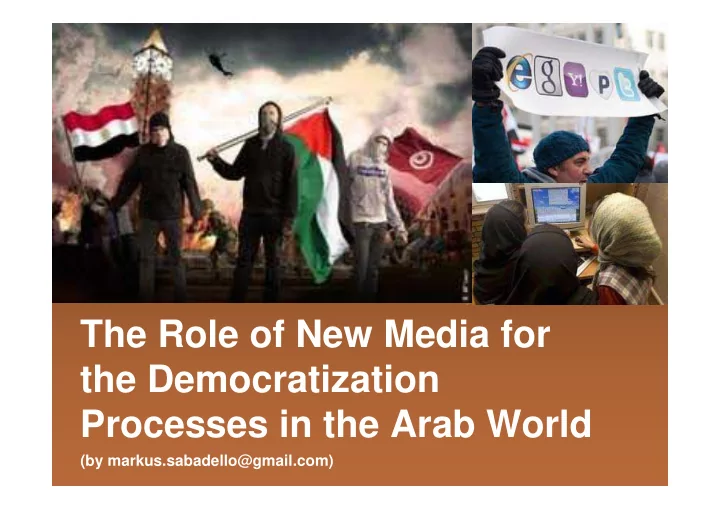
The Role of New Media for the Democratization Processes in the Arab World

(by markus.sabadello@gmail.com)

slide-2
SLIDE 2

Overview

  • 1. Introduction

General overview on the use of new media for Peace & Conflict. The role of new media in democratization processes.

  • 2. Case Studies: Tunisia, Egypt, others

How was new media used in the revolutions? What role did counter-measures play?

  • 3. Western involvement

Support for activists. New media as new diplomacy.

  • 4. Assessment, outlook and discussion

How useful is new media for democratization processes? What are the issues that need to be addressed?

slide-3
SLIDE 3

Part 1: Introduction

(by markus.sabadello@gmail.com)

slide-4
SLIDE 4

New Media for Peace&Conflict

  • Education, Knowledge
  • Development cooperation
  • Intercultural dialogue
  • Cyberwarfare, cybercrime, cyberterrorism
  • Propaganda
  • As a weapon in (nonviolent) conflict

– Organization of a movement, recruiting of new members, political outreach – Protest&Persuasion, Noncooperation, Intervention

  • As a weapon by authoritarian regimes
  • For democracy after a revolution
slide-5
SLIDE 5

Introduction

  • „Twitter Revolutions“ ?
  • Role of social networks ?
slide-6
SLIDE 6

Introduction

  • Revolutions yesterday and today?

1989 2011 ?

slide-7
SLIDE 7

Introduction

  • 1994: EZLN uprising
  • 2000: Serbian Otpor!
  • 2008: Anti-FARC marches
slide-8
SLIDE 8

Introduction

Source: Arab Social Media Report Vol. 1, No. 2

slide-9
SLIDE 9

Introduction

Source: Arab Social Media Report Vol. 1, No. 2

slide-10
SLIDE 10

Introduction

Source: Arab Social Media Report Vol. 1, No. 2

slide-11
SLIDE 11

Part 2: Case Studies: Tunisia, Egypt, others

(by markus.sabadello@gmail.com)

slide-12
SLIDE 12

Case Study: Tunisia

  • Unemployment, civil liberties, corruption
  • Self-Immolation of Mohamed

Bouazizi on Dec 17, 2010

  • President Ben Ali resigned
  • n Jan 14, 2011
  • Freedom of speech promised

and partially implemented

slide-13
SLIDE 13

Case Study: Tunisia

  • Facebook and Youtube used to spread

images of riots in Sidi Bouzid

"Let's hope that this event in Sidi Bouzid isn't limited to Bouazizi's health ... this is only the beginning!!! @youtor_KHAN via Twitter

slide-14
SLIDE 14

Case Study: Tunisia

  • Nhar 3la 3ammar (“Day of Ammar”)

– Anti-Censorship rally

slide-15
SLIDE 15

Case Study: Tunisia

Source: Arab Social Media Report Vol. 1, No. 2

slide-16
SLIDE 16

Case Study: Tunisia

  • State oppression:

– Tight control of traditional media – Censorship of Youtube, Wikileaks, human rights web sites, activists blogs – Bloggers threatened and imprisoned

  • Slim Amamou and Azyz Amamy

– Phishing, hacking of passwords

  • "Here we don't really have Internet, we

have a national Intranet.“

Azyz Amamy, Tunisian web activist

slide-17
SLIDE 17

Case Study: Tunisia

  • Use of the Tor anonymizing network
slide-18
SLIDE 18

Case Study: Egypt

  • Inspired by Tunisia Revolution
  • Death of Khaled Mohamed Saeed
  • Uprising on Jan 25, 2011
  • Mubarak resigned on Feb 11, 2011
slide-19
SLIDE 19

Case Study: Egypt

  • „We are all Khaled Said“
  • #jan25 Twitter hashtag
slide-20
SLIDE 20

Case Study: Egypt

  • April 6 Youth Movement
slide-21
SLIDE 21

Case Study: Egypt

  • Google executive and political activist

Wael Ghonim

  • Symbolic leader for protesters
slide-22
SLIDE 22

Case Study: Egypt

  • Jan 27, 2011: Complete shutdown of

international Internet connections

Source: http://www.renesys.com/blog/2011/01/egypt-leaves-the-internet.shtml

slide-23
SLIDE 23

Case Study: Egypt

Source: Arab Social Media Report Vol. 1, No. 2

slide-24
SLIDE 24

Case Study: Egypt

“If your government shuts down your Internet, it’s time to shut down your government.”

  • Message found on social networks during the Egypt revolution

“We had no freedom of assembly in the streets of Cairo, so we assembled in cyberspace instead.”

  • Comment by a leading Egyptian technologist and activist
slide-25
SLIDE 25

More Case Studies

  • Libya
  • Feb 15, 2011 civil war
  • Internet shutdown
  • Mohammed Nabbous

– blogger and journalist – founder of first private TV station in rebel territory – killed by loyalist sniper

  • n Mar 19, 2011 in Benghazi
slide-26
SLIDE 26

More Case Studies

  • Iran‘s Green Movement
  • Jun 12, 2009 presidential elections

– Facebook and news sites censored – Cell phone service shut down – Large support by diaspora, e.g. proxy servers – Counter propaganda on social networks – Police crackdown on movement

„The government turned to the Internet to identify their real opponents.“ Yevgeny Morozov http://www.youtube.com/watch?v=glSIoRrMr1g

slide-27
SLIDE 27

More Case Studies

  • Moldova
  • Apr 5, 2009 parliamentary elections

– #pman Twitter hashtag to organize protests – Cellphone service turned off on main square

slide-28
SLIDE 28

More Case Studies

  • Belarus
  • Dec 19, 2010 presidential elections

– DDoS attacks against opposition websites – Filtering of port 443 on international traffic

  • Jul 3, 2011 independence day

– Protests organized through VKontakte

slide-29
SLIDE 29

Part 3: Western Involvement

(by markus.sabadello@gmail.com)

slide-30
SLIDE 30

Western Involvement

  • Long-time European

support for dictators

  • For stability, and to fight terrorism???
slide-31
SLIDE 31

Western Involvement

  • Internet censorship software

– Tunisia: SmartFilter software by McAfee

  • Hacktivism

– Tunisia: „Anonymous“ DDoS attacks on president, prime minister, the ministry of industry, the ministry of foreign affairs, and the stock exchange

  • Egyptians trained by Otpor!

– Center for Applied NonViolent Action and Strategies

  • U.S. financial support
slide-32
SLIDE 32

Western Involvement

  • Blogging platform „Global Voices“

– Bridgeblogging between cultures and languages – By Harvard Berkman Center

  • Internet access

– Egypt: xs4all, speak2tweet – Iran: Cooperation between US State Department and Twitter to ensure service – New America Foundation

  • „Twitter Diplomacy“

– Clinton‘s speech on Internet Freedom

slide-33
SLIDE 33

Part 4: Assessment, outlook and discussion

(by markus.sabadello@gmail.com)

slide-34
SLIDE 34

Barriers & Outlook

  • Digital Divide
  • Human Rights

– Access to information, Freedom

  • f Expression, Privacy
  • Architectures

– Decentralization – Anonymizing P2P

slide-35
SLIDE 35

Assessment and Discussion

  • Would the revolutions have happened

without Facebook, Twitter, Youtube, etc.?

  • How useful is new media for

democratization processes?

  • The revolution was
  • successful. What now?
slide-36
SLIDE 36

Sources

http://cpj.org/internet/2011/01/tunisia-invades-censors-facebook-other-accounts.php http://www.rferl.org/content/belarus_oppositon_websites_hijacked/2253038.html http://neteffect.foreignpolicy.com/posts/2009/04/07/moldovas_twitter_revolution http://www.opednews.com/articles/How-Facebook-Helped-Fell-t-by-Tawnia-Sanford-Amm-110115-765.html http://english.aljazeera.net/indepth/opinion/2011/01/201111410250537313.html http://cpj.org/internet/2011/01/tunisia-invades-censors-facebook-other-accounts.php http://www.thetechherald.com/article.php/201101/6651/Tunisian-government-harvesting-usernames-and-passwords http://english.aljazeera.net/indepth/features/2011/01/20111614145839362.html http://www.rferl.org/content/tunisia_can_we_please_stop_talking_about_twitter_revolutions/2277052.html http://jilliancyork.com/2011/01/14/not-twitter-not-wikileaks-a-human-revolution/ http://www.foreignpolicy.com/articles/2011/01/14/the_first_twitter_revolution?page=full http://techliberation.com/2011/01/04/evgeny-morozov-on-the-dark-side-of-internet-freedom/ http://www.renesys.com/blog/2011/01/egypt-leaves-the-internet.shtml http://www.telegraph.co.uk/news/worldnews/africaandindianocean/egypt/8288163/How-Egypt-shut-down-the- internet.html http://ignitenews.mohawkcollege.ca/1658/tech/the-twitter-revolution/ http://www.nonviolent-conflict.org/index.php/learning-and-resources/resources-on-nonviolent- conflict?bTask=bDetails&bId=342