
SLIDE 1
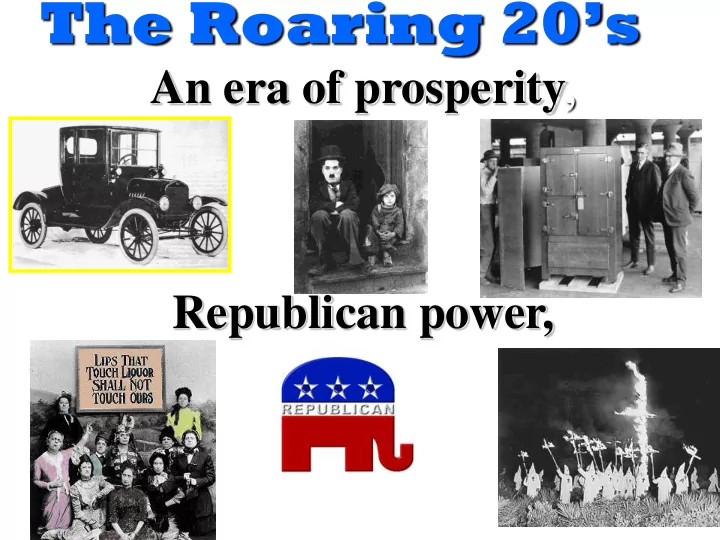
The Roaring 20s An era of prosperity, Republican power, Republican - - PowerPoint PPT Presentation
The Roaring 20s An era of prosperity, Republican power, Republican Power President Harding Elected 1920 Legacy of corruption like the Teapot Dome bribery scandal and reduced taxes on businesses Died in office, 1923
President Harding Elected 1920 Legacy of
corruption like the “Teapot Dome” bribery scandal and reduced taxes on businesses
Died in office, 1923
By the 1920s, the U.S. had become the leading industrial power in the world. This boom was due to several factors:
labor and markets for new products.
16th Amendment passes in 1913: begins Individual and Corporate Income Taxes Today we pay our taxes to the Federal and State governments no later than April 15th
Taxes are reduced under Presidents Harding and Coolidge
World War I left much of the American public divided. The end of the war hurt the economy. Returning soldiers took jobs away from many women and minorities, or faced unemployment
reduce the number of immigrants arriving in the US.
The 19 The 1921 21 Quota Act Quota Act and and the 1 the 192 924 4 Im Immigr migration ation Act Act ref reflec lecte ted d US nati US nativi vism. sm. The They g y greatl reatly y redu reduce ced the n d the numbers of ne umbers of new Ame w Americans as icans as peop people b le became ecame su susp spiciou icious s of
foreigner ners s an and d wanted to pull anted to pull away y from from worl
d aff affair airs.
“The business of America is business. The man who builds a factory builds a temple. The man who works in it worships there.”
1923-29
The political genius of President Coolidge,
Walter Lippmann pointed out in 1926, was his talent for effectively doing nothing: "This active inactivity suits the mood and certain of the needs of the country
which want to be let alone....
Presidents Harding and Coolidge reduce the Progressives’ regulations of businesses. America switches from war goods to consumer goods and advertising to sell products. Instalment Buying: Get it now and pay later Credit: pay a small amount each month until an item is paid for Interest: financial charge for borrowing $ Demand for US goods greatly increases but so does American debt. “If we want anything, all we have to do is go and buy it
whatever, except some day to have to pay for it. But we are certainly not thinking about it this early” Comedian Will Rogers, 1928
Companies sell stocks to gain the money they
need to expand their business. Investors buy the stocks and hope the value of them will increase
The 1920s were a Bull Market where stock
prices rose rapidly. Often the price rose not because the company was improving but simply because investors expected the price to
stocks and selling them for more not long
all was well.
The 1920s is a period of great change in American Society -
modern America is born at this time, with many people enjoying a much higher standard of living.
For first time the census (population count every 10 years) reflected an urban society – over 50% of the US population lived in cities.
1920's Great Changes for Women...
1920 - 19th Amendment
gave them the federal vote
The League of Women
Voters worked to educate women on voting and to ensure women could serve
During WWI many women
worked in factories
After the war, many women
kept working outside the home
More women went to college
and wanted to join the professions
Women didn't want to sacrifice their
wartime gains in income and life
social revolt
the FLAPPER became the name for
"new woman” who wore skirts that
cigarettes and drank alcohol in public, drove cars fast, and cut their hair short
With income from working, women
bought appliances like vacuum cleaners, refrigerators, and radios
Some women had to work and also
run their homes. It was hard for them to combine these roles. While many women worked, most remained homemakers.
Employment and wages/salaries
are strong in the 1920s as the economy expands
Henry Ford introduces the
assembly line to factories – reduces costs and increases supply so the price goes down and more Americans can afford a car
Assembly lines and mass
production spread throughout the US economy
In 1919 there are 7 million cars in
the US but by 1929 there are 23 million on the road; creating an estimated 4 million new jobs
Age of Prosperity
The car transforms the US economy Competition increases as General Motors manufactures cars and
Ford does not have a monopoly
New jobs are needed to keep up with the demand for refining oil
into gasoline, gas stations, building roads, restaurants, and shopping centers.
People move from the crowded cities to the suburbs further
away from work because they can drive there
<<< Radio: GE, Westinghouse,& RCA form NBC Silent nt Movi vies es >>>> >>>> Charl rlie e Chapl plin in
“Talkies” The e Jaz azz z Singer ger Starrin rring g Al Jolson lson Mary Pickford “America’s Sweetheart”
The Flappers
make up cigarettes short skirts
Musicians
Louis Armstrong Duke Ellington
Writers
Ernest Hemingway
Th The J e Jazz azz Ag Age Jazz b azz began egan in Ne in New Or w Orleans leans, based based
est Afr African ican rh rhythms ythms, Black Black spi spirituals ituals and and work songs
and Eu Euro ropean pean ha harmoni monies
Greats inclu included L ded Loui
s Armst mstron rong and g and Duk Duke Elling e Ellington.
Eventuall entually, rock rock and and rol roll l plu plus s hi hip p hop hop wil will l de develop elop from it. from it. Ame Americans bou icans bough ght t rad radios ios and and went t ent to
the movi vies
Popu
lar fads ads grabbed the nation’s attention, lik like f e fla lag-pol pole sit e sitting ting (2 (21 1 da days ys was as the rec the record
) and and then di then disa sapp ppeared eared . The Ch The Charl arlest eston dance bec
ame an another
fad ad.
Jack Dempsey Charles Lindbergh
The Spirit of St. Louis
America was becoming more prosperous. Business and industry required a more educated work force. These two factors caused a huge increase in the number of students going to high school. The nation’s schools were successful in teaching large numbers of Americans and immigrants to
people read newspapers than before.
Charles A. Lindbergh thrilled the nation by becoming the first person to fly solo across the Atlantic Ocean. Lindbergh took off from New York City in his plane, The Spirit of St. Louis. On May 20-21, 1927 he flew for 33 hours and landed outside of Paris, France. On his return to the United States, Lindbergh became the idol of America. In an age of sensationalism and excess, Lindbergh stood for the honesty and bravery the nation seemed to have lost.
The “Roaring Twenties”
"Old" Culture "New" Culture Emphasized Production Emphasized Consumption Character Personality Scarcity Abundunce Religion Science Idealized the Past Looked to the Future Local Culture Mass Culture Substance Image The above graph indicates in a general sense what historians mean when they refer to the "old" and the "new" cultures of the 1920s. This list is not meant to be definitive. Source: Culture as History: The Transformation of American Society in the Twentieth Century (New York: Pantheon Books, 1984).
The Ku Klux Klan: Great increase In power across the US, not just the South Anti-black Anti-immigrant Anti-women’s suffrage Anti-bootleggers Anti-Semitic Anti-Catholic
Evolution vs. Creationism
Dayton, Tennessee
Famous Lawyers
Science vs. Religion
John Scopes High School Biology teacher
During the 1920s, the nation saw the rise of Christian fundamentalism. This religious movement was based
in the Bible was literally true. Fundamentalists were concerned with the growing trust in science that most Americans had. These beliefs led fundamentalists to reject Charles Darwin’s theory of evolution (natural selection)
Fundamentalists did not want evolution taught in schools. In 1925, Tennessee passed a law making it a crime to teach it. John Scopes, a young biology teacher challenged the law and taught it. He was arrested, and his case went to trial. The ACLU hired Clarence Darrow, the most famous trial lawyer in the nation, to defend
guilty because he broke the law. But the trial was really about evolution and about religion in schools. Reporters came from all
highlight of the trial was when Bryan took the stand. Darrow questioned Bryan until Bryan said that while the earth was made in six days, they were “not six days of 24 hours.” Bryan was admitting that the Bible could be interpreted in different ways. Even so, Scopes was found guilty. His conviction was later
teaching evolution remained a law in Tennessee.
18 18th
th Ame
mendm ndment ent
Volstead Act
Gangsters
Al Capone
PROHIBITION - on the
manufacture and sale of alcohol
Ratified in 1919 as the 18th
AMENDMENT
In WWI, temperance (anti-
alcohol) became a patriotic
lower work productivity & inefficiency.
Prohibition was a difficult law
to enforce. Organized crime made millions while millions of law-abiding Americans turned to bootleggers for their booze.
Al Capone virtually controlled
Chicago in this period - capitalism at its zenith…
Prohibition finally ended in
1933 with the 21st Amendment
The 21st forced organized crime
to pursue other interests…
Farming Problemss
an agricultural depression in
early 1920's contributed to this urban migration
U.S. farmers lost agricultural
markets in postwar Europe
at same time efficiency
increased so more food produced (more food = lower prices) and fewer labourers were needed
so farming was no longer as
prosperous, and bankers called in their loans (farms were repossessed)
so American farmers enter the
Depression in advance of the rest of society
Black Americans in
this period continued to live in poverty
sharecropping kept
them in de facto slavery
white landowners
went bankrupt & forced blacks off their land
African-Americans moved north to take advantage of booming
wartime industry (= Great Migration) - Black ghettoes began to form like Harlem in New York City
A distinct Black culture flourished but most neighborhoods
and schools were not integrated in the North.
Marcus Garvey (Jamaican born
immigrant) established the Universal Negro Improvement Association
believed in Black pride advocated racial segregation b/c of
Black superiority
Garvey believed Blacks should
return to Africa
he purchased a ship to start the
Black Star line
attracted many investments: gov't
charged him with with fraud
he was found guilty and eventually
deported to Jamaica, but his