? ? The rank A of a subset A of E is the common size ? ? of - - PDF document

the rank a of a subset a of e is the common size of
SMART_READER_LITE
LIVE PREVIEW

? ? The rank A of a subset A of E is the common size ? ? of - - PDF document

Codes Polynomials associated with code over GF n k q is a k


slide-1
SLIDE 1

Polynomials associated with permutation groups, matroids and codes

Peter J Cameron School of Mathematical Sciences Queen Mary, University of London London E1 4NS, U.K. p.j.cameron@qmul.ac.uk

1

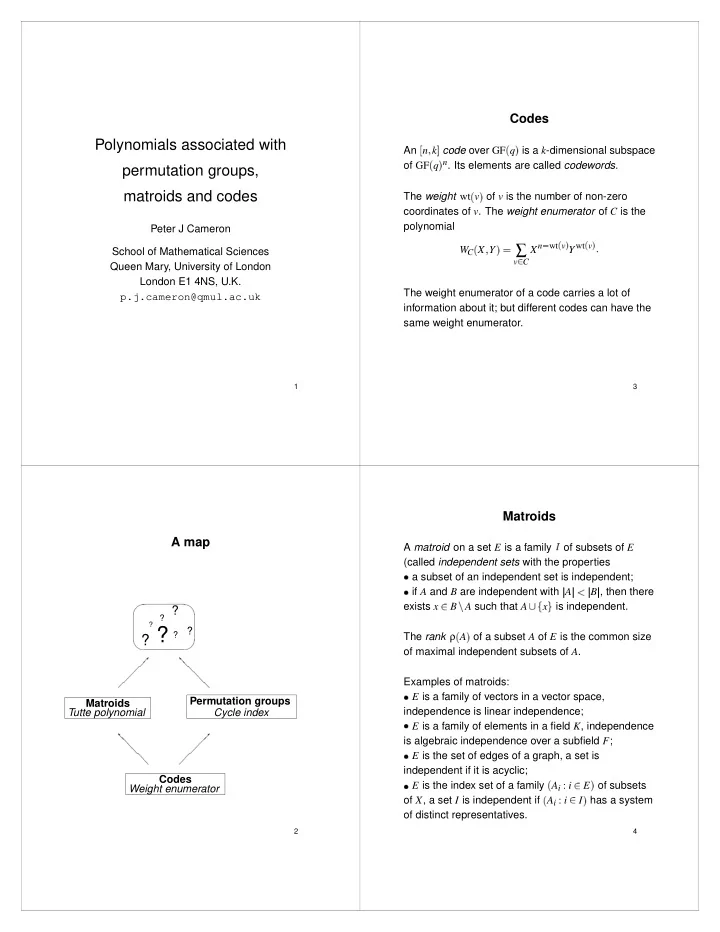
A map

Codes Weight enumerator Matroids Tutte polynomial Permutation groups Cycle index

✂ ✄

?

?

?

?

? ? ?

☎ ☎ ☎ ☎ ☎ ☎ ✆ ✝ ✝ ✝ ✝ ✝ ✝✟✞ ✝ ✝ ✝ ✝ ✝ ✝✟✞ ☎ ☎ ☎ ☎ ☎ ☎ ✆

2

Codes

An

✠ n ✡ k ☛ code over GF ☞ q ✌ is a k-dimensional subspace
  • f GF
☞ q ✌ n. Its elements are called codewords.

The weight wt

☞ v ✌ of v is the number of non-zero

coordinates of v. The weight enumerator of C is the polynomial WC

☞ X ✡ Y ✌✎✍

v

✏ C

Xn

✑ wt ✒ v ✓ Y wt ✒ v ✓✕✔

The weight enumerator of a code carries a lot of information about it; but different codes can have the same weight enumerator.

3

Matroids

A matroid on a set E is a family

  • f subsets of E

(called independent sets with the properties

✗ a subset of an independent set is independent; ✗ if A and B are independent with ✘ A ✘✚✙✛✘ B ✘ , then there

exists x

B

✢ A such that A ✣✥✤ x ✦ is independent.

The rank ρ

☞ A ✌ of a subset A of E is the common size
  • f maximal independent subsets of A.

Examples of matroids:

✗ E is a family of vectors in a vector space,

independence is linear independence;

✗ E is a family of elements in a field K, independence

is algebraic independence over a subfield F;

✗ E is the set of edges of a graph, a set is

independent if it is acyclic;

✗ E is the index set of a family ☞ Ai : i ✜

E

✌ of subsets
  • f X, a set I is independent if
☞ Ai : i ✜

I

✌ has a system
  • f distinct representatives.

4

slide-2
SLIDE 2

Tutte polynomial

The Tutte polynomial of a matroid M is given by T

☞ M;x ✡ y ✌✧✍

A

★ E ☞ x ✩

1

✌ ρ ✒ E ✓✪✑ ρ ✒ A ✓ ☞ y ✩

1

✌✬✫ A ✫ ✑ ρ ✒ A ✓ ✡

where ρ is the rank function of M. The Tutte polynomial carries a lot of information about the matroid; e.g. T

☞ M;2 ✡ 1 ✌ is the number of

independent sets, and T

☞ M;1 ✡ 1 ✌ is the number of

bases (maximal independent sets). But there exist different matroids with the same Tutte polynomial. The Tutte polynomial of a matroid generalises the Jones polynomial of a knot, percolation polynomials, etc.; and also the weight enumerator of a code, as we will see.

5

Matroids and codes

With a linear

✠ n ✡ k ☛ code C we may associate in a

canonical way a matroid MC on the set

✤ 1 ✡ ✔✕✔✕✔ ✡ n ✦

whose independent sets are the sets I for which the columns

☞ ci : i ✜

I

✌ of a generator matrix for C are

linearly independent. Curtis Greene showed that the weight enumerator of the code is a specialisation of the Tutte polynomial of the matroid: WC

☞ X ✡ Y ✌✭✍

Y n

✑ k ☞ X ✩ Y ✌ kT ✮

MC;x

X

✰✱☞ q ✩

1

✌ Y

X

✩ Y ✡ y ✯

X Y

✲ ✔

I use the notation F

☞ x ✯

t

✌ to denote the result of

substituting the term t for x in the polynomial F.

6

Permutation groups

Let G be a permutation group on E, that is, a subgroup of the symmetric group on E, where

✘ E ✘✬✍
  • n. The cycle index of G is the polynomial Z
☞ G ✌

in indeterminates s1

✡ ✔✕✔✕✔ ✡ sn given by

Z

☞ G ✌✧✍

1

✘ G ✘ ∑

g

✏ G

sc1

✒ g ✓

1

✳✕✳✕✳ scn ✒ g ✓

n

In particular, PG

☞ x ✌✧✍

Z

☞ G ✌✬☞ s1 ✯

x

✡ si ✯

1 for i

1

is the p.g.f. for the number of fixed points of a random element of G. The cycle index is very important in enumeration

  • theory. Two simple examples:
✗ Z ☞ G ✌✬☞ s1 ✯

x

1

✡ si ✯

1 for i

1

✌ is the exponential

generating function for the number of G-orbits on k-tuples of distinct points (note that this function is PG

☞ x ✰

1

✌ ); ✗ Z ☞ G ✌✬☞ si ✯

xi

1

✌ is the ordinary generating function

for the number of orbits of G on k-subsets of E.

7

Permutation groups and codes

Let C be an

✠ n ✡ k ☛ code over GF ☞ q ✌ . The additive group

G of C acts as a permutation group on the set E

GF

☞ q ✌✶✵✷✤ 1 ✡ ✔✕✔✕✔ ✡ n ✦ by the rule that the codeword

v

✍✸☞ v1 ✡ ✔✕✔✕✔ ✡ vn ✌ acts as the permutation ☞ x ✡ i ✌✧✹✺✻☞ x ✰

vi

✡ i ✌ ✔

Now each permutation has cycles of length 1 and p

  • nly, where p is the characteristic of GF
☞ q ✌ ; and we

have 1

✘C ✘ WC ☞ X ✡ Y ✌✎✍

Z

☞ G;s1 ✯

X1

✼ q ✡ sp ✯

Y p

✼ q ✌✽✡

For a zero coordinate in v gives rise to q fixed points, and a non-zero coordinate to q

✾ p cycles of length p.

So the cycle index of G carries the same information as the weight enumerator of C.

8

slide-3
SLIDE 3

IBIS groups

Let G be a permutation group on Ω. A base for G is a sequence of points of Ω whose stabiliser is the

  • identity. It is irredundant if no point in the sequence is

fixed by the stabiliser of its predecessors. Cameron and Fon-Der-Flaass showed that the following three conditions on a permutation group are equivalent:

✗ all irredundant bases have the same number of

points;

✗ re-ordering any irredundant base gives an

irredundant base;

✗ the irredundant bases are the bases of a matroid.

A permutation group satisfying these conditions is called an IBIS group (short for Irredundant Bases of Invariant Size).

9

Examples of IBIS groups

✗ Any Frobenius group is an IBIS group of rank 2,

associated with the uniform matroid.

✗ The general linear and symplectic groups, acting on

their natural vector spaces, are IBIS groups, associated with the vector matroid (defined by all vectors in the space).

✗ The Mathieu group M24 in its natural action is an

IBIS group of rank 7.

✗ The permutation group constructed from an ✠ n ✡ k ☛

linear code over GF

☞ q ✌ is an IBIS group of degree nq

and rank k. The associated matroid is obtained from the matroid of the code simply by replacing each element by a set of q parallel elements. It is straightforward to obtain the Tutte polynomial of the group matroid from that of the code matroid and vice versa.

10

Base-transitive groups

A permutation group is base-transitive if it permutes its irredundant bases transitively. A base-transitive group is clearly an IBIS group. All base-transitive groups of rank at least 2 have been determined by Maund, using CFSG; those of large rank (at least 7) by Zil’ber, by a geometric argument not using CFSG. The matroid associated with a base-transitive group is a perfect matroid design; this is a matroid of rank r for which the cardinality ni of an i-flat (a maximal set

  • f rank i) depends only on i.

Mphako showed that the Tutte polynomial of a PMD is determined by the cardinalities n1

✡ ✔✕✔✕✔ ✡ nr of its flats.

If the matroid arises from a base-transitive group, these are the numbers of fixed points of group

  • elements. Thus, for a base-transitive group, the cycle

index determines the Tutte polynomial of the matroid, but not conversely.

11

An example

The cycle index does not in general tell us whether a permutation group is base-transitive. The groups G1

✍✿✤ 1 ✡❀☞ 1 ✡ 2 ✌✬☞ 3 ✡ 4 ✌✽✡❁☞ 1 ✡ 3 ✌✬☞ 2 ✡ 4 ✌✬✡❀☞ 1 ✡ 4 ✌✬☞ 2 ✡ 3 ✌❁✦❂✡

G2

✍✿✤ 1 ✡❀☞ 1 ✡ 2 ✌✬☞ 3 ✡ 4 ✌✽✡❁☞ 1 ✡ 2 ✌✬☞ 5 ✡ 6 ✌✬✡❀☞ 3 ✡ 4 ✌✬☞ 5 ✡ 6 ✌❁✦
  • f degree 6 have the same cycle index, namely

Z

☞ G ✌✧✍

1 4

☞ s6

1

3s2

1s2 2

✌ . The first is base-transitive with

rank 1; the second is an IBIS group of rank 2 (arising from the binary even-weight code of length 3). If a group with this cycle index is base-transitive then Mphako’s result gives the Tutte polynomial as y2

☞ y3 ✰

y2

y

x

✌ .

If a group with this cycle index comes from a code, we can calculate the Tutte polynomial to be y4

2y3

3y2

y

3xy

x2

x. In the second case, the matroid admits two different base-transitive groups with different cycle indices (both isomorphic to S4 as abstract groups).

12

slide-4
SLIDE 4

A polynomial for IBIS groups

There is a polynomial associated with an IBIS group which includes both to the cycle index and to the Tutte polynomial of the matroid. This is the Tutte cycle index, given by ZT

☞ G ✌✧✍

1

✘ G ✘ ∑

A

★ Ω

u

✫ GA ✫ vb ✒ G ❃ A ❄ ✓ Z ☞ GA

A

✌✬✡

where GA and G

✒ A ✓ are the setwise and pointwise

stabilisers of A, GA

A the permutation group induced on

A by GA, and b

☞ G ✌ is the base size of G.

We have:

∂ ∂uZT

☞ G ✌ ✲ ☞ u ✯

1

✡ v ✯

1

✌✎✍

Z

☞ G;si ✯

si

1

✌ ; ✘ G ✘ ZT ☞ G;u ✯

1

✡ si ✯

ti

✌❅✍

tb

✒ G ✓ T ❆ M;x ✯

v t

1

✡ y ✯

t

1

❇❈✡

where M is the matroid associated with the IBIS group G.

13

More generally?

For an arbitrary permutation group, the irredundant bases are not the bases of a matroid. Is there a more general combinatorial structure defined by these bases? Can we associate an analogue of the Tutte polynomial (or the Tutte cycle index) with it? Note that the first specialisation on the preceding slide works for an arbitrary permutation group; we could simply put v

1 and omit all mention of matroid rank.

14

References

  • N. Boston, W. Dabrowski, T. Foguel, P

. J. Gies, J. Leavitt, D. T. Ose and D. A. Jackson, The proportion

  • f fixed-point-free elements of a transitive

permutation group, Commun. Algebra 21 (1993), 3259–3275. P . J. Cameron and D. G. Fon-Der-Flaass, Bases for permutation groups and matroids, Europ. J. Combinatorics 16 (1995), 537–544. P . J. Cameron and D. E. Taylor, Stirling numbers and affine equivalence, Ars Combinatoria 20B (1985), 3–14.

  • M. Deza, Perfect matroid designs, Encycl. Math.
  • Appl. 40 (1992), 54–72.
  • C. Greene, Weight enumeration and the geometry of

linear codes, Studia Appl. Math. 55 (1976), 119–128.

15

References

  • T. C. Maund, D.Phil. thesis, University of Oxford,

1989.

  • E. G. Mphako, Tutte polynomials of perfect matroid

designs, Combinatorics, Probability and Computing 9 (2000), 363–367.

  • C. G. Rutherford, Matroids, codes and their

polynomial links, Ph.D. thesis, University of London, 2001.

  • B. I. Zil’ber, The structure of models of uncountably

categorical theories, pp. 359–368 in Proc. Internat.

  • Congr. Math. Vol. 1 (Warsaw 1983).

16